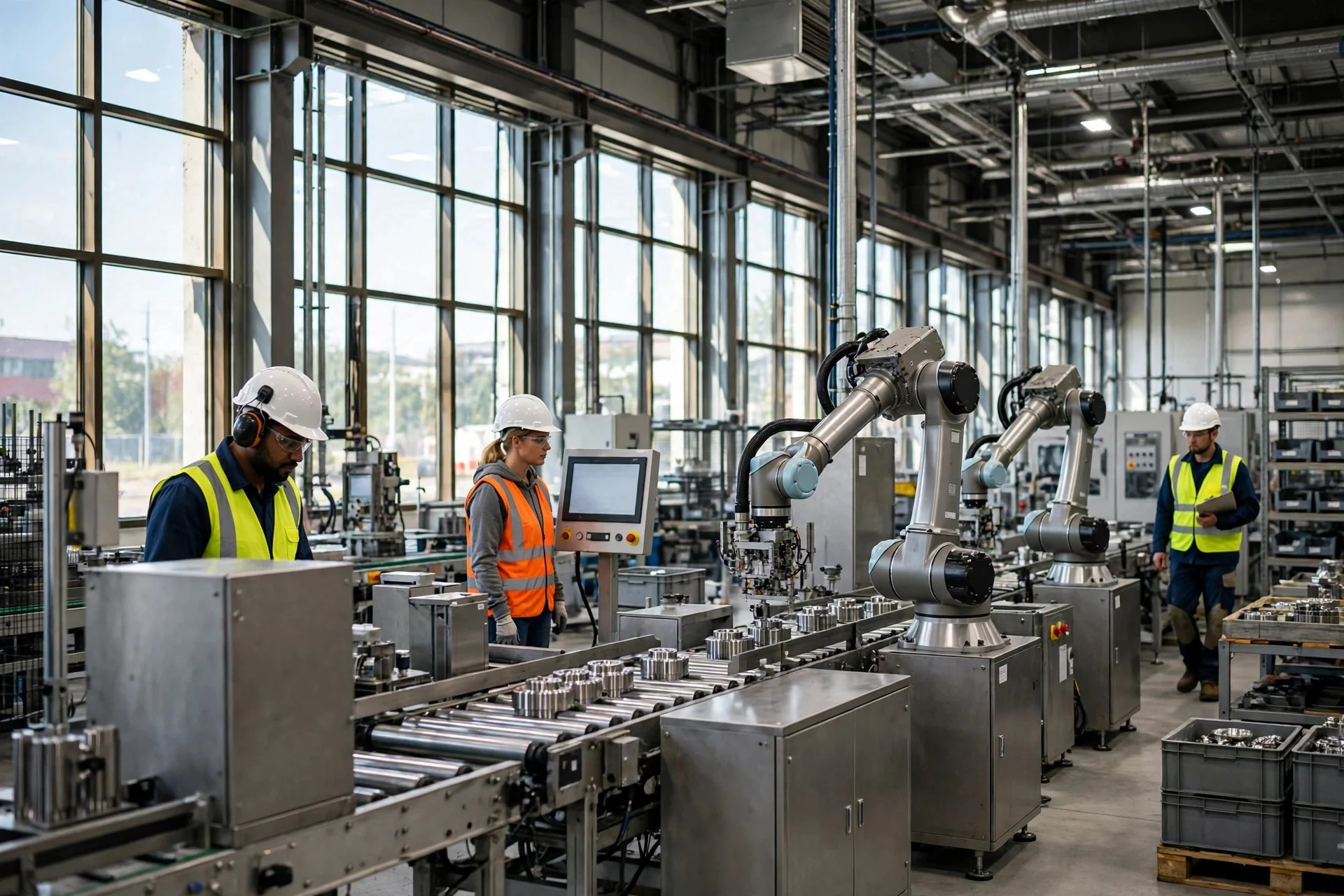
Planta manufacturera moderna con automatización y personal técnico en una línea de producción. · Imagen generada por EPM
White House Credits Trump With a Manufacturing Revival
The White House said manufacturing expanded for a tenth consecutive month, with 72,000 jobs added this year, weekly earnings up 5% and business investment…
Manufacturing Jobs and Investment Rise Under Trump
According to the White House, manufacturing has expanded for ten straight months, with 72,000 jobs added this year, weekly earnings up 5% and business…
--- The context ---
The White House issued a statement presenting manufacturing performance as a centerpiece of President Donald J. Trump's record. According to the official text, a new report shows the sector expanding for the tenth consecutive month, with production growing at its fastest pace in nearly five years, factories expanding and companies committing major investments in the United States.
--- The facts ---
On jobs, the statement says manufacturers have added 72,000 positions this year, a figure the White House contrasts with the 202,000 manufacturing jobs it says were lost in the final two years of the Biden Administration. It also states that employment in factory construction has climbed by nearly 112,000 since President Trump took office, according to the administration's own accounting.
The statement adds that manufacturing workers' weekly earnings are up 5% over the past year, outpacing inflation by the official account. It also says business investment jumped 12.7% in the third quarter of 2026, the fastest growth in fifteen years, and that private investment in plants and equipment rose 9.4%, more than twice the 2025 rate and triple the pace of Biden's final year, all as reported by the White House.
The statement supports its account with recent corporate announcements. According to the text, Audi will invest $4 billion in its first United States plant, in Georgia, creating 4,500 jobs; Westinghouse Electric announced $1 billion in South Carolina; U.S. Steel committed $3 billion near Pittsburgh to add roughly 1.3 million tons of capacity; Apple will put up to $100 million into titanium; Bombardier pledged $270 million, and Carrier more than $600 million in Fort Worth.
--- The positions ---
The administration's position is unambiguous: the statement credits Trump's policies directly and sums the moment up as more jobs, rising wages, new factories and record investment. A cautious reading notes that the text selects favorable indicators and chains them together as a direct effect of presidential management, without offering contrasting elements to weigh the sector as a whole.
--- What remains unknown ---
The statement does not identify the report behind the tenth consecutive month of expansion, nor does it detail execution timelines for each announced investment. It also does not specify how many of the jobs tied to those announcements already exist and how many remain projections, a distinction that matters for measuring their real reach.
--- Unanswered questions ---
Which specific report supports the tenth consecutive month of manufacturing expansion cited by the White House? On what timelines will the investments announced by the companies in the statement actually be carried out? How many of the jobs linked to those announcements have already been created, and how many are still projections?
--- EPM analysis ---
The statement's informational value lies in the figures the government itself puts on the table, but its persuasive force depends on constant attribution: every number comes from the White House. Distinguishing announced investment from investment under way, and from capacity already operating, is what will separate a cycle of announcements from a lasting industrial transformation.
📌 EPM Take:
In EPM's view, the statement builds an apparently solid narrative of momentum, yet every figure should be read as a claim attributed to the White House rather than as independent verification. The cited employment, wage and investment numbers sketch a push, while the corporate announcements add volume to the official message. The decisive test will come when those commitments turn into open plants, effective production and sustained payrolls, backed by comparable data confirming the real scale of the announced manufacturing renaissance.
--- The context ---
The White House presented an account of American manufacturing that describes a sector in full recovery under President Donald J. Trump. According to the official statement, a new report shows activity expanding for the tenth consecutive month and production growing at its fastest pace in nearly five years, with factories expanding, paychecks outrunning inflation and companies betting their productive future on the United States.
--- The facts ---
Jobs are the centerpiece of the announcement. The White House reported that manufacturers have added 72,000 jobs this year, reversing the 202,000 manufacturing jobs it says were lost in the final two years of the Biden Administration. The statement adds that employment in factory construction has climbed by nearly 112,000 since Trump returned to the presidency.
Paychecks are moving with the trend, according to the official text: manufacturing workers' weekly earnings rose 5% over the past year, ahead of inflation. The White House also reported that business investment jumped 12.7% in the third quarter of 2026, its fastest growth in fifteen years, and that private investment in plants and equipment rose 9.4%, more than twice the 2025 rate, signaling companies equipping American factories.
Companies, according to the statement, have answered with weighty commitments. Audi announced $4 billion for its first plant in the country, in Georgia, creating 4,500 jobs; Westinghouse Electric will invest $1 billion in South Carolina; U.S. Steel will invest $3 billion near Pittsburgh to add roughly 1.3 million tons of annual capacity; Apple will put up to $100 million into American titanium; Bombardier pledged $270 million, and Carrier more than $600 million in Fort Worth.
--- The positions ---
The government's position, as expressed in the statement, is that producing in the United States has become the profitable bet again and that the country is rebuilding its industrial base. For defenders of Trump's agenda, the combination of jobs, wages and investment cited by the White House supports the idea that regulatory certainty and a push for domestic industry are bringing back factories that had been lost.
--- What remains unknown ---
The statement does not detail execution timelines for each announced project or the hiring calendar tied to the new plants. It also does not identify the report cited on the sector's expansion, so tracking each commitment will depend on companies confirming progress project by project in the coming months, as the announcements translate into installed capacity.
--- Unanswered questions ---
On what timelines will the plants announced by Audi, Westinghouse and U.S. Steel open under the cited plans? How will the 4,500 jobs linked to Audi's Georgia factory be distributed over time? Will business investment hold the growth pace the White House reported for the third quarter of 2026?
--- EPM analysis ---
What the statement draws is a chain consistent with the promise of reindustrialization: investment coming in, factories going up and jobs returning. Its strength is the concreteness of the corporate announcements, with identifiable amounts and destinations. Following those projects will show whether the momentum described by the White House consolidates into a long-running industrial expansion.
📌 EPM Take:
In EPM's view, the White House statement presents an orderly case for the reindustrialization Trump promises: 72,000 jobs added, paychecks beating inflation and investment growing at its fastest pace in fifteen years, all attributed to the official account. The announcements from Audi, U.S. Steel and Westinghouse give that narrative tangible form. If the plants are executed on the announced terms, the manufacturing renaissance will stop being a slogan and become measurable productive capacity for the country.
La Casa Blanca atribuye a Trump un renacer manufacturero
La Casa Blanca afirmó que la manufactura se expandió por décimo mes consecutivo, con 72,000 empleos sumados este año, salarios semanales un 5% más altos e…
Trump impulsa un renacer manufacturero en Estados Unidos
Según la Casa Blanca, la manufactura suma diez meses de expansión, con 72,000 empleos creados este año, salarios semanales un 5% más altos y una inversión…
--- El contexto ---
La Casa Blanca difundió un comunicado que presenta la manufactura como señal central de la gestión del presidente Donald J. Trump. Según el texto, un nuevo informe muestra al sector en expansión por décimo mes consecutivo, con la producción a su ritmo más rápido en casi cinco años y empresas que comprometen inversiones millonarias en el país.
--- Los hechos ---
El comunicado afirma que los fabricantes sumaron 72,000 puestos de trabajo este año, cifra que la Casa Blanca contrapone a los 202,000 empleos que, según su recuento, se perdieron en los dos últimos años de la administración Biden. También sostiene que el empleo en la construcción de fábricas ha aumentado en casi 112,000 desde que Trump asumió la presidencia.
El comunicado añade que los ingresos semanales de los trabajadores manufactureros subieron un 5% en el último año, por encima de la inflación según la versión oficial. También afirma que la inversión empresarial saltó un 12,7% en el tercer trimestre de 2026, el crecimiento más rápido en quince años, y que la inversión privada en plantas y equipo creció un 9,4%, más del doble de la tasa de 2025.
El comunicado respalda su relato con anuncios recientes. Audi destinará 4 mil millones de dólares a su primera planta en Estados Unidos, en Georgia, con 4,500 empleos; Westinghouse Electric anunció mil millones de dólares en Carolina del Sur; U.S. Steel comunicó 3 mil millones de dólares cerca de Pittsburgh para elevar su capacidad en unas 1,3 millones de toneladas; Apple asignará hasta 100 millones de dólares al titanio; Bombardier, 270 millones de dólares, y Carrier, más de 600 millones de dólares en Fort Worth.
--- Las posiciones ---
La posición del Gobierno es inequívoca: el comunicado atribuye el impulso a las políticas de Trump y lo resume en más empleos, salarios en alza, fábricas nuevas e inversión récord. Una lectura prudente nota que el texto selecciona los indicadores favorables y los encadena como efecto directo de la gestión presidencial, sin ofrecer elementos de contraste para ponderar el conjunto del sector.
--- Lo que falta saber ---
El comunicado no identifica el informe que respalda la expansión por décimo mes consecutivo ni detalla los plazos de cada inversión anunciada. Tampoco precisa qué parte de los empleos vinculados a esos anuncios ya está creada y qué parte son proyecciones futuras, distinción clave para medir su alcance real.
--- Preguntas sin respuesta ---
¿Qué informe concreto respalda la expansión manufacturera por décimo mes consecutivo que cita la Casa Blanca? ¿En qué plazos se ejecutarán las inversiones anunciadas por las empresas mencionadas en el comunicado? ¿Cuántos de los empleos asociados a esos anuncios están ya creados y cuántos siguen siendo proyecciones?
--- Análisis EPM ---
El valor informativo del comunicado está en los datos que el propio Gobierno pone sobre la mesa, pero su fuerza depende de una atribución constante: cada cifra procede de la Casa Blanca. Distinguir inversión anunciada, inversión en curso y capacidad ya operativa separará un ciclo de anuncios de una transformación industrial duradera.
📌 Conclusion EPM:
A juicio de EPM, el comunicado construye un relato de impulso con cifras de empleo, salarios e inversión que deben leerse siempre como afirmaciones atribuidas a la Casa Blanca, no como una verificación independiente. Los anuncios empresariales añaden volumen al mensaje oficial y muestran confianza declarada en producir dentro del país. La prueba decisiva llegará cuando esos compromisos se conviertan en plantas abiertas, producción efectiva y nóminas sostenidas, con datos comparables que confirmen la magnitud real del renacer manufacturero que hoy anuncia el Gobierno.
--- El contexto ---
La Casa Blanca presentó un balance de la manufactura estadounidense que describe un sector en plena recuperación bajo el presidente Donald J. Trump. Según el comunicado oficial, un nuevo informe muestra la actividad expandiéndose por décimo mes consecutivo y la producción a su ritmo más rápido en casi cinco años, con fábricas en ampliación y salarios que superan a la inflación.
--- Los hechos ---
La Casa Blanca informó que los fabricantes han sumado 72,000 puestos de trabajo este año, revirtiendo los 202,000 empleos manufactureros perdidos, según su recuento, en los dos últimos años de la administración Biden. El comunicado añade que el empleo en la construcción de fábricas ha aumentado en casi 112,000 desde que Trump volvió a la presidencia.
Los salarios acompañan la tendencia, según el texto oficial: los ingresos semanales de los trabajadores manufactureros crecieron un 5% en el último año, por encima de la inflación. La Casa Blanca también reportó que la inversión empresarial saltó un 12,7% en el tercer trimestre de 2026, su avance más rápido en quince años, y que la inversión privada en plantas y equipo subió un 9,4%.
Las empresas han respondido con compromisos de peso, según el comunicado. Audi anunció 4 mil millones de dólares para su primera planta en el país, en Georgia, con 4,500 empleos; Westinghouse Electric destinará mil millones de dólares en Carolina del Sur; U.S. Steel invertirá 3 mil millones de dólares cerca de Pittsburgh para sumar unas 1,3 millones de toneladas de capacidad anual; Apple asignará hasta 100 millones de dólares al titanio estadounidense; Bombardier, 270 millones de dólares, y Carrier, más de 600 millones de dólares en Fort Worth.
--- Las posiciones ---
La posición del Gobierno es que producir en Estados Unidos volvió a ser rentable y que el país reconstruye su base industrial. Para los defensores de la agenda de Trump, la combinación de empleo, salarios e inversión que cita la Casa Blanca respalda la idea de que la certeza regulatoria y el impulso a la industria nacional devuelven fábricas perdidas.
--- Lo que falta saber ---
El comunicado no detalla los plazos de ejecución de cada proyecto anunciado ni el calendario de contratación de las nuevas plantas. Tampoco identifica el informe citado sobre la expansión del sector, por lo que el seguimiento dependerá de que las empresas confirmen avances obra por obra conforme los anuncios se traduzcan en capacidad instalada.
--- Preguntas sin respuesta ---
¿En qué plazos abrirán las plantas anunciadas por Audi, Westinghouse y U.S. Steel según los planes citados? ¿Cómo se distribuirán los 4,500 empleos de la fábrica de Audi en Georgia? ¿Mantendrá la inversión empresarial el ritmo de crecimiento que la Casa Blanca reportó para el tercer trimestre de 2026?
--- Análisis EPM ---
Lo que el comunicado dibuja es una cadena coherente con la promesa de reindustrialización: inversión que entra, fábricas que se levantan y empleo que regresa. Su punto fuerte es la concreción de los anuncios empresariales, con montos y destinos identificables. El seguimiento de esas obras mostrará si el impulso se consolida como expansión industrial de largo recorrido.
📌 Conclusion EPM:
A juicio de EPM, el comunicado de la Casa Blanca presenta un caso ordenado a favor de la reindustrialización que promete Trump: 72,000 empleos sumados, salarios que le ganan a la inflación e inversión creciendo a su ritmo más rápido en quince años, todo atribuido a la versión oficial. Los anuncios de Audi, U.S. Steel y Westinghouse dan cuerpo tangible a ese relato. Si las plantas se ejecutan en los términos anunciados, el renacer manufacturero dejará de ser un eslogan para convertirse en capacidad productiva medible.