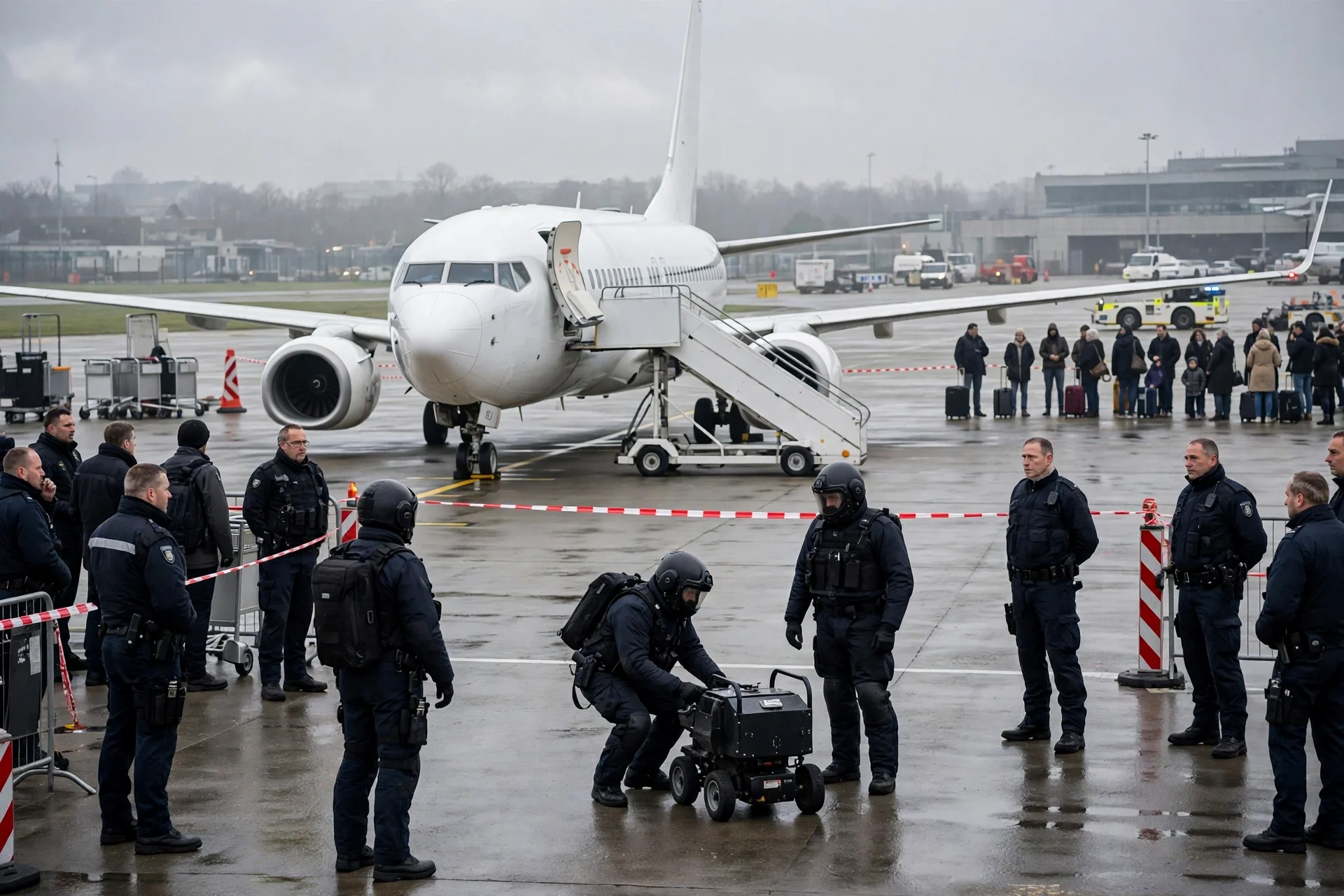
Operativo de seguridad con especialistas en desactivación de explosivos junto a un avión comercial en un aeropuerto europeo. · Imagen generada para EPM
Six flights face bomb threats and trigger airport security checks
Six commercial flights received bomb threats in Europe and triggered checks at airports in Spain, Poland, Bulgaria and Italy.
Bomb threats on six flights prompt firm airport security response
Bomb threats against six commercial flights forced security arrangements at airports in Spain, Poland, Bulgaria and Italy.
--- The context ---
Six commercial flights received bomb threats in Europe this Tuesday, leaving checks at airports in Spain, Poland, Bulgaria and Italy. The aircraft landed without incidents and, so far, no explosives have been found in any inspection, a fact that does not lessen the tension experienced by passengers and crew members during the day.
--- The facts ---
A Ryanair flight between Manchester, in the United Kingdom, and the International Airport of the Region of Murcia, in Corvera, landed at 10.30 hours. Operations were restricted for more than two hours, the 114 passengers and seven crew members disembarked and passed checks, with National Police, Civil Guard, emergency services and bomb disposal specialists deployed.
The inspection detected no device and the airport reopened at 13.00 hours, although the closure forced the diversion to Alicante of a Binter Canarias flight from Gran Canaria scheduled to arrive at midday. In Poland, two aircraft bound for Warsaw also received threats during the same European day of alerts and inspections.
A LOT flight from London Heathrow bound for Warsaw-Chopin was diverted to Modlin, about 36 kilometres from the capital, after an alert about possible explosives. The Boeing 737 MAX, with 181 people on board, landed there and the terminal resumed activity less than two hours later, with no explosives detected in the inspection.
--- The positions ---
Another SAS aircraft from Copenhagen landed normally at Warsaw-Chopin, its passengers disembarked before the Border Guard inspection and one runway remained closed. In Bulgaria, the Interior chief secretary, Lyubomir Nikolov, indicated that there are no elements pointing to an attempted terrorist attack, although security was reinforced by the authorities in response to the threat received.
--- What remains unknown ---
It has not been specified who sent the anonymous warnings received in Rome or the threat by email concerning the flight that landed in Sofia, or whether the episodes are related. The Bulgarian Government also did not specify the airline or final destination of the flight from Tel Aviv, although the only scheduled landing from that city corresponded to El Al.
--- Unanswered questions ---
Who is behind the anonymous warnings and the threat sent by email that triggered checks at several airports across Europe? Is there any link between the threats in Spain, Poland, Bulgaria and Italy, or were they independent episodes? What information will the authorities offer when all the checks on each affected aircraft from this day are concluded?
--- EPM analysis ---
In Rome, two Ryanair flights from Dublin and from Lisbon were inspected after landing, the flight from Ireland was escorted by the Italian Air Forces towards Fiumicino and the alert was deactivated with no explosives. A day earlier, a Wizz Air Airbus A321 from London to Sofia was diverted to Budapest, escorted by a Hungarian Gripen fighter and continued after explosives were ruled out.
📌 EPM Take:
In EPM's view, protecting passengers must guide every decision when a threat forces operations to stop, flights to divert and aircraft to be inspected across several countries at once. Coordination among police forces, guards, emergency services and specialists worked without incidents, but later transparency also matters: the public deserves to know how each alert was carefully checked, how affected travellers were treated and what measures remain so travel stays safe without normalising fear.
--- The context ---
Six commercial flights received bomb threats in Europe this Tuesday, forcing security arrangements at airports in Spain, Poland, Bulgaria and Italy. All the aircraft landed without incidents and, so far, no explosives have been found, a result that does not reduce the seriousness of alerts that altered routes and operations in several countries.
--- The facts ---
The Spanish episode affected a Ryanair flight between Manchester, in the United Kingdom, and the International Airport of the Region of Murcia, in Corvera, which landed at 10.30 hours. Operations were restricted for more than two hours with National Police, Civil Guard, emergency services and bomb disposal specialists deployed to inspect the aircraft thoroughly.
The 114 passengers and seven crew members disembarked and passed checks, the inspection detected no device and the airport reopened at 13.00 hours. The closure forced the diversion to Alicante of a Binter Canarias flight from Gran Canaria scheduled to arrive at midday, during a day of maximum operational demand for airport teams.
In Poland, a LOT flight from London Heathrow bound for Warsaw-Chopin was diverted to Modlin, about 36 kilometres from the capital, after an alert about possible explosives. The Boeing 737 MAX was carrying 181 people on board and the Modlin terminal resumed activity less than two hours later, with no explosives detected in the inspection.
--- The positions ---
Another SAS aircraft from Copenhagen landed normally at Warsaw-Chopin, its passengers disembarked before the Border Guard inspection and one runway remained closed. In Bulgaria, the Interior chief secretary, Lyubomir Nikolov, indicated that there are no elements pointing to an attempted terrorist attack, although the authorities firmly reinforced security in response to the email threat.
--- What remains unknown ---
The authors of the anonymous warnings received in Rome have not been identified, nor has whoever sent by email the threat concerning the flight that landed in Sofia, and it is not known whether the threats are related. The Bulgarian Government did not specify the airline or final destination of the flight from Tel Aviv, although the only scheduled landing corresponded to El Al.
--- Unanswered questions ---
Who sent the threats that forced six flights to be inspected and what consequences will they face if identified by the authorities? Are the warnings in Spain, Poland, Bulgaria and Italy related, or were they separate decisions that coincided this Tuesday? What reinforcements will the affected airports maintain after a day of diversions, runway closures and temporarily suspended operations?
--- EPM analysis ---
In Rome, two other Ryanair flights, one from Dublin and another from Lisbon, were inspected after landing and the flight from Ireland was escorted by the Italian Air Forces towards Fiumicino, with no explosives or incidents. The previous day, a Wizz Air Airbus A321 from London to Sofia was diverted to Budapest, escorted by a Hungarian Gripen fighter and continued after explosives were ruled out.
📌 EPM Take:
In EPM's view, the firm and orderly response of the security forces was the right one: faced with a bomb threat there is no room to improvise or lower checks, even when the operating cost is high. Diverting aircraft, closing runways and inspecting every item of luggage protects lives and preserves State authority against anyone seeking to sow alarm. The pending task is identifying those responsible and maintaining demanding protocols without yielding to fear.
Seis vuelos reciben amenazas de bomba y activan controles en Europa
Seis vuelos comerciales recibieron amenazas de bomba en Europa y activaron controles en aeropuertos de España, Polonia, Bulgaria e Italia.
Amenazas de bomba en seis vuelos obligan a reforzar la seguridad aérea
Amenazas de bomba contra seis vuelos comerciales obligaron a activar dispositivos de seguridad en España, Polonia, Bulgaria e Italia.
--- El contexto ---
Seis vuelos comerciales recibieron este martes amenazas de bomba en Europa y la jornada dejó controles en aeropuertos de España, Polonia, Bulgaria e Italia. Las aeronaves aterrizaron sin incidentes y, hasta el momento, no se han hallado explosivos en ninguna revisión, un dato que no rebaja la tensión vivida por pasajeros y tripulantes.
--- Los hechos ---
Un vuelo de Ryanair entre Mánchester, en el Reino Unido, y el Aeropuerto Internacional de la Región de Murcia, en Corvera, aterrizó a las 10.30 horas. Las operaciones se restringieron durante más de dos horas, los 114 pasajeros y siete tripulantes desembarcaron y pasaron controles, con Policía Nacional, Guardia Civil, servicios de emergencia y especialistas TEDAX.
La inspección no detectó ningún artefacto y el aeropuerto reabrió a las 13.00 horas, aunque el cierre obligó a desviar a Alicante un vuelo de Binter Canarias procedente de Gran Canaria con llegada prevista al mediodía. En Polonia, dos aeronaves con destino a Varsovia también recibieron amenazas durante la misma jornada europea.
Un vuelo de LOT procedente de Londres Heathrow y con destino a Varsovia-Chopin fue desviado a Modlin, a unos 36 kilómetros de la capital, tras una alerta sobre posibles explosivos. El Boeing 737 MAX, con 181 personas a bordo, aterrizó allí y la terminal retomó su actividad menos de dos horas después, sin explosivos detectados.
--- Las posiciones ---
Otro avión de SAS procedente de Copenhague aterrizó con normalidad en Varsovia-Chopin, sus pasajeros desembarcaron antes de la inspección de la Guardia de Fronteras y una pista permaneció cerrada. En Bulgaria, el secretario jefe del Interior, Lyubomir Nikolov, indicó que no hay elementos que apunten a un intento de atentado terrorista, aunque se reforzó la seguridad.
--- Lo que falta saber ---
No se ha precisado quién envió los avisos anónimos recibidos en Roma ni la amenaza por correo electrónico sobre el vuelo aterrizado en Sofía, ni si los episodios guardan relación. El Gobierno búlgaro tampoco precisó la aerolínea ni el destino final del vuelo desde Tel Aviv, aunque el único aterrizaje programado desde esa ciudad correspondía a El Al.
--- Preguntas sin respuesta ---
¿Quién está detrás de los avisos anónimos y de la amenaza enviada por correo electrónico que activaron los controles en varios aeropuertos? ¿Existe algún vínculo entre las amenazas en España, Polonia, Bulgaria e Italia o fueron episodios independientes? ¿Qué información ofrecerán las autoridades cuando concluyan todas las comprobaciones sobre cada aeronave afectada en esta jornada?
--- Análisis EPM ---
En Roma, dos Ryanair procedentes de Dublín y de Lisboa fueron revisados tras aterrizar, el vuelo desde Irlanda fue escoltado por las Fuerzas Aéreas Italianas hacia Fiumicino y la alerta se desactivó sin explosivos. Un día antes, un Airbus A321 de Wizz Air de Londres a Sofía fue desviado a Budapest, escoltado por un caza Gripen húngaro y continuó tras descartarse explosivos.
📌 Conclusion EPM:
A juicio de EPM, la protección de los pasajeros debe guiar cada decisión cuando una amenaza obliga a detener operaciones, desviar vuelos y revisar aeronaves en varios países a la vez. La coordinación entre policías, guardias, servicios de emergencia y especialistas funcionó sin incidentes, pero la transparencia posterior también importa: la ciudadanía merece saber cómo se verificó cada alerta y qué medidas quedan para viajar con seguridad sin normalizar el miedo.
--- El contexto ---
Seis vuelos comerciales recibieron este martes amenazas de bomba en Europa, lo que obligó a activar dispositivos de seguridad en aeropuertos de España, Polonia, Bulgaria e Italia. Todas las aeronaves aterrizaron sin incidentes y, hasta el momento, no se han hallado explosivos, resultado que no reduce la gravedad de unas alertas que alteraron rutas y operaciones.
--- Los hechos ---
El episodio español afectó a un vuelo de Ryanair entre Mánchester, en el Reino Unido, y el Aeropuerto Internacional de la Región de Murcia, en Corvera, que aterrizó a las 10.30 horas. Las operaciones se restringieron durante más de dos horas con Policía Nacional, Guardia Civil, servicios de emergencia y especialistas TEDAX desplegados para revisar el aparato.
Los 114 pasajeros y siete tripulantes desembarcaron y pasaron controles, la inspección no detectó ningún artefacto y el aeropuerto reabrió a las 13.00 horas. El cierre obligó a desviar a Alicante un vuelo de Binter Canarias procedente de Gran Canaria con llegada prevista al mediodía, dentro de una jornada de máxima exigencia operativa.
En Polonia, un vuelo de LOT procedente de Londres Heathrow y con destino a Varsovia-Chopin fue desviado a Modlin, a unos 36 kilómetros de la capital, tras una alerta sobre posibles explosivos. El Boeing 737 MAX llevaba 181 personas a bordo y la terminal de Modlin retomó su actividad menos de dos horas después, sin explosivos detectados.
--- Las posiciones ---
Otro avión de SAS procedente de Copenhague aterrizó con normalidad en Varsovia-Chopin, sus pasajeros desembarcaron antes de la inspección de la Guardia de Fronteras y una pista permaneció cerrada. En Bulgaria, el secretario jefe del Interior, Lyubomir Nikolov, indicó que no hay elementos que apunten a un intento de atentado terrorista, aunque las autoridades reforzaron la seguridad con firmeza.
--- Lo que falta saber ---
No se ha identificado a los autores de los avisos anónimos recibidos en Roma ni a quien envió por correo electrónico la amenaza sobre el vuelo aterrizado en Sofía, ni consta si las amenazas están relacionadas. El Gobierno búlgaro no precisó la aerolínea ni el destino final del vuelo desde Tel Aviv, aunque el único aterrizaje programado correspondía a El Al.
--- Preguntas sin respuesta ---
¿Quiénes enviaron las amenazas que obligaron a revisar seis vuelos y qué consecuencias asumirán si son identificados por las autoridades? ¿Están relacionados los avisos en España, Polonia, Bulgaria e Italia o fueron decisiones separadas que coincidieron este martes? ¿Qué refuerzos mantendrán los aeropuertos afectados tras una jornada con desvíos, cierres de pistas y operaciones suspendidas temporalmente?
--- Análisis EPM ---
En Roma, otros dos Ryanair, uno procedente de Dublín y otro de Lisboa, fueron revisados tras aterrizar y el vuelo desde Irlanda fue escoltado por las Fuerzas Aéreas Italianas hacia Fiumicino, sin explosivos ni incidentes. La víspera, un Airbus A321 de Wizz Air de Londres a Sofía fue desviado a Budapest, escoltado por un caza Gripen húngaro y continuó tras descartarse explosivos.
📌 Conclusion EPM:
A juicio de EPM, la respuesta firme y ordenada de las fuerzas de seguridad fue la correcta: ante una amenaza de bomba no cabe improvisar ni rebajar controles, aunque el coste operativo sea alto. Desviar aeronaves, cerrar pistas y revisar cada equipaje protege vidas y preserva la autoridad del Estado frente a quien busca sembrar alarma. La tarea pendiente es identificar a los responsables y mantener protocolos exigentes sin ceder al miedo.