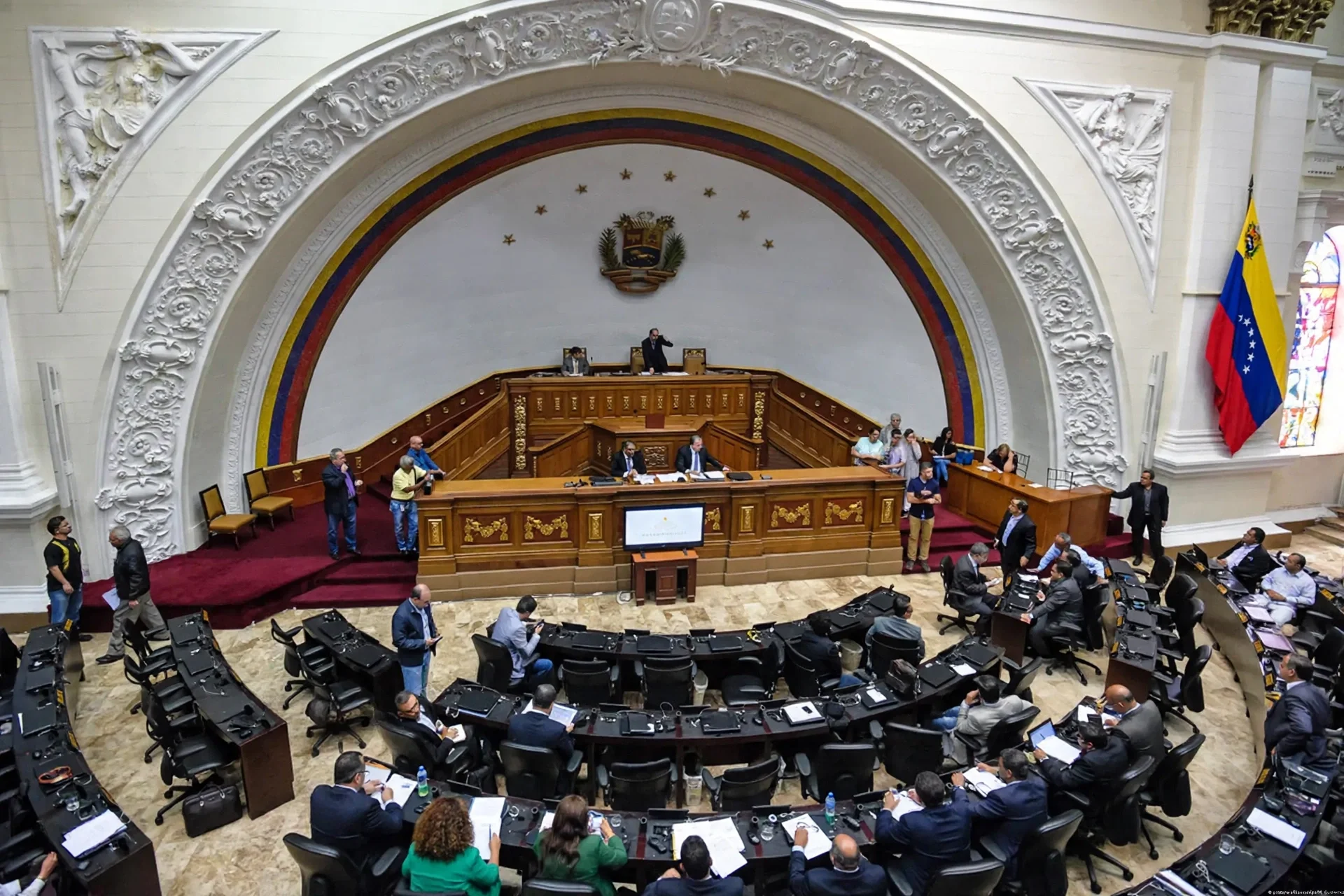
La Asamblea Nacional venezolana durante una sesión en Caracas. · Imagen generada para EPM
Venezuela softens hate law but repeal demands persist
Venezuela's pro-government assembly approved at first reading a plan to remove prison from the hate law and replace it with fines and community service.
Caracas trades prison for fines in coexistence law overhaul
Venezuela's governing majority has begun replacing hate-law prison terms of up to 20 years with fines and community work, presenting the shift as a correction…
--- The context ---
Adopted in November 2017 by the Constituent Assembly after months of street protests that left more than 100 people dead, the existing statute became one of the most contested tools of the Venezuelan state. Human rights monitors have long argued that its broad wording enabled prosecutions far beyond genuine incitement, pointing to at least 927 people accused of incitement to hatred since 2017, according to figures released by Foro Penal in late September.
--- The facts ---
Lawmakers from the pro-government majority approved the overhaul on Tuesday, although only at first reading, removing imprisonment altogether and replacing custodial sentences with fines plus community service. The draft also creates administrative procedures for enforcement, authorizes formal warnings to media outlets without allowing their licenses to be revoked, and introduces financial penalties for spreading hate messages across social networks.
Acting president Delcy Rodríguez sent the request behind the bill to parliament on September 29, and first vice president Pedro Infante formally presented the text to the chamber. Renaming the statute the Peaceful Coexistence and Tolerance Law forms part of the package, which now moves into public consultation before returning for a second, article-by-article debate and a concluding vote.
--- The positions ---
Several opposition blocs voted no, insisting that amending the statute falls short and demanding its complete repeal instead. Legislator Amelia Belisario, speaking for the Libertad bloc, objected that the articles themselves had not even been presented and warned that administrative sanctions would sit with the Interior Ministry. The Democratic Unitary Platform had already argued in late September that abolition, not revision, was the only acceptable outcome, while Cecodap coordinator Carlos Trapani reported on October 5 that 118 teenagers were charged under the rule between 2024 and 2025.
--- What remains unknown ---
The size of the proposed fines, the precise reach of the new administrative track and the safeguards available to people flagged online all remain unspecified. Whether public consultation will alter any core provision, or merely ratify a text already settled by the majority, is equally unclear at this stage.
--- Unanswered questions ---
Can a partial amendment undo the chilling effect accumulated through years of punitive enforcement against critics? What prevents administrative fines from becoming a quieter mechanism for punishing dissenting voices tomorrow? Will the governing bloc allow repeal onto the agenda if consultation responses push strongly in that direction?
--- EPM analysis ---
Venezuela's political landscape shifted after United States forces captured Maduro in Caracas on January 3, an operation after which Rodríguez took office as acting president and her government freed hundreds of political prisoners. Even so, Foro Penal still counted 322 political prisoners on October 26, including 140 members of the military, and IPYS Venezuela documented 85 cases involving individuals and outlets flagged for hate offences between 2017 and October 2025, 65 of them tied to this statute.
📌 EPM Take:
In EPM's view, ending the threat of prison is a tangible gain for anyone facing prosecution, yet the deeper dispute survives because the machinery behind 927 accusations stays largely intact under a different label. As long as enforcement rests with the executive and outright repeal remains excluded from the official agenda, victims and opposition groups will judge every concession against that record of abuse rather than against assurances delivered during a single first-reading session in the chamber.
--- The context ---
For nearly nine years, Venezuela lived under a statute the Constituent Assembly approved back in November 2017, amid a wave of unrest that claimed over 100 lives. That framework punished so-called hate crimes with sentences reaching 20 years behind bars, a severity that even senior figures in the governing movement eventually conceded had produced serious abuses in practice.
--- The facts ---
On Tuesday the chamber, where the governing movement holds the majority, gave initial approval to a sweeping change: prison disappears as a punishment, replaced by monetary sanctions combined with community work requirements. The text establishes administrative channels for handling cases, permits formal admonitions directed at news organizations while barring any withdrawal of their broadcasting concessions, and sets fines targeting hateful content circulated through social platforms.
Under the proposal, the legislation would carry a fresh name, the Peaceful Coexistence and Tolerance Law. A public consultation phase comes next, after which deputies must examine the measure once more, voting provision by provision, before any final decision can turn the changes into binding law for the country.
--- The positions ---
Parliament president Jorge Rodríguez argued that the governing movement intends to guarantee the reformed statute is never used to persecute anybody, defending the need for rules protecting coexistence and invoking the danger of civil war. The initiative originated with a September 29 request from acting president Delcy Rodríguez, who that same day acknowledged the law had been badly applied and abused; a special commission of 11 deputies, chaired by Pedro Infante, began work on October 5. Opposition benches nevertheless rejected the draft because they seek the statute's elimination altogether.
--- What remains unknown ---
Key operational details are still missing, including each fine's amount, the deadlines governing administrative proceedings and the appeal routes open to outlets or ordinary users. Also unresolved is how much room the consultation genuinely leaves for changes ahead of the decisive plenary vote on the package.
--- Unanswered questions ---
Will lighter penalties be enough for Venezuelans to believe that justice is actually changing under the interim government? Does the final text need explicit safeguards so that fines cannot drift into indirect censorship of critical reporting? Can a renamed law deliver genuinely different practice, or will old enforcement habits survive beneath the new title?
--- EPM analysis ---
The timing reflects a broader political reordering that followed the January 3 capture of Maduro in Caracas by American forces, after which the interim administration released hundreds of political detainees and sought signals of normalization. Foro Penal figures dated October 26 nevertheless list 322 people still imprisoned for political reasons, 140 of them soldiers, a reminder that reconciliation promises remain unfinished even as the legal framework begins to soften.
📌 EPM Take:
In EPM's view, replacing sentences of up to two decades with financial penalties repairs the statute's most glaring excess and formalizes an official admission that enforcement went badly wrong. Whether the change deserves trust, however, turns on the limits the second debate writes around administrative discretion: without firm procedural guarantees, the coexistence invoked by the government could slide toward control over expression, and that unresolved risk will define how history judges this announced turning point.
Venezuela debate reformar la ley del odio sin derogarla
La cámara venezolana aprobó en primer debate eliminar la prisión de la ley contra el odio y sustituirla por multas y trabajo comunitario.
Caracas cambia cárcel por multas en su norma de convivencia
El oficialismo venezolano impulsa una reforma que rebaja drásticamente las sanciones por delitos de odio: adiós a condenas de hasta 20 años y paso a multas con…
--- El contexto ---
La norma que hoy se discute nació en noviembre de 2017, cuando la Asamblea Nacional Constituyente la aprobó tras meses de protestas que dejaron más de 100 muertos. Desde entonces, su aplicación acumuló un historial que organizaciones de derechos humanos describen con cifras severas: al menos 927 personas acusadas de incitación al odio, según datos difundidos por Foro Penal a fines de septiembre.
--- Los hechos ---
El pleno de mayoría chavista aprobó este martes, únicamente en primer debate, una reforma que suprime las penas de prisión y las reemplaza por multas junto a trabajo comunitario. El texto también crea procedimientos administrativos, contempla exhortaciones a medios sin llegar a retirarles la concesión y sanciona económicamente la difusión de mensajes de odio en redes sociales.
La iniciativa llegó al Parlamento a pedido de la presidenta encargada, Delcy Rodríguez, quien lo remitió el 29 de septiembre, y el primer vicepresidente, Pedro Infante, se encargó de presentarla. El proyecto cambia además la denominación oficial, que pasaría a ser Ley de Convivencia Pacífica y Tolerancia, y ahora entrará en consulta pública antes de regresar al hemiciclo para un segundo debate, artículo por artículo, con votación final.
--- Las posiciones ---
Varias bancadas opositoras votaron en contra al considerar insuficiente cualquier ajuste parcial y exigir la derogación completa. La diputada Amelia Belisario, integrante de la bancada Libertad, advirtió según lo expuesto en el debate que los artículos ni siquiera habían sido presentados y que las sanciones administrativas quedarían bajo control del Ministerio de Interior. La Plataforma Unitaria Democrática ya había sostenido a fines de septiembre que la norma debe desaparecer, no maquillarse. Desde Cecodap, su coordinador Carlos Trapani informó el 5 de octubre que 118 adolescentes resultaron imputados bajo esta legislación entre 2024 y 2025, dato que alimenta el reclamo de fondo.
--- Lo que falta saber ---
Todavía se desconoce el monto de las multas, el alcance exacto de los procedimientos administrativos y qué garantías tendrán quienes sean señalados en plataformas digitales. Tampoco está claro si la consulta pública modificará artículos centrales o si el texto llegará intacto al segundo debate.
--- Preguntas sin respuesta ---
¿Puede una reforma parcial borrar el efecto disuasorio acumulado durante años de aplicación punitiva? ¿Qué impide que las nuevas sanciones administrativas se usen contra voces críticas del Gobierno? ¿Aceptará el oficialismo discutir la derogación si la consulta pública la coloca sobre la mesa?
--- Análisis EPM ---
El giro ocurre tras la captura de Maduro por fuerzas de Estados Unidos en Caracas, el 3 de enero, episodio después del cual Delcy Rodríguez asumió como presidenta encargada y su Gobierno excarceló a cientos de presos políticos. Aun así, Foro Penal contabilizaba 322 presos políticos al 26 de octubre, 140 de ellos militares, mientras IPYS Venezuela documentó 85 casos de personas y medios señalados entre 2017 y octubre de 2025, con 65 vinculados directamente a esta legislación.
📌 Conclusion EPM:
A juicio de EPM, retirar la cárcel representa un alivio concreto para futuros procesados, pero el debate de fondo sigue abierto porque la estructura que permitió 927 acusaciones permanece vigente bajo otra forma. Mientras las sanciones queden en manos del Ejecutivo y la derogación continúe fuera de la agenda oficial, la desconfianza de víctimas, opositores y organizaciones tendrá sustento, y cada avance parcial se medirá contra ese historial antes que contra las promesas formuladas en el hemiciclo durante esta primera discusión parlamentaria.
--- El contexto ---
Durante casi una década rigió en Venezuela una legislación aprobada en noviembre de 2017 por la Asamblea Nacional Constituyente, en medio de una ola de protestas con saldo superior a 100 fallecidos. Aquella norma castigaba los denominados delitos de odio con condenas que podían alcanzar 20 años tras las rejas, severidad que el propio oficialismo terminó cuestionando públicamente este año.
--- Los hechos ---
Este martes, la cámara de mayoría oficialista dio luz verde inicial a una modificación profunda: desaparece la prisión como castigo y entran en su lugar sanciones económicas acompañadas de labores en beneficio de la comunidad. El articulado incorpora vías administrativas para tramitar los casos, llamados formales a la prensa sin facultad de cancelar concesiones y penalizaciones pecuniarias contra la propagación de contenidos de odio mediante plataformas sociales.
La propuesta incorpora igualmente un cambio de nombre, pues la normativa se llamaría Ley de Convivencia Pacífica y Tolerancia. Su tramitación continuará con una fase de consulta abierta a la ciudadanía y, posteriormente, el pleno deberá examinarla de nuevo, votando cada artículo por separado antes de cualquier aprobación definitiva, requisito indispensable para que entre en vigor.
--- Las posiciones ---
Al frente de la cámara, Jorge Rodríguez sostuvo que el chavismo busca impedir que la herramienta legal sirva para perseguir a cualquier ciudadano, defendió contar con reglas que protejan la convivencia y evocó el peligro de una confrontación civil. La solicitud partió de Delcy Rodríguez el 29 de septiembre, jornada en la cual admitió que la aplicación había sido defectuosa y abusiva, y una comisión especial de 11 diputados, encabezada por Pedro Infante, comenzó a trabajar el 5 de octubre. Sectores opositores rechazaron el texto porque aspiran a eliminarlo por completo, postura coincidente con la Plataforma Unitaria Democrática.
--- Lo que falta saber ---
Faltan detalles decisivos sobre la cuantía de cada multa, los plazos de los trámites administrativos y los mecanismos de apelación disponibles para medios y usuarios de redes. Igualmente incierto resulta el margen real de modificación que tendrá la consulta antes de la votación definitiva del pleno.
--- Preguntas sin respuesta ---
¿Bastará la rebaja de penas para que la ciudadanía perciba un cambio auténtico en la justicia venezolana? ¿Incluirá el texto final salvaguardas claras que impidan convertir las multas en instrumento de censura indirecta? ¿Logrará la nueva denominación reflejar una práctica distinta o quedará como simple gesto simbólico oficial?
--- Análisis EPM ---
El contexto político explica la urgencia del ajuste: tras la captura de Maduro ejecutada por fuerzas estadounidenses en la capital el 3 de enero, el Gobierno interino liberó a cientos de detenidos por motivos políticos y busca señales de normalización. Sin embargo, de acuerdo con el conteo de Foro Penal correspondiente al 26 de octubre, permanecen detenidas 322 personas por razones políticas, entre ellas 140 militares, recordatorio de que la reconciliación anunciada todavía marcha incompleta.
📌 Conclusion EPM:
A juicio de EPM, sustituir condenas de hasta dos décadas por sanciones económicas corrige el exceso más visible de la norma anterior y recoge un reconocimiento oficial de abusos que ya no podía sostenerse. El acierto, no obstante, dependerá de los límites que el segundo debate imponga a la discrecionalidad administrativa: sin garantías procesales firmes, la convivencia invocada puede derivar en control sobre la expresión, y allí se jugará la credibilidad completa de esta reforma anunciada como punto de inflexión nacional.