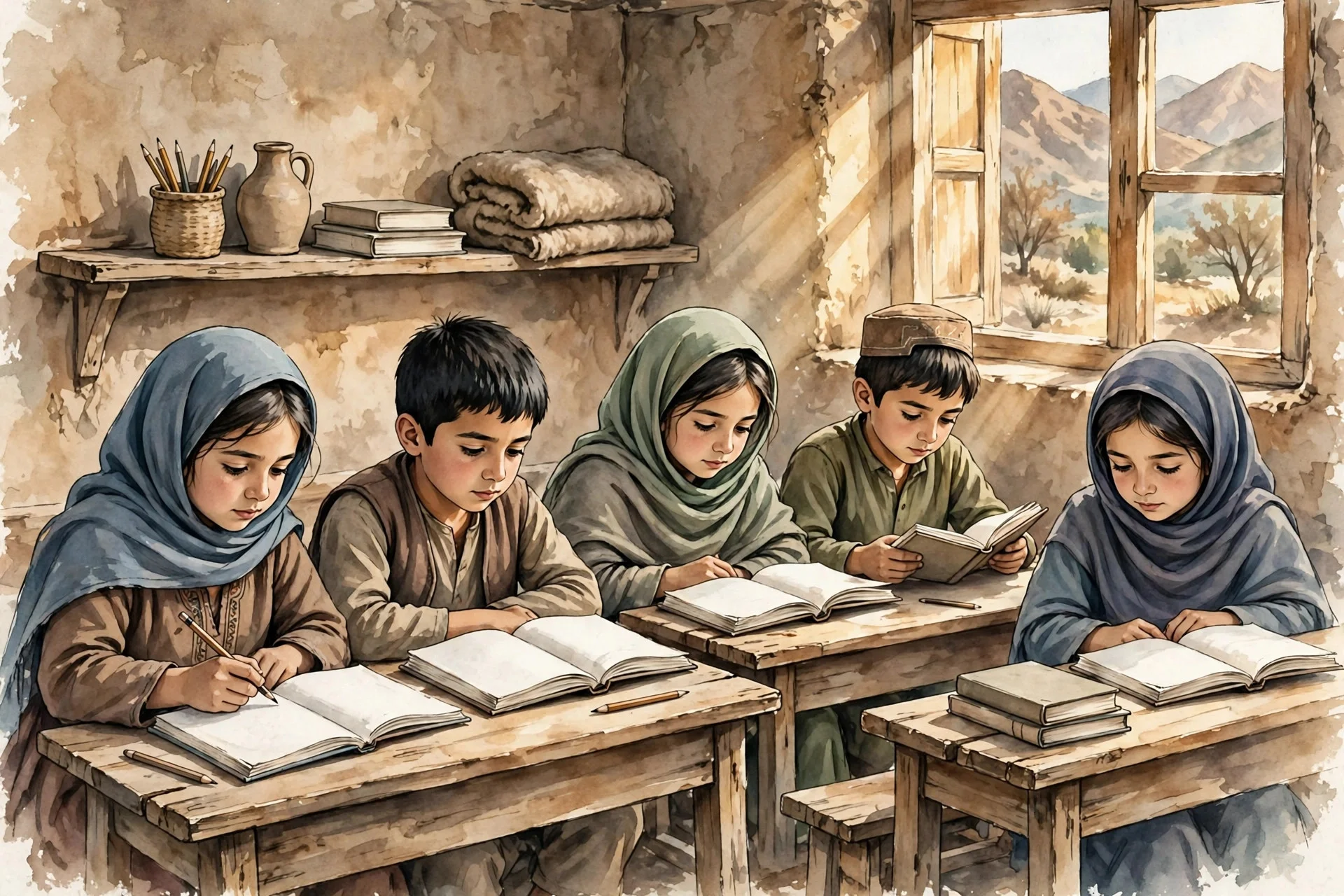
Niños y niñas en un aula afgana, en una ilustración alusiva a la crisis de acceso y calidad educativa descrita por UNESCO y UNICEF. · Imagen generada para EPM
Afghan children face a narrowing path to education, UN warns
UNESCO and UNICEF warn that more than 2.6 million Afghan girls remain barred from secondary school, boys enrolment is weakening and demand outstrips system…
Afghanistan schools strained by growth, returns and weak funding
The UNESCO and UNICEF report describes an overstretched Afghan system: 11.5 million school-age children, more than a million returnees this year and weak…
--- The context ---
Afghanistan enters 2026 with a demand for learning that keeps rising and a system with ever less room to respond. The latest education situation report, published by UNESCO and UNICEF, describes that widening mismatch as the defining feature of the country: families keep seeking schooling for their children, even where schools are inaccessible, while the school-age population grew from 10.4 million in 2019 to 11.5 million in 2024.
--- The facts ---
Access is deeply unequal. More than 2.6 million girls have been barred from attending school beyond the sixth grade since the Taliban returned in August 2021, and the routes left for teenage girls, such as community-based education, literacy and skills programmes, distance and digital learning and private tutoring, fall far short according to the report. Some 5,300 community-driven classes serve around 162,000 learners, with girls accounting for 64 per cent, but nothing can replace in-person schooling or substitute for the fundamental human right to formal education, in the assessment of the authors.
Boys are not spared the decline: roughly 53 per cent of primary school-age children remain outside formal general education, with participation of 67 per cent at lower-secondary level and 79 per cent at upper-secondary level in the figures cited. Around 6.6 million children enrolled in public primary schools last year, around 560,000 more than in 2022, without keeping pace with population growth. At university, with women barred, 208,000 students are enrolled this year, compared with 189,000 in 2024 and around 430,000 in 2020.
--- The positions ---
The two United Nations agencies call for the full restoration of the right to education for Afghan girls and women and for the barriers that undermine teaching quality to be lifted. They also press for better quality and for investment in teachers and classroom materials. Their central warning is that without urgent action a whole generation will be left behind, directly harming the future recovery and development of the country.
--- What remains unknown ---
The report itself acknowledges incomplete information on private, Islamic and alternative educational provision, which makes it hard to measure precisely how many children learn outside the formal system and with what results. It also remains unclear how community classes will be sustained, or what will happen to the teenage girls who now depend on temporary programmes when that support runs out.
--- Unanswered questions ---
When will Afghan girls be able to return to secondary school fully and safely? What will happen to the generation that has already lost years of in-person classes if the ban remains in place? Can community classes and digital learning prevent the gap from becoming permanent?
--- EPM analysis ---
The gravest fact is not only exclusion, but its duration. Each year without secondary school for girls narrows the pathway into tertiary study, skills development and employment, as the report warns when it describes an increasingly narrow route through the system. A quality crisis compounds the problem: a nationwide assessment found that less than half of fourth graders, among eight to nine-year-olds, reached minimum proficiency in language.
📌 EPM Take: In EPM's view, what is at stake in Afghanistan is not one more schooling statistic, but the entire future of a generation whose door is being closed in childhood. Defending the return of girls to the classroom is not a symbolic gesture: without formal education there will be no women doctors, teachers or professionals able to sustain the recovery of the country, and every lost school year makes that rebuilding more distant, more costly and more unequal for all Afghans.
--- The context ---
The Afghan education system is operating under pressure growing on three fronts at once, according to the 2026 situation report published by UNESCO and UNICEF. The population aged seven to 18 rose from 10.4 million in 2019 to 11.5 million in 2024, recurring emergencies strain infrastructure and investment remains insufficient. Large-scale returns of Afghans from Pakistan and Iran add to the burden: more than a million returnees arrived this year alone, including more than 245,000 children who need places, teachers and materials.
--- The facts ---
Capacity is not keeping that pace. Around 6.6 million children enrolled in public primary schools last year, around 560,000 more than in 2022, but the gain does not offset demographic growth. Boys enrolment weakened to the point that roughly 53 per cent of primary school-age children remain outside formal general education, with participation of 67 per cent at lower-secondary level and 79 per cent at upper-secondary level. Higher education has also shrunk: 208,000 students this year, compared with 189,000 in 2024 and around 430,000 in 2020, with women barred from university.
The severest restriction falls on girls: more than 2.6 million cannot go beyond the sixth grade since August 2021. The alternatives open to teenage girls, from community classes to private tutoring and digital learning, are scarce against the scale of demand. Some 5,300 community-driven classes serve around 162,000 learners, with girls accounting for 64 per cent, a valuable network but a small one when set against millions of school-age children and the returnees still arriving in the country.
--- The positions ---
The agencies call for the right to education of girls and women to be restored and for quality barriers to be lifted, alongside investment in teachers and materials. The report insists that quality is already a measurable problem: less than half of fourth graders, among eight to nine-year-olds, reached minimum proficiency in language in a nationwide assessment. Without enough teachers or resources in the classroom, expanding places alone does not guarantee real learning.
--- What remains unknown ---
Complete information on private, Islamic and alternative education is missing, a gap the report highlights and one that complicates any serious planning of places and spending. It is also not known precisely how many of the returned children have managed to enrol, or how long community classes can be sustained with current resources.
--- Unanswered questions ---
How many of the 245,000 children who returned this year are actually in a classroom today? Can the system absorb 11.5 million school-age children without more investment in teachers and infrastructure? What real results do the private, Islamic and alternative options offer, given that the report cannot measure them in full?
--- EPM analysis ---
The practical lesson of the report is one of capacity and order. Afghanistan faces not only a ban that excludes girls, but also overstretched schools, mass returns and a weak learning base from primary school onward. Any response that ignores demography, teacher training and classroom quality will run into the same limits, however well intentioned outside assistance may be.
📌 EPM Take: In EPM's view, Afghanistan shows what happens when demand grows faster than the institutions meant to meet it: neither community classes nor distance programmes can substitute for a complete school system, with trained teachers, sufficient materials and stable rules. Without real capacity in classrooms, every enrolment figure hides fragile learning, and the rebuilding of the country will be compromised for decades if that foundation is not corrected soon through sustained and measurable investment.
La educación afgana se estrecha para millones de niños y niñas
UNESCO y UNICEF advierten que más de 2,6 millones de niñas afganas siguen fuera de la secundaria, la matrícula de los niños se debilita y la demanda supera la…
Afganistán: más alumnos, retornos y escuelas al límite en 2026
El informe de UNESCO y UNICEF describe un sistema afgano desbordado: 11,5 millones de menores en edad escolar, más de un millón de retornados este año y una…
--- El contexto ---
Afganistán llega a 2026 con una demanda de aprendizaje creciente y un sistema con cada vez menos margen. El informe de situación educativa publicado por UNESCO y UNICEF describe ese desajuste como el rasgo que define al país: las familias siguen buscando escuela incluso donde no hay aulas accesibles, mientras la población de siete a 18 años pasó de 10,4 millones en 2019 a 11,5 millones en 2024.
--- Los hechos ---
El acceso es profundamente desigual. Más de 2,6 millones de niñas tienen prohibido asistir a la escuela más allá del sexto grado desde el regreso de los talibanes en agosto de 2021. Las vías restantes para las adolescentes, como la educación comunitaria, la alfabetización, el aprendizaje digital o las tutorías privadas, resultan muy insuficientes. Unas 5,300 clases impulsadas por la comunidad atienden a unos 162,000 alumnos, con un 64% de niñas, pero nada puede reemplazar la escolarización presencial, un derecho humano fundamental según sus autores.
Los niños tampoco escapan a la caída: alrededor del 53% de los que están en edad de primaria permanece fuera de la educación general formal, con una participación del 67% en secundaria inferior y del 79% en secundaria superior. Unos 6,6 millones se matricularon en la primaria pública el año pasado, unos 560,000 más que en 2022, sin seguir el ritmo demográfico. En la universidad, con las mujeres excluidas, hay 208,000 estudiantes este año, frente a 189,000 en 2024 y unos 430,000 en 2020.
--- Las posiciones ---
Las dos agencias de Naciones Unidas piden la restauración plena del derecho a la educación de niñas y mujeres y que se levanten las barreras que socavan la calidad de la enseñanza, además de invertir en docentes y materiales de aula. Su advertencia central es que sin una acción urgente toda una generación quedará atrás, dañando la recuperación y el desarrollo del país.
--- Lo que falta saber ---
El propio informe reconoce información incompleta sobre la oferta educativa privada, islámica y alternativa, lo que impide medir con precisión cuántos niños aprenden fuera del sistema formal . Tampoco queda claro cómo se sostendrán las clases comunitarias ni qué pasará con las adolescentes que hoy dependen de programas temporales cuando esos apoyos se agoten.
--- Preguntas sin respuesta ---
¿Cuándo podrán volver las niñas afganas a la escuela secundaria de forma plena y segura? ¿Qué pasará con la generación que ya perdió años de clases presenciales si la prohibición se mantiene? ¿Alcanzarán las clases comunitarias y el aprendizaje digital para evitar que la brecha se vuelva permanente?
--- Análisis EPM ---
El dato más grave no es solo la exclusión, sino su duración. Cada año sin secundaria para las niñas estrecha el camino hacia los estudios superiores, la formación de habilidades y el empleo. A eso se suma un problema de calidad: una evaluación nacional encontró que menos de la mitad de los alumnos de cuarto grado, entre los ocho y nueve años, alcanzó el nivel mínimo de competencia en lenguaje.
📌 Conclusion EPM: A juicio de EPM, lo que está en juego en Afganistán no es una estadística escolar más, sino el futuro de una generación a la que se le cierra la puerta en plena infancia. Defender el regreso de las niñas a las aulas no es un gesto simbólico. Sin educación formal no habrá médicas, maestras ni profesionales capaces de sostener la recuperación del país, y cada curso perdido hace esa reconstrucción más lejana, más cara y más desigual para todos los afganos.
--- El contexto ---
El sistema educativo afgano opera bajo presión por tres frentes, según el informe de situación de 2026 publicado por UNESCO y UNICEF. La población de siete a 18 años pasó de 10,4 millones en 2019 a 11,5 millones en 2024, las emergencias recurrentes castigan la infraestructura y la inversión resulta insuficiente. Se suma el regreso masivo desde Pakistán e Irán: este año llegaron más de un millón de retornados, incluidos más de 245,000 niños.
--- Los hechos ---
La capacidad no sigue ese ritmo. En la primaria pública se matricularon unos 6,6 millones de niños el año pasado, unos 560,000 más que en 2022, pero el avance no compensa el crecimiento demográfico. Alrededor del 53% de los niños de primaria queda fuera de la educación general formal, con participación del 67% en secundaria inferior y del 79% en secundaria superior. La educación superior también quedó reducida: 208,000 estudiantes este año, frente a 189,000 en 2024 y unos 430,000 en 2020, con las mujeres fuera de la universidad.
La restricción más severa recae sobre las niñas: más de 2,6 millones no pueden pasar del sexto grado desde agosto de 2021. Las alternativas disponibles para las adolescentes, desde clases comunitarias hasta tutorías privadas y aprendizaje digital, son escasas frente a la demanda. Existen unas 5,300 clases de impulso comunitario para unos 162,000 alumnos, con un 64% de niñas, una red valiosa pero pequeña frente a millones de menores y a los retornados que siguen llegando.
--- Las posiciones ---
Las agencias piden restaurar el derecho a la educación de niñas y mujeres y levantar las barreras que dañan la calidad, además de invertir en docentes y materiales. La calidad ya es un problema medible: menos de la mitad de los alumnos de cuarto grado, entre los ocho y nueve años, alcanzó el nivel mínimo en lenguaje en una evaluación nacional. Sin maestros suficientes ni recursos en el aula, ampliar cupos por sí solo no garantiza aprendizaje real.
--- Lo que falta saber ---
Falta información completa sobre la educación privada, islámica y alternativa, una laguna que complica planificar cupos y gasto. Tampoco se conoce con precisión cuántos de los niños retornados han logrado matricularse ni cuánto tiempo podrán sostenerse las clases comunitarias con los recursos actuales.
--- Preguntas sin respuesta ---
¿Cuántos de los 245,000 niños retornados este año están hoy efectivamente en un aula? ¿Puede el sistema absorber a 11,5 millones de menores en edad escolar sin más inversión en docentes e infraestructura? ¿Qué resultados reales ofrecen la educación privada, islámica y alternativa que el informe no logra medir por completo?
--- Análisis EPM ---
La lección práctica del informe es de capacidad y de orden. Afganistán no enfrenta solo una prohibición que excluye a las niñas, enfrenta además escuelas desbordadas, retornos masivos y una base de aprendizaje débil desde la primaria. Toda respuesta que ignore la demografía, la formación de maestros y la calidad en el aula chocará con los mismos límites.
📌 Conclusion EPM: A juicio de EPM, Afganistán muestra lo que ocurre cuando la demanda crece más rápido que las instituciones encargadas de atenderla: ni las clases comunitarias ni los programas a distancia pueden sustituir un sistema escolar completo, con docentes formados, materiales suficientes y reglas estables. Sin capacidad real en las aulas, cada cifra de matrícula esconde un aprendizaje frágil, y la reconstrucción del país quedará comprometida durante décadas si esa base no se corrige pronto con inversión sostenida y medible.