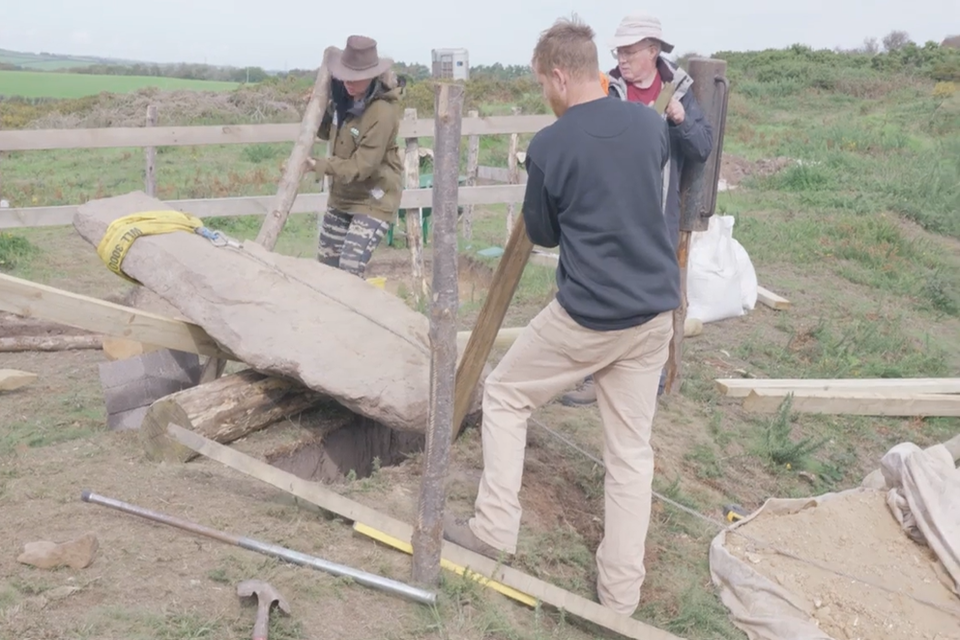
El levantamiento de la piedra Bride Stone en la Reserva Natural Nacional Valley of Stones. · Catherine Roberts / GOV.UK
Bride Stone rises again in Dorset's Valley of Stones
A 5-foot stone hidden for generations, the Bride Stone, has been raised again at the Valley of Stones reserve in Dorset after emerging during scrub clearance.
Lost Bride Stone returns to Dorset's ancient valley
The Bride Stone, a 5-foot stone hidden for generations, has been raised again at the Valley of Stones National Nature Reserve in Dorset.
--- The context ---
The Valley of Stones in Dorset is a National Nature Reserve shaped by large blocks of silicified sandstone known as sarsen boulders, shaped by Ice Age weathering. Some are thought to have been used in Neolithic times to create monuments such as standing stones and stone circles.
--- The facts ---
A mysterious 5-foot stone, hidden for generations, has been raised once more and named the Bride Stone. It emerged during scrub clearance carried out as part of the management of the reserve, thanks to a joint effort by Natural England, Past Participate and local volunteers. Excavation suggests it once formed part of a Stone Age tomb.
--- The facts ---
The stone now stands among stone circles, standing stones, chambered tombs and barrows. The work was undertaken by Past Participate and Historic England, funded by the National Lottery Heritage Fund and supported by Natural England. In 2022, a rare 6,000-year-old polishing stone, or polissoir, was uncovered at this site and sparked much of the research since.
--- The positions ---
Rob Beard, reserve manager for Natural England, said he was thrilled to have the Bride Stone standing over the valley and that it was a visual testament to all the similar monuments that have been lost. Anne Teather, director of Past Participate, said the repositioning celebrates the exceptional recent discoveries and will serve as a focal point for visitors for decades.
--- What remains unknown ---
The information does not give a precise date for when the stone was originally erected, nor does it definitively confirm the exact tomb it belonged to. It also offers no complete count of the monuments lost, dismantled or destroyed across the landscape. Its probable origin as part of a Stone Age tomb is confirmed.
--- Unanswered questions ---
What exact function did the Bride Stone serve within its Stone Age tomb? How many similar monuments remain hidden or lost in the valley? What further discoveries could the continuing research in the reserve still reveal?
--- EPM analysis ---
The recovery brings together conservation and heritage. National Nature Reserves protect England's most important habitats, species and geology, delivering nature recovery at a landscape scale. Natural England is delivering the King's Series of National Nature Reserves, which will create or extend 25 reserves by 2027.
📌 EPM Take: In EPM's view, raising the Bride Stone matters for what it restores and for what it reveals, because a community that takes part in its own heritage understands the land it inhabits far better. The gesture gives visibility back to vanished monuments and turns environmental management into shared memory, without separating nature protection from the human history that came before it. If the stone encourages respectful visits and rigorous new research, its return will have served a cultural and educational purpose well beyond its physical size.
--- The context ---
In Dorset, the Valley of Stones preserves one of England's most extraordinary prehistoric landscapes, defined by large blocks of silicified sandstone known as sarsen boulders. Those formations were shaped by Ice Age weathering, and some are thought to have been used in Neolithic times for monuments such as standing stones and stone circles.
--- The facts ---
A 5-foot stone, hidden for generations and named the Bride Stone, has been raised once more at the Valley of Stones National Nature Reserve. It emerged during scrub clearance carried out as part of the management of the reserve, through a joint effort by Natural England, Past Participate and local volunteers. Excavation suggests it once formed part of a Stone Age tomb.
--- The facts ---
The stone now stands among stone circles, standing stones, chambered tombs and barrows. The work was undertaken by Past Participate and Historic England, funded by the National Lottery Heritage Fund and supported by Natural England. In 2022, a rare 6,000-year-old polishing stone, or polissoir, was uncovered at this site, a discovery that sparked much of the research since.
--- The positions ---
Rob Beard, reserve manager for Natural England, said he was thrilled to have the Bride Stone standing over the valley and that it stands as a visual testament to all the similar monuments that have been lost. Anne Teather, director of Past Participate, said the repositioning celebrates the exceptional recent discoveries and will serve as a focal point for visitors for decades.
--- What remains unknown ---
No precise date is given for the original erection of the stone, nor is the exact tomb it belonged to definitively confirmed. Its probable funerary function in the Stone Age can be verified.
--- Unanswered questions ---
Can research confirm the Stone Age tomb from which the Bride Stone originally came? Which lost monuments of the valley could still be documented through new excavation work? How will greater visitor interest avoid harming such a fragile landscape?
--- EPM analysis ---
The recovery belongs to a policy that combines heritage and environment. National Nature Reserves protect England's most important habitats, species and geology, delivering nature recovery at a landscape scale. Natural England is delivering the King's Series of National Nature Reserves, which will create or extend 25 reserves by 2027.
📌 EPM Take: In EPM's view, rescuing the Bride Stone is a sensible act of heritage stewardship, because it returns to its place a piece that time and neglect had hidden, and it does so with archaeological backing and local participation. Preserving is not freezing the past, but passing it on with rigour to the next generations. If the reserve keeps its balance between public access, serious research and protection of the setting, the valley will gain an orderly symbol of historical continuity and shared responsibility for what was inherited.
La Bride Stone vuelve a alzarse en el valle de Dorset
Una piedra de 5 pies oculta durante generaciones, la Bride Stone, ha sido levantada de nuevo en la reserva Valley of Stones, en Dorset, tras emerger durante el…
Una piedra perdida regresa al paisaje sagrado de Dorset
La Bride Stone, una piedra de 5 pies oculta durante generaciones, vuelve a alzarse en la Reserva Natural Nacional Valley of Stones, en Dorset.
--- El contexto ---
El Valley of Stones, en Dorset, es una Reserva Natural Nacional definida por grandes bloques de arenisca silicificada, las piedras sarsen, moldeadas por la meteorización de la Edad de Hielo. Algunas se habrían usado en tiempos neolíticos para monumentos como piedras erguidas y círculos de piedra.
--- Los hechos ---
Una piedra misteriosa de 5 pies, oculta durante generaciones, ha sido levantada de nuevo y nombrada Bride Stone. Emergió durante el desbroce realizado como parte de la gestión de la reserva, por un esfuerzo conjunto de Natural England, Past Participate y voluntarios locales. La excavación sugiere que formó parte de una tumba de la Edad de Piedra.
--- Los hechos ---
La piedra se alza entre círculos de piedra, piedras erguidas, tumbas de cámara y túmulos. El trabajo lo realizaron Past Participate e Historic England, con financiación del National Lottery Heritage Fund y apoyo de Natural England. En 2022 se descubrió allí una rara piedra de pulir de seis mil años, el polissoir, que impulsó la investigación posterior.
--- Las posiciones ---
Rob Beard, gerente de la reserva para Natural England, afirmó que estaba encantado de ver la Bride Stone dominando el valle y que era un testimonio visual de los monumentos similares perdidos. Anne Teather, directora de Past Participate, sostuvo que la recolocación celebra los descubrimientos excepcionales recientes y que será un punto focal para los visitantes durante décadas.
--- Lo que falta saber ---
La información no precisa la fecha exacta de erección original ni confirma la tumba concreta a la que perteneció. Tampoco ofrece un inventario de los monumentos perdidos, desmantelados o destruidos en el paisaje. Lo confirmado es su origen probable como parte de una tumba de la Edad de Piedra.
--- Preguntas sin respuesta ---
¿Qué función exacta cumplía la Bride Stone en su tumba de la Edad de Piedra? ¿Cuántos monumentos parecidos siguen ocultos en el valle? ¿Qué nuevos hallazgos revelará la investigación que continúa en la reserva?
--- Análisis EPM ---
El caso une conservación y patrimonio. Las Reservas Naturales Nacionales protegen los hábitats, las especies y la geología más importantes de Inglaterra. Natural England impulsa la Serie del Rey, que creará o ampliará 25 reservas hasta 2027, un marco donde la arqueología comunitaria gana protagonismo.
📌 Conclusion EPM: A juicio de EPM, levantar la Bride Stone vale por lo que recupera y por lo que revela, porque una comunidad que participa en su propio patrimonio entiende mejor el territorio que habita. El gesto devuelve visibilidad a monumentos desaparecidos y convierte la gestión ambiental en memoria compartida, sin separar la protección de la naturaleza de la historia que la precede. Si la piedra inspira visitas respetuosas y nueva investigación rigurosa, su regreso habrá cumplido una función cultural y educativa que va mucho más allá de su tamaño y de su peso.
--- El contexto ---
En Dorset, el Valley of Stones conserva uno de los paisajes prehistóricos más extraordinarios de Inglaterra, definido por grandes bloques de arenisca silicificada, las piedras sarsen. Fueron moldeadas por la meteorización de la Edad de Hielo y algunas se habrían usado en tiempos neolíticos para monumentos como piedras erguidas y círculos de piedra.
--- Los hechos ---
Una piedra de 5 pies, oculta durante generaciones y bautizada como Bride Stone, ha sido levantada de nuevo en la Reserva Natural Nacional Valley of Stones. Apareció durante labores de desbroce de gestión y su recuperación fue posible por el trabajo conjunto de Natural England, Past Participate y voluntarios locales. La excavación sugiere que formó parte de una tumba de la Edad de Piedra.
--- Los hechos ---
La piedra preside un paisaje rodeado de círculos de piedra, piedras erguidas, tumbas de cámara y túmulos. La intervención estuvo a cargo de Past Participate e Historic England, financiada por el National Lottery Heritage Fund y apoyada por Natural England. En 2022 se halló allí una rara piedra de pulir de seis mil años, el polissoir, que impulsó la investigación posterior.
--- Las posiciones ---
Rob Beard, gerente de la reserva para Natural England, declaró que estaba encantado de tener la Bride Stone dominando el valle y que la veía como testimonio visual de los monumentos similares perdidos. Anne Teather, directora de Past Participate, afirmó que la recolocación celebra los descubrimientos excepcionales recientes y servirá como punto focal para los visitantes durante décadas.
--- Lo que falta saber ---
No consta la fecha precisa de erección original ni una confirmación definitiva de la tumba exacta a la que perteneció. Lo verificable es su probable función funeraria en la Edad de Piedra y su hallazgo durante el desbroce.
--- Preguntas sin respuesta ---
¿Podrá la investigación confirmar la tumba de la Edad de Piedra de la Bride Stone? ¿Qué monumentos perdidos del valle podrían documentarse con nuevas excavaciones? ¿Cómo se evitará que el aumento de visitas dañe un paisaje tan frágil?
--- Análisis EPM ---
La recuperación combina patrimonio y medio ambiente. Las Reservas Naturales Nacionales protegen los hábitats, las especies y la geología más importantes de Inglaterra. En ese marco, Natural England desarrolla la Serie del Rey, que creará o ampliará 25 reservas hasta 2027.
📌 Conclusion EPM: A juicio de EPM, rescatar la Bride Stone es un acto de custodia sensata del patrimonio, porque devuelve a su lugar una pieza que el tiempo y el abandono habían ocultado y lo hace con respaldo arqueológico y participación local. Preservar no es inmovilizar el pasado, sino transmitirlo con rigor a las próximas generaciones. Si la reserva mantiene el equilibrio entre acceso público, investigación seria y protección del entorno, el valle ganará un símbolo ordenado de continuidad histórica y de responsabilidad compartida sobre lo heredado por todos.