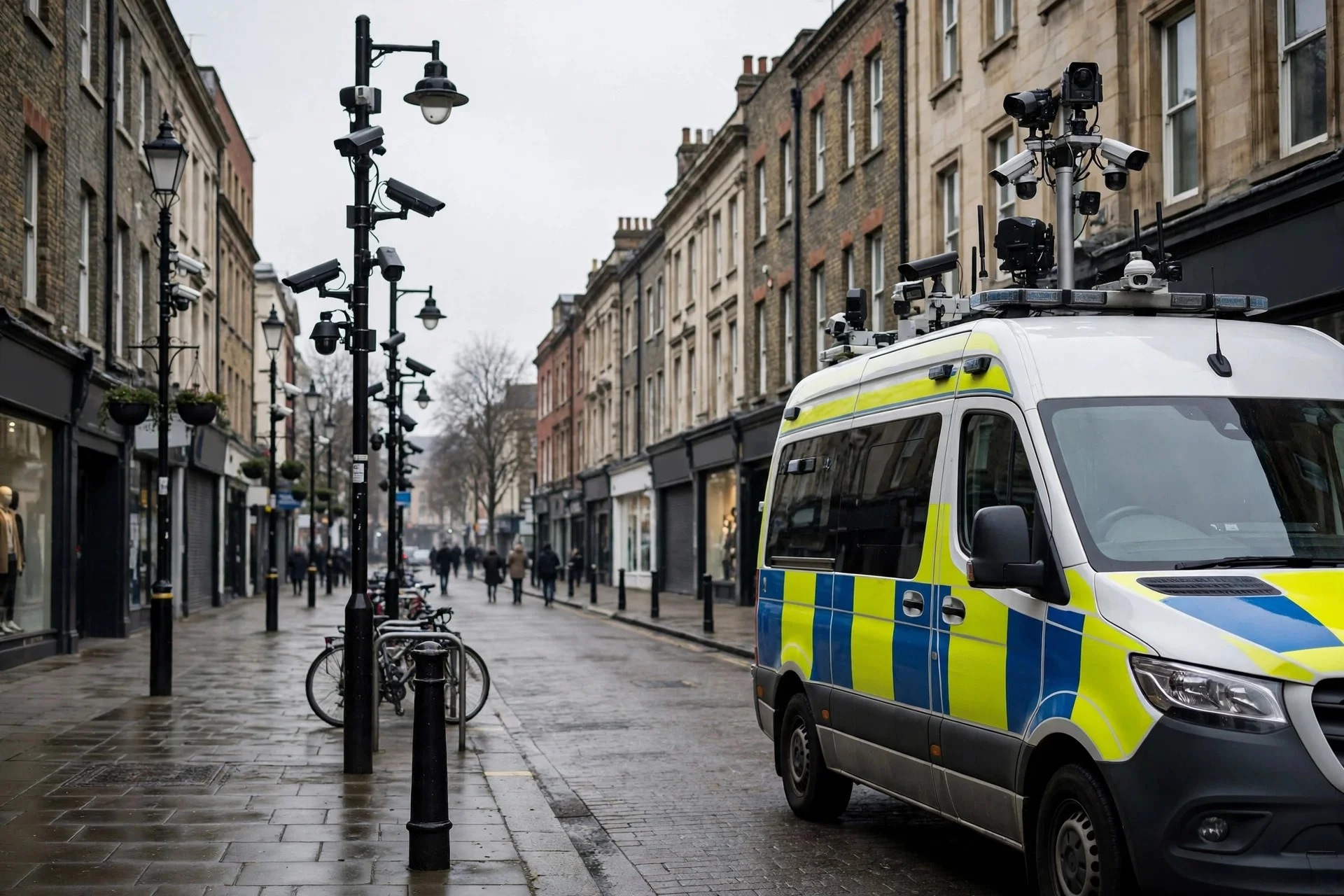
Furgoneta de reconocimiento facial en vivo y cámaras de vigilancia en una calle del Reino Unido. · Imagen generada para EPM
United Kingdom sets hard safeguards for police facial recognition
The UK government announced tough safeguards for police facial recognition, with an independent watchdog, mandatory bias testing and a specific law requiring…
More oversight and more tools for police facial recognition
The UK government will strengthen police facial recognition with an independent watchdog, mandatory bias testing and a specific proportionate-use law.
--- The context ---
Facial recognition helps British police catch thousands of dangerous criminals every year, according to the UK government, but the rules governing it are spread across a vast and fragmented patchwork of requirements. That dispersion now requires, in the government's own assessment, a clear and consistent set of laws able to sustain public confidence in a technology that operates in everyday public space.
A public consultation held beforehand confirmed that underlying tension. There was strong support for the technology and for its effectiveness in catching offenders, but also a clear demand for stronger safeguards on the extent of its use. The announced package is presented as the answer to that demand for both security and restraint.
--- The facts ---
The package creates an independent watchdog to oversee police use of current and future technologies. It will advise on standards, provide scrutiny and make recommendations on emerging technologies and risks. In extreme cases of non-compliance, it may pursue enforcement action that could lead to a court injunction preventing a force from using these technologies.
Any technology used by law enforcement must pass rigorous and independent testing against bias or discrimination on grounds of age, gender or race. A specific law will also make clear that police use of facial recognition must be intelligence led and proportionate, so that it is only used when officers believe wanted people could be present in an area.
A legal code of practice will set the standards and rules that every police force must follow, and a separate legal code will cover the private sector, including shops, so that business use is responsible and complementary to law enforcement. The measures follow an £11 million investment to triple the number of live facial recognition vans in England and Wales, as part of policing reforms described as the biggest in 200 years.
In Croydon, static live facial recognition cameras piloted between October 2025 and March 2026 led to 173 arrests, including suspects wanted for rape, kidnap and sexual assault. Overall crime in the area fell by 10.5% against the previous year and offences linked to violence against women and girls fell by 21%, supporting the mission to halve that violence within a decade. At Notting Hill Carnival, police stopped 86 registered sex offenders and arrested 7 who were in breach of civil orders or notification requirements. A retrospective algorithm independently tested by the Home Office, described as highly accurate and without bias, will be available to forces from next year.
--- The positions ---
The Home Secretary, Shabana Mahmood, argued in attributed remarks that facial recognition has been the biggest breakthrough for catching criminals since DNA matching and has already helped take thousands of dangerous criminals off the streets. She also maintained that its use must be fair, safe and proportionate, and that clear and watertight laws are needed so the public can trust that tools vital to safety are also used responsibly.
Figures linked to police innovation said that, used responsibly, the technology helps officers identify wanted offenders more quickly and focus more time on protecting victims and communities. Former senior police officers stressed that the final decision remains a human one, made by a real officer, while technology sector representatives backed clear and consistent regulation as essential to maintaining public support in the long term.
--- What remains unknown ---
The exact timetable for the specific law, the membership of the new watchdog and the resources it will have to inspect forces have not yet been set out. Nor is it clear how the results of bias testing will be published, or what procedure a person who has been wrongly identified will be able to follow to correct the record.
--- Unanswered questions ---
What threshold of non-compliance will trigger the watchdog to seek a court injunction against a force? How often will independent bias testing be repeated when algorithms are updated or suppliers change? What concrete rights will a wrongly identified person have to challenge that identification and obtain an effective remedy?
--- EPM analysis ---
The significant shift is one of legitimacy rather than capability. Facial recognition is no longer justified by results alone, but is also measured by how it treats the many people who are not wanted by anyone. Mandatory bias testing and a supervisor with real stopping power turn equal treatment into an operational condition, instead of a statement of intent attached to a deployment.
The risk is that oversight always arrives one step behind deployment. The Croydon and Notting Hill results show effectiveness, but they also raise the democratic standard that must accompany every additional van and every additional camera placed in British public space.
📌 EPM Take: In EPM's view, the announced safeguards point in the right direction because they subordinate a powerful tool to verifiable bias testing, to a specific law on proportionality and to a supervisor able to go to court. Their real worth will depend on three conditions that still have to be proven in practice: genuine independence for the watchdog from the government that creates it, public transparency for the result of every test and swift consequences whenever a force fails to comply. Without those three guarantees, the framework risks becoming a formal endorsement for expanding surveillance; with them, it could become the standard other countries must explain why they have not adopted.
--- The context ---
Facial recognition has become one of the most effective tools available to British police, helping to catch thousands of dangerous criminals every year, including sex offenders and rapists who would otherwise remain on the streets. Yet the legal requirements are spread across a vast patchwork, without the clear and consistent laws that officers and citizens need.
A public consultation showed strong support for the technology and its effectiveness against offenders, while also demanding stronger safeguards. The response combines both demands: more capability against the dangerous offender, and tougher, uniform rules for fair, safe and proportionate use.
--- The facts ---
An independent watchdog will be created to oversee police use of current and future technologies, advise on standards, provide scrutiny and recommend action on emerging technologies and risks. Where a force fails to comply in extreme cases, the watchdog can pursue enforcement action that could see it handed a court injunction preventing it from using these technologies, giving supervision real teeth.
It will be made clear that any law enforcement technology must be rigorously and independently tested against bias or discrimination of age, gender or race. A specific law will establish that police facial recognition must be intelligence led and proportionate, used only when officers believe wanted people could be present in an area. The final decision, consulted commanders underline, remains a human one taken by a real officer.
A new legal code of practice, developed in consultation with the regulator, will set standards that all police forces must abide by, and a separate legal code will cover the private sector, including shops, so that business use is responsible and complementary to law enforcement. The measures follow an £11 million investment to triple live facial recognition vans in England and Wales, within the biggest reforms to policing in 200 years.
The measured results support the decision. In Croydon, the static live camera pilot between October 2025 and March 2026 led to 173 arrests, including suspects wanted for rape, kidnap and sexual assault, while overall crime dropped by 10.5% and offences of violence against women and girls fell by 21%, central to the mission to halve that violence within a decade. At Notting Hill Carnival, 86 registered sex offenders were stopped and 7 were arrested for breaching orders or notification requirements. A retrospective algorithm tested by the Home Office, described as highly accurate and without bias, will reach forces from next year.
--- The positions ---
The Home Secretary, Shabana Mahmood, maintained in attributed remarks that facial recognition has been the biggest breakthrough for catching criminals since DNA matching and that its benefits are clear. She added that its use must be fair, safe and proportionate, and that watertight laws are the condition for public confidence in tools that are vital to safety. It is the argument for order under rules: neither an ideological brake on technology nor a blank cheque for its deployment.
Former senior police officers, including voices from counter terrorism policing and the metropolitan force, welcomed the plan and said that, with proper legal safeguards and independent oversight in place, live facial recognition will catch many more criminals and make communities safer. Police innovation figures and technology representatives agreed that adoption works best when matched by consistent standards, transparency and public accountability.
--- What remains unknown ---
The timetable for the specific law and the membership of the watchdog have not yet been published, nor how the private sector code will apply to shops in daily practice. The territorial detail of the van deployment and the dates for the retrospective algorithm are also outstanding.
--- Unanswered questions ---
At what pace will the new vans reach forces across England and Wales, and on what criteria will they be shared between areas? What will happen to deployments already running while the specific law and the new codes of practice come into force? Will the watchdog be able to act at the speed a live deployment demands when it detects a serious breach?
--- EPM analysis ---
The underlying reading is one of authority and results. For years the British debate mixed the defence of liberty with operational paralysis, and the dangerous offender was the main beneficiary of that legal uncertainty. A single framework, with mandatory bias testing and a supervisor able to seek a court injunction, protects the citizen twice over: from the offender who is found sooner, and from any disproportionate use of the technology itself.
The Croydon test is hard to dispute on public safety terms, with overall crime down and a marked fall in violence against women and girls. The challenge from here is execution, not concept.
📌 EPM Take: In EPM's view, the plan is right not to choose between security and safeguards, because it strengthens both at the same time: it triples the means on the street, demands independent testing against every form of bias and subjects each force to a supervisor that can end up before the courts. That combination is what allows facial recognition to be defended without rhetorical reservations and without institutional naivety. What will prove decisive is the speed of execution and the firmness shown in the first sanctioned case of non-compliance, because a law and order rule only deters if it is applied from the first day, without exceptions for anyone, however large the force found in breach may be.
Reino Unido pone límites duros al reconocimiento facial policial
El Gobierno británico anunció salvaguardas duras para el reconocimiento facial policial, con un organismo de control independiente, pruebas obligatorias contra…
Más control y más medios para el reconocimiento facial policial
El Gobierno británico reforzará el reconocimiento facial policial con un organismo de control independiente, pruebas obligatorias contra sesgos y una ley…
--- El contexto ---
El reconocimiento facial ayuda cada año a la policía británica a capturar a miles de delincuentes peligrosos, según sostiene el Gobierno británico, pero su marco legal está repartido en un entramado amplio y fragmentado. Esa dispersión exige, según el propio Ejecutivo, un conjunto claro y coherente de leyes que sostenga la confianza pública en su uso.
Una consulta pública previa confirmó esa tensión. Hubo un apoyo fuerte a la herramienta y a su eficacia para detener a infractores, pero también una demanda de salvaguardas más sólidas sobre el alcance de su empleo. El anuncio responde a ese equilibrio entre seguridad, proporcionalidad y derechos.
--- Los hechos ---
El paquete crea un organismo de control independiente para supervisar el uso policial de las tecnologías actuales y futuras. Asesorará sobre estándares, someterá la práctica a escrutinio y formulará recomendaciones sobre tecnologías emergentes y riesgos. En casos extremos de incumplimiento, podrá emprender acciones de ejecución que desemboquen en una orden judicial que impida a una fuerza seguir usando estas herramientas.
Toda tecnología empleada por las fuerzas del orden deberá someterse a pruebas rigurosas e independientes contra sesgos o discriminación por edad, género o raza. Una ley específica dejará además claro que el uso policial del reconocimiento facial debe estar guiado por inteligencia y ser proporcionado, de modo que solo se emplee cuando los agentes crean que puede haber personas buscadas en una zona concreta.
Habrá un código legal de práctica policial, con estándares que todas las fuerzas deberán cumplir, y un código separado para el sector privado, incluidos los comercios. Las medidas siguen a una inversión de 11 millones de libras para triplicar las furgonetas de reconocimiento facial en vivo en Inglaterra y Gales, dentro de unas reformas policiales descritas como las mayores en 200 años.
En Croydon, cámaras fijas de reconocimiento facial en vivo probadas entre octubre de 2025 y marzo de 2026 permitieron 173 detenciones, incluidas personas buscadas por violación, secuestro y agresión sexual. La delincuencia total en la zona cayó un 10,5% frente al año anterior y los delitos vinculados a la violencia contra mujeres y niñas bajaron un 21%, en línea con la misión de reducir a la mitad esa violencia en una década. En el Carnaval de Notting Hill, la policía interceptó a 86 infractores sexuales registrados y arrestó a 7 por incumplir órdenes civiles o requisitos de notificación. Un algoritmo retrospectivo probado por el Ministerio del Interior, descrito como muy preciso y sin sesgos, estará disponible para las fuerzas el próximo año.
--- Las posiciones ---
La ministra del Interior, Shabana Mahmood, defendió que el reconocimiento facial ha sido el mayor avance para capturar delincuentes desde la coincidencia de ADN y que ya ha ayudado a retirar de las calles a miles de personas peligrosas. También sostuvo que su uso debe ser justo, seguro y proporcionado, y que unas leyes claras y herméticas son la condición para que la ciudadanía confíe en herramientas vitales para la seguridad.
Responsables de innovación policial señalaron que, usado con responsabilidad, el sistema ayuda a identificar antes a los buscados y a proteger mejor a víctimas y comunidades. Antiguos mandos subrayaron que la decisión final sigue siendo humana, a cargo de un agente real, y el sector tecnológico apoyó una regulación clara como condición del apoyo público.
--- Lo que falta saber ---
No se conocen aún el calendario de la ley específica, la composición del nuevo organismo ni sus recursos de inspección. Tampoco se ha detallado cómo se publicarán los resultados de las pruebas contra sesgos ni qué procedimiento seguirá una persona identificada por error para corregir su situación.
--- Preguntas sin respuesta ---
¿Qué umbral de incumplimiento activará que el organismo de control lleve a una fuerza ante los tribunales para frenar su uso de la tecnología? ¿Con qué frecuencia se repetirán las pruebas independientes contra sesgos cuando los algoritmos se actualicen o cambien de proveedor? ¿Qué derechos concretos tendrá una persona identificada por error para impugnar esa identificación y obtener una reparación efectiva?
--- Análisis EPM ---
El giro relevante no es solo tecnológico, sino de legitimidad. El reconocimiento facial deja de justificarse únicamente por sus resultados y pasa a medirse también por cómo trata a quienes nunca han sido buscados por nadie. Las pruebas obligatorias contra sesgos por edad, género o raza y un supervisor con capacidad de freno convierten la igualdad de trato en condición operativa, no en declaración de intenciones.
El riesgo es que el control llegue un paso por detrás del despliegue. Croydon y Notting Hill muestran eficacia, pero también elevan la exigencia democrática que acompaña a cada nueva cámara en el espacio público.
📌 Conclusion EPM: A juicio de EPM, las salvaguardas anunciadas van en la dirección correcta porque subordinan una herramienta poderosa a pruebas de sesgo verificables, a una ley específica de proporcionalidad y a un supervisor capaz de acudir a los tribunales. Su valor real dependerá de tres condiciones que aún deben demostrarse en la práctica: independencia efectiva del organismo frente al Gobierno que lo crea, transparencia pública de los resultados de cada prueba y consecuencias rápidas cuando una fuerza incumpla. Sin esas tres garantías, el marco corre el riesgo de ser un aval formal para expandir la vigilancia; con ellas, puede convertirse en el estándar que otros países deberán explicar por qué no adoptan.
--- El contexto ---
El reconocimiento facial es una de las herramientas más eficaces de la policía británica para capturar cada año a miles de delincuentes peligrosos, entre ellos infractores sexuales y violadores que seguirían en las calles. Sin embargo, las exigencias legales vigentes están repartidas en un entramado fragmentado, sin un conjunto claro de leyes que dé certeza a agentes y ciudadanos.
Una consulta pública previa mostró un apoyo fuerte a la tecnología y a su eficacia contra los infractores, aunque también reclamó salvaguardas más sólidas. La respuesta del Gobierno combina ambas cosas: más medios contra el delincuente y reglas más duras y uniformes para un uso justo, seguro y proporcionado.
--- Los hechos ---
Se creará un organismo de control independiente que supervisará el uso policial de las tecnologías actuales y futuras, asesorará sobre estándares, ejercerá escrutinio y recomendará medidas ante tecnologías emergentes y riesgos. Si una fuerza incumple la regulación en casos extremos, el organismo podrá emprender acciones de ejecución que desemboquen en una orden judicial que le impida seguir usando estas herramientas, una sanción que da dientes reales a la supervisión.
Toda tecnología policial deberá superar pruebas rigurosas e independientes contra sesgos por edad, género o raza. Una ley específica aclarará que el uso debe estar guiado por inteligencia y ser proporcionado, solo cuando los agentes crean que puede haber personas buscadas en una zona. La decisión final, subrayan los mandos, sigue siendo humana.
Se elaborará un código legal de práctica policial con estándares para todas las fuerzas, y un código separado para el sector privado, incluidos los comercios, para un uso responsable y complementario al policial. Las medidas siguen a una inversión de 11 millones de libras para triplicar las furgonetas de reconocimiento facial en vivo en Inglaterra y Gales, dentro de las mayores reformas policiales en 200 años.
Los resultados medidos sostienen la apuesta. En Croydon, el piloto con cámaras fijas en vivo entre octubre de 2025 y marzo de 2026 permitió 173 detenciones, incluidas personas buscadas por violación, secuestro y agresión sexual, con una caída del 10,5% de la delincuencia total y del 21% en los delitos de violencia contra mujeres y niñas, claves en la misión de reducir a la mitad esa violencia en una década. En el Carnaval de Notting Hill se interceptó a 86 infractores sexuales registrados y se arrestó a 7 por incumplir órdenes o notificaciones. Un algoritmo retrospectivo probado por el Ministerio del Interior, descrito como muy preciso y sin sesgos, llegará a las fuerzas el próximo año.
--- Las posiciones ---
La ministra del Interior, Shabana Mahmood, sostuvo que el reconocimiento facial ha sido el mayor avance para capturar delincuentes desde la coincidencia de ADN y que sus beneficios son claros, aunque remarcó que su uso debe ser justo, seguro y proporcionado y que unas leyes herméticas son la condición para que la ciudadanía confíe en herramientas vitales para su seguridad. Es el argumento del orden con reglas: ni freno ideológico a la tecnología ni carta blanca para su despliegue.
Antiguos mandos policiales, entre ellos voces de la lucha antiterrorista y de la policía metropolitana, respaldaron el plan y señalaron que, con salvaguardas y supervisión independiente, el sistema capturará a muchos más delincuentes. Innovación policial y sector tecnológico coincidieron en que la adopción funciona mejor con estándares consistentes, transparencia y rendición de cuentas.
--- Lo que falta saber ---
No se ha publicado aún el calendario de la ley específica ni la composición del organismo, y falta por ver cómo se aplicará el código privado a los comercios. Tampoco se conoce el detalle territorial de las nuevas furgonetas ni cuándo llegará el algoritmo retrospectivo a cada fuerza.
--- Preguntas sin respuesta ---
¿A qué ritmo llegarán las nuevas furgonetas a las fuerzas de Inglaterra y Gales y con qué criterios se repartirán entre territorios? ¿Qué ocurrirá con los despliegues ya activos mientras entran en vigor la ley específica y los nuevos códigos de práctica? ¿Podrá el organismo de control actuar con la rapidez que exige un despliegue en vivo cuando detecte un incumplimiento grave?
--- Análisis EPM ---
La lectura de fondo es de autoridad y resultados. Durante años el debate mezcló la defensa de las libertades con la parálisis operativa, y el delincuente peligroso fue el beneficiado de esa indefinición legal. Un marco único, con pruebas de sesgo obligatorias y un supervisor con freno judicial, protege al ciudadano dos veces: frente al infractor localizado antes y frente al uso desproporcionado.
La prueba de Croydon es difícil de discutir en seguridad pública, con menos delincuencia y una bajada marcada de la violencia contra mujeres y niñas. El reto ahora es de ejecución, no de concepto.
📌 Conclusion EPM: A juicio de EPM, el plan acierta al no elegir entre seguridad y garantías, porque refuerza ambas a la vez: triplica los medios en la calle, exige pruebas independientes contra todo sesgo y somete a cada fuerza a un supervisor que puede acabar ante los tribunales. Esa combinación es la que permite defender el reconocimiento facial sin reservas retóricas y sin ingenuidad institucional. Lo decisivo será la velocidad de ejecución y la firmeza del primer caso de incumplimiento que se sancione, porque una norma de orden solo disuade si se aplica desde el primer día y sin excepciones para nadie, por grande que sea la fuerza implicada en el incumplimiento detectado.