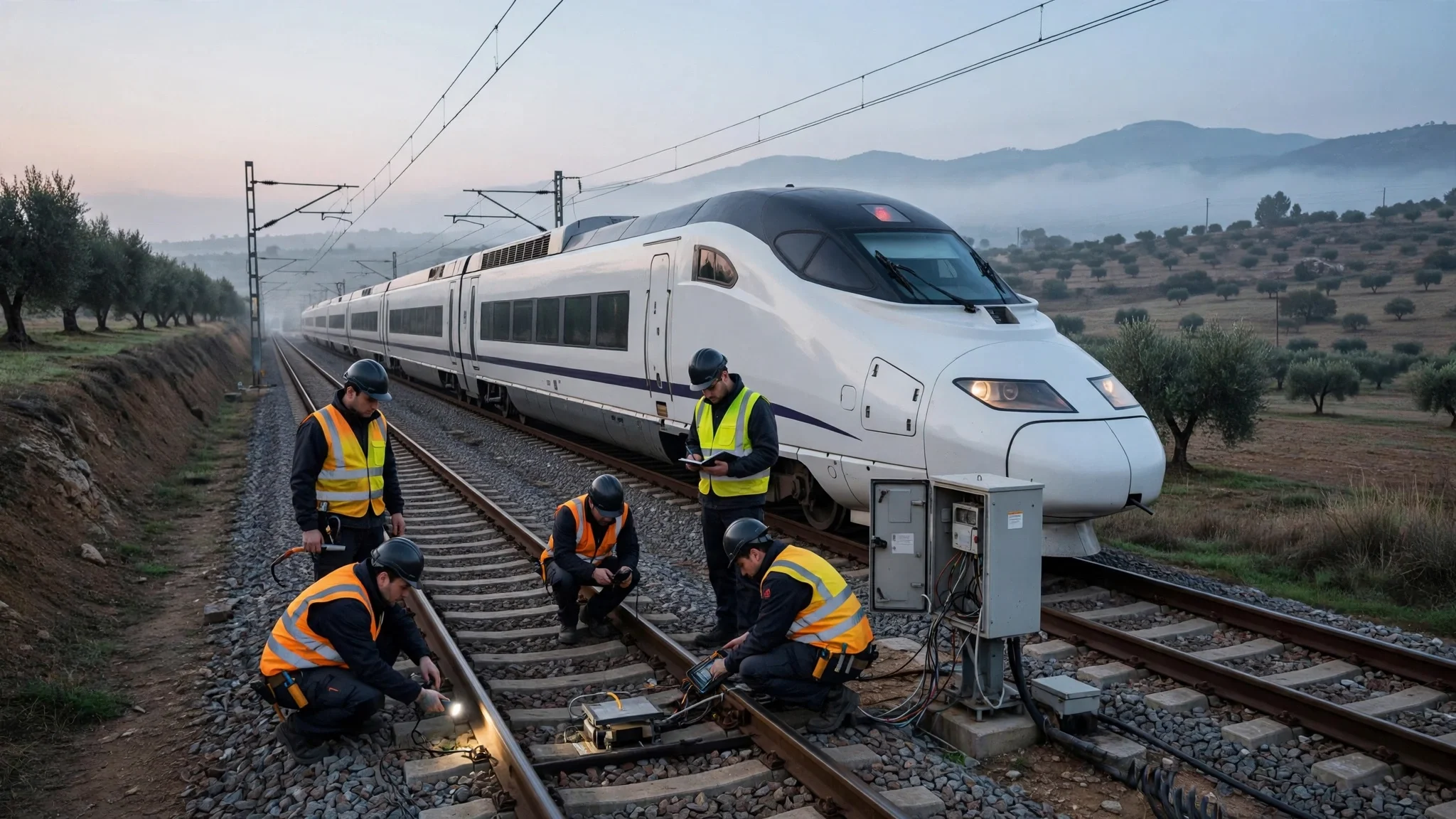
Imagen alusiva generada para EPM sobre la inspección y el mantenimiento ferroviario en España · Imagen generada — EPM
Marina: a human error can stop a train, never cause a tragedy
Alberto Marina, dean of Andalusia's civil engineers, argues that a human error can never cause a railway tragedy, calls for the causes of Adamuz and Urda to be…
Marina calls for audit and upkeep after Adamuz and Urda
Alberto Marina says the cause of Urda is still unknown, that the 170 failures of the LZB system should have raised the alarm, and that lack of maintenance is…
--- The context ---
Alberto Marina is dean of the College of Civil Engineers of Andalusia, and a month ago he denounced the abandonment of major infrastructure in Andalusia and, by extension, across Spain. His sector has for some time been warning about the lack of investment in maintaining roads, dams and, of course, rail connections.
Marina answers, as the interview underlines, from prudence and analysis of the data, clearing away speculation. Even so, he insists on two ideas after the accidents at Adamuz and at Urda, in Toledo: that a human error can never cause an accident of such dimensions, and that it is essential to know what happened at Adamuz in order to guarantee passenger safety.
--- The facts ---
A week and a day has passed since the Urda accident and, according to Marina, the true cause is currently not known. The systems have failed, and that is something that cannot happen, because they are redundant and have protocols, so it is very surprising that this failure occurred. What is needed, he argues, is an investigation as rapid as possible, with the necessary means, to clarify what happened.
Regarding Adamuz, which took place on January 18, after nine months we still do not know what happened. The causes of Urda are not known either, and although they seem to be different causes, it is not known whether there is any relationship. The unease is heightened because the CIA, the Railway Accident Investigation Commission, was not set up until July.
In the interview he was asked whether 69 people had to die for protocol changes to be announced, and Marina replied that this is precisely what is surprising. The fact that the protocols have to be changed denotes, in his view, that there was a flaw in them, something that cannot be allowed in a country at Spain's level.
He also referred to the LZB system, which has failed 170 times this year, a figure he considers not normal and which should have alerted those responsible that additional measures had to be taken. If that system fails, he explains, trains must travel at a speed that cannot be 200 km/h, because at that speed you cannot see a signal or react to it. The recommended speed is 40 km/h, in order to react visually, because a train's stopping times are much longer than those of a vehicle. Why the train was travelling at 200 km/h is, for Marina, indeed the key.
--- The positions ---
Marina argues that human error cannot be decisive, because railway safety systems can never depend on it. There can be a mistake, because it is in people's nature to make mistakes, but there must be something that prevents it from causing an accident with consequences of that gravity. A failure can make the train come to a halt and be a nuisance for users, but never end in a tragedy.
He partly agrees with the former minister, who stated that such an accident is not possible: Marina considers that he is right that it should not be possible, but that it has happened for some reason and that reason must be found out. On the resignation of Óscar Puente, he views it as a political matter and one of responsibilities, without believing it very significant who holds the post, nor that problems built up over years can be solved in a month.
His College proposes an internal and external audit to evaluate these circumstances and offer travellers maximum reassurance. Before reopening the tracks, he argues, they must be analysed well and there must be a maximum guarantee of safety. Technicians have to determine whether the problem can extend to the whole network, although in principle it does not seem to be widespread, and it is the Adif technicians in charge who must analyse its scope.
Marina maintains that the train is the safest means of transport, but it has to be in adequate conditions. It is the means in which the fewest accidents occur, although after these two accidents statistics in Spain have worsened considerably. For a railway to operate safely it has to be well designed, well built and well maintained: design and construction are done well, but maintenance is not up to standard. Asked whether the lack of maintenance is the main problem, he replies that it indeed is, and recalls that his College has called for an investment of 10,000 million euros to bring infrastructure up to date.
--- What remains unknown ---
The true cause of Urda is not known, nor are the causes of Adamuz, nor whether there is a relationship between the two. Nor is it known why the train was travelling at 200 km/h when, with the LZB system failing, the recommended speed is 40 km/h. The data on the new problems reported on Wednesday on the Adamuz section also remain to be fully known: what was measured and why. Marina asks for prudence and suggests that, if there is a problem, it should be analysed within the audit.
--- Unanswered questions ---
Why was the train travelling at 200 km/h if the LZB system had failed and the recommended speed in that case is 40 km/h? What structural flaw allowed the LZB system to fail 170 times this year without additional measures being taken beforehand? Is there any relationship between the still unknown causes of the Adamuz and Urda accidents? When will the Adamuz investigation, nine months after January 18, have conclusions that make it possible to adopt measures?
--- EPM analysis ---
The thread is not an isolated episode, but a chain of warnings: the 170 failures of the LZB system, the sustained demand for investment, and an old line such as Madrid-Seville subjected to upkeep that, according to the dean, may not have been sufficient, because if adequate upkeep is not carried out it ends up deteriorating. Marina separates the technical plane from the political one: decisions on infrastructure, he argues, cannot be political decisions and have to be based on technical criteria and economic sustainability.
That logic also applies to President Juanma Moreno's statement that right now he would not board the Madrid-Seville AVE: before any person boards, Marina argues, the situation must be analysed and the safety conditions determined; if they are safe, the service must operate, and if not, the necessary measures must be adopted.
📌 EPM Take: In EPM's view, the interview leaves a verifiable demand that goes beyond the political debate of the moment: publish as soon as possible the causes of Adamuz and Urda, audit the network with internal and external review, and explain why the 170 failures of the LZB system did not trigger a proportionate response earlier. Without those three pieces, travellers' confidence will continue to rest on statements and not on guarantees, and maintenance will keep arriving after tragedy instead of preceding it, as befits a system presented as the safest.
--- The context ---
Alberto Marina, dean of the College of Civil Engineers of Andalusia, denounced a month ago the abandonment of infrastructure in Andalusia and by extension across Spain. His sector has warned about the lack of investment in maintaining roads, dams and, of course, rail connections.
Marina always answers from prudence and analysis of the data. Even so, in an interview he insists on two ideas that could have prevented the tragedy at Urda, in Toledo: that a human error can never cause an accident of such dimensions, and that it is essential to know what happened at Adamuz to guarantee safety.
--- The facts ---
A week and a day has passed since the Urda accident and, according to Marina, the true cause is not known. The systems have failed, and that is something that cannot happen, because they are redundant and have protocols, so it is very surprising that this failure occurred. Now what is needed, he states, is an investigation as rapid as possible, with the necessary means, to clarify what happened.
Of the Adamuz accident, which happened on January 18, the causes are still not known after nine months, and neither are those of Urda. It seems to Marina that they are different causes, but it is not known whether there is any relationship. The unease also comes from the fact that nine months have passed and the CIA, the Railway Accident Investigation Commission, was not set up until July.
In the interview he was asked whether 69 people had to die for protocol changes to be announced. Marina replied that this is precisely what is surprising, because the fact that the protocols have to be changed denotes that there was a flaw in them, something that cannot be allowed in a country at Spain's level, which he describes as top division.
The other central figure is the LZB system, which has failed 170 times this year. Marina states that it is not normal and that that symptom should have alerted those responsible that additional measures had to be taken, because there seems to be some structural flaw. If the LZB system fails, he explains, trains cannot travel at 200 km/h, because at that speed you cannot see a signal or react to it; the recommended speed is 40 km/h, given that a train's stopping times are much longer than those of a vehicle. Why the train was travelling at 200 km/h is, he confirms, the key.
--- The positions ---
Marina defends the position that human error cannot be decisive and that railway safety systems can never depend on it. There can be a mistake, because it is in people's nature to make mistakes, but there must be something that prevents it from causing an accident with consequences of that gravity. A failure can make the train come to a halt and be a nuisance for users, but never end in a tragedy, he argues.
On what the former minister said, that such an accident is not possible, Marina considers that he is right that it should not be possible, but that it has happened for some reason and that reason must be found out to prevent it happening again. Regarding the resignation of Óscar Puente, he places it as a political matter, without believing it very significant who holds the post, because problems built up over years cannot be solved in a month.
His College proposes an internal and external audit to offer travellers maximum reassurance. Before reopening the tracks, Marina argues, they must be analysed well and there must be a maximum guarantee of safety. Asked whether the problem can extend to the whole network, he replies that technicians have to determine it and that, in principle, it does not seem to be widespread, but that it is the Adif technicians who must determine its scope.
Marina maintains that the train is the safest means of transport, but that it has to be in adequate conditions, well equipped and well maintained. For a railway to operate safely it has to be well designed, well built and well maintained, and, in his judgement, design and construction are done well, but maintenance is not up to standard. Asked whether the lack of maintenance is the main problem of the Spanish railway system, he replies that it indeed is. His College has called for an investment of 10,000 million euros to bring infrastructure up to date.
--- What remains unknown ---
The truth of what happened at Adamuz on January 18 is still not known, nor is the true cause of Urda, nor whether the two accidents have any relationship. Without knowing what happened at Adamuz, it is difficult to determine whether any conclusion could have been applied to prevent Urda. It also remains to clarify why the train was travelling at 200 km/h and what the scope of the problem on the network is. On Wednesday it was learned that the Adamuz section is again presenting problems; Marina asks for prudence and for any problem to be analysed within the audit.
--- Unanswered questions ---
What allowed the LZB system to fail 170 times this year without that symptom activating additional measures in time? Why was the train travelling at 200 km/h when, if the LZB system fails, the speed recommended by Marina is 40 km/h? When will the causes of Adamuz, nine months later, and those of the Urda accident be known? Will the internal and external audit proposed by the College determine whether the problem is widespread across the whole Spanish railway network?
--- EPM analysis ---
The interview orders responsibilities without turning them into a slogan: Marina does not attribute the accident to a person, but to a system that should not have allowed an error to have consequences of that gravity, and he places maintenance as the weak point of a country with world-leading engineering companies. His patrimonial warning is severe: there are major infrastructures that will end up ruined if they are not preserved and, when they are lost, it will be very costly to put them back into operation. In general, he argues, little attention is devoted to maintenance.
He also defends that decisions on infrastructure cannot be political decisions and have to be based on technical criteria and economic sustainability: it is up to the Administration to plan, prioritise and invest, and not buy something that later cannot be maintained. On the Madrid-Seville line, the oldest, he warns that without adequate upkeep it ends up deteriorating and that the renovation plan applied may not have been sufficient.
📌 EPM Take: In EPM's view, the most solid part of Marina's argument is that it returns railway safety to the ground it should never have left: the technical one. Neither a minister's resignation nor a protocol announcement replaces a complete audit, a rapid and rigorous investigation of Adamuz and Urda, and sustained investment in upkeep such as the 10,000 million euros his College calls for. If things are done well, the dean argues, another accident will not occur; that sentence will only be worth something when the data back it up.
Marina: un fallo humano puede detener un tren, nunca causar una tragedia
Alberto Marina, decano de los ingenieros de caminos de Andalucía, sostiene que un fallo humano nunca puede causar una tragedia ferroviaria, reclama saber las…
Marina exige auditoría y mantenimiento tras Adamuz y Urda
Alberto Marina afirma que la causa de Urda aún no se conoce, que los 170 fallos del sistema LZB debieron alertar y que la falta de mantenimiento es el…
--- El contexto ---
Alberto Marina es decano del Colegio de Ingenieros de Caminos, Canales y Puertos de Andalucía y hace un mes denunció el abandono de las grandes infraestructuras en Andalucía y, por extensión, en toda España. Su colectivo lleva tiempo advirtiendo de la falta de inversión en el mantenimiento de carreteras, presas y, por supuesto, de las conexiones ferroviarias.
Marina responde, según se subraya en la conversación, desde la prudencia y el análisis del dato, despejando especulaciones. Aun así, insiste en dos ideas tras los accidentes de Adamuz y de Urda, en Toledo: que un fallo humano nunca puede provocar un accidente de tales dimensiones y que es clave saber qué ocurrió en Adamuz para garantizar la seguridad de los pasajeros.
--- Los hechos ---
Del accidente de Urda ha pasado una semana y un día y, según Marina, actualmente no se conoce cuál es la causa verdadera. Han fallado los sistemas, algo que no puede pasar, porque son redundantes y tienen unos protocolos, por lo que resulta muy sorprendente que se haya producido este fallo. Se necesita, sostiene, una investigación lo más rápida posible, con los medios necesarios, para esclarecer lo ocurrido.
De Adamuz, ocurrido el 18 de enero, después de nueve meses seguimos sin saber qué ha ocurrido. Tampoco se conocen las causas de Urda, y aunque parece que son causas diferentes, no se sabe si existe alguna relación. El malestar se agrava porque hasta el mes de julio no se constituyó la CIA, la Comisión de Investigación de Accidentes Ferroviarios.
En la entrevista se le preguntó si han tenido que morir 69 personas para que se anuncien cambios de protocolos, y Marina respondió que eso es precisamente lo que sorprende. El hecho de tener que cambiar los protocolos denota, a su juicio, que existía un fallo en ellos, algo que no se puede permitir en un país del nivel de España.
También se refirió al sistema LZB, que se ha caído 170 veces este año, un dato que considera que no es normal y que debería haber alertado de que había que tomar medidas adicionales. Si falla ese sistema, explica, hay que circular a una velocidad que no puede ser de 200 km/h, porque a esa velocidad no se puede ver una señal ni reaccionar ante ella. La velocidad recomendada es de 40 km/h, para poder reaccionar visualmente, porque los tiempos de parada de un tren son mucho más largos que los de un vehículo. Por qué se circulaba a 200 km/h es, para Marina, efectivamente la clave.
--- Las posiciones ---
Marina sostiene que el fallo humano no puede ser determinante, porque los sistemas de seguridad ferroviaria nunca pueden depender de ello. Puede haber un error, porque está en la naturaleza de las personas equivocarse, pero tiene que existir algo que evite que provoque un accidente con consecuencias de esa gravedad. Un fallo puede hacer que el tren se quede detenido y sea una molestia para los usuarios, pero nunca que acabe en una tragedia.
Coincide en parte con el exministro, quien afirmó que un accidente así no es posible: Marina considera que tiene razón en que no debería ser posible, pero que ha ocurrido por algún motivo y hay que averiguar cuál es. Sobre la dimisión de Óscar Puente, la valora como una cuestión política y de responsabilidades, sin que crea muy significativo quién ocupe el cargo ni que en un mes puedan solucionarse problemas de años.
Desde su Colegio se propone una auditoría interna y externa para evaluar las circunstancias y ofrecer la máxima tranquilidad a los viajeros. Antes de abrir las vías, defiende, hay que analizarlas bien y que exista una garantía máxima de seguridad. Los técnicos tienen que determinar si el problema puede extenderse a toda la red, aunque en principio no parece que esté extendido, y son los técnicos responsables de Adif quienes deben analizar su alcance.
Marina mantiene que el tren es el medio de transporte más seguro, pero tiene que estar en condiciones adecuadas. Es el medio en el que se producen menos accidentes, aunque tras estos dos accidentes las estadísticas en España hayan empeorado sensiblemente. Para que un ferrocarril funcione con seguridad tiene que estar bien diseñado, bien construido y bien mantenido: el diseño y la construcción se hacen bien, pero el mantenimiento no está a la altura. Preguntado por si la falta de mantenimiento es el principal problema, responde que efectivamente lo es, y recuerda que su Colegio ha reclamado una inversión de 10.000 millones de euros para poner al día las infraestructuras.
--- Lo que falta saber ---
No se conoce la causa verdadera de Urda ni las causas de Adamuz, ni si existe relación entre ambos. Tampoco se sabe por qué se circulaba a 200 km/h cuando, con el sistema LZB fallando, la velocidad recomendada es de 40 km/h. También falta conocer bien los datos sobre los nuevos problemas conocidos el miércoles en el tramo de Adamuz: qué se ha medido y por qué. Marina pide prudencia y plantea que, si existe un problema, deberá analizarse dentro de la auditoría.
--- Preguntas sin respuesta ---
¿Por qué circulaba el tren a 200 km/h si el sistema LZB había fallado y la velocidad recomendada en ese caso es de 40 km/h? ¿Qué fallo estructural permitió que el sistema LZB se cayera 170 veces este año sin que se tomaran medidas adicionales antes? ¿Existe alguna relación entre las causas, todavía desconocidas, de los accidentes de Adamuz y de Urda? ¿Cuándo contará la investigación de Adamuz, nueve meses después del 18 de enero, con conclusiones que permitan adoptar medidas?
--- Análisis EPM ---
El hilo no es un episodio aislado, sino una cadena de avisos: los 170 fallos del sistema LZB, la reclamación sostenida de inversión y una línea antigua como la Madrid-Sevilla sometida a una conservación que, según el decano, quizá no ha sido suficiente, porque si no se realiza una conservación adecuada acaba deteriorándose. Marina separa el plano técnico del político: las decisiones sobre infraestructuras, sostiene, no pueden ser decisiones políticas y tienen que basarse en criterios técnicos y de sostenibilidad económica.
Esa lógica aplica también a la afirmación del presidente Juanma Moreno de que ahora mismo no se subiría al AVE Madrid-Sevilla: antes de que se suba cualquier persona, sostiene Marina, debe analizarse la situación y determinarse las condiciones de seguridad; si son seguras, hay que poner el servicio en marcha, y si no, adoptar las medidas necesarias.
📌 Conclusion EPM: A juicio de EPM, la entrevista deja una exigencia verificable que va más allá del debate político del momento: publicar cuanto antes las causas de Adamuz y de Urda, auditar la red con revisión interna y externa, y explicar por qué los 170 fallos del sistema LZB no activaron antes una respuesta proporcional. Sin esas tres piezas, la confianza de los viajeros seguirá apoyada en afirmaciones y no en garantías, y el mantenimiento continuará llegando después de la tragedia en lugar de precederla como corresponde a un sistema que se presenta como el más seguro.
--- El contexto ---
Alberto Marina, decano del Colegio de Ingenieros de Caminos, Canales y Puertos de Andalucía, denunció hace un mes el abandono de grandes infraestructuras en Andalucía y por extensión en toda España. Su sector ha elevado la voz advirtiendo de la falta de inversión en mantenimiento de carreteras, presas y, por supuesto, de las conexiones ferroviarias.
Marina responde siempre desde la prudencia y el análisis del dato. Aun así, en una entrevista insiste en dos ideas que podrían haber evitado la tragedia en Urda, en Toledo: que un fallo humano nunca puede provocar un accidente de tales dimensiones y que es clave saber qué ocurrió en Adamuz para garantizar la seguridad.
--- Los hechos ---
Ha pasado una semana y un día desde el accidente de Urda y, según Marina, no se conoce la causa verdadera. Han fallado los sistemas y eso es algo que no puede pasar, porque son redundantes y tienen unos protocolos, por lo que resulta muy sorprendente que se haya producido este fallo. Ahora lo que se necesita, afirma, es una investigación lo más rápida posible, con los medios necesarios, para esclarecer lo ocurrido.
Del accidente de Adamuz, sucedido el 18 de enero, todavía no se conocen las causas después de nueve meses, y tampoco las de Urda. A Marina le parece que son causas diferentes, pero no se sabe si existe alguna relación. El malestar viene también de que han pasado nueve meses y hasta el mes de julio no se constituyó la CIA, la Comisión de Investigación de Accidentes Ferroviarios.
En la entrevista se le planteó si han tenido que morir 69 personas para que se anuncien cambios de protocolos. Marina respondió que eso es precisamente lo que sorprende, porque el hecho de tener que cambiar los protocolos denota que existía un fallo en ellos, algo que no se puede permitir en un país del nivel de España, que describe como de primera división.
El otro dato central es el sistema LZB, que se ha caído 170 veces este año. Marina afirma que no es normal y que ese síntoma debería haber alertado de que había que tomar medidas adicionales, porque parece existir algún fallo estructural. Si falla el sistema LZB, explica, no se puede circular a 200 km/h, porque a esa velocidad no se puede ver una señal ni reaccionar ante ella; la velocidad recomendada es de 40 km/h, dado que los tiempos de parada de un tren son mucho más largos que los de un vehículo. Por qué se circulaba a 200 km/h es, confirma, la clave.
--- Las posiciones ---
Marina defiende que el fallo humano no puede ser determinante y que los sistemas de seguridad ferroviaria nunca pueden depender de ello. Puede haber error, porque está en la naturaleza de las personas equivocarse, pero tiene que existir algo que evite que provoque un accidente con consecuencias de esa gravedad. Un fallo puede hacer que el tren se quede detenido y sea una molestia para los usuarios, pero nunca que acabe en una tragedia, sostiene.
Sobre lo dicho por el exministro de que un accidente así no es posible, Marina considera que tiene razón en que no debería ser posible, pero que ha ocurrido por algún motivo y hay que averiguarlo para evitar que vuelva a producirse. Respecto a la dimisión de Óscar Puente, la sitúa como una cuestión política, sin que crea muy significativo quién ocupe el cargo, porque no se pueden solucionar en un mes problemas de años.
Desde el Colegio se propone una auditoría interna y externa para ofrecer la máxima tranquilidad a los viajeros. Antes de abrir las vías, sostiene, hay que analizarlas bien y que exista una garantía máxima de seguridad. Preguntado por si el problema puede extenderse a toda la red, responde que los técnicos tienen que determinarlo y que, en principio, no parece que esté extendido, pero que son los técnicos de Adif quienes deben determinar su alcance.
Marina mantiene que el tren es el medio de transporte más seguro, pero que tiene que estar en condiciones adecuadas, bien dotado y bien mantenido. Para que un ferrocarril funcione con seguridad tiene que estar bien diseñado, bien construido y bien mantenido, y, a su juicio, el diseño y la construcción se hacen bien, pero el mantenimiento no está a la altura. Preguntado por si la falta de mantenimiento es el principal problema del sistema ferroviario español, responde que efectivamente lo es. Desde su Colegio han reclamado una inversión de 10.000 millones de euros para poner al día las infraestructuras.
--- Lo que falta saber ---
Sigue sin saberse la verdad de lo que sucedió en Adamuz el 18 de enero ni la causa verdadera de Urda, ni si ambos accidentes tienen alguna relación. Sin saber qué ocurrió en Adamuz, es difícil determinar si alguna conclusión podría haberse aplicado para evitar Urda. También falta esclarecer por qué se circulaba a 200 km/h y qué alcance tiene el problema en la red. El miércoles se conoció que el tramo de Adamuz vuelve a presentar problemas; Marina pide prudencia y que, si existe un problema, se analice dentro de la auditoría.
--- Preguntas sin respuesta ---
¿Qué permitió que el sistema LZB se cayera 170 veces este año sin que ese síntoma activara medidas adicionales a tiempo? ¿Por qué se circulaba a 200 km/h cuando, si falla el sistema LZB, la velocidad recomendada por Marina es de 40 km/h? ¿Cuándo se conocerán las causas de Adamuz, nueve meses después, y las del accidente de Urda? ¿Determinará la auditoría interna y externa propuesta por el Colegio si el problema está extendido a toda la red ferroviaria española?
--- Análisis EPM ---
La entrevista ordena responsabilidades sin convertirlas en consigna: Marina no atribuye el accidente a una persona, sino a un sistema que no debió permitir que un error tuviera consecuencias de esa gravedad, y sitúa el mantenimiento como el punto débil de un país con empresas de ingeniería de primer nivel mundial. Su advertencia patrimonial es severa: hay grandes infraestructuras que acabarán arruinándose si no se conservan y, cuando se pierdan, será muy costoso volver a ponerlas en funcionamiento. En general, sostiene, se le dedica poca atención al mantenimiento.
También defiende que las decisiones sobre infraestructuras no pueden ser políticas y tienen que basarse en criterios técnicos y de sostenibilidad económica: corresponde a la Administración planificar, priorizar e invertir, y no comprar algo que después no se va a poder mantener. Sobre la línea Madrid-Sevilla, la más antigua, advierte de que sin una conservación adecuada acaba deteriorándose y de que el plan de renovación aplicado quizá no ha sido suficiente.
📌 Conclusion EPM: A juicio de EPM, lo más sólido de Marina es que devuelve la seguridad ferroviaria al terreno que nunca debió abandonar: el técnico. Ni la dimisión de un ministro ni un anuncio de protocolos sustituyen una auditoría completa, una investigación rápida y rigurosa de Adamuz y de Urda y una inversión sostenida en conservación como la de 10.000 millones de euros que reclama su Colegio. Si se hacen las cosas bien, sostiene el decano, no se producirá otro accidente; esa frase solo valdrá cuando los datos la respalden.