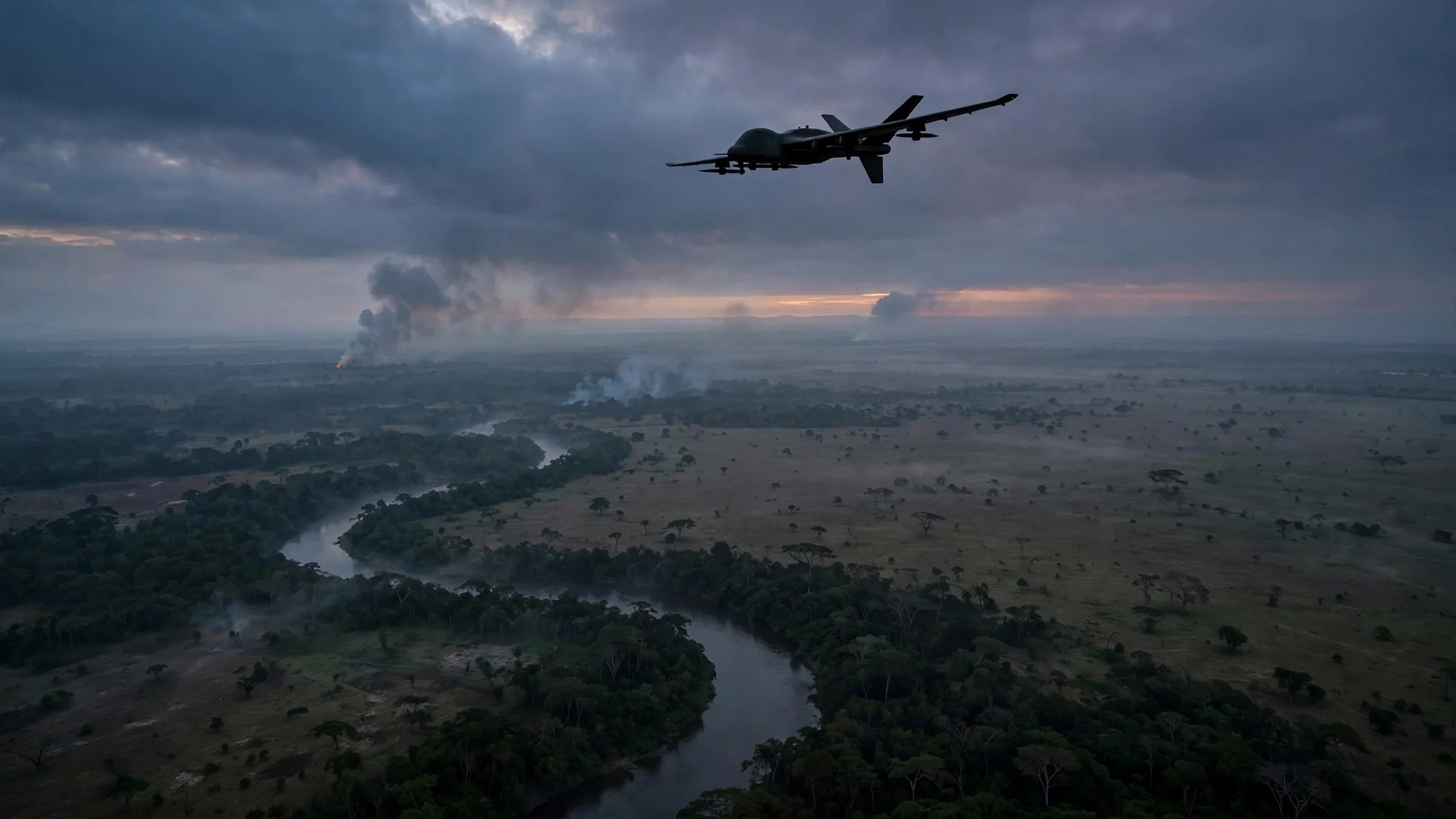
Imagen alusiva generada por EPM: un dron sobre la frontera colombo-venezolana al amanecer. · EPM (imagen generada)
FundaRedes Attributes Apure ELN Camp Strike Solely to the United States
FundaRedes said the bombing of an ELN camp in Apure was carried out solely by the United States with unmanned aircraft, without Venezuelan participation…
Drone Strike on ELN Camp in Apure Killed 23, FundaRedes Reports
According to FundaRedes, United States unmanned aircraft bombed an ELN camp in Apure without Venezuelan participation, leaving 23 dead.
--- The context ---
The state of Apure, along the border between Venezuela and Colombia, has hosted a sustained ELN presence for years, according to documentation compiled by FundaRedes. The organization describes that vast, sparsely populated strip as a rear guard area for the armed group and a corridor for drug trafficking activities. For the communities who live there, that presence has meant years of armed dynamics with very little verifiable official explanation.
--- The facts ---
According to FundaRedes, a bombing struck an ELN camp in Apure during the early hours of Friday. Its regional coordinator, Juan Francisco García, maintained that the operation was carried out solely by the United States, using unmanned aircraft, with no participation by Venezuelan military forces. The organization said it had accessed visual records of the targeted area and reported a toll of 23 people killed at the site of the attack, a figure that has not been independently confirmed.
García added that Venezuelan troops arrived hours after the strike only to inspect the area and collect remains, and that a rapid response unit moved into the sector afterward. Among the dead, the coordinator identified Luis Alexander Solorzano Camacho, whom he described as a logistics operator, and said he had spoken with his relatives. Based on information from families and residents, the organization said the attack coincided with a senior ELN commander present.
--- The positions ---
FundaRedes questioned the absence of any public statement from minister Diosdado Cabello, from the military high command or from regional authorities about what happened. The organization also repeated its denunciation of a historical relationship between Venezuelan forces and the ELN, holding that soldiers had provided military vehicles and armed boats to that group. For the organization, that alleged coexistence deepens the vulnerability of border communities.
--- What remains unknown ---
So far there is no independent confirmation from Venezuelan or United States authorities about who carried out the attack or its exact circumstances. It also remains unconfirmed which ELN commanders were actually at the camp. FundaRedes mentioned speculation about the possible presence of alias Garganta, commander M.EL and alias Silvana Guerrero, but clarified that this information is not a definitive confirmation and should be treated with caution by every reader.
--- Unanswered questions ---
Who actually carried out this operation, and under what authorization was Venezuelan territory struck? Were the ELN commanders mentioned in preliminary accounts really present at the camp that night? Why have Venezuelan authorities still offered no public explanation about the 23 reported deaths? What protection will families and communities in Apure receive after an action of this scale carried out without any official information?
--- EPM analysis ---
The central claim by FundaRedes joins two planes that deserve separate scrutiny. On one side, it describes a foreign military action without Venezuelan participation, which would demand an urgent clarification from both governments. On the other, it portrays a territory with more than 60 drug trafficking airstrips and cocaine base hydrochloride laboratories, per its records. If those records are accurate, the debate goes far beyond a single isolated bombing.
📌 EPM Take: In EPM's view, the most serious aspect of this case is not only the scale of the reported bombing, but the information vacuum surrounding it for the communities who live along that border. An operation with 23 reported deaths demands public explanations, independent verification and effective protection for the civilian population of Apure. As long as no authority confirms or refutes the account presented by FundaRedes with evidence, accountability will remain absent and the border will keep paying for distant decisions.
--- The context ---
Apure is, according to records kept by FundaRedes, one of the ELN strategic corridors along the Colombian Venezuelan border. The organization describes that territory as a rear guard zone for the armed group and a route for drug trafficking, with more than 60 clandestine airstrips and laboratories for cocaine base hydrochloride identified in the area. That control forms the backdrop to the bombing reported this week against one of its camps.
--- The facts ---
According to FundaRedes, the attack took place during the early hours of Friday against an ELN camp in Apure and was carried out exclusively by the United States using unmanned aircraft. Its regional coordinator, Juan Francisco García, reported 23 dead and said the organization had accessed visual records of the site. Under his account, no Venezuelan military force took part in executing the operation against the guerrilla structure installed on Venezuelan soil.
García said Venezuelan personnel arrived hours later, only to inspect the site and collect remains, and that a rapid response unit was deployed afterward. Among the dead he identified Luis Alexander Solorzano Camacho, described as a logistics operator, after speaking with his relatives. The organization also held that the bombing coincided with the presence of a senior ELN commander who had previously recruited 16 young people from San Fernando and taken them to the area.
--- The positions ---
The organization noted that neither minister Diosdado Cabello nor the military high command nor regional authorities had made any public statement about the events. FundaRedes went further and denounced a historical relationship between Venezuelan forces and the ELN, stating that members of the Armed Forces had in past years provided military vehicles and armed boats to guerrilla fighters. If proven, it would point to state tolerance toward a foreign armed group.
--- What remains unknown ---
No Venezuelan or United States authority has independently confirmed who carried out the bombing or its exact circumstances. The identity of the commanders present also remains unconfirmed. The organization relayed speculation about alias Garganta, commander M.EL and alias Silvana Guerrero, while acknowledging it is not a definitive confirmation. Without verification, any conclusion about the blow to the ELN leadership would be premature.
--- Unanswered questions ---
Will Caracas allow it to be clarified who bombed a guerrilla camp on its own territory? How can a foreign armed group operate with airstrips and laboratories in Apure for years without a firm response? Were the ELN commanders named in preliminary accounts actually hit in the strike? What concrete measures will be taken to restore sovereign control over a border where a foreign guerrilla force currently holds sway?
--- EPM analysis ---
The episode exposes a fundamental contradiction for the Venezuelan state. If the FundaRedes account is correct, the elimination of an ELN structure was not the work of national forces but of a foreign power, while the guerrilla presence in Apure consolidated itself with airstrips, laboratories and the recruitment of young people. The 16 young people from San Fernando taken to the camp illustrate the human cost of that loss of territorial authority.
📌 EPM Take: In EPM's view, a state that does not control its border ends up surrendering its sovereignty twice, first to the guerrilla force occupying the territory and then to whoever decides to act from outside. Venezuela needs to recover Apure with its own authority, shut down the drug trafficking airstrips and laboratories, and protect its young people from recruitment. The reported bombing may have struck the ELN, but without a firm and permanent policy of territorial control, that strike will remain only one more episode.
FundaRedes atribuye a EE. UU. bombardeo contra campamento del ELN en Apure
FundaRedes aseguró que el bombardeo contra un campamento del ELN en Apure fue ejecutado solo por Estados Unidos con aeronaves no tripuladas, sin participación…
Ataque con drones en Apure dejó 23 muertos, según FundaRedes
Según FundaRedes, aeronaves no tripuladas de Estados Unidos bombardearon sin participación venezolana un campamento del ELN en Apure y dejaron 23 muertos.
--- El contexto ---
El estado Apure, en la frontera entre Venezuela y Colombia, concentra desde hace años una presencia sostenida del ELN, según ha documentado FundaRedes. De acuerdo con la organización, esa franja extensa y de baja densidad poblacional funciona como retaguardia del grupo armado y como corredor para actividades vinculadas al narcotráfico, en un territorio donde la población civil rara vez recibe una explicación oficial completa y verificable.
--- Los hechos ---
Según FundaRedes, durante la madrugada del viernes se produjo un bombardeo contra un campamento del ELN en Apure. Su coordinador zonal, Juan Francisco García, sostuvo que la operación fue ejecutada únicamente por Estados Unidos, con aeronaves no tripuladas, y sin participación de fuerzas militares venezolanas. La organización aseguró haber accedido a registros visuales de la zona atacada y reportó un saldo de 23 personas muertas en el lugar del impacto.
García indicó además que las tropas venezolanas llegaron horas después del ataque para inspeccionar el área y recoger los restos, y que una unidad de respuesta rápida se desplazó posteriormente al sector. Entre los muertos, el coordinador identificó a Luis Alexander Solorzano Camacho, a quien describió como operador logístico, y afirmó haber conversado con sus familiares. Según la información recopilada por la organización, el ataque habría coincidido con la presencia de un mando importante del ELN.
--- Las posiciones ---
FundaRedes cuestionó la ausencia de un pronunciamiento público del ministro Diosdado Cabello, de la cúpula militar y de las autoridades regionales sobre lo ocurrido. La organización también reiteró su denuncia de una relación histórica entre fuerzas venezolanas y el ELN, y sostuvo que militares habrían facilitado vehículos y lanchas artilladas a ese grupo. Para la ONG, esa convivencia agrava la vulnerabilidad fronteriza.
--- Lo que falta saber ---
Hasta ahora no existe una confirmación independiente de las autoridades venezolanas ni de Estados Unidos sobre la autoría y las circunstancias exactas del ataque. Tampoco está confirmado qué mandos del ELN se encontraban realmente en el campamento. FundaRedes mencionó especulaciones sobre la posible presencia de alias Garganta, el comandante M.EL y alias Silvana Guerrero, pero aclaró que esa información no constituye una confirmación definitiva y debe tratarse con cautela.
--- Preguntas sin respuesta ---
¿Quién ejecutó realmente la operación y con qué autorización se actuó sobre territorio venezolano? ¿Estaban en el campamento los mandos del ELN que se mencionan en las versiones preliminares? ¿Por qué las autoridades venezolanas no han ofrecido todavía una explicación pública sobre los 23 muertos reportados? ¿Qué protección tendrán las familias y las comunidades de Apure tras una acción de esta magnitud ejecutada sin información oficial?
--- Análisis EPM ---
El señalamiento central de FundaRedes combina dos planos que deben examinarse por separado. Por un lado, plantea una acción militar extranjera sin participación venezolana, lo que exigiría una aclaración urgente de ambos gobiernos. Por otro, describe un territorio con más de 60 pistas de narcotráfico y laboratorios de clorhidrato base de cocaína, según sus registros. Si esos registros son correctos, la discusión no se agota en un bombardeo aislado, sino en años de presencia armada tolerada.
📌 Conclusion EPM: A juicio de EPM, lo más grave de este caso no es solo la magnitud del bombardeo reportado, sino el vacío de información que lo rodea para las comunidades que viven junto a esa frontera. Una operación con 23 muertos exige explicaciones públicas, verificación independiente y protección efectiva para la población civil de Apure. Mientras ninguna autoridad confirme o desmienta con pruebas la versión de FundaRedes, la rendición de cuentas seguirá ausente y la frontera continuará pagando el costo de decisiones tomadas lejos de sus habitantes.
--- El contexto ---
Apure es, según los registros de FundaRedes, uno de los corredores estratégicos del ELN en la frontera colombo venezolana. La organización describe ese territorio como retaguardia del grupo armado y vía para el narcotráfico, con más de 60 pistas clandestinas y laboratorios de clorhidrato base de cocaína identificados en la zona. Ese control territorial, sostenido durante años, es el telón de fondo del bombardeo reportado esta semana contra uno de sus campamentos.
--- Los hechos ---
De acuerdo con FundaRedes, el ataque ocurrió durante la madrugada del viernes contra un campamento del ELN en Apure y fue ejecutado exclusivamente por Estados Unidos mediante aeronaves no tripuladas. Su coordinador zonal, Juan Francisco García, reportó 23 muertos y aseguró que la organización accedió a registros visuales del lugar. Según su versión, ninguna fuerza militar venezolana participó en la ejecución de la operación contra la estructura guerrillera instalada en suelo venezolano.
García señaló que efectivos venezolanos arribaron horas después, únicamente para inspeccionar el sitio y recoger los restos, y que luego se desplazó una unidad de respuesta rápida. Entre los fallecidos identificó a Luis Alexander Solorzano Camacho, descrito como operador logístico, tras conversar con sus familiares. La ONG sostuvo además que el bombardeo coincidió con la presencia de un mando importante del ELN que previamente habría reclutado a 16 jóvenes de San Fernando y los habría trasladado a la zona.
--- Las posiciones ---
La organización reclamó que ni el ministro Diosdado Cabello ni la cúpula militar ni las autoridades regionales se habían pronunciado públicamente sobre el hecho. FundaRedes fue más allá y denunció una relación histórica entre fuerzas venezolanas y el ELN, al afirmar que integrantes de la Fuerza Armada habrían facilitado vehículos militares y lanchas artilladas a guerrilleros en años pasados. Esa denuncia, de comprobarse, apuntaría a una tolerancia estatal frente a un grupo armado extranjero.
--- Lo que falta saber ---
Ninguna autoridad venezolana ni estadounidense ha confirmado de forma independiente la autoría ni las circunstancias exactas del bombardeo. También permanece sin confirmar la identidad de los mandos presentes. La ONG recogió especulaciones sobre alias Garganta, el comandante M.EL y alias Silvana Guerrero, pero reconoció que no se trata de una confirmación definitiva. Sin esa verificación, cualquier conclusión sobre el golpe real a la cúpula del ELN sería prematura.
--- Preguntas sin respuesta ---
¿Permitirá Caracas que se esclarezca quién bombardeó un campamento guerrillero en su propio territorio? ¿Cómo se explica que un grupo armado extranjero opere con pistas y laboratorios en Apure desde hace años? ¿Fueron alcanzados los mandos del ELN señalados en las versiones preliminares? ¿Qué medidas concretas se tomarán para recuperar el control soberano de una frontera donde hoy manda una guerrilla foránea?
--- Análisis EPM ---
El episodio expone una contradicción de fondo para el Estado venezolano. Si la versión de FundaRedes es correcta, la eliminación de una estructura del ELN no fue obra de las fuerzas nacionales, sino de una potencia extranjera, mientras la presencia guerrillera en Apure se consolidaba con pistas, laboratorios y reclutamiento de jóvenes. Los 16 jóvenes de San Fernando que, según la ONG, fueron llevados al campamento ilustran el costo humano de esa pérdida prolongada de autoridad territorial.
📌 Conclusion EPM: A juicio de EPM, un Estado que no controla su frontera termina cediendo su soberanía dos veces, primero ante la guerrilla que ocupa el territorio y después ante quien decide actuar desde fuera. Venezuela necesita recuperar Apure con autoridad propia, cerrar las pistas y los laboratorios del narcotráfico y proteger a sus jóvenes del reclutamiento. El bombardeo reportado puede haber golpeado al ELN, pero sin una política firme y permanente de control territorial, ese golpe será solo un episodio más.