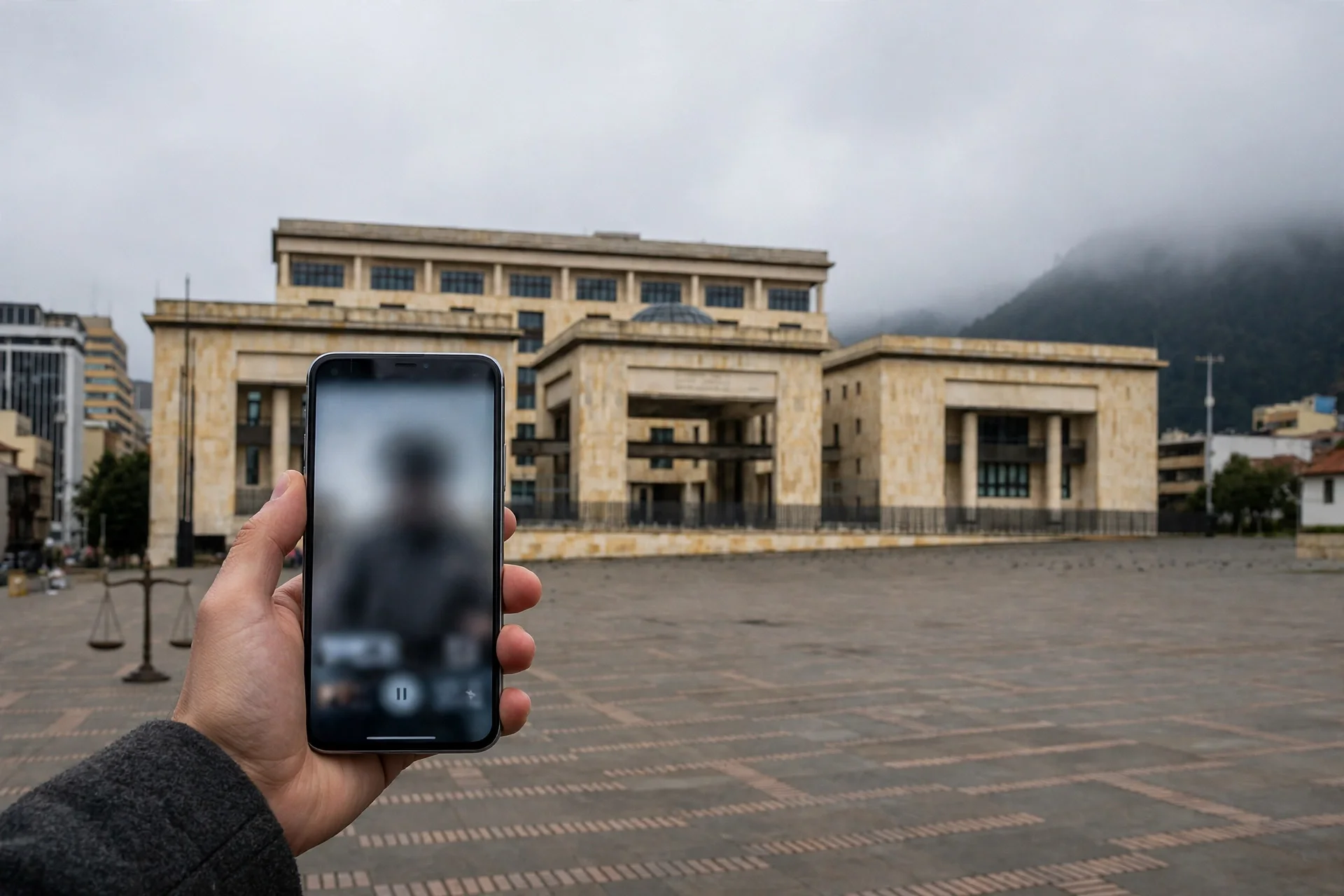
Ilustración alusiva a la controversia por el video divulgado y la respuesta judicial anunciada · Imagen generada para EPM
Petro denies contract claims and asks court to assess video
Former president Gustavo Petro denied using state contracts to obtain favors after Deicy Jiménez released a video she presented as proof of an alleged…
Petro rejects allegations and says he will answer in court
Gustavo Petro rejected the allegations attributed to Deicy Jiménez about alleged favors in exchange for contracts after the release of a video she presented as…
--- The context ---
Former president Gustavo Petro spoke out after Deicy Jiménez published a video that she presented as proof of an alleged intimate relationship that, according to her version, she had maintained with the former president. The publication came amid allegations made by Jiménez about an alleged network of women who, according to her version, had received public contracts in exchange for favors. Those allegations, always attributed to her version, have not been proven in judicial proceedings and form the background to a controversy that must now be handled by the competent authorities with guarantees for all parties involved in the process.
--- The facts ---
According to the description of the material, the video shows the former president during a private conversation with Jiménez, his voice and laughter can be heard, and both make comments about the physical condition of the man who occupied the Casa de Nariño. Jiménez said she decided to share the material so Colombians would hear her version and she asked for security guarantees for herself and her family.
Hours later, Petro denied having used state contracts to obtain favors and rejected the allegations about an alleged link between public contracting and his personal ties with women who worked during his government. According to his statement, he will answer before judges and will not turn the case into a public discussion through videos.
--- The positions ---
Petro held, in remarks attributed to his message, that he never used a state contract to obtain favors from anyone and that the women who worked in his government arrived through their ability and effort. He also noted that the video has not been examined by experts or assessed by a judge, that it has not been established when it was recorded or where it came from, and that it contains no contract, payment or government decision.
His lawyer Alejandro Carranza, in a statement dated 4 November 2026, reiterated the denial, questioned that the video was released before being handed to the authority and asked that its authenticity be established through expert examinations.
--- What remains unknown ---
There is still no judicial assessment of the video and no expert examination establishing its authenticity, integrity, date, context and real scope. No contract, payment or administrative decision linked to the allegations attributed to Jiménez has been proven in the public case file either. The defense also mentioned that a scheduled proceeding before the Attorney General Office did not take place, that the lawyer who previously represented Jiménez resigned and that the video appeared on social media the following day, points that must be confirmed through formal channels.
--- Unanswered questions ---
What will the expert examinations establish about the authenticity, date and full context of the released video? Will the investigation provide any contract, payment or decision that supports or rules out the allegations attributed to Jiménez? What protection measures will the authorities adopt for the witness and for the other people taking part in the process? In what terms and before which authority will the formal response announced by Petro and his defense be handled?
--- EPM analysis ---
The case combines a high impact allegation, a categorical denial and audiovisual material that has not yet been validated, a mixture that requires informational restraint. Releasing the material before handing it to the authority, as the defense questioned, does not invalidate it by itself, but it does move the debate to the media arena before the judicial one. At the same time, the confidentiality ordered by the magistrate and the request for protection for the witness show that the process seeks to preserve both the effectiveness of the investigation and the safety of those who take part in it.
📌 EPM Take: In EPM's view, this case requires a strict separation between allegation, defense and proof, because so far there are only competing versions and a video whose authenticity, date and scope have not been established by experts or assessed by a judge. Protection for the witness, respect for the confidentiality ordered by the magistrate and the presumption of innocence are not formalities, they are guarantees that sustain any serious investigation. If there were irregularities involving contracts, they must be proven with verifiable documents and decisions inside the case file, not through lynchings or early judgments on social media that damage names without providing certainty.
--- The context ---
The controversy erupted after Deicy Jiménez published a video that she presented as support for her statements about an alleged intimate relationship with former president Gustavo Petro. According to her version, there would also be an alleged network of women who received public contracts in exchange for favors during the then government. These are serious allegations attributed to Jiménez that so far have no judicial decision proving them, and that by their nature require rigorous verification of contracts, appointments and decisions if the authority decides to investigate them thoroughly and without exceptions.
--- The facts ---
In the publication, Jiménez said she shared the recording so Colombians would hear her version and she requested security guarantees for herself and her family. According to the description of the material, the video shows the former president in a private conversation with Jiménez, his voice and laughter can be heard, and comments are made about his physical condition.
After that release, Petro rejected having conditioned or delivered state contracts in exchange for favors and defended that the women who worked in his administration arrived through ability and effort. The former president also said he will face the accusations before the judicial authorities and will respect the confidentiality of the process.
--- The positions ---
According to his statement, Petro considered that media trials often occur before courts rule and held that he will face this case before judges and with the truth, in remarks attributed to him in indirect form. On the video, he indicated that no expert has examined it and no judge has assessed it, that its date and origin are unknown, and that its content does not show corruption because it contains no contracts or payments.
Lawyer Alejandro Carranza, on 4 November 2026, reiterated that denial, questioned the release before delivery to the authority and supported assessing risks and protections for the witness against threats or pressure.
--- What remains unknown ---
There is still no expert report or judicial assessment establishing what the video really shows, when it was recorded, where it comes from and whether it was altered or edited. There is also no known public and documented review of the contracts that, according to the version of Jiménez, would be linked to the allegations. What the defense stated about the proceeding that did not take place before the Attorney General Office, the resignation of the previous lawyer of Jiménez and the exact sequence between those events and the publication still needs formal confirmation.
--- Unanswered questions ---
Will the authority review, document by document, the contracts and decisions that the version of Jiménez calls into question? When will the expert examination of the video be carried out and who will guarantee its chain of custody and integrity? What effective protection will the witness receive against threats, harassment or pressure from any source? Will the defense present additional elements inside the case file or limit itself to the denial already communicated?
--- EPM analysis ---
When an allegation touches public contracting, the institutional response cannot be either an early conviction or filing the matter away for political discomfort. The denial by Petro and Carranza is clear and must be sustained in the case file, but public trust is rebuilt with verification, not only with statements. That the video was released on social media before the authority received it, as the defense warned, complicates the natural order of a serious investigation and fuels a parallel trial that produces certainty neither for the person reporting nor for the person defending himself.
📌 EPM Take: In EPM's view, the seriousness of the allegations attributed to Deicy Jiménez requires a complete, transparent judicial investigation without privileges, where every contract, payment and decision mentioned is reviewed with evidence and not with narratives alone. The denial by former president Gustavo Petro and his defense deserves to be heard in the case file, but it does not replace the independent verification that only judges can carry out with expert examinations and guarantees for all parties. Colombia needs institutions that act firmly, protect the witness and clarify the facts without turning justice into spectacle or impunity.
Petro niega uso de contratos y pide que el video lo valore un juez
El expresidente Gustavo Petro negó haber usado contratos del Estado para obtener favores, tras el video divulgado por Deicy Jiménez que ella presentó como…
Petro rechaza señalamientos y dice que responderá ante los jueces
Gustavo Petro rechazó los señalamientos atribuidos a Deicy Jiménez sobre presuntos favores a cambio de contratos, tras la divulgación de un video que ella…
--- El contexto ---
El expresidente Gustavo Petro se pronunció después de que Deicy Jiménez publicara un video que ella presentó como prueba de una presunta relación íntima que, según su versión, habría mantenido con el exmandatario. La publicación se produjo en medio de denuncias formuladas por Jiménez sobre una presunta red de mujeres que, según su versión, habría recibido contratos públicos a cambio de favores. Esos señalamientos, atribuidos siempre a su versión, no han sido probados en un proceso judicial y forman el trasfondo de una controversia que ahora deberá tramitarse ante las autoridades competentes con garantías para todas las partes involucradas.
--- Los hechos ---
Según lo divulgado, en el video se observa al exmandatario durante una conversación privada con Jiménez, se escucha su voz y su risa, y ambos hacen comentarios sobre el estado físico de quien ocupó la Casa de Nariño. Jiménez aseguró que decidió compartir el material para que los colombianos conocieran su versión y pidió garantías de seguridad para ella y su familia.
Horas después, Petro negó haber utilizado contratos del Estado para obtener favores y rechazó los señalamientos sobre una presunta relación entre la contratación pública y sus vínculos personales con mujeres que trabajaron durante su Gobierno. Según su pronunciamiento, responderá ante los jueces y no convertirá el caso en una discusión pública mediante videos.
--- Las posiciones ---
Petro sostuvo, en indirecto atribuido a su mensaje, que nunca usó un contrato del Estado para obtener favores de nadie y que las mujeres que trabajaron en su Gobierno llegaron por su capacidad y su esfuerzo. También señaló que el video no ha sido examinado por peritos ni valorado por un juez, que no se ha establecido cuándo fue grabado ni cuál es su procedencia, y que en él no hay un contrato, ni un pago, ni una decisión de Gobierno.
Su abogado Alejandro Carranza, en comunicado del 4 de noviembre de 2026, reiteró la negativa, cuestionó que el video se divulgara antes de entregarse a la autoridad y pidió que su autenticidad se establezca con peritajes dentro del proceso.
--- Lo que falta saber ---
Todavía no consta una valoración judicial del video ni un examen pericial que establezca su autenticidad, su integridad, su fecha, su contexto y su alcance real. Tampoco se ha acreditado en el expediente público ningún contrato, pago o decisión administrativa vinculados a los señalamientos atribuidos a Jiménez. La defensa mencionó además que una diligencia prevista ante la Fiscalía General de la Nación no se realizó, que el abogado que representaba anteriormente a Jiménez renunció y que al día siguiente apareció el video en redes sociales, extremos que deberán confirmarse por las vías formales.
--- Preguntas sin respuesta ---
¿Qué establecerán los peritajes sobre la autenticidad, la fecha y el contexto completo del video divulgado? ¿Aportará la investigación algún contrato, pago o decisión que respalde o descarte los señalamientos atribuidos a Jiménez? ¿Qué medidas de protección adoptarán las autoridades para la testigo y para las demás personas que intervienen en el proceso? ¿En qué términos y ante qué autoridad se tramitará la respuesta formal anunciada por Petro y por su defensa?
--- Análisis EPM ---
El caso combina una denuncia de alto impacto, una negativa categórica y una prueba audiovisual aún sin validar, una mezcla que exige contención informativa. Publicar el material antes de entregarlo a la autoridad, como cuestionó la defensa, no lo invalida por sí solo, pero sí traslada el debate al terreno mediático antes que al judicial. Al mismo tiempo, la reserva ordenada por el magistrado y la petición de protección para la testigo muestran que el proceso busca preservar tanto la eficacia de la investigación como la seguridad de quienes participan en ella.
📌 Conclusion EPM: A juicio de EPM, este caso exige separar con rigor la denuncia, la defensa y la prueba, porque hasta ahora solo existen versiones enfrentadas y un video cuya autenticidad, fecha y alcance no han sido establecidos por peritos ni valorados por un juez. La protección de la testigo, el respeto a la reserva ordenada por el magistrado y la presunción de inocencia no son formalidades, son garantías que sostienen cualquier investigación seria. Si hubo irregularidades en contratos, deberán probarse con documentos y decisiones verificables dentro del expediente, no con linchamientos ni con juicios anticipados en redes sociales que dañan nombres sin aportar certezas.
--- El contexto ---
La controversia estalló tras la publicación de un video por parte de Deicy Jiménez, quien lo presentó como respaldo de sus declaraciones sobre una presunta relación íntima con el expresidente Gustavo Petro. Según su versión, existiría además una presunta red de mujeres que habría recibido contratos públicos a cambio de favores durante el entonces Gobierno. Son señalamientos graves atribuidos a Jiménez que, hasta ahora, no cuentan con una decisión judicial que los acredite, y que por su naturaleza exigen una verificación rigurosa de contratos, nombramientos y decisiones si la autoridad decide investigarlos a fondo.
--- Los hechos ---
En la publicación, Jiménez aseguró que compartió el registro para que los colombianos conocieran su versión y solicitó garantías de seguridad para ella y su familia. Según la descripción del material, en el video se observa al exmandatario en una conversación privada con Jiménez, se escucha su voz y su risa, y se hacen comentarios sobre su estado físico.
Después de esa divulgación, Petro rechazó haber condicionado o entregado contratos del Estado a cambio de favores y defendió que las mujeres que trabajaron en su administración llegaron por capacidad y esfuerzo. El expresidente afirmó además que enfrentará las acusaciones ante las autoridades judiciales y que respetará la reserva del proceso.
--- Las posiciones ---
De acuerdo con su pronunciamiento, Petro consideró que los juicios mediáticos suelen producirse antes de que los tribunales se pronuncien y sostuvo que este caso lo enfrentará ante los jueces y con la verdad, según su expresión atribuida en indirecto. Sobre el video, indicó que ningún perito lo ha examinado y ningún juez lo ha valorado, que se desconoce su fecha y su procedencia, y que su contenido no muestra corrupción porque no contiene contratos ni pagos.
El abogado Alejandro Carranza, el 4 de noviembre de 2026, reiteró esa negativa, cuestionó la divulgación previa a la entrega a la autoridad y respaldó que se evalúen riesgos y protecciones para la testigo.
--- Lo que falta saber ---
No hay todavía un dictamen pericial ni una valoración judicial que fije qué muestra realmente el video, cuándo fue grabado, de dónde viene y si fue alterado o recortado. Tampoco se conoce una revisión pública y documentada de los contratos que, según la versión de Jiménez, estarían vinculados a los señalamientos. Queda por confirmar formalmente lo señalado por la defensa sobre la diligencia que no se realizó ante la Fiscalía General de la Nación, la renuncia del anterior abogado de Jiménez y la secuencia exacta entre esos hechos y la publicación del registro.
--- Preguntas sin respuesta ---
¿Revisará la autoridad, documento por documento, los contratos y decisiones que la versión de Jiménez pone en cuestión? ¿Cuándo se practicará el examen pericial del video y quién garantizará su cadena de custodia y su integridad? ¿Qué protección efectiva recibirá la testigo frente a amenazas, hostigamientos o presiones de cualquier origen? ¿Presentará la defensa elementos adicionales dentro del expediente o se limitará a la negativa ya comunicada?
--- Análisis EPM ---
Cuando una denuncia toca la contratación pública, la respuesta institucional no puede ser ni la condena anticipada ni el archivo por incomodidad política. La negativa de Petro y de Carranza es clara y deberá sostenerse en el expediente, pero la confianza pública se reconstruye con verificación, no solo con comunicados. Que el video se divulgara en redes antes que ante la autoridad, como advirtió la defensa, complica el orden natural de una investigación seria y alimenta un juicio paralelo que no produce certezas ni para quien denuncia ni para quien se defiende.
📌 Conclusion EPM: A juicio de EPM, la gravedad de los señalamientos atribuidos a Deicy Jiménez obliga a una investigación judicial completa, transparente y sin privilegios, donde cada contrato, cada pago y cada decisión mencionados sean revisados con evidencia y no con relatos. La negativa del expresidente Gustavo Petro y de su defensa merece ser escuchada en el expediente, pero tampoco sustituye la verificación independiente que solo pueden hacer los jueces con peritajes y garantías para todas las partes. Colombia necesita instituciones que actúen con firmeza, protejan a la testigo y aclaren los hechos sin convertir la justicia en espectáculo ni en impunidad.