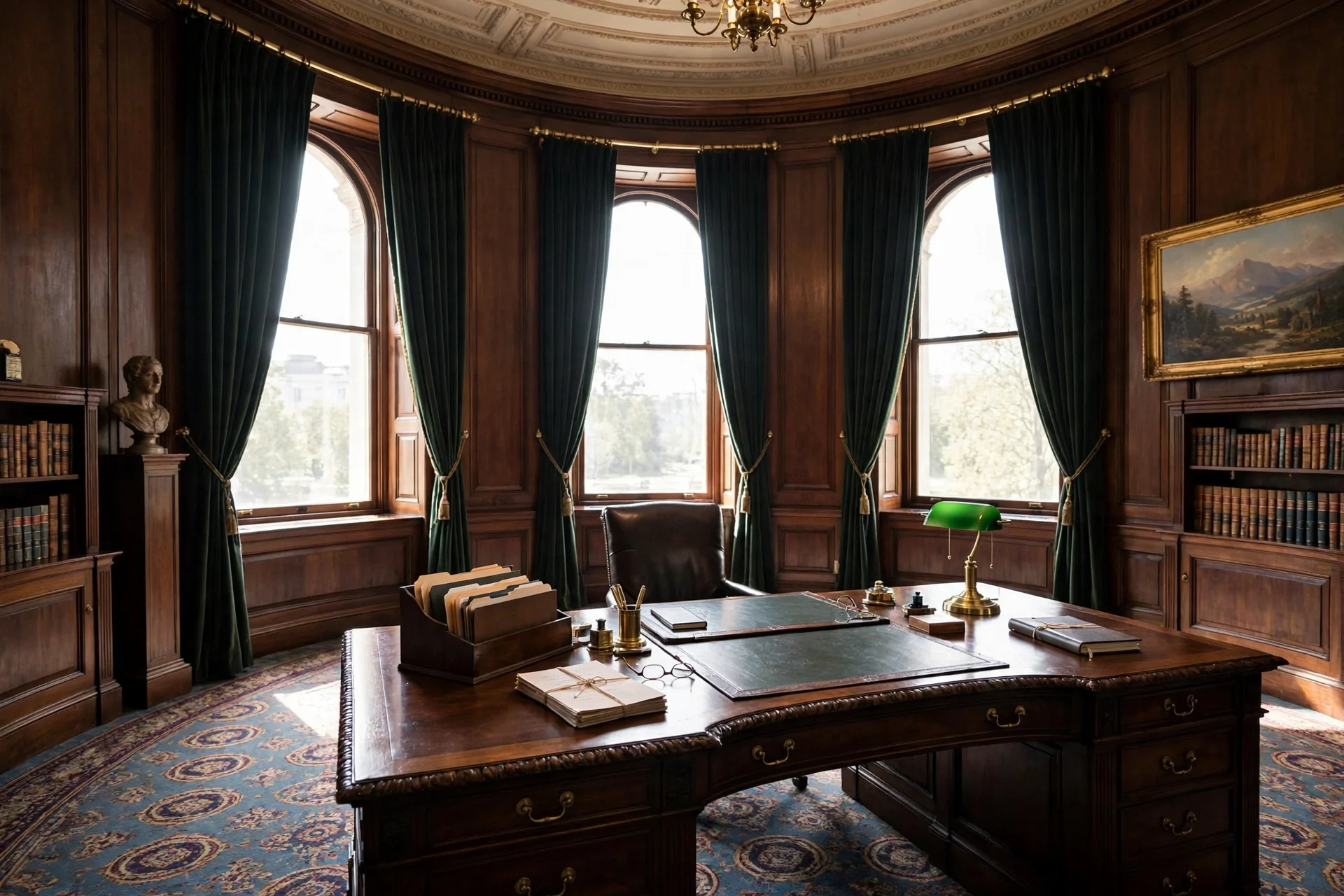
Oficina ovalada gubernamental de carácter histórico, similar al espacio protegido por la proclamación · Ilustración generada para EPM
Trump Declares the White House Oval Office a National Monument
Donald Trump declared the Oval Office a national monument on November 5, 2026, protecting rooms 110, 106, 108 and 105 of the West Wing.
The White House Shields Its Oval Office as a National Monument
Trump proclaimed the Oval Office a national monument on November 5, 2026, under the Antiquities Act.
--- The context ---
The Oval Office is the president's main working space and one of the most recognizable settings of political power in Washington. Within its walls, different leaders adopted decisions of enormous national and international weight and received heads of state from around the world, yet the rooms remained exposed to demolitions or structural renovations.
--- The facts ---
President Donald Trump declared the Oval Office a national monument through an official proclamation signed in Washington on November 5, 2026. The decree, named the Oval Office National Monument, protects room 110, rooms 106 and 108 of the Outer Oval Office, and the Cabinet Room, in room 105, inside the West Wing.
To support the measure, the president applied section 320301 of title 54 of the United States Code, known as the Antiquities Act, which empowers the head of state to proclaim national monuments on federally controlled lands. According to the official White House document, the boundaries set represent the smallest area necessary to ensure the proper care and management of the protected objects.
--- The positions ---
The White House presents the decision as a heritage preservation framework safeguarding the architectural and historical value of these rooms. The Department of the Interior and the National Park Service assume technical management and supervision of any future works, without interrupting the Executive Branch's daily tasks, and must carry out a comprehensive management plan in consultation with the White House Office of Administration.
--- What remains unknown ---
The document argues that these rooms require individualized safeguarding even though the presidential park is already a National Historic Landmark, given their significance in the country's public life. The rule requires coordination with the Committee for the Preservation of the White House and subjects any substantial modification or demolition to prior technical documentation and a strict evaluation of alternatives.
--- Unanswered questions ---
How will the comprehensive management plan translate into concrete rules for future works? What criteria will separate a substantial renovation from a permitted operational adjustment? Could this individualized safeguarding become a model for other historic federal government rooms?
--- EPM analysis ---
The oval shape first appeared in the West Wing in 1909, at the initiative of President William Howard Taft, combining functional and ceremonial purposes. During Franklin D. Roosevelt's tenure, in the 1930s, the office adopted its current location and modern architectural configuration, the same one now receiving reinforced protection.
📌 EPM Take: In EPM's view, declaring the Oval Office a national monument protects a heritage that belongs to the country's institutional memory, not to the administration in office. The measure is right to demand technical documentation and an evaluation of alternatives before altering spaces laden with history, and to do so without slowing the Executive Branch's daily work. Its real value will be measured in application: if the management plan sets clear, public criteria, preservation will no longer depend on each president's taste.
--- The context ---
Few offices in the world hold as much history as the Oval Office, the setting of decisions of enormous national and international weight and of meetings with heads of state from around the world. That legacy, built over more than a century of American public life, is what the new proclamation seeks to secure against future building reforms.
--- The facts ---
President Donald Trump signed in Washington, on November 5, 2026, the proclamation declaring the Oval Office a national monument. The protection covers the main presidential working area, room 110, rooms 106 and 108 of the Outer Oval Office, and the Cabinet Room, in room 105, all inside the West Wing of the White House.
The legal basis is section 320301 of title 54 of the United States Code, the Antiquities Act, which grants the head of state discretionary authority to proclaim national monuments on federally controlled lands. According to the official White House document, the boundaries defined represent the smallest area necessary to properly care for and manage the objects the order protects.
--- The positions ---
The administration defends the measure as a safeguard of the architectural and historical value of the seat of government. The Secretary of the Interior, through the National Park Service, will guard the complex's historical character and physical integrity, coordinate tasks with the Committee for the Preservation of the White House, and require prior technical documentation for any proposal of substantial modification or demolition.
--- What remains unknown ---
The proclamation clarifies that it does not restrict the president's authority to redecorate the rooms, choose the furniture, or carry out operational or security adjustments that do not harm the historical structure. It also ratifies Congress's authority over public properties and preserves the ordinary exceptions of the National Historic Preservation Act, a balance whose practical scope remains to be defined.
--- Unanswered questions ---
Will future administrations keep this protection framework intact? Where exactly will the line fall between redecorating a room and altering its protected architectural design? How would a conflict between security needs and historical preservation be resolved?
--- EPM analysis ---
The office took its oval shape in the West Wing in 1909, at the initiative of President William Howard Taft, and reached its current location and configuration during Franklin D. Roosevelt's tenure, in the 1930s. Protecting that continuity means, at bottom, protecting the very setting where presidential power has been exercised for generations.
📌 EPM Take: In EPM's view, shielding the Oval Office as a national monument defends the institutional continuity of the United States without weakening the authority of whoever governs. The proclamation preserves tradition, keeps the president's operational and security capacity intact, and recalls that certain national symbols stand above each administration's fashions. It is a decision of state: what that room represents, and the dignity of the office it houses, belongs not to one term, but to the country's shared history.
Trump declara monumento nacional al Despacho Oval de la Casa Blanca
Donald Trump declaró el Despacho Oval monumento nacional el 5 de noviembre de 2026, con protección para las salas 110, 106, 108 y 105 del Ala Oeste.
La Casa Blanca blinda su Despacho Oval como monumento nacional
Trump proclamó monumento nacional al Despacho Oval el 5 de noviembre de 2026, amparado en la Ley de Antigüedades.
--- El contexto ---
El Despacho Oval es el área principal de trabajo del presidente de Estados Unidos y un espacio emblemático en Washington. Dentro de sus paredes, distintos gobernantes adoptaron resoluciones de enorme peso nacional e internacional y recibieron a jefes de Estado de todo el mundo, aunque el recinto seguía expuesto a demoliciones o reformas estructurales.
--- Los hechos ---
El presidente Donald Trump declaró el Despacho Oval como monumento nacional mediante una proclama oficial rubricada en Washington el 5 de noviembre de 2026. El decreto, denominado Monumento Nacional del Despacho Oval, protege la sala 110, las salas 106 y 108 del Despacho Oval Exterior y la Sala del Gabinete, en la sala 105, dentro del Ala Oeste.
Para sustentar la medida, el mandatario aplicó el artículo 320301 del título 54 del Código de Estados Unidos, conocido como la Ley de Antigüedades, que faculta al jefe de Estado a proclamar monumentos nacionales en tierras bajo control federal. Según el documento oficial de la Casa Blanca, los límites fijados corresponden al área mínima necesaria para garantizar el cuidado y la gestión adecuados de los bienes protegidos.
--- Las posiciones ---
La Casa Blanca presenta la decisión como un marco de preservación patrimonial para resguardar el valor arquitectónico e histórico de estas dependencias. El Departamento del Interior y el Servicio de Parques Nacionales asumen la gestión técnica y la supervisión de cualquier obra futura, sin interrumpir las tareas cotidianas del Poder Ejecutivo, y deberán ejecutar un plan de manejo integral en consulta con la Oficina de Administración de la Casa Blanca.
--- Lo que falta saber ---
El documento sostiene que estas salas requieren una salvaguarda individualizada pese a que el parque presidencial ya es Hito Histórico Nacional, por su trascendencia pública. La norma exige coordinar con el Comité para la Preservación de la Casa Blanca y someter toda modificación sustancial o demolición a documentación técnica previa y a una evaluación estricta de alternativas.
--- Preguntas sin respuesta ---
¿Cómo se traducirá el plan de manejo integral en reglas concretas para futuras obras? ¿Qué criterios separarán una reforma sustancial de una adecuación operativa permitida? ¿Servirá esta salvaguarda individualizada como modelo para otros recintos históricos del gobierno federal?
--- Análisis EPM ---
La forma oval apareció por primera vez en el Ala Oeste en 1909, por iniciativa del presidente William Howard Taft, con fines funcionales y ceremoniales. Durante el mandato de Franklin D. Roosevelt, en la década de 1930, el despacho adoptó su ubicación actual y su configuración moderna, la misma que ahora recibe protección reforzada.
📌 Conclusion EPM: A juicio de EPM, declarar monumento nacional al Despacho Oval protege un patrimonio que pertenece a la memoria institucional del país y no a la gestión de turno. La medida acierta al exigir documentación técnica y evaluación de alternativas antes de alterar espacios cargados de historia, y al hacerlo sin frenar el trabajo diario del Poder Ejecutivo. Su valor real se medirá en la aplicación: si el plan de manejo fija criterios claros y públicos, la preservación dejará de depender del gusto de cada presidente.
--- El contexto ---
Pocas oficinas en el mundo concentran tanta historia como el Despacho Oval, escenario de decisiones de enorme peso nacional e internacional y de encuentros con jefes de Estado de todo el mundo. Ese legado, construido durante más de un siglo de vida pública estadounidense, es el que la nueva proclamación busca asegurar frente a reformas edilicias futuras.
--- Los hechos ---
El presidente Donald Trump firmó en Washington, el 5 de noviembre de 2026, la proclama que declara al Despacho Oval monumento nacional. La protección cubre el área principal de trabajo presidencial, la sala 110, las salas 106 y 108 del Despacho Oval Exterior y la Sala del Gabinete, en la sala 105, todas dentro del Ala Oeste de la Casa Blanca.
El fundamento legal es el artículo 320301 del título 54 del Código de Estados Unidos, la Ley de Antigüedades, que otorga al jefe de Estado la facultad discrecional de proclamar monumentos nacionales en tierras bajo control federal. De acuerdo con el documento oficial de la Casa Blanca, los límites definidos representan el área mínima necesaria para cuidar y gestionar correctamente los bienes que la orden protege.
--- Las posiciones ---
La administración defiende la medida como una salvaguarda del valor arquitectónico e histórico de la sede de gobierno. La Secretaría del Interior, a través del Servicio de Parques Nacionales, resguardará el carácter histórico y la integridad física del complejo, coordinará tareas con el Comité para la Preservación de la Casa Blanca y exigirá documentación técnica previa ante cualquier propuesta de modificación sustancial o demolición.
--- Lo que falta saber ---
La proclamación aclara que no restringe la potestad del presidente para redecorar los salones, elegir el mobiliario ni ejecutar adecuaciones operativas o de seguridad que no perjudiquen la estructura histórica. También ratifica la autoridad del Congreso sobre las propiedades públicas y conserva las excepciones ordinarias de la Ley Nacional de Preservación Histórica, un equilibrio cuyo alcance práctico aún debe definirse.
--- Preguntas sin respuesta ---
¿Mantendrán las futuras administraciones intacto este marco de protección? ¿Dónde quedará el límite exacto entre redecorar un salón y alterar su diseño arquitectónico protegido? ¿Cómo se resolverá un eventual choque entre necesidades de seguridad y preservación histórica?
--- Análisis EPM ---
El despacho nació con forma oval en el Ala Oeste en 1909, por iniciativa del presidente William Howard Taft, y alcanzó su ubicación y configuración actuales durante el mandato de Franklin D. Roosevelt, en la década de 1930. Proteger esa continuidad es, en el fondo, proteger la escenografía misma donde se ha ejercido el poder presidencial durante generaciones.
📌 Conclusion EPM: A juicio de EPM, blindar el Despacho Oval como monumento nacional defiende la continuidad institucional de Estados Unidos sin debilitar la autoridad de quien gobierna. La proclamación preserva la tradición, mantiene intacta la capacidad operativa y de seguridad del presidente y recuerda que ciertos símbolos nacionales están por encima de las modas de cada administración. Es una decisión de Estado: lo que representa ese recinto no pertenece a un mandato, sino a la historia compartida del país.