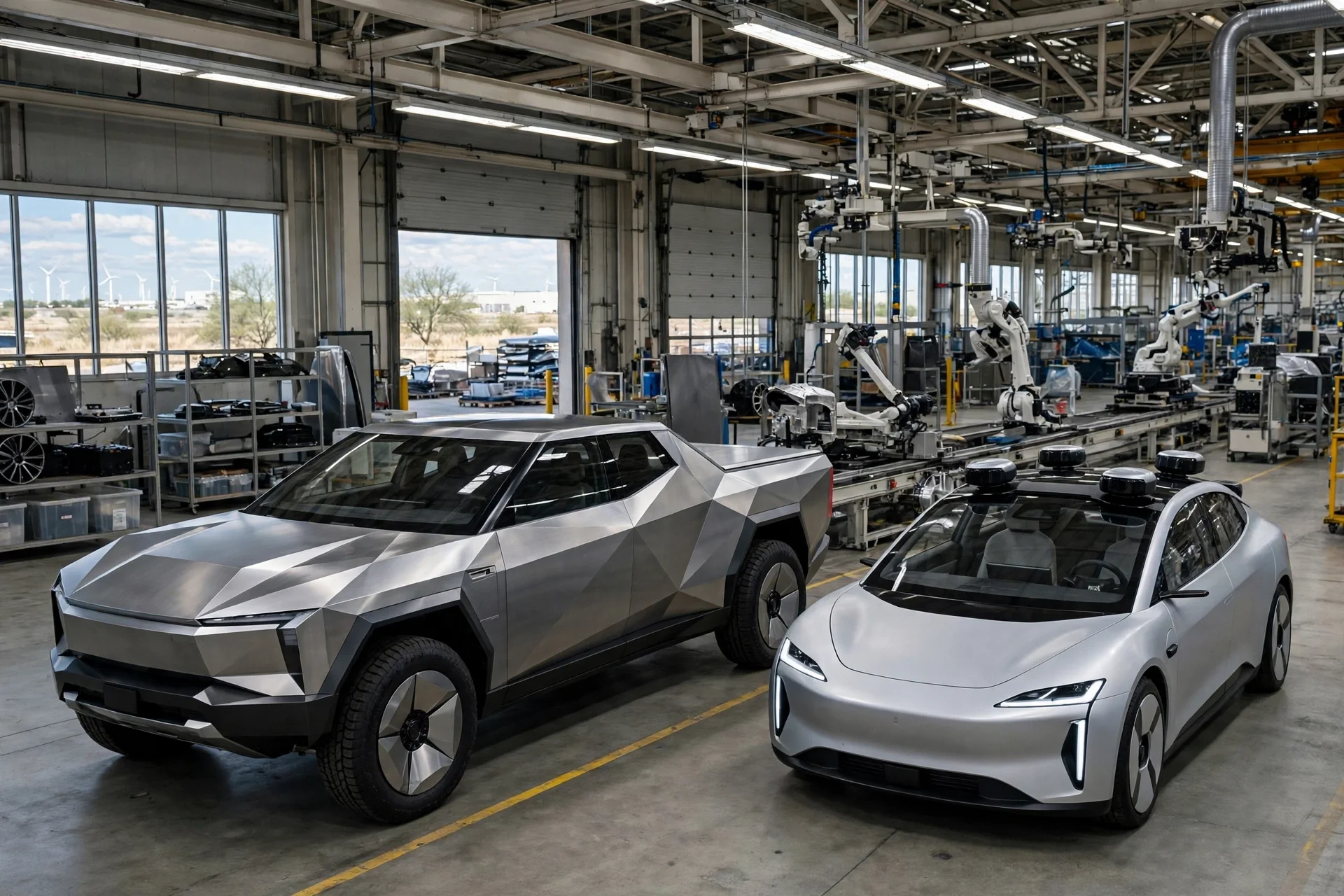
Imagen alusiva a la transición productiva en la planta de Texas: de la camioneta eléctrica angular al robotaxi sin conductor. · Imagen generada para EPM
Tesla to Scale Back Cybertruck in Texas to Make Room for Cybercab
Tesla will gradually reduce Cybertruck production in Texas around the middle of 2027 to make room for the Cybercab, Elon Musk announced on X on November 6.
Tesla Prioritizes Cybercab as Cybertruck Output Winds Down in Texas
Tesla will gradually reduce the Cybertruck at its Texas plant around the middle of 2027 to build more Cybercabs, the robotaxi without pedals it plans to sell…
--- The context ---
The Cybertruck reached the market in 2023 with an angular stainless steel body. Its Texas plant is now preparing to shift production priority.
--- The facts ---
Elon Musk announced on X on November 6 that Tesla will gradually reduce Cybertruck production in Texas around the middle of 2027 to make space for greater production of the Cybercab, its driverless vehicle.
Tesla groups Cybertruck sales with the Model S and Model X, which totaled 8,295 deliveries in the third quarter of 2026, out of 486,532 vehicles overall. According to third-party estimates, 4,323 Cybertrucks were delivered in the United States in that period and up to 70,000 since 2023, far from the 250,000 annual units Musk once foresaw.
--- The positions ---
Musk, in attributed indirect speech, said the Cybertruck fleet will keep circulating for a long time, after replying to a follower who lamented a possible discontinuation. Wes Morrill, the project's chief engineer, said in attributed indirect speech that the Cybertruck was a technology development platform and that it lives on through the Cybercab, a remark analysts took as a sign of discontinuation. Tesla has given no further details.
--- What remains unknown ---
Musk did not specify whether the pickup will stop being built altogether or whether production will move to another plant. The Austin factory is the only known facility that assembles the Cybertruck and has the equipment for its special components.
--- Unanswered questions ---
Will the Cybertruck stop being built entirely or will production move to another plant? What will happen to the special equipment at the Austin plant during the transition? Will the Cybercab overcome the regulatory investigations and reach the public before 2026 ends?
--- EPM analysis ---
Price shaped the model's trajectory: it ended at USD 61,000 for the most equipped versions and the Cyberbeast costs USD 102,000 in 2026. In 2025, a recall affected more than 46,000 pickups over the risk of a trim piece detaching, and other defective components and reported fatal accidents followed. The Cybercab, a robotaxi without pedals the company plans to sell to the public before 2026 ends, faces investigations by the United States road safety agency because it lacks manual controls federal regulation usually requires.
📌 EPM Take: In EPM's view, the Cybertruck cutback acknowledges in practice what the figures already showed: an emblematic model with deliveries far below forecasts and a record marked by high prices and recalls. The bet on the Cybercab could give the Texas plant a broader future, but it shifts uncertainty onto regulatory ground, because a vehicle without manual controls still faces federal investigations. Transparency about the final fate of the model and the plant will be key to judging this announcement.
--- The context ---
The Cybertruck went on sale in 2023 with an angular stainless steel body and became Tesla's most recognizable model. Its Texas plant will now devote its capacity to autonomous transport.
--- The facts ---
Elon Musk announced on X on November 6 that Tesla will gradually reduce Cybertruck production at Gigafactory Texas around the middle of 2027 to make space for greater production of the Cybercab, its robotaxi without pedals.
Tesla groups the Cybertruck with the Model S and Model X, which totaled 8,295 deliveries in the third quarter of 2026, out of 486,532 vehicles overall. According to third-party estimates, 4,323 Cybertrucks were delivered in the United States and up to 70,000 since 2023, against the 250,000 annual units Musk once foresaw.
--- The positions ---
Musk, in attributed indirect speech, replied to a follower who lamented a possible discontinuation and said the Cybertruck fleet will keep circulating for a long time. Wes Morrill, the project's chief engineer, said in attributed indirect speech that the Cybertruck was a technology development platform and that it lives on through the Cybercab, a remark analysts read as a sign of discontinuation. The company gave no further details.
--- What remains unknown ---
It remains unknown whether the pickup will stop being built or move to another plant, a point Musk did not specify. The Austin factory has the equipment for the model's special components, and no alternative has been announced.
--- Unanswered questions ---
Will the Cybertruck be built at another plant or will its cycle end with the Texas cutback? When will the Cybercab reach greater production at Gigafactory Texas after the change? Will federal regulation allow a vehicle without manual controls to be sold to the public?
--- EPM analysis ---
Reassigning capacity to the product with the longer runway is efficient. The Cybertruck ended at USD 61,000 for the most equipped versions and the Cyberbeast costs USD 102,000 in 2026, prices far from the accessible value raised with analysts. In 2025, a recall affected more than 46,000 pickups over the risk of a trim piece detaching, alongside other defective components and reported fatal accidents. The Cybercab, with which Tesla seeks to expand its autonomous transport network, faces road safety agency investigations because it lacks manual controls.
📌 EPM Take: In EPM's view, focusing the Texas plant on the Cybercab is a course correction consistent with the figures: the Cybertruck never reached the expected volume and its production cost competes with a larger-scale bet. The success of the shift will depend on the robotaxi passing regulatory scrutiny and on the company explaining clearly what happens to the outgoing model. Reassigning resources in time, rather than sustaining a limited-demand line by inertia, is the solid part of this announcement.
Tesla reducirá la Cybertruck en Texas para dar paso al Cybercab
Tesla reducirá gradualmente la producción de la Cybertruck en Texas alrededor de la mitad de 2027 para dar espacio al Cybercab, según anunció Elon Musk en X el…
Tesla prioriza el Cybercab y recorta la Cybertruck en Texas
Tesla reducirá gradualmente la Cybertruck en su planta de Texas alrededor de la mitad de 2027 para producir más Cybercab, el robotaxi sin pedales que planea…
--- El contexto ---
La Cybertruck llegó al mercado en 2023 con una carrocería de acero inoxidable de formas angulares. Su planta de Texas cambiará ahora de prioridad productiva.
--- Los hechos ---
Elon Musk anunció en X el 6 de noviembre que Tesla reducirá gradualmente la producción de la Cybertruck en Texas alrededor de la mitad de 2027 para dar espacio a mayor producción del Cybercab, su vehículo sin conductor.
Tesla agrupa las ventas de la Cybertruck con los Model S y Model X, que sumaron 8.295 entregas en el tercer trimestre de 2026, de 486.532 vehículos en total. Según estimaciones de terceros, se entregaron 4.323 Cybertruck en Estados Unidos y hasta 70.000 desde 2023, lejos de las 250.000 unidades anuales que Musk llegó a prever.
--- Las posiciones ---
Musk, en indirecto atribuido, sostuvo que la flota de Cybertruck seguirá circulando durante mucho tiempo, tras responder a un seguidor que lamentaba una posible discontinuación. Wes Morrill, ingeniero jefe del proyecto, señaló en indirecto atribuido que la Cybertruck fue una plataforma de desarrollo tecnológico y sigue viva a través del Cybercab, frase interpretada por analistas como señal de discontinuación. Tesla no ha dado más detalles.
--- Lo que falta saber ---
Musk no precisó si la camioneta dejará de fabricarse o se trasladará a otra planta. La fábrica de Austin es la única instalación conocida que la ensambla y tiene el equipo para sus componentes especiales.
--- Preguntas sin respuesta ---
¿Dejará de fabricarse la Cybertruck por completo o se trasladará su producción a otra planta? ¿Qué pasará con los equipos especiales de Austin durante la transición? ¿Logrará el Cybercab superar las investigaciones regulatorias y llegar al público antes de que termine 2026?
--- Análisis EPM ---
El precio marcó al modelo: terminó en USD 61.000 para las versiones más equipadas y la Cyberbeast cuesta USD 102.000 en 2026. En 2025, una revisión afectó a más de 46.000 camionetas por riesgo de desprendimiento de una pieza del revestimiento, con otros componentes defectuosos y accidentes fatales reportados. El Cybercab, robotaxi sin pedales que la empresa planea vender al público antes de que termine 2026, enfrenta investigaciones de la agencia de seguridad vial por carecer de controles manuales que la regulación federal suele exigir.
📌 Conclusion EPM: A juicio de EPM, el recorte de la Cybertruck reconoce con hechos lo que las cifras ya mostraban: un modelo emblemático con entregas muy por debajo de lo previsto y una trayectoria marcada por precios altos y revisiones. La apuesta por el Cybercab puede darle a la planta un futuro más amplio, pero traslada la incertidumbre al terreno regulatorio: un vehículo sin controles manuales todavía enfrenta investigaciones federales. La transparencia sobre el destino final del modelo y de la planta será clave para valorar el anuncio.
--- El contexto ---
La Cybertruck salió al mercado en 2023 con una carrocería de acero inoxidable de formas angulares, el modelo más reconocible de Tesla. Su planta de Texas dedicará su capacidad al transporte autónomo.
--- Los hechos ---
Elon Musk anunció en X el 6 de noviembre que Tesla reducirá gradualmente la producción de la Cybertruck en Gigafactory Texas alrededor de la mitad de 2027 para dar espacio a mayor producción del Cybercab, su robotaxi sin pedales.
Tesla agrupa la Cybertruck con los Model S y Model X, que sumaron 8.295 entregas en el tercer trimestre de 2026, de 486.532 vehículos en total. Según estimaciones de terceros, se entregaron 4.323 Cybertruck en Estados Unidos y hasta 70.000 desde 2023, frente a las 250.000 unidades anuales que Musk llegó a prever.
--- Las posiciones ---
Musk, en indirecto atribuido, respondió a un seguidor que lamentaba una posible discontinuación y sostuvo que la flota de Cybertruck seguirá circulando durante mucho tiempo. Wes Morrill, ingeniero jefe del proyecto, afirmó en indirecto atribuido que la Cybertruck fue una plataforma de desarrollo tecnológico y sigue viva a través del Cybercab, frase leída por analistas como señal de discontinuación. La empresa no ofreció más detalles.
--- Lo que falta saber ---
Queda por saber si la camioneta dejará de fabricarse o se trasladará a otra planta, punto que Musk no precisó. La fábrica de Austin tiene el equipo para sus componentes especiales y no se ha anunciado otra instalación.
--- Preguntas sin respuesta ---
¿Se fabricará la Cybertruck en otra planta o su ciclo terminará con el recorte de Texas? ¿Cuándo producirá más Cybercab Gigafactory Texas tras el cambio? ¿Permitirá la regulación federal vender al público un vehículo sin controles manuales?
--- Análisis EPM ---
Reasignar capacidad al producto con mayor recorrido es una decisión de eficiencia. La Cybertruck terminó en USD 61.000 en sus versiones más equipadas y la Cyberbeast cuesta USD 102.000 en 2026, precios alejados del valor accesible planteado ante analistas. En 2025, una revisión afectó a más de 46.000 camionetas por riesgo de desprendimiento de una pieza del revestimiento, con otros componentes defectuosos y accidentes fatales. El Cybercab, con el que Tesla ampliará su red de transporte autónomo, enfrenta investigaciones de la agencia de seguridad vial por carecer de controles manuales.
📌 Conclusion EPM: A juicio de EPM, concentrar la planta de Texas en el Cybercab es una corrección de rumbo coherente con las cifras: la Cybertruck no alcanzó el volumen previsto y su coste compite con una apuesta de mayor escala. El éxito dependerá de que el robotaxi supere el examen regulatorio y de que la empresa explique el destino del modelo saliente. Reasignar recursos a tiempo, y no sostener por inercia una línea con demanda limitada, es la parte sólida del anuncio.