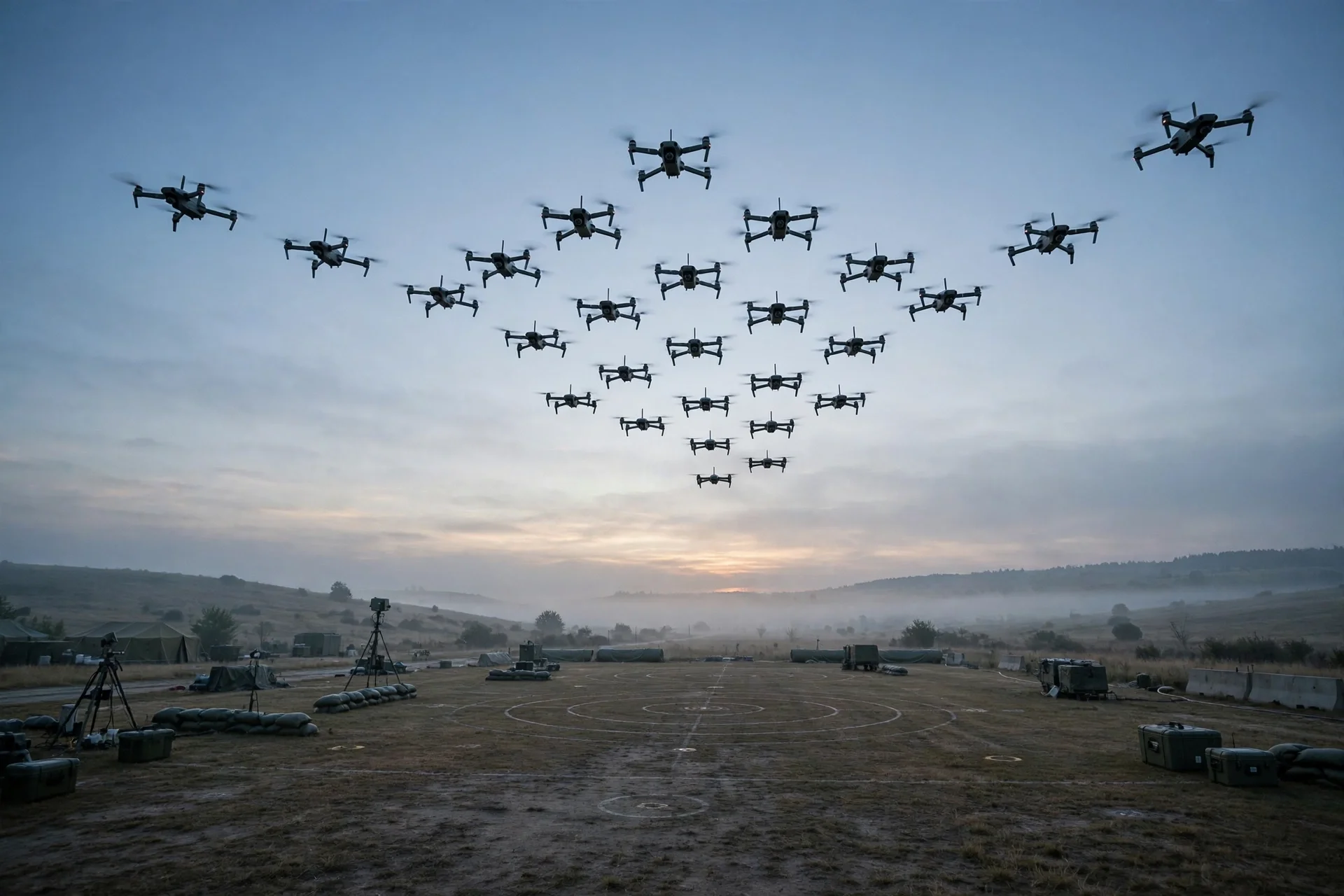
Enjambre de drones en formación durante una prueba al amanecer. · Imagen generada por EPM
Pentagon creates unified command for drones and artificial intelligence
The United States is creating a unified command for drones, robotics and artificial intelligence to close its gap with China and Iran in mass, low-cost…
United States centralizes drone warfare to face China and Iran
The Department of Defense is centralizing drones, robotics and artificial intelligence under a four-star command to mass-produce affordable systems, counter…
--- The context ---
The war in Ukraine and recent hostilities in the Middle East changed the measure of military power. Saturation of the front with massive, low-cost drones showed that superiority based only on multimillion-dollar conventional platforms no longer guarantees control. Washington admitted that it had fallen behind China and Iran in manufacturing unmanned aircraft at industrial scale and at disposable cost.
--- The facts ---
The Department of Defense has begun a deep restructuring of its doctrine and bureaucracy. In the late nineties and the early two-thousands, the United States led the integration of large drones such as the Predator and Reaper, but those platforms were designed for surgical, high-cost missions, not for massive, expendable use. Iranian-designed loitering munitions and adapted commercial drones in Eastern Europe also exposed a clear asymmetry: intercepting devices worth a few thousand dollars with missiles that cost millions is unsustainable.
Secretary of Defense Pete Hegseth ordered a unified four-star command devoted to drones, robotics and artificial intelligence. The measure dismantles the fragmentation among the Army, the Navy and the Air Force, consolidates procurement and doctrine under a single chain of command and opens the field to mid-sized companies oriented toward affordable serial production. The restructuring seeks to adopt the rhythms of the technology ecosystem in place of the timelines of traditional contractors.
--- The positions ---
For the drivers of the change, the advantage does not lie in basic hardware but in artificial intelligence on board. According to that view, computer vision and autonomous mapping allow platforms to process and attack targets without emitting signals or depending on data links, making them immune to electromagnetic interference. Palmer Luckey, the founder of Anduril Industries, and Newt Gingrich joined an advisory group. The doctrine bets on hybridization: F-15, F-16 and F-35 fighters will operate under the loyal wingman concept, escorted by dozens of drones, while unmanned ground vehicles advance and naval platforms and submarine drones patrol.
--- What remains unknown ---
The deployment calendar is still unknown, as are first-year production volumes and how contracts will be divided between mid-sized firms and traditional contractors. Also undefined are the degree of autonomy per mission and the protocols for preserving human oversight when swarms operate without links under intense electronic warfare.
--- Unanswered questions ---
Can the United States produce cheap drones at the industrial scale now attributed to China? How long will the unified command take to turn the new doctrine into deployed, ready units? What effective limits will human control retain when an autonomous swarm must decide within seconds under total interference?
--- EPM analysis ---
The turn is industrial, doctrinal and cultural. Industrial, because the problem is manufacturing a lot, cheaply and fast. Doctrinal, because concern over Taiwan and China's swarm industrial base forces planners to think about saturation, not only precision. And cultural, because the Pentagon accepts that its fragmented bureaucracy became a disadvantage. The ethical debate over the lethal decision is its most delicate frontier.
📌 EPM Take: In EPM's view, creating a single command for drones, robotics and artificial intelligence acknowledges a lesson that recent fronts have already imposed: numbers, cost and autonomy weigh as much as sophistication. If the United States manages to combine serial production, on-board software resistant to electronic warfare and verifiable human oversight, it will regain initiative against China and Iran. If the reform stays at the level of charts and announcements, the industrial gap will keep deciding outcomes before any strategic speech, in a possible clash over Taiwan and beyond.
--- The context ---
For decades, the United States built its military superiority on expensive, precise and scarce platforms. That model entered crisis when Ukraine and the Middle East demonstrated that swarms of cheap drones can saturate conventional defenses. Washington admitted an uncomfortable gap: against China and Iran, it fell behind in manufacturing unmanned aircraft at industrial scale and at disposable cost.
--- The facts ---
The Department of Defense answered with a deep restructuring of doctrine and bureaucracy. In the late nineties and the early two-thousands, American forces led the use of large drones such as the Predator and Reaper, conceived for surgical, high-cost missions. None of that prepared them for massive, expendable systems. Added to this was the asymmetry of intercepting devices worth a few thousand dollars with missiles that cost millions, a calculation that erodes any defense if the adversary replaces losses faster.
Secretary of Defense Pete Hegseth ordered a unified four-star command devoted to drones, robotics and artificial intelligence. The decision dismantles fragmentation among the Army, the Navy and the Air Force, concentrates procurement and doctrine under a single chain of command and opens space to mid-sized companies able to produce in series at affordable prices. The greatest concern remains the Indo-Pacific: in an eventual confrontation over Taiwan, China can deploy swarms at a far larger scale and saturate air defense networks.
--- The positions ---
The official bet holds that the difference will not be in the airframe but in the software. According to that position, computer vision and autonomous mapping will allow drones to process and attack targets without emitting signals or depending on links, making them immune to electronic warfare. The advisory group adds Palmer Luckey, the founder of Anduril Industries, and Newt Gingrich, seeking shorter cycles typical of the technology ecosystem. F-15, F-16 and F-35 fighters will act with dozens of drones as loyal wingmen; on land and at sea, automation will cover fire support, medical evacuation, patrols and saturation attacks.
--- What remains unknown ---
Still missing are entry-into-service timelines, the monthly production capacity demanded from suppliers and the sustained budget of the new command. It has also not been detailed how bottlenecks will be avoided, nor what rules will govern lethal autonomy when no link with a human operator exists because of enemy interference.
--- Unanswered questions ---
Will the new command succeed in imposing a common doctrine on services accustomed to buying separately? Can American industry match the swarm production pace attributed to China? Will Washington keep a firm requirement of human control over the lethal decision when the speed of combat pushes toward full autonomy?
--- EPM analysis ---
The reform corrects an error: confusing technological superiority with strategic superiority. An excellent system that is scarce and extremely expensive loses against an adversary able to saturate, replace and wear down. Centralizing command and procurement attacks fragmentation, and on-board artificial intelligence answers the practical lesson of current fronts, where the remote link is the first thing the enemy tries to cut. The unknown is industrial execution.
📌 EPM Take: In EPM's view, the unified command is a necessary and overdue correction: the United States admits that swarm warfare demands mass production, low costs and clear command, not only exceptional platforms. Its success will depend on three concrete tests, manufacturing at scale, integrating autonomy without losing human control and sustaining the effort beyond the initial announcement. If those three conditions are met, deterrence against China will emerge stronger; if they fail, the country will keep paying for million-dollar missiles against threats worth a few thousand dollars.
El Pentágono crea un mando único de drones e inteligencia artificial
Estados Unidos crea un comando unificado de drones, robótica e inteligencia artificial para cerrar su brecha frente a China e Irán en producción masiva y…
Estados Unidos centraliza su guerra de drones ante China e Irán
El Departamento de Defensa centraliza drones, robótica e inteligencia artificial en un comando de cuatro estrellas para producir en masa, bajar costos y…
--- El contexto ---
La guerra en Ucrania y las hostilidades en Oriente Medio cambiaron la medida del poder militar. La saturación del frente con drones baratos mostró que la superioridad apoyada solo en plataformas convencionales multimillonarias ya no garantiza el control. Washington admitió que quedó rezagado frente a China e Irán en fabricar aeronaves no tripuladas a escala industrial y con costos descartables.
--- Los hechos ---
El Departamento de Defensa inició una reestructuración profunda de su doctrina y su burocracia. A fines de los años noventa y principios de los 2000, Estados Unidos lideró la integración de drones grandes como los Predator y Reaper, pero esas plataformas se diseñaron para misiones quirúrgicas de alto costo, no para un empleo masivo y prescindible. Las municiones merodeadoras de diseño iraní y los drones comerciales adaptados en Europa del Este expusieron además una asimetría clara: interceptar aparatos de pocos miles de dólares con misiles que cuestan millones resulta insostenible.
El secretario de Defensa, Pete Hegseth, dispuso un comando unificado de cuatro estrellas dedicado a drones, robótica e inteligencia artificial. La medida desmantela la fragmentación entre el Ejército, la Marina y la Fuerza Aérea, consolida adquisiciones y doctrina bajo una sola línea de mando y abre el juego a medianas empresas orientadas a la producción serial asequible. La reestructuración busca adoptar los ritmos del ecosistema tecnológico frente a los plazos de los contratistas tradicionales.
--- Las posiciones ---
Para los impulsores del cambio, la ventaja no está en el hardware básico, sino en la inteligencia artificial a bordo. Según esa visión, la visión computacional y la cartografía autónoma permiten procesar y atacar objetivos sin emitir señales ni depender de enlaces, con lo que las plataformas se vuelven inmunes a la interferencia electromagnética. Se suman Palmer Luckey, fundador de Anduril Industries, y Newt Gingrich en un grupo asesor. La doctrina apuesta por la hibridación: cazas F-15, F-16 y F-35 operarán como compañero leal de ala, escoltados por decenas de drones, mientras avanzan vehículos terrestres no tripulados y patrullan plataformas navales y drones submarinos.
--- Lo que falta saber ---
No se conoce el calendario de despliegue, ni el volumen de producción de los primeros años, ni cómo se repartirán los contratos entre empresas medianas y contratistas tradicionales. Tampoco está definido el grado de autonomía por misión ni los protocolos para mantener supervisión humana cuando los enjambres operen sin enlaces bajo intensa guerra electrónica.
--- Preguntas sin respuesta ---
¿Podrá Estados Unidos producir drones baratos a la escala que hoy se atribuye a China? ¿Cuánto tardará el comando unificado en traducir la doctrina en unidades desplegadas? ¿Qué límites conservará el control humano cuando un enjambre autónomo deba decidir en segundos bajo interferencia total?
--- Análisis EPM ---
El giro es industrial, doctrinal y cultural. Industrial, porque el problema es fabricar mucho, barato y rápido. Doctrinal, porque la preocupación por Taiwán y la base industrial china de enjambres obliga a pensar en saturación y no solo en precisión. Y cultural, porque el Pentágono acepta que su burocracia fragmentada se volvió una desventaja. El debate ético sobre la decisión letal es su frontera más delicada.
📌 Conclusion EPM: A juicio de EPM, la creación de un mando único para drones, robótica e inteligencia artificial reconoce una lección que los frentes recientes ya impusieron: el número, el costo y la autonomía pesan tanto como la sofisticación. Si Estados Unidos logra unir producción serial, software a bordo resistente a la guerra electrónica y supervisión humana verificable, recuperará iniciativa frente a China e Irán. Si la reforma se queda en organigramas y anuncios, la brecha industrial seguirá decidiendo antes que cualquier discurso estratégico en un eventual choque por Taiwán y en otros escenarios.
--- El contexto ---
Estados Unidos construyó su superioridad militar sobre plataformas caras, precisas y escasas. Ese modelo entró en crisis cuando Ucrania y Medio Oriente demostraron que enjambres de drones baratos pueden saturar defensas convencionales. Washington admitió una brecha incómoda: frente a China e Irán, quedó rezagado en fabricar aeronaves no tripuladas a escala industrial y con costos descartables.
--- Los hechos ---
El Departamento de Defensa respondió con una reestructuración profunda de doctrina y burocracia. A fines de los años noventa y principios de los 2000, las fuerzas estadounidenses lideraron el uso de drones grandes como los Predator y Reaper, concebidos para misiones quirúrgicas de alto costo. Nada de eso preparaba para sistemas masivos y prescindibles. A ello se sumó la asimetría de interceptar aparatos de pocos miles de dólares con misiles que cuestan millones, un cálculo que erosiona cualquier defensa si el adversario repone pérdidas más rápido.
El secretario de Defensa, Pete Hegseth, dispuso un comando unificado de cuatro estrellas dedicado a drones, robótica e inteligencia artificial. La decisión desmantela la fragmentación entre el Ejército, la Marina y la Fuerza Aérea, concentra adquisiciones y doctrina bajo una sola línea de mando y abre espacio a medianas empresas capaces de producir en serie a precios asequibles. La mayor preocupación sigue siendo el Indopacífico: ante una eventual confrontación por Taiwán, China puede desplegar enjambres a una escala muy superior y saturar redes de defensa aérea.
--- Las posiciones ---
La apuesta oficial sostiene que la diferencia no estará en el fuselaje, sino en el software. Según esa posición, la visión computacional y la cartografía autónoma permitirán procesar y atacar objetivos sin emitir señales ni depender de enlaces, haciéndolos inmunes a la guerra electrónica. El grupo asesor suma a Palmer Luckey, fundador de Anduril Industries, y a Newt Gingrich, en busca de ciclos más cortos, propios del ecosistema tecnológico. Cazas F-15, F-16 y F-35 actuarán con decenas de drones como compañeros leales de ala; en tierra y mar, la automatización cubrirá apoyo de fuego, evacuación médica, patrullaje y ataques de saturación.
--- Lo que falta saber ---
Falta conocer los plazos de entrada en servicio, la capacidad de producción mensual exigida a los proveedores y el presupuesto sostenido del comando. Tampoco se ha detallado cómo se evitarán cuellos de botella, ni qué reglas regirán la autonomía letal cuando no exista enlace con un operador por la interferencia enemiga.
--- Preguntas sin respuesta ---
¿Logrará el nuevo comando imponer una doctrina común a servicios acostumbrados a comprar por separado? ¿Podrá la industria igualar el ritmo de enjambres que se atribuye a China? ¿Mantendrá Washington el control humano sobre la decisión letal cuando la velocidad del combate empuje hacia la autonomía total?
--- Análisis EPM ---
La reforma corrige un error: confundir superioridad tecnológica con superioridad estratégica. Un sistema excelente pero escaso y carísimo pierde frente a un adversario capaz de saturar, reponer y desgastar. Centralizar mando y adquisiciones ataca la fragmentación, y la inteligencia artificial a bordo responde a la lección práctica de los frentes actuales, donde el enlace remoto es lo primero que el enemigo intenta cortar. La incógnita es la ejecución industrial.
📌 Conclusion EPM: A juicio de EPM, el comando unificado es una corrección necesaria y tardía: Estados Unidos admite que la guerra de enjambres exige producción masiva, costos bajos y mando claro, no solo plataformas excepcionales. Su éxito dependerá de tres pruebas concretas, fabricar a escala, integrar la autonomía sin perder control humano y sostener el esfuerzo más allá del anuncio inicial. Si esas tres condiciones se cumplen, la disuasión frente a China saldrá reforzada; si fallan, el país seguirá pagando misiles millonarios contra amenazas de pocos miles de dólares.