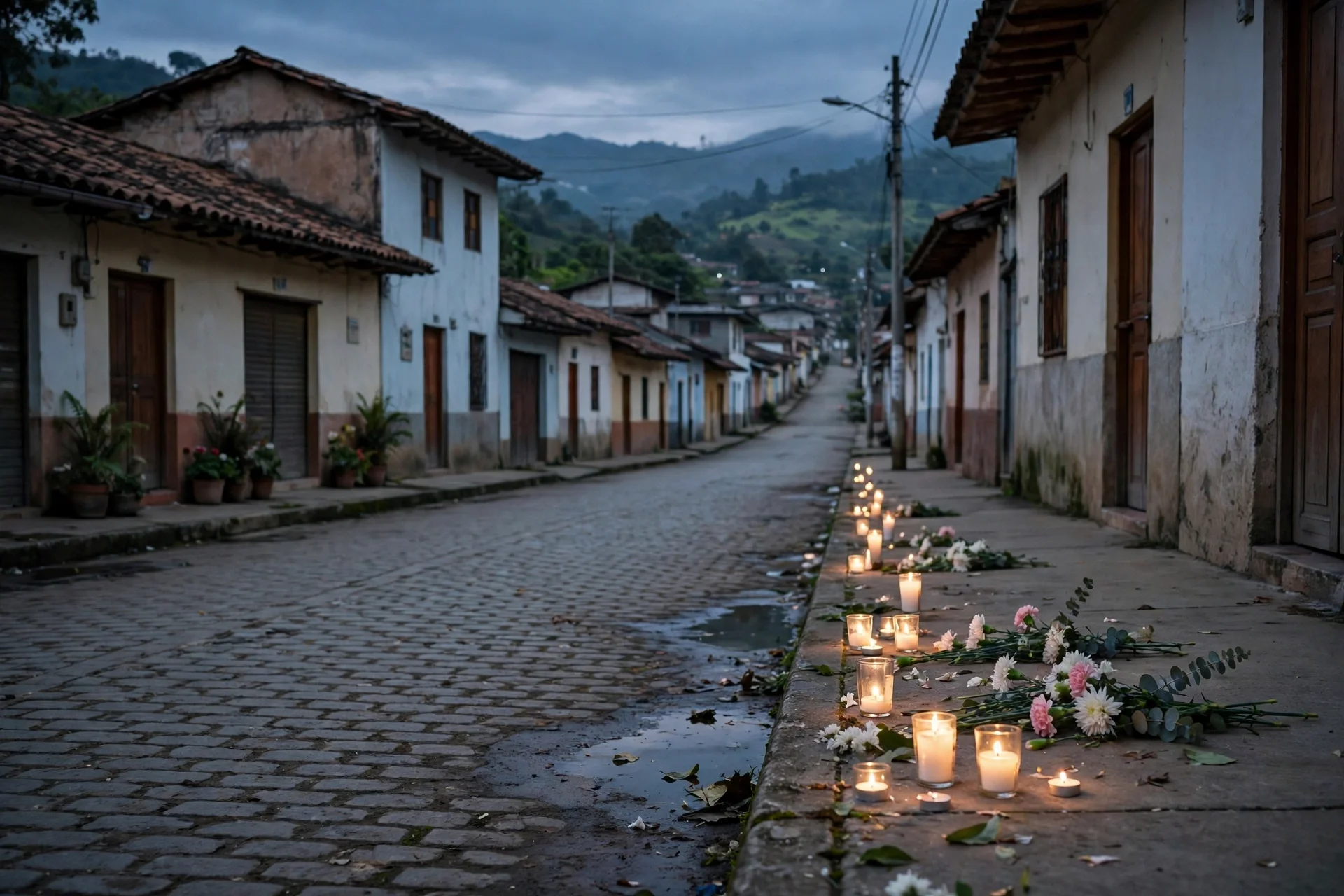
Velas y flores sobre una acera en señal de duelo en un pueblo del norte del Valle del Cauca. Imagen generada.
Massacre in Toro: a mother and her two daughters killed at home
Armed men killed María del Carmen Gutiérrez and her daughters Yarlin Andrea and Sulisney Muñoz Gutiérrez at their home in Toro, Valle del Cauca, on November 6…
Toro demands answers after a mother and her two daughters are killed
A mother and her two daughters were killed on November 6, 2026, inside their home in Toro, Valle del Cauca, by armed men who fired indiscriminately.
--- The context ---
The municipality of Toro, in northern Valle del Cauca, has long faced disputes over territorial control and illicit economies such as drug trafficking, a setting that keeps the civilian population of the area at constant risk.
According to the development and peace studies institute that tracks these events, the Adán Izquierdo Front of the Isaías Pardo Bloc, the group known as Los Flacos and local criminal groups operate in the territory, although it has not been established which of those structures, if any, is behind the most recent crime.
--- The facts ---
On November 6, 2026, armed men arrived at a home in Toro and fired indiscriminately at three women from the same family who were inside the house.
The victims were identified as María del Carmen Gutiérrez and her daughters Yarlin Andrea Muñoz Gutiérrez and Sulisney Muñoz Gutiérrez, a mother and her two daughters who died as a result of the armed attack on their own home.
--- The positions ---
The director of the institute, Leonardo González Perafán, called for the circumstances of the crime to be fully clarified and for those responsible to be identified, and he warned that protecting the civilian population requires an urgent and comprehensive institutional response.
Senator Ana Paola García rejected the crime and demanded speed in capturing those responsible, while Representative Juan Carlos Garcés Rojas also rejected it, called for investigations and arrests, urged stronger security in northern Valle and expressed his solidarity with the affected families.
--- What remains unknown ---
The authorship of the attack and the motives behind it are still unknown, and no arrests related to the case have been reported. The Ombudsman Office had warned of the persistence and worsening of risks in Toro and nearby localities, with threats of homicides, direct threats and extortion against the population.
--- Unanswered questions ---
Who ordered and carried out the attack against this family in Toro? What concrete protection measures will be activated for residents of northern Valle after the earlier warnings? When will the authorities present the first results of the investigation and the arrests described as urgent?
--- EPM analysis ---
According to the institute figures, 104 massacres have been recorded in Colombia so far in 2026, 24 of them during the administration of President Abelardo De La Espriella, which began on August 7, 2026. In Valle del Cauca the count reaches 14 this year and 6 since the start of that administration, showing sustained pressure on this department.
📌 EPM Take: In EPM's view, the Toro massacre confirms that early warnings are not enough when they do not translate into effective and permanent protection for the civilian population. A comprehensive response demands sustained institutional presence, a rapid investigation and real guarantees for families living amid territorial disputes. Public solidarity is necessary, but the country needs verifiable results: identified perpetrators, arrests and territories where daily life is no longer a constant risk for mothers and daughters.
--- The context ---
Toro, in northern Valle del Cauca, is a municipality battered by territorial control disputes linked to illicit economies such as drug trafficking, where the civilian population remains exposed to homicides, threats and extortion.
According to the development and peace studies institute, the Adán Izquierdo Front of the Isaías Pardo Bloc, the group known as Los Flacos and local criminal groups operate in that area. The Ombudsman Office had already warned of the persistence and worsening of that risk in Toro and nearby localities.
--- The facts ---
On November 6, 2026, armed men arrived at a home in the municipality and fired indiscriminately at three women from the same family.
The victims were María del Carmen Gutiérrez and her daughters Yarlin Andrea Muñoz Gutiérrez and Sulisney Muñoz Gutiérrez. The attack, carried out inside the family home, left all three women dead and shook the whole of northern Valle.
--- The positions ---
Leonardo González Perafán, director of the institute, called for the circumstances of the crime to be fully clarified and for those responsible to be found, and he argued that protecting the civilian population requires an urgent and comprehensive response.
Senator Ana Paola García rejected the crime and demanded speed in capturing those responsible. Representative Juan Carlos Garcés Rojas likewise rejected it, called for investigations, arrests and stronger security in northern Valle, and expressed his solidarity with the families of the victims.
--- What remains unknown ---
It has not been established which armed structure carried out the massacre or for what purpose, and no arrests are known so far. It is also unknown whether the victims had received prior threats or what protection measures existed in the sector where the attack occurred.
--- Unanswered questions ---
Which armed structure is responsible for the Toro massacre and when will its perpetrators fall? What real security reinforcement will reach northern Valle to recover control of the territory? What concrete results will the investigation deliver in the coming days?
--- EPM analysis ---
The institute figures count 104 massacres in Colombia so far in 2026, with 24 during the administration of President Abelardo De La Espriella, which began on August 7, 2026. Valle del Cauca records 14 this year and 6 since the start of that administration, a sequence that confirms the firepower and intimidation capacity that the illegal structures in dispute still hold.
📌 EPM Take: In EPM's view, the Toro massacre demands a response of authority without delay: identify the responsible structure, capture its members and recover effective control of the territory. Security in northern Valle will not be restored with statements, but with permanent presence, intelligence and justice that reaches the last person responsible. Protecting families begins by making clear that no armed group commands more than the State in any municipality of the country.
Masacre en Toro: madre y sus dos hijas asesinadas en su vivienda
Hombres armados asesinaron el 6 de noviembre de 2026 en Toro, Valle del Cauca, a María del Carmen Gutiérrez y a sus hijas Yarlin Andrea y Sulisney Muñoz…
Toro exige respuestas tras el asesinato de una madre y sus dos hijas
Una madre y sus dos hijas fueron asesinadas el 6 de noviembre de 2026 dentro de su vivienda en Toro, Valle del Cauca, por hombres armados que dispararon de…
--- El contexto ---
El municipio de Toro, en el norte del Valle del Cauca, enfrenta desde hace tiempo disputas por el control territorial y por economías ilícitas como el narcotráfico, un escenario que mantiene en riesgo constante a la población civil de la zona.
Según el instituto de estudios para el desarrollo y la paz que sigue estos hechos, en el territorio operan el Frente Adán Izquierdo del Bloque Isaías Pardo, el grupo conocido como Los Flacos y grupos delincuenciales locales, sin que hasta ahora se haya establecido cuál de esas estructuras, si alguna, está detrás del crimen más reciente.
--- Los hechos ---
El 6 de noviembre de 2026, hombres armados llegaron a una vivienda de Toro y dispararon de manera indiscriminada contra tres mujeres de una misma familia que se encontraban en el lugar.
Las víctimas fueron identificadas como María del Carmen Gutiérrez y sus hijas Yarlin Andrea Muñoz Gutiérrez y Sulisney Muñoz Gutiérrez, una madre y sus dos hijas que murieron como consecuencia del ataque armado contra su propia casa.
--- Las posiciones ---
El director del instituto, Leonardo González Perafán, pidió que se esclarezcan plenamente las circunstancias del crimen y se identifique a los responsables, y advirtió que la protección de la población civil requiere una respuesta urgente e integral por parte de las instituciones.
La senadora Ana Paola García rechazó el crimen y exigió celeridad para capturar a los responsables, mientras el congresista Juan Carlos Garcés Rojas también lo rechazó, pidió investigaciones y capturas, reclamó reforzar la seguridad en el norte del Valle y expresó su solidaridad con las familias afectadas.
--- Lo que falta saber ---
Todavía no se conoce la autoría del ataque ni los móviles que lo explican, y tampoco se han reportado capturas relacionadas con el caso. La Defensoría del Pueblo había advertido la persistencia y el agravamiento de los riesgos en Toro y en localidades cercanas, con amenazas de homicidios, amenazas directas y extorsiones sobre la población.
--- Preguntas sin respuesta ---
¿Quién ordenó y ejecutó el ataque contra esta familia en Toro? ¿Qué medidas concretas de protección se activarán para los habitantes del norte del Valle tras las advertencias previas? ¿Cuándo presentarán las autoridades los primeros resultados de la investigación y las capturas anunciadas como urgentes?
--- Análisis EPM ---
De acuerdo con las cifras del instituto, en lo corrido de 2026 se han registrado 104 masacres en Colombia, 24 de ellas durante la administración del presidente Abelardo De La Espriella, iniciada el 7 de agosto de 2026. En el Valle del Cauca la cuenta llega a 14 en el año y a 6 desde el inicio de ese mandato, lo que muestra una presión sostenida sobre este departamento.
📌 Conclusion EPM: A juicio de EPM, la masacre de Toro confirma que las advertencias tempranas no bastan si no se traducen en protección efectiva y permanente para la población civil. Una respuesta integral exige presencia institucional sostenida, investigación rápida y garantías reales para las familias que viven bajo disputa territorial. La solidaridad pública es necesaria, pero el país necesita resultados verificables: autores identificados, capturas y territorios donde vivir ya no sea un riesgo cotidiano para madres e hijas.
--- El contexto ---
Toro, en el norte del Valle del Cauca, es un municipio golpeado por disputas de control territorial ligadas a economías ilícitas como el narcotráfico, donde la población civil queda expuesta a homicidios, amenazas y extorsiones.
En esa zona operan, según el instituto de estudios para el desarrollo y la paz, el Frente Adán Izquierdo del Bloque Isaías Pardo, el grupo conocido como Los Flacos y grupos delincuenciales locales. La Defensoría del Pueblo ya había advertido la persistencia y el agravamiento de ese riesgo en Toro y en localidades cercanas.
--- Los hechos ---
El 6 de noviembre de 2026, hombres armados llegaron a una vivienda del municipio y dispararon de manera indiscriminada contra tres mujeres de una misma familia.
Las víctimas fueron María del Carmen Gutiérrez y sus hijas Yarlin Andrea Muñoz Gutiérrez y Sulisney Muñoz Gutiérrez. El ataque, ejecutado dentro de la vivienda familiar, dejó a las tres mujeres muertas y estremeció a todo el norte del Valle.
--- Las posiciones ---
Leonardo González Perafán, director del instituto, pidió esclarecer plenamente las circunstancias del crimen y dar con los responsables, y sostuvo que la protección de la población civil requiere una respuesta urgente e integral.
La senadora Ana Paola García rechazó el crimen y exigió celeridad para capturar a los responsables. El congresista Juan Carlos Garcés Rojas lo rechazó igualmente, pidió investigaciones, capturas y reforzar la seguridad en el norte del Valle, y expresó su solidaridad con las familias de las víctimas.
--- Lo que falta saber ---
No se ha establecido qué estructura armada ejecutó la masacre ni con qué propósito, y no se conocen capturas hasta el momento. Tampoco se sabe si las víctimas habían recibido amenazas previas ni qué medidas de protección existían en el sector donde ocurrió el ataque.
--- Preguntas sin respuesta ---
¿Qué estructura armada es responsable de la masacre de Toro y cuándo caerán sus autores? ¿Qué refuerzo real de seguridad llegará al norte del Valle para recuperar el control del territorio? ¿Qué resultados concretos entregará la investigación en los próximos días?
--- Análisis EPM ---
Las cifras del instituto cuentan 104 masacres en Colombia en lo corrido de 2026, con 24 durante la administración del presidente Abelardo De La Espriella, iniciada el 7 de agosto de 2026. En el Valle del Cauca se registran 14 en el año y 6 desde el inicio de ese mandato, una secuencia que confirma la capacidad de fuego y de intimidación que conservan las estructuras ilegales en disputa.
📌 Conclusion EPM: A juicio de EPM, la masacre de Toro exige una respuesta de autoridad sin dilaciones: identificar a la estructura responsable, capturar a sus integrantes y recuperar el control efectivo del territorio. La seguridad del norte del Valle no se restablece con comunicados, sino con presencia permanente, inteligencia y justicia que llegue hasta el último responsable. Proteger a las familias empieza por dejar claro que ningún grupo armado manda más que el Estado en ningún municipio del país.