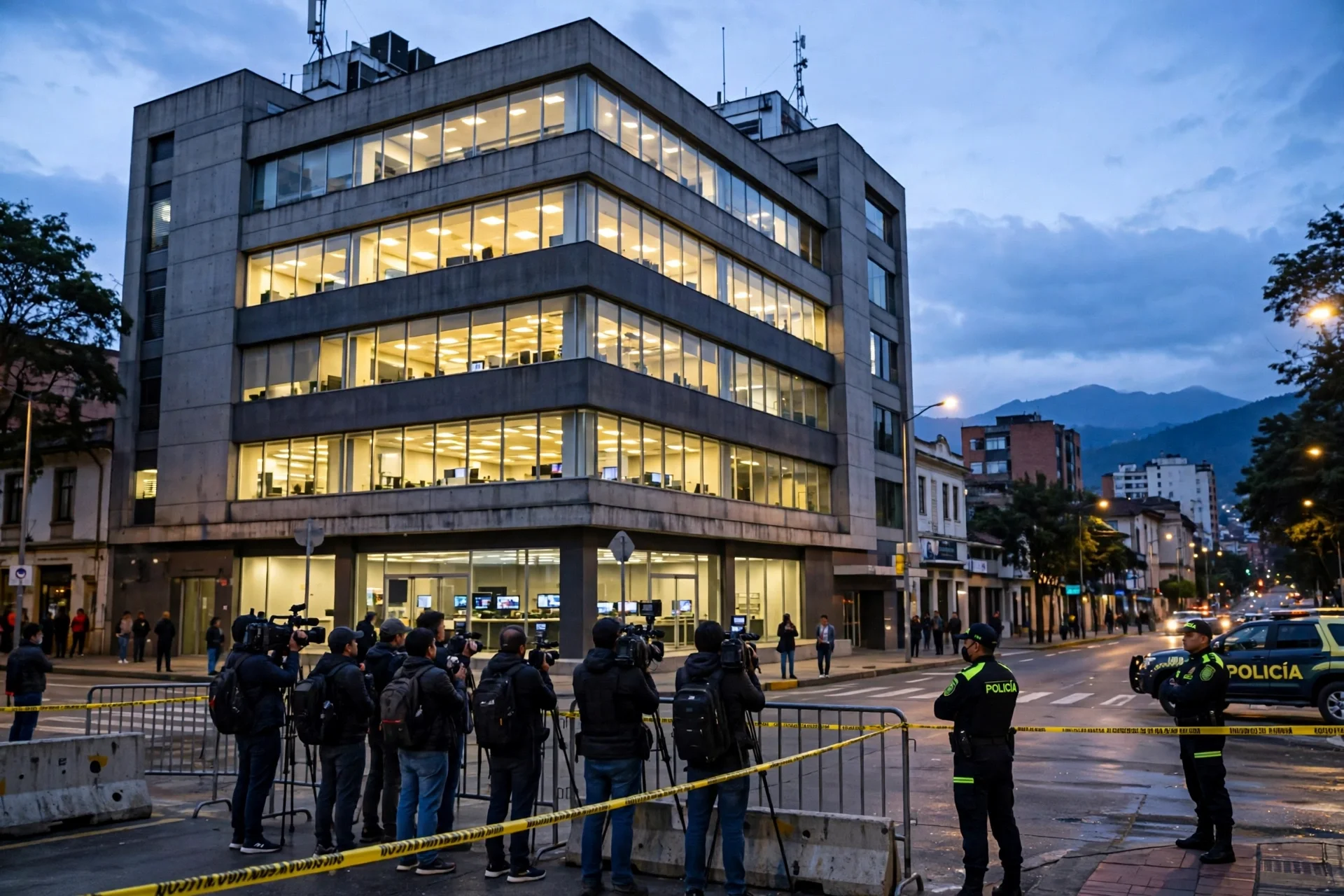
Cordón policial frente a un edificio de medios en Bogotá tras la alerta de seguridad. Imagen generada.
Bogota Calls Urgent Intelligence Meeting Over Threats Against Media
Bogota's Mayor's Office requested on November 7 the immediate convening of the CI3 after a CTI alert about possible attacks against media outlets.
Bogota Steps Up Security After Alert of Possible Attacks on Media
The district government requested on November 7 an immediate CI3 meeting to analyze the CTI alert about possible attacks against media in Bogota.
--- The context ---
Bogota's Mayor's Office requested the immediate convening of the Integrated Information and Intelligence Center (CI3) after receiving an alert about possible attacks against media outlets in the capital. The decision was announced on Saturday, November 7, after the Attorney General's Office, through the Technical Investigation Corps (CTI), shared security information with the district government and with several news companies.
The warning reached a television channel and a radio station that had been told of possible violent actions against their facilities and against other media outlets. When a newsroom must evacuate its staff, the risk goes beyond one company and touches the public's right to receive verified and timely information.
--- The facts ---
The mayor, through the District Security Secretariat, asked intelligence and security agencies to meet immediately to examine the alert shared by the CTI. The district administration also confirmed that Bogota's Police adopted preventive actions related to the information received, although it gave no details about the procedures implemented or the places where they were carried out.
During the afternoon of Saturday, November 7, workers at a television channel were evacuated from the company's main headquarters, located in northern Bogota. Staff left the building after a warning about the possible presence of an explosive device on the premises, and the company confirmed that authorities had informed it of the intention of illegal groups to attack the outlet.
A radio station also reported the risk of a possible attack against its company and other media outlets. The station said it had received the information from authorities in recent hours and had activated prevention protocols in coordination with the competent institutions, with measures aimed at protecting its journalists, collaborators and visitors.
--- The positions ---
The Inspector General of the Nation, Gregorio Eljach, rejected the possible intentions of illegal groups to attack the television channel. He held that intimidation cannot prevent the exercise of journalism and asked authorities to investigate what happened and guarantee the safety of the channel's workers.
The Ombudswoman, Iris Marin, expressed her solidarity with the channel's workers and asked authorities to clarify the information about the possible threats. She called for establishing the truthfulness of the warning and adopting the necessary protection measures, and later referred to the radio station as well, saying the threats extended further and made the situation more serious.
--- What remains unknown ---
The Mayor's Office did not specify whether the Police preventive actions were directed exclusively at the headquarters of the outlets mentioned or whether they covered other points in the city. No details were released about the content of the information delivered by the CTI, the identity of those possibly responsible, or the circumstances in which the threat became known.
--- Unanswered questions ---
Which illegal groups would be behind the intention to attack media outlets, according to the information shared by authorities? What concrete preventive measures did Bogota's Police adopt, and in which places in the city were they applied? Does the alert cover other outlets besides the television channel and the radio station that already activated their protocols? When will the CI3 report the results of its analysis of the warning received on November 7?
--- EPM analysis ---
The district reaction combined an immediate intelligence convening with preventive measures whose scope was not disclosed. That combination protects in the short term, but it leaves open the need to explain to the public what is known and what is being done, without compromising the ongoing investigation.
📌 EPM Take: In EPM's view, the alert made public on November 7 must be read as a test of the state's duty to protect journalism before harm occurs, not after. Evacuating a newsroom and activating prevention protocols were necessary steps, yet the public still does not know the real scope of the threat or the concrete measures in place. Keeping the media working requires a fast investigation, effective protection and honest communication about what is known. Without those three elements, intimidation achieves part of its purpose even if no explosive device is ever found inside any building in the capital.
--- The context ---
Bogota's Mayor's Office requested the immediate convening of the Integrated Information and Intelligence Center (CI3) to analyze an alert about possible attacks against media outlets in the country's capital. The decision was announced on Saturday, November 7, after the Attorney General's Office, through the Technical Investigation Corps (CTI), shared security information with the district government and with several news companies.
The district announcement came amid warnings received by a television channel and a radio station about possible violent actions against their facilities and against other media outlets. The threat, linked in the official information to the intention of illegal groups, required a coordinated response from the authorities.
--- The facts ---
The mayor, through the District Security Secretariat, asked intelligence and security agencies to meet immediately to examine the alert. The district administration confirmed that Bogota's Police took preventive actions related to the information received, without providing details about the type of procedures implemented, the places where they were carried out or the specific characteristics of the threats.
The alert took concrete form during the afternoon of Saturday, November 7, when workers at a television channel were evacuated from the company's main headquarters, located in northern Bogota. Staff left after a warning about the possible presence of an explosive device on the premises, and the company adopted the necessary measures to protect its workers and its facilities.
The radio station, for its part, reported the risk of a possible attack against its company and against other media outlets. It said it had received the information from authorities in recent hours and had activated prevention protocols in coordination with the competent institutions to protect its journalists, collaborators and visitors, while reiterating that it will continue its reporting work.
--- The positions ---
The Inspector General of the Nation, Gregorio Eljach, rejected the possible intentions of illegal groups to attack the television channel. He stated that intimidation cannot prevent the exercise of journalism and asked authorities to investigate what happened and guarantee the safety of the channel's workers.
The Ombudswoman, Iris Marin, expressed solidarity with the channel's workers and asked authorities to clarify the information about the possible threats, establish the truthfulness of the warning and adopt the necessary protection measures. She later referred to the radio station as well, with a message of commitment, solidarity and full backing for a free press.
--- What remains unknown ---
The district administration did not specify whether the preventive actions were directed exclusively at the headquarters of the outlets mentioned or whether they covered other points in the city. Nor was the content of the information delivered by the CTI disclosed, along with the identity of those possibly responsible or the circumstances in which the threat became known.
--- Unanswered questions ---
Which illegal groups would be behind the intention to attack media outlets in Bogota? What preventive procedures did Bogota's Police apply, and how long will those measures remain in place? Are there other outlets under the same alert besides the television channel and the radio station already mentioned? What conclusions will the CI3 deliver after analyzing the warning shared by the CTI on November 7?
--- EPM analysis ---
The sequence of November 7 shows the institutions acting in the right order: prosecutors shared the information, the district convened the intelligence body and the Police adopted preventive measures. The next step, identifying those responsible, will decide whether the response stays at containment or becomes real deterrence against illegal groups.
📌 EPM Take: In EPM's view, the correct response to an alert of this seriousness is the one that began to unfold on November 7: an immediate intelligence convening, preventive police action and unambiguous institutional backing. Illegal groups that seek to intimidate the press are attacking the very order of society, and no threat of this kind can be treated as a minor incident. What must follow is sustained firmness, identification of those responsible and protection maintained for as long as necessary. The safety of journalists and the authority of the state are defended with verifiable actions, not only with statements of solidarity.
Bogotá convoca reunión urgente de inteligencia por alerta contra medios
La Alcaldía de Bogotá pidió el 7 de noviembre la convocatoria inmediata del CI3 tras una alerta del CTI de la Fiscalía sobre posibles atentados contra medios.
Bogotá activa respuesta de seguridad ante posible atentado contra medios
El Distrito solicitó el 7 de noviembre la reunión inmediata del CI3 para analizar la alerta compartida por el CTI sobre posibles atentados contra medios en…
--- El contexto ---
La Alcaldía de Bogotá solicitó la convocatoria inmediata del Centro Integrado de Información e Inteligencia (CI3) tras conocer una alerta sobre posibles atentados contra medios de comunicación en la capital. La decisión se anunció el sábado 7 de noviembre, después de que la Fiscalía General de la Nación, a través del Cuerpo Técnico de Investigación (CTI), compartiera información de seguridad con el Gobierno distrital y con diferentes empresas periodísticas.
La advertencia llegó en un momento en que la protección de quienes informan se vuelve una condición básica para la vida democrática. Cuando una sede periodística debe evacuar a su personal, el riesgo no afecta solo a una empresa: afecta el derecho de la ciudadanía a recibir información verificada y oportuna.
--- Los hechos ---
El alcalde mayor, por medio de la Secretaría Distrital de Seguridad, pidió que los organismos de inteligencia y seguridad se reunieran de manera inmediata para examinar la alerta compartida por el CTI. La Administración distrital confirmó además que la Policía de Bogotá adoptó acciones preventivas relacionadas con la información recibida, aunque no entregó detalles sobre los procedimientos implementados ni sobre los lugares donde se desarrollaron.
Durante la tarde del sábado 7 de noviembre, los trabajadores de un canal de televisión fueron evacuados de la sede principal de la empresa, ubicada en el norte de Bogotá. La salida del personal se produjo ante una advertencia sobre la posible presencia de un artefacto explosivo en las instalaciones, y la compañía confirmó que las autoridades le informaron de la intención de grupos ilegales de atentar contra el medio.
Una emisora de radio informó también sobre el riesgo de un posible atentado contra su empresa y contra otros medios de comunicación. La compañía señaló que recibió la información de las autoridades durante las últimas horas y que activó protocolos de prevención en coordinación con las instituciones competentes, con medidas orientadas a proteger a sus periodistas, colaboradores y visitantes.
--- Las posiciones ---
El procurador general de la Nación, Gregorio Eljach, rechazó las posibles intenciones de grupos ilegales de atentar contra el canal de televisión. El funcionario sostuvo que las intimidaciones no pueden impedir el ejercicio del periodismo y pidió a las autoridades investigar lo ocurrido y garantizar la seguridad de los trabajadores del canal.
La defensora del Pueblo, Iris Marín, manifestó su solidaridad con los trabajadores del canal y solicitó a las autoridades esclarecer la información sobre las posibles amenazas. La funcionaria pidió establecer la veracidad de la advertencia y adoptar las medidas necesarias para proteger a quienes trabajan en la sede, y después se refirió también a la emisora, al señalar que las amenazas se extendían y que eso hacía la situación más grave.
--- Lo que falta saber ---
La Alcaldía no precisó si las acciones preventivas de la Policía estaban dirigidas exclusivamente a las sedes de los medios mencionados o si contemplaban otros puntos de la ciudad. Tampoco se divulgaron detalles sobre el contenido de la información entregada por el CTI, la identidad de los posibles responsables ni las circunstancias en que se habría conocido la amenaza.
--- Preguntas sin respuesta ---
¿Qué grupos ilegales estarían detrás de la intención de atentar contra los medios según la información compartida por las autoridades? ¿Qué medidas preventivas concretas adoptó la Policía de Bogotá y en qué lugares de la ciudad se aplicaron? ¿La alerta cubre a otros medios además del canal de televisión y la emisora que ya activaron sus protocolos? ¿Cuándo informará el CI3 los resultados de su análisis de la advertencia recibida el 7 de noviembre?
--- Análisis EPM ---
La reacción distrital combinó una convocatoria inmediata de inteligencia con medidas preventivas cuyo alcance no fue divulgado. Esa combinación protege en el corto plazo, pero deja abierta la necesidad de explicar a la ciudadanía qué se sabe y qué se está haciendo, sin comprometer la investigación en curso.
📌 Conclusion EPM: A juicio de EPM, la alerta conocida el 7 de noviembre obliga a mirar la protección de los periodistas como una tarea central del Estado y no como una reacción pasajera frente a una emergencia. La evacuación de una sede y la activación de protocolos muestran que el riesgo fue tomado en serio, pero la ciudadanía todavía no conoce el alcance real de la amenaza ni las medidas concretas adoptadas. Garantizar que los medios sigan informando exige investigación rápida, protección efectiva y transparencia sobre lo que se sabe. Sin esas tres condiciones, la intimidación cumple parte de su objetivo aunque ningún artefacto llegue a aparecer.
--- El contexto ---
La Alcaldía de Bogotá solicitó la convocatoria inmediata del Centro Integrado de Información e Inteligencia (CI3) para analizar una alerta sobre posibles atentados contra medios de comunicación en la capital del país. La decisión fue anunciada el sábado 7 de noviembre, luego de que la Fiscalía General de la Nación, a través del Cuerpo Técnico de Investigación (CTI), compartiera información de seguridad con el Gobierno distrital y con diferentes empresas periodísticas.
El anuncio del Distrito se produjo en medio de las advertencias recibidas por un canal de televisión y una emisora de radio sobre posibles acciones violentas contra sus instalaciones y contra otros medios de comunicación. La amenaza, atribuida en la información oficial a la intención de grupos ilegales, exigía una respuesta coordinada de las autoridades.
--- Los hechos ---
El alcalde mayor, por medio de la Secretaría Distrital de Seguridad, pidió que los organismos de inteligencia y seguridad se reunieran de manera inmediata para examinar la alerta. La Administración distrital confirmó que la Policía de Bogotá tomó acciones preventivas relacionadas con la información recibida, sin entregar detalles sobre el tipo de procedimientos implementados, los lugares en que se desarrollaron ni las características específicas de las amenazas.
La alerta tuvo una manifestación concreta durante la tarde del sábado 7 de noviembre, cuando los trabajadores de un canal de televisión fueron evacuados de la sede principal de la empresa, ubicada en el norte de Bogotá. La salida del personal se produjo ante una advertencia sobre la posible presencia de un artefacto explosivo en las instalaciones, y la compañía adoptó las medidas necesarias para proteger a sus trabajadores y sus instalaciones.
La emisora de radio informó por su parte sobre el riesgo de un posible atentado contra su empresa y contra otros medios de comunicación. La compañía señaló que recibió la información de las autoridades durante las últimas horas y que activó protocolos de prevención en coordinación con las instituciones competentes para proteger a sus periodistas, colaboradores y visitantes, al tiempo que reiteró que continuará su labor informativa.
--- Las posiciones ---
El procurador general de la Nación, Gregorio Eljach, rechazó las posibles intenciones de grupos ilegales de atentar contra el canal de televisión. El funcionario afirmó que las intimidaciones no pueden impedir el ejercicio del periodismo y pidió a las autoridades investigar lo ocurrido y garantizar la seguridad de los trabajadores del canal.
La defensora del Pueblo, Iris Marín, expresó su solidaridad con los trabajadores del canal y solicitó a las autoridades esclarecer la información sobre las posibles amenazas, establecer la veracidad de la advertencia y adoptar las medidas necesarias de protección. Después se refirió también a la emisora, con un mensaje de compromiso, solidaridad y respaldo total a una prensa libre.
--- Lo que falta saber ---
La Administración distrital no precisó si las acciones preventivas estaban dirigidas exclusivamente a las sedes de los medios mencionados o si contemplaban otros puntos de la ciudad. Tampoco se divulgó el contenido de la información entregada por el CTI, la identidad de los posibles responsables ni las circunstancias en que se habría conocido la amenaza.
--- Preguntas sin respuesta ---
¿Qué grupos ilegales estarían detrás de la intención de atentar contra los medios de comunicación en Bogotá? ¿Qué procedimientos preventivos aplicó la Policía de Bogotá y durante cuánto tiempo se mantendrán esas medidas? ¿Existen otros medios bajo la misma alerta además del canal de televisión y la emisora ya mencionados? ¿Qué conclusiones entregará el CI3 tras analizar la advertencia compartida por el CTI el 7 de noviembre?
--- Análisis EPM ---
La secuencia del 7 de noviembre muestra a las instituciones actuando en el orden correcto: la Fiscalía compartió la información, el Distrito convocó la instancia de inteligencia y la Policía adoptó medidas preventivas. El paso siguiente, identificar a los responsables, definirá si la respuesta queda en contención o se convierte en disuasión real frente a los grupos ilegales.
📌 Conclusion EPM: A juicio de EPM, frente a una alerta de esta gravedad la respuesta correcta es la que ya empezó a verse el 7 de noviembre: convocatoria inmediata de inteligencia, acción preventiva de la Policía y respaldo institucional sin ambigüedades. Los grupos ilegales que buscan intimidar a la prensa atacan el orden mismo de la sociedad, y ninguna amenaza de ese tipo puede tratarse como un hecho menor. Ahora corresponde sostener la firmeza, identificar a los responsables y mantener la protección el tiempo que sea necesario. La seguridad de los periodistas y la autoridad del Estado se defienden con hechos verificables, no solo con declaraciones de solidaridad.