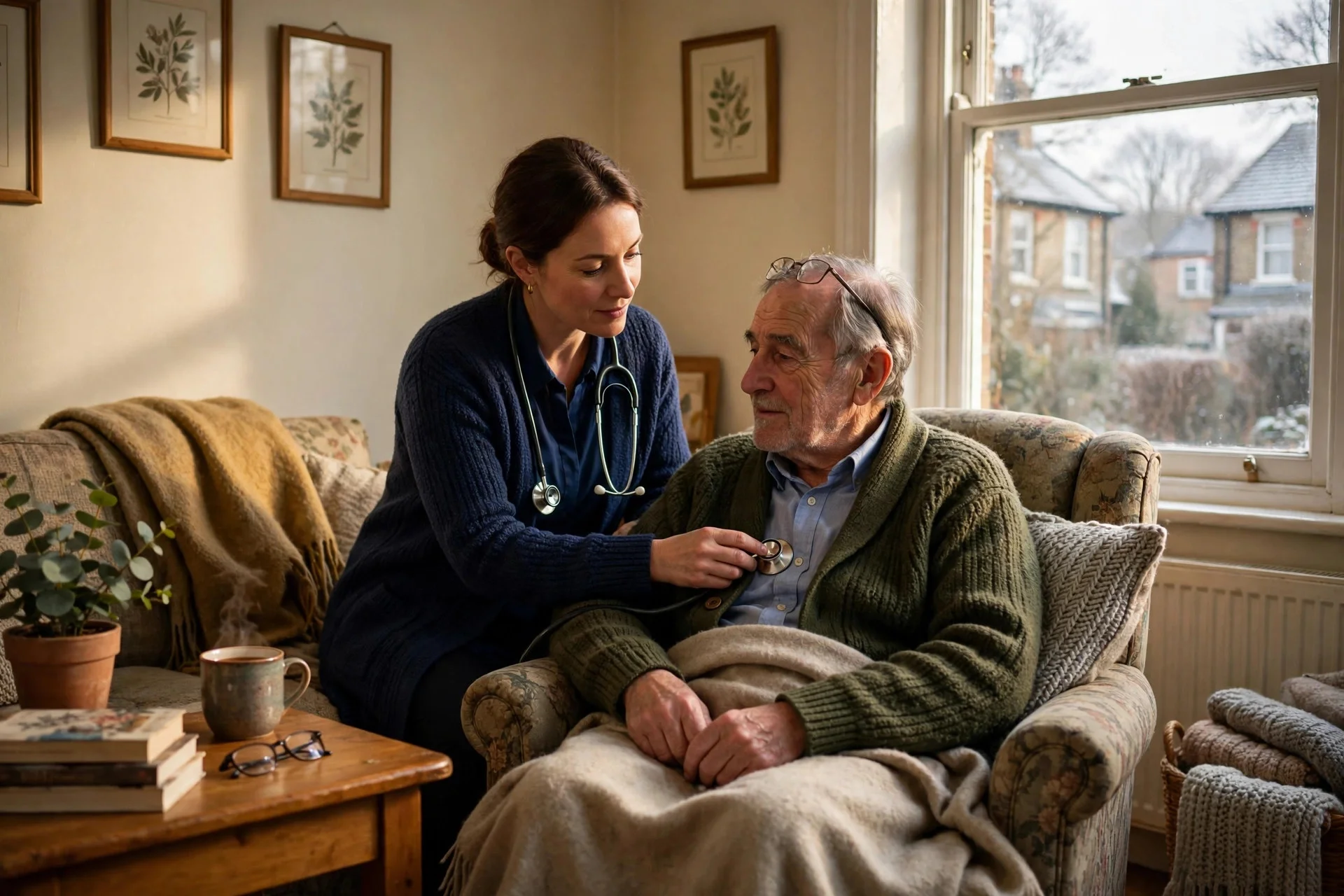
Atención proactiva en el domicilio: una médica revisa a un paciente mayor en su casa durante el invierno. · Imagen generada por EPM
United Kingdom puts £40 million behind GPs to protect vulnerable patients at home
The British government will fund GPs with £40 million to proactively support up to 300,000 vulnerable patients this winter through health checks, home…
£40 million for GPs aims to cut avoidable admissions and ease emergency pressure
With £40 million in ring-fenced funding, Primary Care Networks will receive £126 per patient to support up to 300,000 vulnerable people this winter and reduce…
--- The context ---
Winter places sustained pressure on emergency departments every year, and patients living with chronic conditions or frailty are often the first to feel the bottleneck when a minor problem worsens without early attention. In response, the British government is shifting part of the effort toward neighbourhoods and people's homes, backing general practitioners to act before a situation turns into an avoidable hospital admission.
--- The facts ---
The programme carries £40 million in funding and will help GPs proactively support up to 300,000 vulnerable patients across the country. People with heart disease, frailty or chronic obstructive pulmonary disease, including emphysema, will be able to receive health checks, home assessments and medication reviews tailored to their needs. Primary Care Networks will be able to receive £126 for each eligible patient supported, and the extra help may include nurse-led respiratory clinics.
--- The facts ---
Prime Minister Andy Burnham and Health Secretary Yvette Cooper set out the programme as part of wider preparations to bolster the health service for winter. Burnham argued indirectly that easing pressure on hospitals means keeping people well at home and reaching the most vulnerable early, before a small problem becomes a trip to the emergency department. Cooper said indirectly that the practical plan helps local teams support the frailest patients in the community through the winter months, which is better for patients and makes hospital care less likely.
--- The positions ---
Amanda Doyle, who leads primary care and community services in England, said indirectly that GP teams are delivering record numbers of appointments and are well placed to spot patients at greatest risk, with home assessments that can help prevent falls. Andy Brooks, of the national primary care association, welcomed the investment and urged national policy to go further so proactive care becomes sustainable and lasting within neighbourhoods. Ruth Rankine argued in the same direction, saying indirectly that the next step is to make this kind of proactive care permanent.
--- The positions ---
Ed Kennedy welcomed the commitment and noted indirectly that general practice teams know their patients and can provide proactive, personalised care. Victoria Tzortziou Brown, president of the GPs' professional college, warned indirectly that short-term initiatives alone cannot deliver the sustained improvements that patients with complex needs require, and called for sustainable investment in general practice. Matt Swallow stressed that winter raises the risk for people living with chronic obstructive pulmonary disease, as cold weather and seasonal infections can trigger serious flare-ups and emergency admissions.
--- What remains unknown ---
Since October, practices have had greater flexibility to bring in locum GPs using reimbursement funding and respond to local demand. There are now more than 2,800 additional GPs compared with July 2024, and more than 30,500 fully qualified full-time equivalent GPs working in general practice, the highest number in over a decade. Over the past year, more than 400 million appointments were delivered, around 24 million more than in the equivalent period in the run-up to July 2024.
--- What remains unknown ---
According to the 2026 GP patient survey, more than three quarters of patients rate their overall experience as good, and satisfaction with ease of access has risen to 75.5%, up 15 percentage points from July 2024. In the wider winter picture, 13.6 million people in England had received a flu vaccine by 1 November, around 300,000 more than at the same point last year, alongside 2.4 million school-aged children. Almost 2,000 new or replacement ambulances have been delivered since July 2024, a million more scans have been carried out, and 125 additional CT and MRI scanners have been operational since March 2024.
--- Unanswered questions ---
How will each neighbourhood decide which patients receive support first among the 300,000 expected to benefit? Will the payment of £126 per patient cover health checks, home assessments and medication reviews at the intensity vulnerable patients need? Will this winter programme become permanent proactive care, as several of the voices cited are asking?
--- EPM analysis ---
The plan places prevention at the centre and recognises that fairness in health is also decided by early access within the community, not only inside hospitals. If local teams identify people with frailty or lung disease in time, many avoidable admissions may never happen, and emergency departments can focus on the patients in greatest need. The broad backing from the sector sits alongside a clear warning about continuity that the programme's own design will still have to answer.
📌 EPM Take: In EPM's view, the programme is right to fund proactive, close-to-home care for up to 300,000 vulnerable patients, because preventing illness at home protects people and relieves hospitals at the moment of greatest winter pressure. Its real value will depend on support reaching the neighbourhoods that need it most fairly, on respiratory clinics and medication reviews being sustained over time, and on the evaluation the sector expects leading to stable investment rather than a one-off measure that fades when the cold passes and leaves frail patients exposed again.
--- The context ---
Each winter, avoidable admissions of chronic and frail patients crowd emergency departments and consume resources that should be reserved for the most serious cases. The announcement seeks efficiency at the source: fund general practitioners to detect and treat deterioration earlier, so fewer people reach a crisis requiring hospital care and the system spends where it prevents a larger cost.
--- The facts ---
The programme, backed by £40 million, will proactively support up to 300,000 vulnerable patients with heart disease, frailty or chronic obstructive pulmonary disease, including emphysema. The help includes health checks, home assessments, medication reviews and nurse-led respiratory clinics. Primary Care Networks will be able to receive £126 for each eligible patient supported, through ring-fenced funding to identify those most at risk of becoming seriously unwell this winter.
--- The facts ---
Prime Minister Andy Burnham and Health Secretary Yvette Cooper set out the plan. Burnham argued indirectly that taking pressure off hospitals requires keeping people well at home and acting before a small problem turns into an emergency visit. Cooper defended indirectly that supporting the frailest patients in the community is better for them and reduces their likelihood of needing hospital care, as part of preparations that combine flu vaccination, extra urgent care capacity and stronger partnerships with social care.
--- The positions ---
Amanda Doyle said indirectly that GP teams are delivering record appointment numbers and can spot the patients at greatest risk, with home assessments to prevent falls. Andy Brooks welcomed the investment as a valuable first step and urged policy to go further to build sustainable, lasting proactive care within neighbourhoods. Ruth Rankine agreed indirectly that the next step is to make proactive care a permanent part of how neighbourhood health is funded, while Ed Kennedy stressed that practice teams know their patients and can offer personalised support.
--- The positions ---
The sharpest warning came from Victoria Tzortziou Brown, president of the GPs' professional college, who said indirectly that short-term initiatives alone cannot deliver the sustained improvements required by patients with complex health needs, and called for sustainable investment in general practice. Matt Swallow added that winter is particularly challenging for people living with chronic obstructive pulmonary disease, because cold weather can irritate the airways and seasonal infections, including influenza, can trigger exacerbations and emergency admissions.
--- What remains unknown ---
Practice capacity is being reinforced, with flexibility since October to bring in locum GPs through reimbursement funding. There are more than 2,800 additional GPs compared with July 2024 and more than 30,500 fully qualified full-time equivalent GPs, the highest number in over a decade. More than 400 million appointments were delivered over the past year, around 24 million more than in the equivalent period in the run-up to July 2024, and satisfaction with ease of access rose to 75.5% in the 2026 GP patient survey, up 15 percentage points from July 2024.
--- What remains unknown ---
The programme sits within a wider winter effort: 13.6 million people in England had received a flu vaccine by 1 November, around 300,000 more than last year, and 2.4 million school-aged children had been vaccinated. Almost 2,000 new or replacement ambulances have been delivered since July 2024, a million more scans have been carried out, and 125 additional CT and MRI scanners have been operational since March 2024. The health service received £190 million in the Budget for winter pressures and £140 million for 14 new urgent care schemes, with 25 new or expanded urgent care sites, including a £29 million same-day emergency care unit opened on 20 October at a hospital in Ashford, Kent, expected to accommodate an additional 60 patients a day against the roughly 350 patients its emergency department sees daily.
--- Unanswered questions ---
Will the evaluation prove that each pound spent on prevention saves more in admissions avoided? Can practices sustain checks, home visits and reviews at £126 per patient without displacing other appointments? Will the government turn this winter initiative into stable funding, as the professional colleges themselves demand, or will it remain a seasonal patch?
--- EPM analysis ---
The design is sensible on efficiency grounds: paying per patient supported, ring-fencing the funds and judging the outcome by admissions avoided creates accountability for the spending. Easing emergency departments by treating people earlier in the community also protects urgent services for cases of greatest need. Yet the programme's financial sustainability is its weak point if every winter requires a new allocation without consolidating staffing and capacity in general practice.
📌 EPM Take: In EPM's view, committing £40 million so GPs can keep up to 300,000 vulnerable patients well at home is a defensible investment if it is measured by admissions avoided and by pressure taken off emergency departments. To be sustainable, the programme will need to prove its results through evaluation, keep the discipline of paying for patients actually supported, and become permanent primary care capacity, because, as the professional colleges warn, short initiatives alone cannot meet complex needs or guarantee lasting savings for the public health service.
Reino Unido destina 40 millones de libras a cuidar en casa a los más vulnerables
El Gobierno británico destina 40 millones de libras a que los médicos de cabecera apoyen este invierno a hasta 300.000 pacientes vulnerables con controles…
40 millones de libras para aliviar urgencias cuidando a 300.000 pacientes en casa
Con 40 millones de libras, las redes de atención primaria recibirán 126 libras por paciente para apoyar a hasta 300.000 personas vulnerables este invierno y…
--- El contexto ---
El invierno somete cada año a urgencias a una presión sostenida, y los pacientes con enfermedades crónicas o fragilidad son quienes primero la sufren cuando un problema menor se agrava sin atención temprana. Frente a ese riesgo, el Gobierno británico desplaza parte del esfuerzo hacia los barrios y los domicilios, reforzando a los médicos de cabecera para actuar antes de un ingreso evitable.
--- Los hechos ---
El programa, con 40 millones de libras, permitirá a los médicos de cabecera apoyar de forma proactiva a hasta 300.000 pacientes vulnerables. Las personas con enfermedad cardíaca, fragilidad o enfermedad pulmonar obstructiva crónica, incluido el enfisema, podrán recibir controles de salud, evaluaciones en el domicilio y revisiones de su medicación. Las redes de atención recibirán 126 libras por cada paciente elegible apoyado, y la ayuda podrá incluir clínicas respiratorias lideradas por enfermería.
--- Los hechos ---
El anuncio lo presentaron el primer ministro, Andy Burnham, y la ministra de Sanidad, Yvette Cooper, Burnham defendió en forma indirecta que, para aliviar los hospitales, hay que mantener bien a las personas en casa y llegar pronto a las más vulnerables, antes de que un problema pequeño acabe en urgencias. Cooper sostuvo en forma indirecta que el plan ayuda a los equipos locales a sostener a los pacientes más frágiles en la comunidad durante los meses de invierno.
--- Las posiciones ---
Amanda Doyle, responsable de atención primaria y servicios comunitarios en Inglaterra, señaló de forma indirecta que los equipos de cabecera entregan cifras récord de citas y están bien situados para detectar a quienes corren mayor riesgo. Andy Brooks, de la asociación nacional de atención primaria, celebró la inversión y pidió ir más allá para hacer sostenible la atención proactiva en los barrios. Ruth Rankine planteó que el siguiente paso es hacer permanente este tipo de atención.
--- Las posiciones ---
Ed Kennedy valoró que los equipos conocen a sus pacientes y pueden identificar a los más vulnerables con atención personalizada. Victoria Tzortziou Brown, presidenta del colegio de médicos de cabecera, advirtió en forma indirecta que las iniciativas cortas no bastan para los pacientes con necesidades complejas y reclamó inversión sostenida en medicina general. Matt Swallow recordó que el invierno eleva el riesgo de reagudizaciones en las personas con enfermedad pulmonar obstructiva crónica, por el frío y las infecciones respiratorias estacionales.
--- Lo que falta saber ---
Desde octubre, las consultas disponen de mayor flexibilidad para contratar médicos de cabecera suplentes con fondos de reembolso y responder a la demanda local. El sistema suma más de 2.800 médicos de cabecera adicionales frente a julio de 2024 y más de 30.500 médicos de cabecera plenamente cualificados en equivalente a tiempo completo, la cifra más alta en más de una década. En el último año se entregaron más de 400 millones de citas, unos 24 millones más que en el periodo equivalente previo a julio de 2024.
--- Lo que falta saber ---
La encuesta de pacientes de 2026 indica que más de tres cuartas partes califican su experiencia como buena, y la satisfacción con la facilidad de acceso subió a 75,5 %, 15 puntos porcentuales más que en julio de 2024. En el contexto invernal, a 1 de noviembre ya se habían vacunado contra la gripe 13,6 millones de personas en Inglaterra, 300.000 más que el año pasado, y 2,4 millones de escolares. Desde julio de 2024 se entregaron casi 2.000 ambulancias nuevas o de reemplazo, se realizaron un millón de escáneres más y operan 125 escáneres de tomografía y resonancia desde marzo de 2024.
--- Preguntas sin respuesta ---
¿Cómo se seleccionará en cada barrio a los pacientes que reciban primero el apoyo entre los 300.000 previstos? ¿Alcanzará la financiación de 126 libras por paciente para cubrir controles, visitas domiciliarias y revisiones de medicación con la intensidad necesaria? ¿Se convertirá este programa de invierno en una atención proactiva permanente, como piden varias de las voces citadas?
--- Análisis EPM ---
La apuesta coloca la prevención en el centro y reconoce que la igualdad en salud se juega en el acceso temprano en la comunidad, no solo en el hospital. Si los equipos locales identifican a tiempo a las personas con fragilidad o enfermedad pulmonar, muchos ingresos evitables no se producirán y urgencias podrá concentrarse en los casos graves. El respaldo del sector convive con una advertencia clara sobre la continuidad.
📌 Conclusion EPM: A juicio de EPM, el programa acierta al financiar atención proactiva y cercana para hasta 300.000 pacientes vulnerables, porque prevenir en casa protege a las personas y alivia a los hospitales en el momento de mayor presión invernal. Su valor real dependerá de que la ayuda llegue con equidad a los barrios que más la necesitan, de que las clínicas respiratorias y las revisiones de medicación se sostengan en el tiempo y de que la evaluación anunciada por el sector se traduzca en inversión estable, y no en una medida aislada que se apague cuando pase el frío y deje de nuevo desprotegidos a los pacientes frágiles.
--- El contexto ---
Cada invierno, los ingresos evitables de pacientes crónicos y frágiles saturan urgencias y consumen recursos reservados a los casos graves. La respuesta busca eficiencia en el origen: financiar a los médicos de cabecera para que detecten y atiendan el deterioro, de modo que menos personas lleguen a una crisis que exija hospitalización y el sistema gaste donde evita un coste mayor.
--- Los hechos ---
El programa, con 40 millones de libras, apoyará de forma proactiva a hasta 300.000 pacientes vulnerables con enfermedad cardíaca, fragilidad o enfermedad pulmonar obstructiva crónica, incluido el enfisema. La ayuda incluye controles de salud, evaluaciones en el domicilio, revisiones de medicación y clínicas respiratorias lideradas por enfermería. Las redes de atención primaria recibirán 126 libras por cada paciente elegible apoyado, con fondos delimitados para identificar a quienes tienen mayor riesgo de enfermar gravemente este invierno.
--- Los hechos ---
Lo presentaron el primer ministro, Andy Burnham, y la ministra de Sanidad, Yvette Cooper. Burnham planteó de forma indirecta que aliviar los hospitales exige mantener bien a la gente en casa y actuar antes de que un problema pequeño termine en urgencias. Cooper defendió de forma indirecta que apoyar a los pacientes más frágiles en la comunidad es mejor para ellos y reduce su probabilidad de necesitar atención hospitalaria
--- Las posiciones ---
Amanda Doyle destacó de forma indirecta que los equipos de cabecera entregan cifras récord de citas y pueden detectar a los pacientes de mayor riesgo. Andy Brooks celebró la inversión como un primer paso y pidió que la política vaya más lejos para hacer sostenible la atención proactiva en los barrios. Ruth Rankine coincidió en que el siguiente paso debe ser hacer permanente el modelo, y Ed Kennedy subrayó que los equipos conocen a sus pacientes y pueden ofrecerles atención personalizada.
--- Las posiciones ---
La advertencia más exigente llegó de Victoria Tzortziou Brown, presidenta del colegio de médicos de cabecera, quien señaló de forma indirecta que las iniciativas cortas por sí solas no pueden lograr las mejoras sostenidas que requieren los pacientes con necesidades complejas, y reclamó inversión sostenida en la medicina general. Matt Swallow añadió que el invierno agrava el riesgo de las personas con enfermedad pulmonar obstructiva crónica, por el frío y las infecciones estacionales que pueden desencadenar reagudizaciones.
--- Lo que falta saber ---
Las consultas también ganan flexibilidad desde octubre para incorporar médicos suplentes con fondos de reembolso. Hay más de 2.800 médicos de cabecera adicionales frente a julio de 2024 y más de 30.500 plenamente cualificados en equivalente a tiempo completo, el mayor número en más de una década. En el último año se entregaron más de 400 millones de citas, unos 24 millones más que en el periodo equivalente previo a julio de 2024, y la satisfacción con la facilidad de acceso subió a 75,5 % en la encuesta de pacientes de 2026, 15 puntos porcentuales más que en julio de 2024.
--- Lo que falta saber ---
El esfuerzo invernal suma 13,6 millones de personas vacunadas contra la gripe en Inglaterra a 1 de noviembre, 300.000 más que el año pasado, y 2,4 millones de escolares vacunados. Desde julio de 2024 se entregaron casi 2.000 ambulancias nuevas o de reemplazo; desde marzo de 2024 operan 125 escáneres de tomografía y resonancia y se hizo un millón de escáneres más. El Presupuesto asignó 190 millones de libras a las presiones invernales y 140 millones de libras a 14 esquemas de atención urgente, con 25 sitios o ampliados, incluida la unidad de atención el mismo día de 29 millones de libras abierta el 20 de octubre en Ashford, Kent, para 60 pacientes adicionales al día frente a las 350 visitas habituales de su urgencias.
--- Preguntas sin respuesta ---
¿Demostrará la evaluación que cada libra invertida en prevención ahorra más en ingresos evitados? ¿Podrán las consultas sostener controles, visitas y revisiones con 126 libras por paciente sin desplazar otras citas? ¿Convertirá el Gobierno la iniciativa invernal en financiación estable, como exigen los colegios profesionales, o quedará como un parche de temporada?
--- Análisis EPM ---
El diseño es sensato desde la eficiencia: pagar por paciente apoyado, delimitar los fondos y medir el resultado en ingresos evitados obliga a rendir cuentas. Aliviar urgencias atendiendo antes en la comunidad protege a los servicios de emergencia para los casos de mayor necesidad. Pero la sostenibilidad del programa es su punto débil si cada invierno exige una partida nueva sin consolidar plantillas ni capacidad en medicina general.
📌 Conclusion EPM: A juicio de EPM, destinar 40 millones de libras a que los médicos de cabecera sostengan en casa a hasta 300.000 pacientes vulnerables es una inversión defensible si se mide por ingresos evitados y por presión retirada a urgencias. Para que sea sostenible, el programa deberá demostrar resultados con su evaluación, mantener la disciplina de pagar por paciente efectivamente apoyado y transformarse en capacidad permanente de la atención primaria, porque, como advierten los propios colegios, las iniciativas cortas no resuelven las necesidades complejas ni garantizan ahorros duraderos al sistema sanitario público británico.