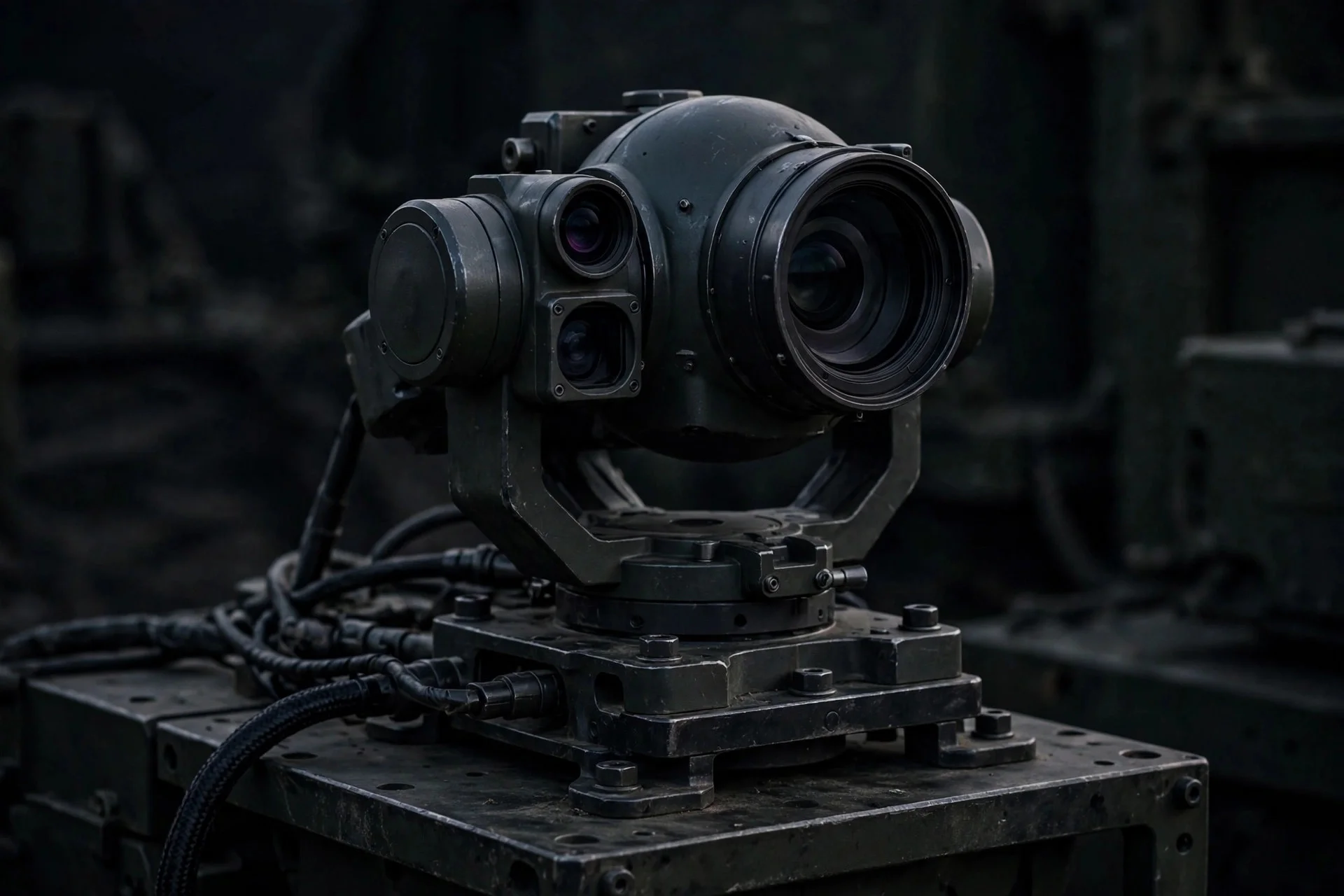
Imagen alusiva de un sensor electroóptico militar montado sobre una plataforma. · Imagen generada por EPM
UK seeks electro-optic sensing ideas with £2.8 million in funding
UK Defence Innovation has launched a themed competition on behalf of Dstl seeking electro-optic sensing technologies, with up to £2.8 million for five to seven…
Britain backs military sensors for contested environments
The United Kingdom has opened an electro-optic sensing competition with up to £2.8 million to strengthen defence across land, maritime, air and space…
--- The context --- Seeing better, earlier and farther has become a decisive advantage for any military force. Electro-optic sensors support threat warning, target detection, discrimination and identification, but contested and degraded environments test their limits amid obscurants, clutter and dim, distant targets.
--- The facts --- UK Defence Innovation, on behalf of the Defence Science and Technology Laboratory, has launched a new Themed Competition seeking cutting-edge electro-optic sensing technologies that can enhance the defence capability of the United Kingdom across land, maritime, air and space environments. The competition is delivered on behalf of the Electro Optic Sensing project and aims to identify technologies that help forces operate more effectively in contested and degraded environments.
Up to £2.8 million in funding, excluding VAT, is available, and that total is expected to support between five and seven projects. Individual proposals can receive up to £600,000, and projects are expected to mature technologies from Technology Readiness Level 3 to Technology Readiness Level 6, a step toward a demonstrable system.
The solutions sought should extend sensing range, improve target recognition, operate through environmental obscurants and provide enhanced situational awareness. The nine challenge areas include infrared active imaging, detection and characterisation of laser sources on the battlefield, automatic target recognition for 3D LiDAR data, machine learning methods for hyperspectral imaging and high resolution imaging through aperture synthesis.
--- The positions --- The organising body presents its two-stage model as a way for innovators to learn quickly whether their idea aligns with defence requirements before investing significant effort in a detailed submission. Stage one is an outline concept, and stage two, a full proposal, is by invitation only. The competition is open only to businesses registered in the United Kingdom, sole traders and British academic institutions, with projects delivered in the country.
--- What remains unknown --- It is not yet known which proposals will be submitted or funded, or which technologies will manage the required jump in maturity. Applicants are asked to read the full competition document and watch the recorded webinar before submitting. Stage one closes at 12 noon GMT on 9 December 2026, with successful applicants progressing to the next phase in early 2027.
--- Unanswered questions --- Can the proposed sensors extend their range without raising costs so far that wider deployment becomes unrealistic? Will they keep working through environmental obscurants and in cluttered environments without losing reliability? Which projects will prove they can mature from level 3 to level 6 within the announced timetable and funding ceiling set for each individual proposal?
--- EPM analysis --- Opening the call to small businesses, sole traders and universities widens the talent base beyond the usual large defence contractors. That openness, combined with a clear ceiling per proposal and a light first stage, lowers the barrier to entry and makes the use of public money in a strategic technology easier to scrutinise. The challenge is ensuring that a broader field of participants produces useful, verifiable systems rather than promising concepts on paper.
📌 EPM Take: In EPM's view, the value of this competition lies in opening a critical technology to those who are normally shut out of major defence programmes. If the selection is rigorous and its results are verifiable, public money can turn ideas from laboratories and small firms into real capability. If, instead, invitations to the second stage concentrate opportunities among the usual players, the openness will remain an announcement and the technological edge will keep depending on very few established suppliers, to the detriment of competition.
--- The context --- On a battlefield crowded with signals, jamming and obscurants, detecting the adversary first can decide the outcome of an operation. Electro-optic sensors underpin threat warning, target detection, discrimination and identification across land, maritime, air and space, and their worth is proven where the environment is contested and degraded.
--- The facts --- UK Defence Innovation, on behalf of the Defence Science and Technology Laboratory, has launched a new Themed Competition seeking cutting-edge electro-optic sensing technologies to strengthen the defence capability of the United Kingdom. Delivered on behalf of the Electro Optic Sensing project, it aims to find technologies that help forces operate more effectively in contested and degraded environments, extending sensing range and improving target recognition and situational awareness.
Funding of up to £2.8 million, excluding VAT, is available, with the total expected to support between five and seven projects. Individual proposals can receive up to £600,000 and must mature their technology from Technology Readiness Level 3 to Technology Readiness Level 6. That requirement matters: it rules out loose ideas and demands measurable progress toward systems that armed forces can actually field and use.
The nine challenge areas include infrared active imaging, detection of laser sources on the battlefield and technologies to counter electromagnetic jamming, detection of dim and distant targets in cluttered environments, low size, weight, power and cost hyperspectral sensors for tactical platforms and high resolution imaging through aperture synthesis.
--- The positions --- The competition organisers defend a two-stage model that filters quickly what fits defence requirements: an outline concept first, then a full proposal by invitation only. Eligibility is limited to businesses registered in the United Kingdom, sole traders and British academic institutions, and projects are expected to be delivered in the country, a condition that keeps the knowledge, the testing and the production under national control.
--- What remains unknown --- Which teams will apply and which solutions will pass the first filter remain unknown, as does whether all funded projects will reach the required maturity. Before submitting, applicants must read the full competition document and watch the recorded webinar. Stage one closes at 12 noon GMT on 9 December 2026, with successful applicants progressing in early 2027.
--- Unanswered questions --- Will the proposed sensors work through environmental obscurants without losing accuracy in target identification when it matters most? Can British industry deliver these capabilities on time without depending on critical components from abroad? Which projects will demonstrate the step from level 3 to level 6 in practice rather than remaining laboratory demonstrations with no path to service?
--- EPM analysis --- The key here is not the amount, modest beside major weapons programmes, but the direction: investing in homegrown eyes for the armed forces across every domain. Requiring delivery in the United Kingdom and demonstrable maturity protects technological sovereignty and stops the funding from scattering into promises with no military application. The risk is the timetable, because a slow selection would deliver the sought advantage late to units already operating in degraded environments today.
📌 EPM Take: In EPM's view, this competition is right to treat electro-optic sensing as a sovereign capability rather than a product to be bought abroad when urgency strikes. The money is limited, but the criteria are sound: projects delivered at home, maturity that must be proven and direct application across land, maritime, air and space. Success will be measured in systems that forces can use in contested environments, not in the number of proposals received or in innovation announcements with no operational follow-through.
Reino Unido busca sensores electroópticos con 2,8 millones de libras
UK Defence Innovation lanzó en nombre de Dstl una competición temática de sensado electroóptico con hasta 2,8 millones de libras para entre cinco y siete…
Londres financia sensores militares para entornos disputados
El Reino Unido abrió una competición de sensores electroópticos con hasta 2,8 millones de libras para reforzar su defensa en tierra, mar, aire y espacio…
--- El contexto --- Ver antes y a mayor distancia es una ventaja decisiva para cualquier fuerza militar. Los sensores electroópticos apoyan la alerta de amenazas, la detección de objetivos, su discriminación y su identificación, pero los entornos disputados y degradados ponen a prueba sus límites ante oscurecedores, saturación visual o blancos lejanos.
--- Los hechos --- UK Defence Innovation, en nombre del Defence Science and Technology Laboratory, lanzó una nueva competición temática que busca tecnologías punteras de sensado electroóptico para mejorar la capacidad de defensa del Reino Unido en tierra, mar, aire y espacio. El concurso se entrega en nombre del proyecto Electro Optic Sensing y busca operar con más eficacia en entornos disputados y degradados.
La financiación disponible llega hasta 2,8 millones de libras, sin incluir el IVA, y con ese total se espera apoyar entre cinco y siete proyectos. Cada propuesta puede recibir hasta 600.000 libras, y los proyectos deben hacer madurar las tecnologías desde el nivel de madurez tecnológica 3 hasta el nivel 6, un salto hacia un sistema demostrable.
Las soluciones buscadas deben ampliar el alcance de sensado, mejorar el reconocimiento de objetivos, operar a través de oscurecedores ambientales y ofrecer mayor conciencia situacional. Entre las nueve áreas de desafío figuran la imagen infrarroja activa, la detección de fuentes láser en el campo de batalla, el sensado submarino, el reconocimiento automático de objetivos para datos LiDAR 3D, el aprendizaje automático para imagen hiperespectral y la imagen por síntesis de apertura.
--- Las posiciones --- La entidad organizadora presenta el modelo en dos fases para que los innovadores comprueben pronto si su idea encaja con las necesidades de defensa. Primero se presenta un concepto resumido y después, solo por invitación, la propuesta completa. La convocatoria queda reservada a empresas registradas en el Reino Unido, autónomos e instituciones académicas británicas, con proyectos entregados en el propio país.
--- Lo que falta saber --- Todavía no se conoce qué propuestas se presentarán ni cuáles recibirán financiación, ni qué tecnologías lograrán el nivel de madurez exigido. La convocatoria pide leer el documento completo del concurso y ver el seminario grabado antes de postular. La primera fase cierra a las 12 del mediodía GMT del 9 de diciembre de 2026 y los seleccionados avanzarán a principios de 2027.
--- Preguntas sin respuesta --- ¿Lograrán las propuestas ampliar el alcance de sensado sin elevar los costos hasta hacer inviable un despliegue amplio? ¿Podrán los sensores rendir a través de oscurecedores ambientales y en entornos saturados sin perder fiabilidad? ¿Qué proyectos madurarán del nivel 3 al nivel 6 dentro del calendario y el techo previstos?
--- Análisis EPM --- El diseño abierto a empresas pequeñas, autónomos y universidades amplía la base de talento más allá de los grandes contratistas habituales de defensa. Esa apertura, unida a un techo claro por propuesta y a una primera fase ligera, reduce la barrera de entrada y hace más transparente el uso de fondos públicos. El reto será que esa diversidad de participantes se traduzca en sistemas útiles y verificables, y no solo en conceptos prometedores.
📌 Conclusion EPM: A juicio de EPM, el valor de esta convocatoria está en abrir una tecnología crítica a quienes normalmente quedan fuera de los grandes programas de defensa. Si el proceso selecciona con rigor y publica resultados verificables, el dinero público puede convertir ideas de laboratorios y empresas pequeñas en capacidad real. Si, en cambio, la invitación a la segunda fase concentra las oportunidades en los actores de siempre, la apertura quedará en anuncio y la ventaja tecnológica seguirá dependiendo de muy pocos proveedores habituales en detrimento de la competencia.
--- El contexto --- En un campo de batalla saturado de señales, interferencias y oscurecedores, detectar primero al adversario puede decidir el resultado de una operación. Los sensores electroópticos sostienen la alerta de amenazas, la detección de objetivos, su discriminación y su identificación en tierra, mar, aire y espacio.
--- Los hechos --- UK Defence Innovation, en nombre del Defence Science and Technology Laboratory, lanzó una nueva competición temática en busca de tecnologías punteras de sensado electroóptico que refuercen la capacidad de defensa del Reino Unido. El concurso se entrega en nombre del proyecto Electro Optic Sensing y busca tecnologías que permitan operar con más eficacia en entornos disputados y degradados, ampliando el alcance de sensado y mejorando el reconocimiento de objetivos y la conciencia situacional.
La financiación llega hasta 2,8 millones de libras, sin incluir el IVA, con la previsión de apoyar entre cinco y siete proyectos. Cada propuesta puede optar a hasta 600.000 libras y debe hacer madurar su tecnología desde el nivel de madurez tecnológica 3 hasta el nivel 6. El salto exigido obliga a demostrar avances medibles hacia sistemas empleables.
Entre las nueve áreas de desafío figuran la imagen infrarroja activa, la detección de fuentes láser en el campo de batalla y las tecnologías contra la interferencia electromagnética, la detección de objetivos tenues y lejanos en entornos saturados y la imagen de alta resolución por síntesis de apertura.
--- Las posiciones --- La organización del concurso defiende un modelo en dos fases para filtrar con rapidez lo que encaja con los requisitos de defensa: primero un concepto resumido y después, solo por invitación, la propuesta completa. La elegibilidad se limita a empresas registradas en el Reino Unido, autónomos e instituciones académicas británicas, y los proyectos deben entregarse en territorio británico, una condición que mantiene el conocimiento bajo control nacional.
--- Lo que falta saber --- Aún no se sabe qué equipos concurrirán ni qué soluciones superarán el filtro inicial, y tampoco si todas lograrán el nivel de madurez exigido. Antes de postular, la convocatoria exige leer el documento completo del concurso y ver el seminario grabado. La primera fase cierra a las 12 del mediodía GMT del 9 de diciembre de 2026 y los seleccionados avanzarán a principios de 2027.
--- Preguntas sin respuesta --- ¿Conseguirán los sensores propuestos operar a través de oscurecedores ambientales sin perder precisión en la identificación de objetivos? ¿Podrá la industria británica entregar estas capacidades a tiempo y sin depender de componentes críticos del exterior? ¿Qué proyectos demostrarán en la práctica el paso del nivel 3 al nivel 6 y no se quedarán en demostraciones de laboratorio?
--- Análisis EPM --- Aquí la clave no es el monto, modesto frente a los grandes programas de armamento, sino la dirección: invertir en ojos propios para las fuerzas armadas en todos los dominios. Exigir entrega en el Reino Unido y madurez demostrable protege la soberanía tecnológica y evita que la financiación se disperse en promesas sin aplicación militar. El riesgo es el calendario: una selección lenta entregaría tarde la ventaja buscada.
📌 Conclusion EPM: A juicio de EPM, esta competición acierta al tratar el sensado electroóptico como una capacidad soberana y no como un producto que se compra fuera cuando surge la urgencia. El dinero es limitado, pero el criterio es correcto: proyectos entregados en casa, madurez exigible y aplicación directa en tierra, mar, aire y espacio. El éxito se medirá en sistemas que las fuerzas puedan usar en entornos disputados, no en el número de propuestas recibidas ni en anuncios de innovación sin recorrido operativo real.