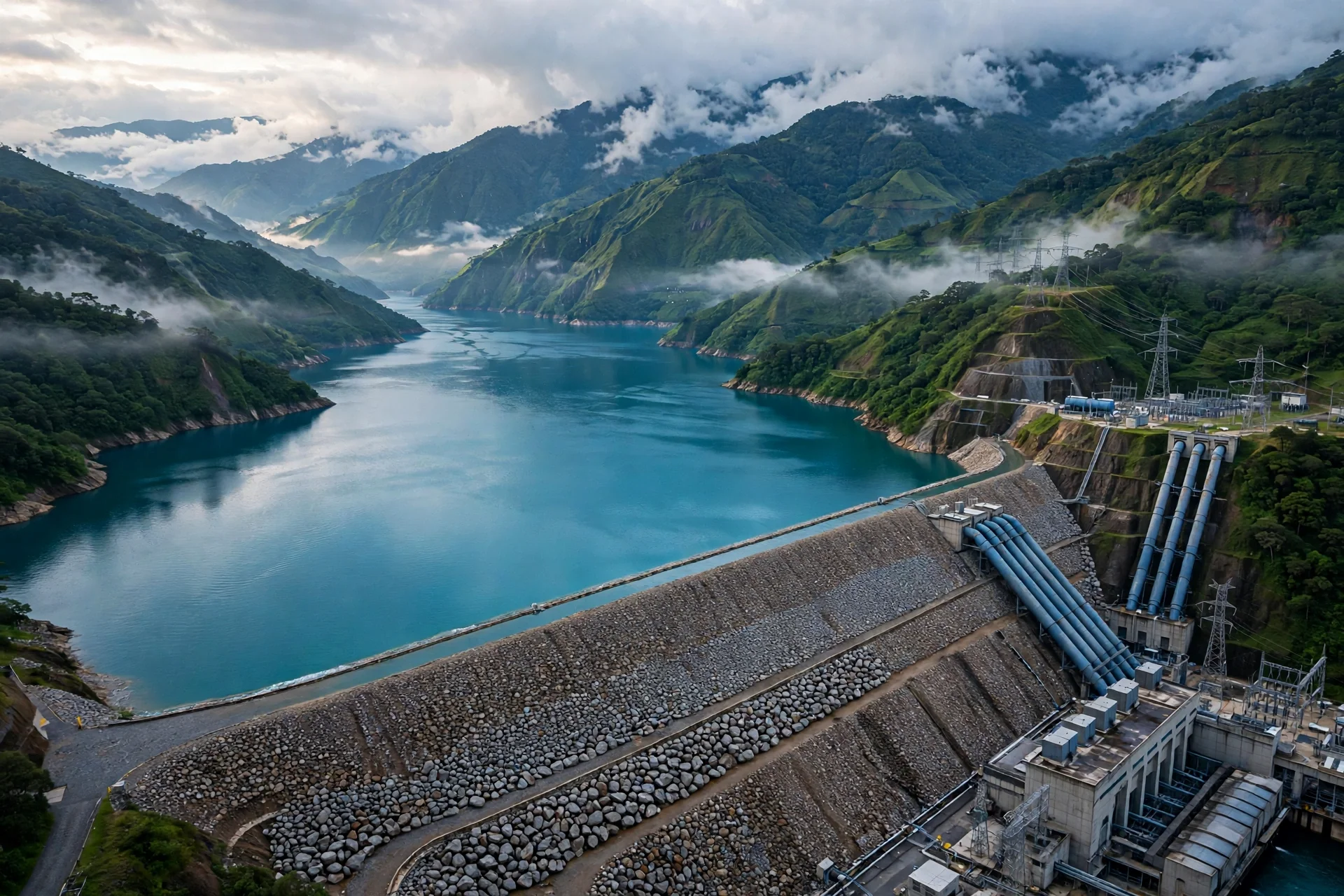
Un embalse hidroeléctrico a su nivel máximo entre montañas, en una imagen alusiva. · Imagen generada
Hidroituango Reaches Level 420 and Strengthens Reserves for El Niño
The Hidroituango reservoir reached level 420, its maximum design level, after environmental authorisation, and accumulated close to 390 million additional…
Hidroituango Hits Its Design Maximum After Years of Costly Delay
Hidroituango reached level 420 after remaining at level 408, added close to 390 million additional cubic metres of reserve and reopened the debate over the…
--- The context ---
Hidroituango has reached its maximum design level at a decisive moment for Colombia. The country is preparing for a season of lower rainfall between December and April, linked to the El Niño phenomenon, and every stored reserve of water takes on strategic value. The plant, still being completed, also carries a long history of construction, a contingency eight years ago and debates over environmental and administrative decisions that shaped its pace.
--- The facts ---
The reservoir reached level 420 metres above sea level, the maximum operating level for which it was designed, after the controlled rise authorised by the National Environmental Licensing Authority on 19 September 2026. Before that decision the reservoir stood at level 408. The difference of 12 metres made it possible to accumulate close to 390 million additional cubic metres of water.
That reserve is equivalent, in energy terms, to the generation of a thermal plant of 130 megawatts or to consumption in Medellín for approximately 15 days. As of 31 October 2026, the project recorded construction progress of 96.47 %, with 4,800 people working to complete the pending units. When the eight turbines are in operation, installed capacity will be 2,400 megawatts, with 300 megawatts per unit, and full operation would make it possible to generate the equivalent of 17 % of the energy Colombia demands. The dam is 225 metres high and the reservoir extends 79 kilometres, with more than 3,600 monitoring instruments able to anticipate risk situations by up to 40 hours.
--- The positions ---
Medellín mayor Federico Gutiérrez held that the previous government kept the reservoir at level 408 and that this decision put the country's energy security at risk, and he went so far as to state that the sector's crisis had been deliberately provoked. In his account, the change of government made it possible to unlock the authorisation, and the October rains helped reach the maximum level before the most demanding stage of El Niño.
Environment minister Fabio Alberto Arjona Hincapié defended the rise and questioned the earlier removal of plant material, holding that this intervention represented an investment of 36,000 million pesos that was not necessary. The environmental authority's director, Sergio Arturo Piñeros Botero, explained in turn that the operation has been carried out within the authorised parameters and that, so far, no effects on water quality and no changes in the dam's natural seepage have been identified.
Antioquia governor Andrés Julián Rendón stressed that income derived from the settlement and from generation exceeded 600,000 million pesos this year, and that the resources will make it possible to finance the regional aqueduct for Turbo, Apartadó and Carepa, with investment above 1.6 trillion pesos. Energy minister María Nohemí Arboleda Arango compared the reservoir to a storage battery, underlined the reassurance it brings in the face of El Niño and called on households, businesses and industry to save energy.
--- What remains unknown ---
The verified evolution of water quality over the coming months remains to be known, along with the concrete progress of the pending works in the southern zone of the powerhouse cavern and the assembly schedule for the units that have yet to enter operation. Nor is the public debate closed over the decisions that kept the reservoir below its design level, because the political claims made at the event do not amount to a complete documentary verification.
--- Unanswered questions ---
Will the environmental authority publish periodic, comparable measurements of water quality after the rise to level 420? On what dates will the pending units enter operation until the capacity of 2,400 megawatts is completed? How will the resources destined for the regional aqueduct of Turbo, Apartadó and Carepa be executed, under what timetable and with what public oversight?
--- EPM analysis ---
The central fact is not only technical: a larger reserve reduces the system's vulnerability in the dry months and turns water stored today into room for manoeuvre tomorrow. At the same time, the project links energy, environment and regional development, because the income it generates can be translated into continuous drinking water for municipalities that waited for years for their aqueduct. The demand that follows is double and practical: transparent environmental monitoring and rigorous completion of the works, without the celebration of the milestone replacing permanent verification of every commitment made.
📌 EPM Take:
In EPM's view, reaching level 420 is good news for Colombia's energy security because it adds 390 million cubic metres of reserve before the most demanding months of El Niño and brings closer a plant able to supply 17 % of national demand. The public value of the milestone, however, will be measured by what follows: water quality verified with open data, constant monitoring downstream, full completion of the pending units and transparent execution of the resources that must become drinking water for Turbo, Apartadó and Carepa in the coming years ahead.
--- The context ---
For years, Hidroituango operated below the level for which it was designed. The reservoir remained at level 408 while the country debated environmental risks, administrative decisions and the future of its largest hydroelectric plant. That brake carried an evident opportunity cost: less water stored ahead of an announced dry season and less margin for an electricity system that cannot rely on improvisation when rainfall falls between December and April.
--- The facts ---
After the authorisation granted by the National Environmental Licensing Authority on 19 September 2026, the controlled rise took the reservoir to level 420 metres above sea level, its maximum operating level. The difference of 12 metres made it possible to store close to 390 million additional cubic metres of water, a key reserve in the face of the El Niño phenomenon.
That quantity is equivalent, in energy terms, to a thermal plant of 130 megawatts or to consumption in Medellín for approximately 15 days. As of 31 October 2026 construction progress stood at 96.47 %, with 4,800 workers dedicated to finishing the pending units. With the eight turbines in operation, the plant will total 2,400 megawatts of installed capacity, at 300 megawatts per unit, and will be able to generate the equivalent of 17 % of the energy Colombia demands. The dam reaches 225 metres in height, the reservoir extends 79 kilometres and the surveillance network exceeds 3,600 instruments, with anticipation capacity of up to 40 hours in the face of situations that endanger communities downstream.
--- The positions ---
Medellín mayor Federico Gutiérrez stated that the previous government unjustifiably kept the reservoir at level 408, that this decision put energy security at risk and that the sector's crisis had been deliberately provoked. In his reading, the change of government made it possible to unlock the authorisation, and the October rains made it easier to reach the maximum level before the most intense phase of El Niño. He also recalled the contingency of eight years ago and valued the work of the teams that sustained the project.
Environment minister Fabio Alberto Arjona Hincapié questioned the removal of plant material ordered in the earlier stage and held that it cost 36,000 million pesos that were not required. The environmental authority's director, Sergio Arturo Piñeros Botero, pointed instead to the technical plane: in his explanation, the operation has been carried out within the authorised parameters, with no identified effects on water quality and no changes in the dam's natural seepage, and monitoring will continue.
Antioquia governor Andrés Julián Rendón underlined the project's economic return: this year more than 600,000 million pesos came in from the settlement and generation, and the surpluses will make it possible to finance the regional aqueduct for Turbo, Apartadó and Carepa, with investment above 1.6 trillion pesos. Energy minister María Nohemí Arboleda Arango described the reservoir as a battery for the system, asked for calm in the face of El Niño and, at the same time, called on households, businesses and industry to consume with saving and responsibility.
--- What remains unknown ---
The full closure of the works is still missing: the pending tasks in the southern zone of the powerhouse cavern, the assembly of the equipment for the remaining units and the definitive calendar for the entry of each one. Also missing is a settlement of the debate over the years of restriction with documents and clear responsibilities, and not only with crossed statements at a public event, however grounded or exaggerated they may prove to be.
--- Unanswered questions ---
What did it cost the country, in energy not stored and in risk assumed, to keep the reservoir at level 408 during that period? Which authority will answer for the 36,000 million pesos invested in a plant removal that the current Government itself now considers unnecessary? Will the completion timetable be met until the eight units deliver the planned 2,400 megawatts?
--- EPM analysis ---
The underlying lesson is one of management: when a strategic work becomes trapped between precautions without technical closure and decisions that are delayed, users pay the cost in the form of risk. Level 420 does not erase that history, but it does correct its practical effect by storing today the water that will be needed tomorrow. The immediate challenge is to finish what remains with the same determination, to keep monitoring without pause and to protect the project's income from any use other than the works and services that justify it.
📌 EPM Take:
In EPM's view, reaching level 420 corrects a restriction that left Colombia with less reserve just when El Niño demanded more foresight, and it shows that unlocking a strategic work with verifiable technical controls yields more than prolonging its paralysis. The plant already provides a reserve equivalent to 390 million additional cubic metres and promises 2,400 megawatts when it operates in full. What is now required is to finish it without new delays, to account for the costs of the wait and to turn its income into concrete results, starting with the committed regional aqueduct in the coming years.
Hidroituango llega a la cota 420 y refuerza la reserva ante El Niño
El embalse de Hidroituango alcanzó la cota 420, su nivel máximo de diseño, tras la autorización ambiental, y acumuló cerca de 390 millones de metros cúbicos…
Hidroituango alcanza su nivel máximo tras años de espera y restricciones
Hidroituango llegó a la cota 420 después de permanecer en la cota 408, sumó cerca de 390 millones de metros cúbicos adicionales de reserva y reabrió el debate…
--- El contexto ---
Hidroituango llega a su nivel máximo de diseño en un momento decisivo para Colombia. El país se prepara para una temporada de menores precipitaciones entre diciembre y abril, asociada al fenómeno de El Niño, y cada reserva de agua almacenada adquiere un valor estratégico. La central, todavía en terminación, concentra además una historia larga de obras, una contingencia ocurrida hace ocho años y debates sobre decisiones ambientales y administrativas que marcaron su ritmo.
--- Los hechos ---
El embalse alcanzó la cota 420 metros sobre el nivel del mar, el nivel máximo de operación para el que fue diseñado, tras la autorización de ascenso controlado concedida por la Autoridad Nacional de Licencias Ambientales el 19 de septiembre de 2026. Antes de esa decisión el embalse se encontraba en la cota 408. Los 12 metros de diferencia permitieron acumular cerca de 390 millones de metros cúbicos adicionales de agua.
Esa reserva equivale, en términos energéticos, a la generación de una planta térmica de 130 megavatios o al consumo de Medellín durante aproximadamente 15 días. Con corte al 31 de octubre de 2026, el proyecto registra un avance constructivo del 96,47 %, con 4.800 personas trabajando en la terminación de las unidades pendientes. Cuando las ocho turbinas estén en funcionamiento, la capacidad instalada será de 2.400 megavatios, con 300 megavatios por unidad, y la operación total permitiría generar el equivalente al 17 % de la energía que demanda Colombia. La presa tiene 225 metros de altura y el embalse, 79 kilómetros de extensión, con más de 3.600 instrumentos de monitoreo capaces de anticipar situaciones de riesgo con hasta 40 horas.
--- Las posiciones ---
El alcalde de Medellín, Federico Gutiérrez, sostuvo que el gobierno anterior mantuvo el embalse en la cota 408 y que esa decisión puso en riesgo la seguridad energética del país, y llegó a afirmar que la crisis del sector habría sido provocada deliberadamente. Según su planteamiento, el cambio de gobierno permitió destrabar la autorización y las lluvias de octubre ayudaron a alcanzar el nivel máximo antes de la etapa más exigente de El Niño.
El ministro de Ambiente, Fabio Alberto Arjona Hincapié, defendió el ascenso y cuestionó la remoción de material vegetal realizada antes, al sostener que esa intervención representó una inversión de 36.000 millones de pesos que no era necesaria. El director de la autoridad ambiental, Sergio Arturo Piñeros Botero, explicó por su parte que la operación se ha desarrollado dentro de los parámetros autorizados y que, hasta el momento, no se han identificado afectaciones en la calidad del agua ni cambios en las filtraciones naturales de la presa.
El gobernador de Antioquia, Andrés Julián Rendón, destacó que los ingresos derivados de la conciliación y de la generación superaron este año los 600.000 millones de pesos, y que los recursos permitirán financiar el acueducto regional de Turbo, Apartadó y Carepa, con inversiones superiores a 1,6 billones de pesos. La ministra de Minas y Energía, María Nohemí Arboleda Arango, comparó el embalse con una batería de almacenamiento, subrayó la tranquilidad que aporta frente a El Niño y llamó a hogares, empresas e industria a ahorrar energía.
--- Lo que falta saber ---
Falta conocer la evolución verificada de la calidad del agua durante los próximos meses, el avance concreto de las obras pendientes en la zona sur de la caverna de máquinas y el ritmo de montaje de las unidades que aún no entran en operación. Tampoco está cerrado el debate público sobre las decisiones que mantuvieron el embalse por debajo de su nivel de diseño, porque las afirmaciones políticas formuladas en el acto no equivalen a una comprobación documental completa.
--- Preguntas sin respuesta ---
¿Publicará la autoridad ambiental mediciones periódicas y comparables de la calidad del agua tras el ascenso a la cota 420? ¿En qué fechas entrarán en operación las unidades pendientes hasta completar la capacidad de 2.400 megavatios? ¿Cómo se ejecutarán, con qué cronograma y con qué control público, los recursos destinados al acueducto regional de Turbo, Apartadó y Carepa?
--- Análisis EPM ---
El dato central no es solo técnico: una reserva mayor reduce la vulnerabilidad del sistema en los meses secos y convierte el agua guardada hoy en margen de maniobra mañana. Al mismo tiempo, el proyecto enlaza energía, ambiente y desarrollo regional, porque los ingresos que genera pueden traducirse en agua potable continua para municipios que esperaron durante años su acueducto. La exigencia que sigue es doble y práctica: monitoreo ambiental transparente y terminación rigurosa de la obra, sin que la celebración del hito sustituya la verificación permanente de cada compromiso asumido.
📌 Conclusion EPM:
A juicio de EPM, alcanzar la cota 420 es una buena noticia para la seguridad energética de Colombia porque suma 390 millones de metros cúbicos de reserva antes de los meses más exigentes de El Niño y acerca una central capaz de aportar el 17 % de la demanda nacional. El valor público del hito, sin embargo, se medirá en lo que sigue: calidad del agua verificada con datos abiertos, monitoreo constante aguas abajo, terminación completa de las unidades pendientes y una ejecución transparente de los recursos que deben convertirse en agua potable para Turbo, Apartadó y Carepa en los próximos años.
--- El contexto ---
Durante años, Hidroituango operó por debajo del nivel para el que fue diseñado. El embalse permaneció en la cota 408 mientras el país discutía riesgos ambientales, decisiones administrativas y el futuro de su mayor central hidroeléctrica. Ese freno tuvo un costo de oportunidad evidente: menos agua guardada frente a una temporada seca anunciada y menos margen para un sistema eléctrico que no puede depender de la improvisación cuando bajan las precipitaciones entre diciembre y abril.
--- Los hechos ---
Tras la autorización concedida por la Autoridad Nacional de Licencias Ambientales el 19 de septiembre de 2026, el ascenso controlado llevó el embalse a la cota 420 metros sobre el nivel del mar, su nivel máximo de operación. La diferencia de 12 metros permitió almacenar cerca de 390 millones de metros cúbicos adicionales de agua, una reserva clave ante el fenómeno de El Niño.
Esa cantidad equivale, en términos energéticos, a una planta térmica de 130 megavatios o al consumo de Medellín durante aproximadamente 15 días. Al 31 de octubre de 2026 el avance constructivo era del 96,47 %, con 4.800 trabajadores dedicados a terminar las unidades pendientes. Con las ocho turbinas en funcionamiento, la central sumará 2.400 megavatios de capacidad instalada, a razón de 300 megavatios por unidad, y podrá generar el equivalente al 17 % de la energía que demanda Colombia. La presa alcanza 225 metros de altura, el embalse se extiende 79 kilómetros y la red de vigilancia supera los 3.600 instrumentos, con capacidad de anticipación de hasta 40 horas frente a situaciones que comprometan a las comunidades aguas abajo.
--- Las posiciones ---
El alcalde de Medellín, Federico Gutiérrez, afirmó que el gobierno anterior mantuvo injustificadamente el embalse en la cota 408, que esa decisión puso en riesgo la seguridad energética y que la crisis del sector habría sido provocada deliberadamente. En su lectura, el cambio de gobierno permitió destrabar la autorización, y las lluvias de octubre facilitaron llegar a la cota máxima antes de la fase más intensa de El Niño. También recordó la contingencia de hace ocho años y valoró el trabajo de los equipos que sostuvieron el proyecto.
El ministro de Ambiente, Fabio Alberto Arjona Hincapié, cuestionó la remoción de material vegetal ordenada en la etapa anterior y sostuvo que costó 36.000 millones de pesos que no se requerían. El director de la autoridad ambiental, Sergio Arturo Piñeros Botero, señaló en cambio el plano técnico: según su explicación, la operación se ha desarrollado dentro de los parámetros autorizados, sin afectaciones identificadas en la calidad del agua ni cambios en las filtraciones naturales de la presa, y el seguimiento continuará.
El gobernador de Antioquia, Andrés Julián Rendón, subrayó el rendimiento económico del proyecto: este año ingresaron más de 600.000 millones de pesos por conciliación y generación, y los excedentes permitirán financiar el acueducto regional de Turbo, Apartadó y Carepa, con inversiones superiores a 1,6 billones de pesos. La ministra de Minas y Energía, María Nohemí Arboleda Arango, describió el embalse como una batería para el sistema, pidió tranquilidad frente a El Niño y, a la vez, llamó a hogares, empresas e industria a consumir con ahorro y responsabilidad.
--- Lo que falta saber ---
Todavía falta el cierre completo de la obra: las tareas pendientes en la zona sur de la caverna de máquinas, el montaje de los equipos de las unidades restantes y el calendario definitivo de entrada de cada una. Falta también que el debate sobre los años de restricción se resuelva con documentos y responsabilidades claras, y no solo con declaraciones cruzadas en un acto público, por fundadas o exageradas que resulten.
--- Preguntas sin respuesta ---
¿Cuánto costó al país, en energía no almacenada y en riesgo asumido, mantener el embalse en la cota 408 durante ese periodo? ¿Qué autoridad responderá por los 36.000 millones de pesos invertidos en una remoción vegetal que hoy el propio Gobierno considera innecesaria? ¿Se cumplirá el cronograma de terminación hasta que las ocho unidades entreguen los 2.400 megavatios previstos?
--- Análisis EPM ---
La lección de fondo es de gestión: cuando una obra estratégica queda atrapada entre precauciones sin cierre técnico y decisiones que se dilatan, el costo lo pagan los usuarios en forma de riesgo. La cota 420 no borra esa historia, pero sí corrige su efecto práctico al guardar hoy el agua que hará falta mañana. El reto inmediato es terminar lo que falta con la misma determinación, mantener el monitoreo sin pausa y proteger los ingresos del proyecto de cualquier uso distinto a las obras y servicios que lo justifican.
📌 Conclusion EPM:
A juicio de EPM, llegar a la cota 420 corrige una restricción que dejó a Colombia con menos reserva justo cuando El Niño exigía más previsión, y demuestra que destrabar una obra estratégica con controles técnicos verificables rinde más que prolongar su parálisis. La central aporta ya una reserva equivalente a 390 millones de metros cúbicos adicionales y promete 2.400 megavatios cuando opere completa. Lo que ahora corresponde es terminarla sin nuevas dilaciones, rendir cuentas por los costos de la espera y convertir sus ingresos en resultados concretos, empezando por el acueducto regional comprometido para los próximos años.