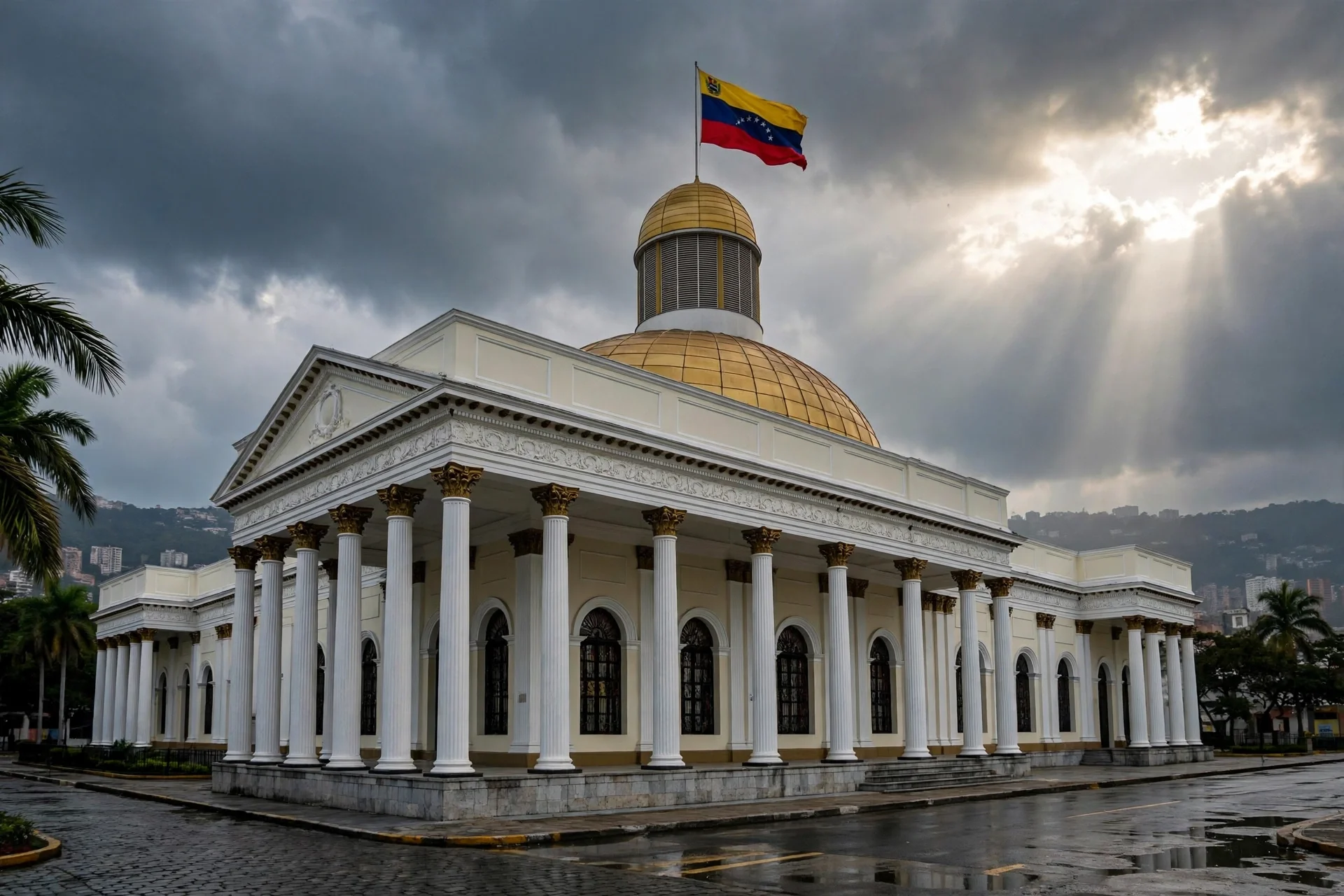
El palacio legislativo de Caracas, en una imagen alusiva a la reorganización institucional anunciada para Venezuela. · Imagen generada
Rubio Says Venezuela Will Get New Top Court in December
Secretary of State Marco Rubio announced in Paris that Venezuela could have new Supreme Tribunal of Justice justices by mid December and a new National…
Venezuela to Renew Court and Election Authority Before Voting
Secretary of State Marco Rubio confirmed in Paris that Venezuela will renew its Supreme Tribunal of Justice by mid December and then form a new National…
--- The context ---
Venezuela is undergoing an institutional reorganization promoted by Washington after the capture of Nicolás Maduro, with the stated goal of creating the conditions needed to hold presidential elections with guarantees. The process is part of the transition scheme advanced by the administration of Donald Trump.
Within that framework, renewing the judiciary and the electoral authority is a central stage, because without renewed institutions a presidential call would lack, in the United States position, the institutional guarantees that the process itself requires in order to be credible for citizens at home and abroad.
--- The facts ---
United States Secretary of State Marco Rubio announced in Paris, where he took part in a G7 meeting, that Venezuela could have new justices on the Supreme Tribunal of Justice by mid December and that a new National Electoral Council would be formed shortly afterward.
Rubio told reporters that talks among the parties involved are continuing and that there is room to meet the established timetable. He said progress so far has been good and that the work now is to stay attentive and make sure the agreed deadlines can actually be met.
--- The positions ---
Washington considers the reorganization of the judiciary and the electoral authority indispensable for moving toward a presidential call with institutional guarantees. Rubio stressed that both steps are fundamental within the schedule and must be completed before the process moves on to its following stages.
For the process to be credible, Rubio also pointed to the need for a renewed judicial system, an electoral authority with administrative functions and not subordinated to partisan interests, and media outlets able to work without restrictions across the country throughout the entire transition period ahead.
--- What remains unknown ---
The roadmap provides that, once the new authorities are in place, interim President Delcy Rodríguez would declare the Presidency vacant, opening a six month period to organize and hold presidential elections. Political and operational questions remain unresolved, however, including how the more than seven million Venezuelans living abroad will be able to cast their vote.
--- Unanswered questions ---
How will the new Supreme Tribunal justices and the members of the new National Electoral Council be selected in practice? What concrete mechanisms will allow more than seven million Venezuelans living abroad to exercise their right to vote? Will consulates in the United States, currently closed, reopen in time for those residents to cast ballots?
--- EPM analysis ---
The announcement gives the transition, for the first time, a verifiable sequence: first the courts, then the electoral authority, and only afterward the presidential vacancy and the six month clock. The weakest link remains operational, because guaranteeing the overseas vote requires consulates, registries and logistics that today do not exist for millions of people spread across many countries.
📌 EPM Take: In EPM's view, the importance of the Paris announcement is that it turns a diffuse transition into a sequence with dates, responsible parties and verifiable steps, making compliance measurable in December. The decisive test will not be naming justices and council members alone, but making the vote of more than seven million Venezuelans abroad real and verifiable, with open consulates and clear rules for every participant in the Venezuelan electoral process ahead.
--- The context ---
After the capture of Nicolás Maduro, Venezuela entered a phase of institutional reorganization aimed at restoring constitutional order and preparing a presidential election. The plan promoted by Washington places two key institutions at its center: the country's highest court and its national electoral body.
Without a renewed judiciary or a trustworthy electoral authority, any call to the polls would be questioned from the start. That is why the schedule presented in Paris orders the institutions first and leaves the larger political decision for later: the formal declaration of a presidential vacancy and the opening of the electoral calendar.
--- The facts ---
Marco Rubio, the United States Secretary of State, confirmed in Paris, during a G7 meeting, that Venezuela would have new Supreme Tribunal of Justice justices by mid December and that a new National Electoral Council would be established shortly afterward.
Rubio said talks among the parties involved are continuing and that there is room to meet the deadlines. He stated that good progress is being made and that the task is to stay attentive in order to ensure the planned timetable is fulfilled without deviations from the agreed schedule.
--- The positions ---
The administration of Donald Trump considers judicial and electoral reorganization an indispensable condition for a presidential call with guarantees. Rubio insisted both steps are fundamental and added other credibility requirements: a renewed judiciary, an administrative and nonpartisan electoral authority, and a press able to work without restrictions.
On the domestic political front, Rubio noted that María Corina Machado and other opposition leaders have been in the country for more than two weeks without being detained, holding press conferences and with full internet access. Machado, the 2025 Nobel Peace Prize winner, returned on October 25 after almost ten months abroad.
--- What remains unknown ---
Once the institutional stage is complete, interim President Delcy Rodríguez would declare the Presidency vacant and a six month period to organize the elections would begin. Still unresolved is the participation of the more than seven million Venezuelans abroad, an issue discussed last week in Washington with Foreign Minister Oliver Blanco, and the reopening of consulates in the United States, currently closed.
--- Unanswered questions ---
Will the interim president declare the vacancy as soon as the new judicial and electoral authorities are in place? What guarantees will the new justices and council members have against partisan pressure during the process? Will Venezuelans living in the United States be able to vote effectively if consulates remain closed in the coming months?
--- EPM analysis ---
The announced design bets on sequence over haste: institutions first, election afterward. That logic protects the legitimacy of the result, but it also concentrates risk in two appointments that must be perceived as technical rather than a simple change of control, plus an overseas vote that still lacks needed infrastructure.
📌 EPM Take: In EPM's view, the roadmap gains strength because it subordinates the presidential election to prior institutions capable of refereeing it, rather than the reverse, as has happened so often in the region. Its weak point is practical: without open consulates and a reliable overseas registry, millions of citizens would be left out of the country's most important decision, and that exclusion would damage the very legitimacy this institutional process seeks to build from the start.
Rubio anuncia nuevo TSJ en diciembre y ruta hacia elecciones en Venezuela
Marco Rubio anunció en París que Venezuela tendrá nuevos magistrados del Tribunal Supremo de Justicia a mediados de diciembre y después un nuevo Consejo…
Venezuela renovará su justicia y su autoridad electoral antes de votar
El secretario de Estado Marco Rubio confirmó en París que Venezuela renovará su Tribunal Supremo de Justicia a mediados de diciembre y conformará luego un…
--- El contexto ---
Venezuela atraviesa una reorganización institucional impulsada desde Washington tras la captura de Nicolás Maduro, con el objetivo de crear las condiciones para celebrar elecciones presidenciales con garantías. El proceso forma parte del esquema de transición que impulsa la administración de Donald Trump para el país.
En ese marco, la renovación del Poder Judicial y de la autoridad electoral aparece como una etapa central, porque sin instituciones renovadas la convocatoria presidencial carecería, según la posición estadounidense, de las garantías institucionales que el propio proceso requiere para resultar creíble ante la ciudadanía.
--- Los hechos ---
El secretario de Estado de Estados Unidos, Marco Rubio, anunció en París, donde participó en una reunión del G7, que Venezuela podría contar con nuevos magistrados del Tribunal Supremo de Justicia a mediados de diciembre y que poco después se conformará un nuevo Consejo Nacional Electoral.
Rubio sostuvo ante periodistas que las conversaciones entre las partes involucradas continúan y que existe margen para cumplir los tiempos establecidos. Según explicó, el avance se mantiene conforme a lo previsto y el progreso es bueno, siempre que se mantenga la atención sobre los plazos.
--- Las posiciones ---
Washington considera que la reorganización del Poder Judicial y de la autoridad electoral es indispensable para avanzar hacia una convocatoria presidencial con garantías institucionales. Rubio remarcó además que ambos pasos son fundamentales dentro del cronograma y que deben cumplirse antes de pasar a las etapas siguientes.
Para que el proceso tenga credibilidad, Rubio señaló también la necesidad de un sistema judicial renovado, una autoridad electoral con funciones administrativas y no subordinada a intereses partidarios, y medios de comunicación que puedan trabajar sin restricciones en el país durante todo el proceso.
--- Lo que falta saber ---
La hoja de ruta contempla que, una vez constituidas las nuevas autoridades, la presidenta interina Delcy Rodríguez declare vacante la Presidencia, lo que abriría un período de seis meses para organizar y celebrar elecciones presidenciales. Todavía quedan, sin embargo, cuestiones políticas y operativas por resolver, entre ellas cómo votarán los más de siete millones de venezolanos que residen en el exterior.
--- Preguntas sin respuesta ---
¿Cómo se elegirá a los nuevos magistrados del Tribunal Supremo de Justicia y a los integrantes del nuevo Consejo Nacional Electoral? ¿Qué mecanismos concretos permitirán votar a los más de siete millones de venezolanos que viven fuera del país? ¿Se abrirán a tiempo los consulados en Estados Unidos, hoy cerrados, para que esos residentes puedan sufragar?
--- Análisis EPM ---
El anuncio ordena por primera vez un calendario verificable: primero la justicia, después la autoridad electoral y solo entonces la vacancia presidencial y el plazo de seis meses. El eslabón más frágil sigue siendo operativo, porque garantizar el voto exterior exige consulados, registros y logística que hoy no existen para millones de personas repartidas por el mundo.
📌 Conclusion EPM: A juicio de EPM, el valor del anuncio de París reside en que convierte una transición difusa en una secuencia con fechas, responsables y pasos comprobables, lo que permite medir el cumplimiento en diciembre. La prueba decisiva no será solo nombrar magistrados y rectores, sino lograr que el voto de más de siete millones de venezolanos en el exterior sea real y verificable, con consulados abiertos y reglas claras para todos los participantes del proceso electoral venezolano venidero.
--- El contexto ---
Tras la captura de Nicolás Maduro, Venezuela entró en una fase de reorganización institucional orientada a restablecer el orden constitucional y preparar una elección presidencial. El plan que impulsa Washington coloca en el centro la reconstrucción de dos instituciones consideradas clave: el máximo tribunal y el organismo electoral del país.
Sin un Poder Judicial renovado ni una autoridad electoral confiable, cualquier convocatoria a las urnas nacería cuestionada. Por eso el cronograma presentado en París ordena primero las instituciones y deja para después la decisión política mayor: la declaración formal de vacancia de la Presidencia y la apertura del calendario electoral.
--- Los hechos ---
Marco Rubio, secretario de Estado de Estados Unidos, confirmó en París, en el marco de una reunión del G7, que a mediados de diciembre Venezuela tendría nuevos magistrados del Tribunal Supremo de Justicia y que poco después se establecerá un nuevo Consejo Nacional Electoral.
Según dijo Rubio, las conversaciones entre las partes continúan y hay margen para cumplir los plazos. El funcionario afirmó que hay buen progreso y que el trabajo consiste en mantenerse atentos para que los tiempos previstos se cumplan sin desviaciones.
--- Las posiciones ---
La administración de Donald Trump considera la reorganización judicial y electoral una condición indispensable para una convocatoria presidencial con garantías. Rubio insistió en que se trata de dos pasos fundamentales y añadió otros requisitos de credibilidad: justicia renovada, autoridad electoral administrativa y no partidista, y prensa que trabaje sin restricciones.
En el plano político interno, Rubio destacó que María Corina Machado y otros dirigentes opositores llevan más de dos semanas en el país sin ser detenidos, dando conferencias de prensa y con acceso total a internet. Machado, Premio Nobel de la Paz de 2025, regresó el 25 de octubre tras casi diez meses fuera.
--- Lo que falta saber ---
Superada la etapa institucional, la presidenta interina Delcy Rodríguez declararía vacante la Presidencia y se abriría un período de seis meses para organizar las elecciones. Queda por resolver la participación de los más de siete millones de venezolanos en el exterior, tema tratado la semana pasada en Washington con el canciller Oliver Blanco, y la reapertura de consulados en Estados Unidos, hoy cerrados.
--- Preguntas sin respuesta ---
¿Declarará la presidenta interina la vacancia en cuanto se constituyan las nuevas autoridades judiciales y electorales? ¿Qué garantías tendrán los nuevos magistrados y rectores frente a presiones partidarias durante el proceso? ¿Podrán votar efectivamente los venezolanos residentes en Estados Unidos si los consulados permanecen cerrados durante los próximos meses?
--- Análisis EPM ---
El diseño anunciado apuesta por la secuencia antes que por la prisa: instituciones primero, elección después. Esa lógica protege la legitimidad del resultado, pero también concentra el riesgo en dos nombramientos que deberán percibirse como técnicos y no como un simple relevo de controles, además de un voto exterior sin infraestructura disponible.
📌 Conclusion EPM: A juicio de EPM, la hoja de ruta gana solidez porque subordina la elección presidencial a instituciones previas capaces de arbitrarla, y no al revés, como tantas veces ocurrió en la región. Su punto débil es práctico: sin consulados abiertos ni un registro exterior confiable, millones de ciudadanos quedarían fuera de la decisión más importante del país, y esa exclusión dañaría la legitimidad que todo el proceso institucional busca construir desde el inicio.