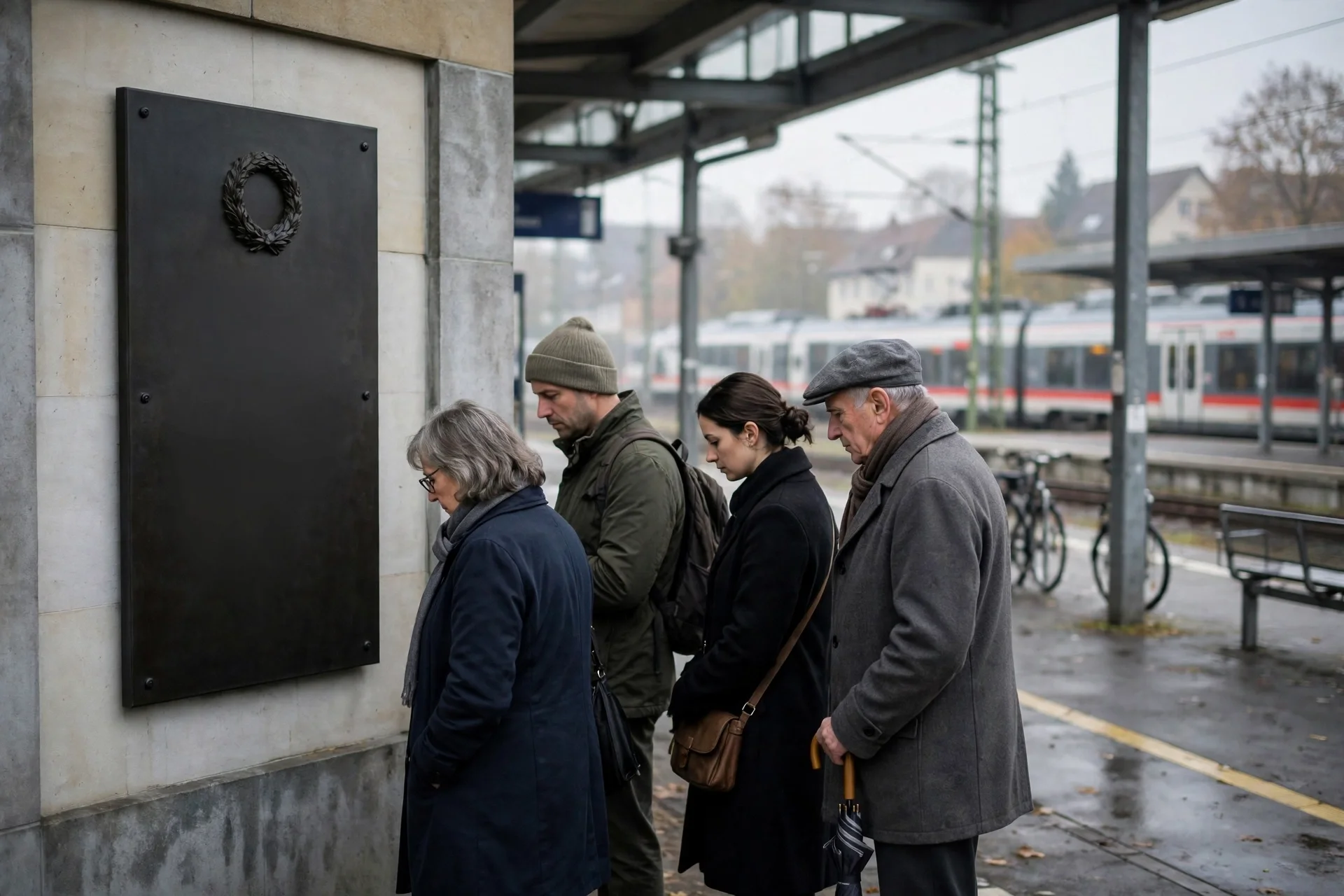
Una placa conmemorativa en una estación y visitantes en silencio, en una imagen alusiva. · Imagen generada
Thirteen German stations now recall Nazi deportation and persecution
MemoRails created 13 remembrance places at German stations linked to Nazi deportation, forced labor and persecution, with public and EVZ Foundation funding…
MemoRails brings Nazi history remembrance to thirteen German stations
Thirteen German stations now carry signs and educational programs about their role in Nazi deportation and persecution under MemoRails, whose results will be…
--- The context ---
During National Socialism, railway stations in Germany were places of deportation, forced labor and persecution. From those platforms, many persecuted people began journeys from which they did not return, turning everyday infrastructure into part of the Nazi crimes.
--- The facts ---
MemoRails has created new places of remembrance at 13 stations: Meppen, Cottbus, Weiden, Trebnitz, Ober-Roden, Neumünster, Köln-Deutz, Böhlen, Göttingen, Birkenwerder, Meiningen, Königstein and Berlin. Associations, educational institutions, memorial sites and municipalities researched local Nazi history and turned it into memorial signs, exhibitions, tours and artistic and digital educational offers.
Funding came through a one-time contribution of one million euros from the Federal Government Commissioner for Culture and the Media, plus another 100,000 euros from the EVZ Foundation, in cooperation with Deutsche Bahn. The railway supported installing the signs and will preserve them.
In Meppen, the Spuren der Nachbarn project by VHS Meppen examines the station's role and remembers the people deported from there to the Emsland camps, through a city rally, educational materials and art workshops. In Birkenwerder, VON HIER AUS centers on Ruth Winkelmann, a Jewish survivor, as children and young people explore how exclusion shaped everyday life.
--- The positions ---
Wolfram Weimer, Minister of State for Culture and the Media, said in indirect terms that remembrance needs every person and that the projects show people making forgotten stories of persecution, forced labor and murder visible. Andrea Despot, chair of the EVZ Foundation, said local research and personal life stories carry the memory of Nazi crimes into the present and into everyday municipal life.
Katja Hüske, board member for passenger stations at DB InfraGO, noted that stations today stand for encounter and arrival, but that under the Nazis many persecuted people began there a journey of no return to the extermination camps. She added that taking part in MemoRails aims to build public awareness of that history and of why it must never repeat itself.
--- What remains unknown ---
The results will be presented at the DB Museum in Nuremberg from November 13, 2026 to February 28, 2027, with an opening on November 12, 2026. Large-format panels will present selected projects in detail, digital content through QR codes will deepen individual stories, and the display will place them in the context of the German Reichsbahn under National Socialism.
--- Unanswered questions ---
How will the use of the educational materials at each station be measured in the coming years? What follow-up will the tours and workshops receive once the Nuremberg presentation ends? How will schools and residents take part in the everyday care of these places of remembrance?
--- EPM analysis ---
MemoRails is right not to confine remembrance to the best-known memorial sites. By placing it in stations used every day, the program forces a look at the past where part of the persecution unfolded, and connects local research with travelers and students.
📌 EPM Take:
In EPM's view, MemoRails shows that the strongest remembrance grows when a station stops being only a place of transit and becomes a permanent public classroom. Thirteen places do not settle a historic debt, but they do widen the map of shared responsibility. If the signs are preserved, the materials are used and young people keep asking questions, the program will have achieved something more valuable than an opening: it will have placed memory inside routine, where forgetting usually advances without resistance.
--- The context ---
German stations were not neutral places during National Socialism. They were points of deportation, forced labor and persecution, from which many victims were sent toward a fate without return. Acknowledging it on the platforms is a demand of truth.
--- The facts ---
The new places of remembrance are in Meppen, Cottbus, Weiden, Trebnitz, Ober-Roden, Neumünster, Köln-Deutz, Böhlen, Göttingen, Birkenwerder, Meiningen, Königstein and Berlin. In each place, associations, educational institutions, memorial sites and municipalities studied local Nazi history and created memorial signs, exhibitions, tours and artistic and digital educational offers to make little-known stories visible.
The EVZ Foundation program received a one-time contribution of one million euros from the Federal Government Commissioner for Culture and the Media, with the foundation itself adding another 100,000 euros, in cooperation with Deutsche Bahn. The railway committed to installing the signs and will maintain them.
In Meppen, Spuren der Nachbarn, by VHS Meppen, illuminates the station's role and remembers the people deported from there to the Emsland camps through a city rally, educational materials and art workshops. In Birkenwerder, VON HIER AUS follows the story of Ruth Winkelmann, a Jewish survivor, while children and young people in Brandenburg research persecution at stations.
--- The positions ---
Wolfram Weimer, Minister of State for Culture and the Media, argued in indirect terms that remembrance requires everyone's participation and that these projects show citizens rescuing, on their own responsibility, stories of persecution, forced labor and murder. Andrea Despot, chair of the EVZ Foundation, stressed that confronting Nazi crimes does not belong only to major memorial sites, but also to the daily life of towns and cities.
Katja Hüske, board member for passenger stations at DB InfraGO, recalled that stations today mean encounter, departure and arrival, but that under the Nazi regime for many persecuted people the journey of no return to the extermination camps began there. She explained that the company's participation seeks to create public awareness of that history and to make clear why it must never be repeated.
--- What remains unknown ---
The final presentation will bring the results together at the DB Museum in Nuremberg from November 13, 2026 to February 28, 2027, after an opening on November 12, 2026. Large-format panels will set out selected projects in detail and digital content through QR codes will deepen individual stories, alongside the history of the German Reichsbahn under National Socialism.
--- Unanswered questions ---
Who will guarantee in ten years that the signs remain legible and cared for at the 13 stations? How will the educational materials avoid being forgotten after Nuremberg closes? What role will municipalities play so remembrance does not depend only on anniversaries?
--- EPM analysis ---
The program's value lies in its concreteness. It does not stop at general declarations: it names stations, investigates local cases and leaves permanent physical marks. That permanence allows each community to recognize itself in its history without abstract phrases.
📌 EPM Take:
In EPM's view, a credible culture of remembrance needs concrete places, recovered names and commitments that last longer than a ceremony. MemoRails meets that demand by fixing history to the platforms and by obliging institutions and residents to guard it. Thirteen stations are not enough to settle the past, but they set a clear standard: remembering precisely, preserving without excuses and teaching without ornament is the serious way to keep barbarism from finding room again in ordinary life.
Trece estaciones alemanas recuerdan la deportación y la persecución nazi
MemoRails creó 13 lugares de memoria en estaciones alemanas sobre deportación, trabajo forzado y persecución nazi, con financiación pública y de la Fundación…
MemoRails instala memoria nazi en trece estaciones de Alemania
Trece estaciones alemanas incorporan señales y programas educativos sobre su papel en la deportación y la persecución nazi gracias a MemoRails, cuyos…
--- El contexto ---
Durante el nacionalsocialismo, las estaciones de tren en Alemania fueron lugares de deportación, trabajo forzado y persecución. Desde esos andenes, muchas personas perseguidas iniciaron traslados de los que no regresaron, lo que convirtió infraestructuras cotidianas en parte de los crímenes nazis.
--- Los hechos ---
MemoRails ha creado nuevos lugares de memoria en 13 estaciones: Meppen, Cottbus, Weiden, Trebnitz, Ober-Roden, Neumünster, Köln-Deutz, Böhlen, Göttingen, Birkenwerder, Meiningen, Königstein y Berlín. Asociaciones, instituciones educativas, lugares de memoria y municipios investigaron la historia nazi local y crearon señales, exposiciones, recorridos y ofertas educativas artísticas y digitales.
La financiación combina una aportación única de un millón de euros del comisionado del Gobierno federal para Cultura y Medios y otros 100.000 euros de la Fundación EVZ, en colaboración con Deutsche Bahn. La compañía apoyó instalar las señales y asumirá su conservación.
En Meppen, Spuren der Nachbarn, de la VHS Meppen, examina el papel de la estación y recuerda a quienes fueron deportados desde allí a los campos de Emsland, con un rally urbano, materiales educativos y talleres de arte. En Birkenwerder, VON HIER AUS pone en el centro a Ruth Winkelmann, superviviente judía, y permite que niños y jóvenes investiguen cómo la exclusión marcó la vida diaria.
--- Las posiciones ---
Wolfram Weimer, ministro de Estado de Cultura y Medios, sostuvo en indirecto que la memoria necesita a cada persona y que los proyectos muestran cómo la sociedad hace visibles historias olvidadas de persecución, trabajo forzado y asesinato. Andrea Despot, presidenta de la Fundación EVZ, afirmó que las investigaciones locales y las historias personales llevan esa memoria al presente y a la vida cotidiana de ciudades y municipios.
Katja Hüske, directiva de estaciones de viajeros de DB InfraGO, señaló que las estaciones representan hoy encuentro y llegada, pero que bajo el nazismo para muchos perseguidos comenzó allí un viaje sin retorno hacia los campos de exterminio. Añadió que participar en MemoRails busca crear conciencia pública sobre esa historia y sobre por qué no debe repetirse.
--- Lo que falta saber ---
Los resultados se presentarán en el DB Museum de Núremberg del 13 de noviembre de 2026 al 28 de febrero de 2027, con inauguración el 12 de noviembre de 2026. Paneles de gran formato presentarán proyectos seleccionados y contenidos digitales mediante códigos QR ampliarán historias concretas, en el contexto de la Reichsbahn alemana durante el nacionalsocialismo.
--- Preguntas sin respuesta ---
¿Cómo se medirá el uso de los materiales educativos en cada estación durante los próximos años? ¿Qué seguimiento tendrán los recorridos y talleres tras la presentación en Núremberg? ¿Cómo participarán escuelas y vecinos en el cuidado cotidiano de estos lugares de memoria?
--- Análisis EPM ---
MemoRails acierta al no concentrar la memoria solo en los grandes memoriales. Al situarla en estaciones de uso diario, obliga a mirar el pasado donde ocurrió parte de la persecución y conecta la investigación local con viajeros y estudiantes.
📌 Conclusion EPM:
A juicio de EPM, MemoRails demuestra que la memoria más sólida nace cuando una estación deja de ser solo un punto de paso y se convierte en aula pública permanente. Trece lugares no cierran una deuda histórica, pero sí amplían el mapa de responsabilidad compartida. Si las señales se conservan, los materiales se usan y los jóvenes siguen preguntando, el programa habrá logrado algo más valioso que una inauguración: habrá instalado la memoria en la rutina, donde el olvido suele avanzar sin resistencia.
--- El contexto ---
Las estaciones alemanas no fueron escenarios neutrales bajo el nacionalsocialismo. Fueron puntos de deportación, trabajo forzado y persecución, desde donde muchas víctimas partieron sin retorno. Reconocerlo allí es exigencia de verdad.
--- Los hechos ---
Los nuevos lugares de memoria están en Meppen, Cottbus, Weiden, Trebnitz, Ober-Roden, Neumünster, Köln-Deutz, Böhlen, Göttingen, Birkenwerder, Meiningen, Königstein y Berlín. En cada sitio, asociaciones, instituciones educativas, lugares de memoria y municipios estudiaron la historia local y crearon señales conmemorativas, exposiciones, recorridos y propuestas educativas artísticas y digitales para visibilizar relatos poco conocidos.
El programa, impulsado por la Fundación EVZ, recibió del comisionado del Gobierno federal para Cultura y Medios una aportación única de un millón de euros, a la que la fundación sumó otros 100.000 euros, con la colaboración de Deutsche Bahn. La empresa apoyó colocar las señales y asumirá su mantenimiento.
En Meppen, Spuren der Nachbarn, de la VHS Meppen, ilumina el papel de la estación y recuerda a las personas deportadas desde allí a los campos de Emsland mediante un rally urbano, materiales educativos y talleres de arte. En Birkenwerder, VON HIER AUS sigue la historia de Ruth Winkelmann, superviviente judía, mientras niños y jóvenes de Brandeburgo investigan la persecución en las estaciones.
--- Las posiciones ---
Wolfram Weimer, ministro de Estado de Cultura y Medios, defendió en indirecto que la memoria requiere la participación de todos y que estos proyectos muestran a ciudadanos que rescatan por iniciativa propia historias de persecución, trabajo forzado y asesinato. Andrea Despot, presidenta de la Fundación EVZ, subrayó que la reflexión sobre los crímenes nazis no pertenece solo a los grandes memoriales, sino también al día a día local.
Katja Hüske, directiva de estaciones de viajeros de DB InfraGO, recordó que hoy las estaciones significan encuentro, partida y llegada, pero que bajo el régimen nazi para muchos perseguidos empezó allí el viaje sin regreso a los campos de exterminio. Explicó que la participación de la compañía pretende generar conciencia pública sobre esa historia y dejar claro por qué no puede repetirse.
--- Lo que falta saber ---
La presentación final reunirá los resultados en el DB Museum de Núremberg del 13 de noviembre de 2026 al 28 de febrero de 2027, tras una inauguración el 12 de noviembre de 2026. Estelas expondrán proyectos seleccionados y contenidos digitales por códigos QR profundizarán en historias individuales, junto a la historia de la Reichsbahn alemana.
--- Preguntas sin respuesta ---
¿Quién garantizará dentro de diez años que las señales sigan legibles y cuidadas en las 13 estaciones? ¿Cómo se evitará que los materiales educativos queden olvidados tras Núremberg? ¿Qué papel tendrán los municipios para que la memoria no dependa solo de aniversarios?
--- Análisis EPM ---
El valor del programa está en su concreción. No se limita a declaraciones generales: nombra estaciones, investiga casos locales y deja marcas físicas permanentes. Esa permanencia permite que cada comunidad se reconozca en su historia sin frases abstractas.
📌 Conclusion EPM:
A juicio de EPM, una cultura de memoria creíble necesita lugares concretos, nombres recuperados y compromisos que duren más que una ceremonia. MemoRails cumple esa exigencia al fijar la historia en los andenes y al obligar a instituciones y vecinos a custodiarla. Trece estaciones no bastan para saldar el pasado, pero establecen un estándar claro: recordar con precisión, conservar sin excusas y enseñar sin adornos es la forma seria de impedir que la barbarie encuentre otra vez espacio en la vida ordinaria.