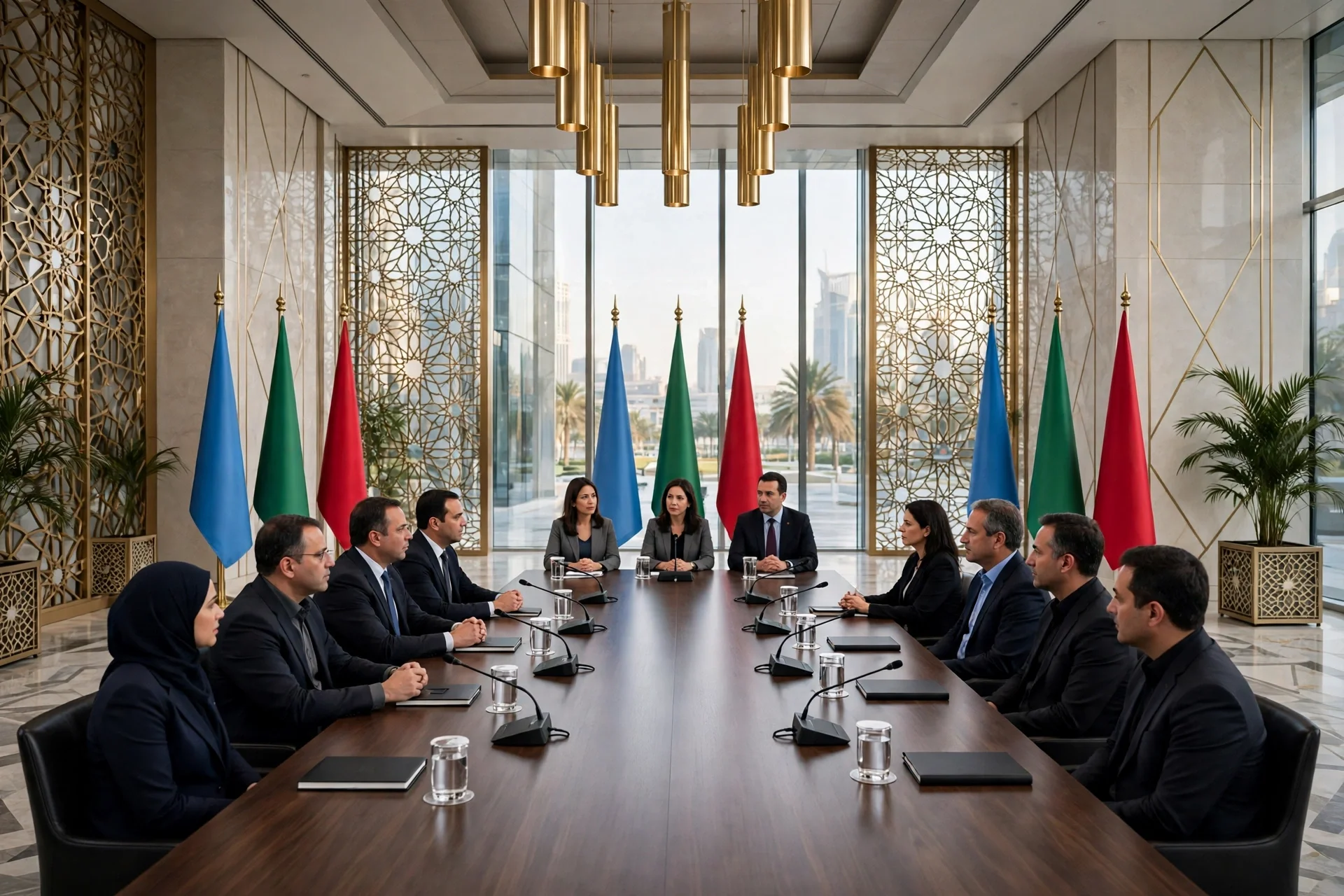
Mesa de negociación diplomática con delegaciones enfrentadas y banderas genéricas sin texto. · Imagen generada
Ukraine, Russia and the United States resume talks in Abu Dhabi
Representatives of Ukraine, Russia and the United States meet in Abu Dhabi in the first meeting of its kind in more than nine months, with Ukraine's…
Abu Dhabi talks reopen with territory and European security at stake
Ukraine, Russia and the United States resume negotiations in Abu Dhabi for the first time since February, led by Steve Witkoff and Jared Kushner.
--- The context ---
Representatives of Ukraine, Russia and the United States meet this Tuesday in Abu Dhabi to negotiate a way out of the war, in the first meeting of its kind in more than nine months. The talks come as another winter of war approaches and after several failed attempts to reach an agreement, while Europe seeks to prevent Washington and Moscow from agreeing on a new security architecture without consulting the countries of the continent.
--- The facts ---
The President of the United States, Donald Trump, pushed the negotiations since his return to power, although the process lost prominence because of the war between the United States, Israel and Iran. The meeting will be led by the United States special envoy, Steve Witkoff, and the president's son-in-law, Jared Kushner, who will bring together the delegations of the two warring countries for the first time since February, when the negotiations took place in Geneva.
The meeting will unfold amid differences over Ukraine's territorial future. In the run-up to the negotiations, Russia intensified its attacks on Ukrainian territory and carried out one of its deadliest bombings: authorities in Kiev reported that 55 people died in a frontline locality while they waited to receive humanitarian aid. Expectations for the outcome of the meeting are limited, and a senior Ukrainian official in Kiev said there are no particular expectations.
--- The positions ---
Trump anticipated that Kiev will have to accept modifications to its borders and argued that the process will end with a Ukraine in a slightly different form. Russia occupies wide areas of Ukrainian territory, but its troops did not manage to conquer the whole of the Donetsk region, and the Kremlin demands that Kiev hand over the parts of that territory it still controls, warning that otherwise it will continue its offensive. Ukraine, which resisted for more than four and a half years the invasion of a considerably larger army, ruled out that possibility, and President Volodymyr Zelensky repeatedly rejected any territorial withdrawal as a condition for reaching an agreement. Zelensky also argued that the intensification of the attacks is part of a Moscow strategy to pressure Ukraine's position during the negotiations.
--- What remains unknown ---
It remains unknown whether Abu Dhabi will produce any concrete progress on territory, what security guarantees will be put on the table, and whether the trilateral format, with the exclusive participation of Russia, Ukraine and the United States, will leave real room for Europe's voice. It is also unknown whether there will be face-to-face meetings between the leaders or broader ceasefire proposals, which Russian President Vladimir Putin repeatedly rejected.
--- Unanswered questions ---
Will Kiev accept any modification of its borders, or will it maintain its rejection of any territorial withdrawal? Will the meeting translate into concrete security guarantees for Ukraine and for Europe? Can the recent truce in the Kherson region become a model for a broader de-escalation?
--- EPM analysis ---
The Abu Dhabi table brings together the two disputes that blocked every previous attempt: the territory of Donetsk and who decides Europe's security. Europe fears that Washington and Moscow will agree on a new architecture without its participation, a fear Zelensky summed up by warning of a possible Yalta 2.0, in reference to the 1945 conference. At the same time, Kushner said on Monday that a peace agreement will require direct talks between Russia and Europe on the broader security agreements that affect them, and Ukraine's chief negotiator, Rustem Umerov, confirmed that representatives of the United Kingdom, France, Germany and Italy, together with officials from NATO and the European Union, will hold separate talks with the Kiev delegation in Abu Dhabi.
📌 EPM Take:
In EPM's view, Abu Dhabi matters for what it tries to prevent as much as for what it seeks to achieve: that Ukraine's peace and Europe's security be decided between two powers and behind the backs of those affected. Without Kiev there is no legitimate agreement over its territory, and without Europe there is no security architecture that will hold. The local truce in Kherson shows that de-escalation is possible step by step. The challenge is for the trilateral table to also listen to those who live under the bombing and to those who will share the consequences of any pact for decades.
--- The context ---
Ukraine, Russia and the United States resume negotiations this Tuesday in Abu Dhabi to seek a way out of the war, in the first meeting of its kind in more than nine months and the first between the delegations since February, when they met in Geneva. The talks will take place as another winter of war approaches and after several failed attempts to reach an agreement to end the invasion ordered by Vladimir Putin in February 2022.
--- The facts ---
The meeting will be led by the United States special envoy, Steve Witkoff, and President Donald Trump's son-in-law, Jared Kushner, who will bring together the delegations of the two warring countries. Trump pushed the negotiations since his return to power, although the process lost prominence because of the war between the United States, Israel and Iran. The meeting will unfold amid deep differences over Ukraine's territorial future, the point that has stalled every previous approach.
In the run-up to the negotiations, Russia intensified its attacks on Ukrainian territory and carried out one of its deadliest bombings. Authorities in Kiev reported that 55 people died in a frontline locality while they waited to receive humanitarian aid. Zelensky argued that the intensification of the attacks is part of a Moscow strategy to pressure Ukraine's position during the negotiations, while Putin repeatedly rejected broader ceasefire proposals and face-to-face meetings with his Ukrainian counterpart.
--- The positions ---
The Kremlin demands that Kiev hand over the parts of the Donetsk region it still controls and warned that otherwise it will continue its offensive, even though its troops did not manage to conquer that whole region while Russia occupies wide areas of Ukrainian territory. Trump anticipated that Kiev will have to accept modifications to its borders. Against that, Zelensky repeatedly rejected any territorial withdrawal as a condition for reaching an agreement, and Ukraine, which resisted for more than four and a half years the invasion of a considerably larger army, ruled out that possibility. In Europe, Germany's Foreign Minister, Johann Wadephul, urged Moscow to abandon its maximalist demands and warned against any negotiation spectacle in the capital of the United Arab Emirates.
--- What remains unknown ---
It is not known whether Moscow is willing to give ground on its demand over Donetsk, nor what difficult decisions each side will be asked to take, after Kushner noted that the United States recognizes that there are difficult decisions ahead. Nor is it clear whether the meeting will produce more than contacts, when expectations are limited and a senior Ukrainian official said there are no particular expectations.
--- Unanswered questions ---
Will the Kremlin give ground on its demand that Kiev hand over the Donetsk territory it still controls? What concrete border modifications does Washington consider acceptable to close an agreement? Will Abu Dhabi help open a de-escalation through local truces such as the recent one in Kherson?
--- EPM analysis ---
The format says much about the moment: the Kremlin, which sought to exclude Europe from the negotiations, insisted that the process will continue under a trilateral format, with the exclusive participation of Russia, Ukraine and the United States. The Russian delegation, however, will be led by Vladimir Medinsky, a nationalist adviser to Putin, and will include for the first time Sergei Ryabkov, the diplomat who before the 2022 invasion presented the ultimatum demanding that NATO withdraw its troops from Eastern Europe. Europe, for its part, rejects having its security decided without it: Wadephul said that for Europe it is clear that there is no need to establish a new security architecture for the continent.
📌 EPM Take:
In EPM's view, negotiating is preferable to another winter of war, but a peace built on maximalist demands and territory handed over under pressure would be fragile from day one. Order requires agreements that can be defended: borders that do not move by force, verifiable guarantees and a Europe seated at the table when its own security is discussed. Abu Dhabi will be a test of seriousness for the three delegations. If Moscow only seeks to gain time while intensifying its attacks, the table will expose that before the whole world.
Ucrania, Rusia y Estados Unidos negocian en Abu Dabi tras nueve meses
Representantes de Ucrania, Rusia y Estados Unidos se reúnen en Abu Dabi en el primer encuentro de este tipo en más de nueve meses, con el futuro territorial de…
Abu Dabi reúne a Kiev, Moscú y Washington con el territorio en disputa
Ucrania, Rusia y Estados Unidos retoman en Abu Dabi las negociaciones por primera vez desde febrero, encabezadas por Steve Witkoff y Jared Kushner.
--- El contexto ---
Representantes de Ucrania, Rusia y Estados Unidos se reúnen este martes en Abu Dabi para negociar una salida a la guerra, en el primer encuentro de este tipo en más de nueve meses. La cita llega ante la proximidad de otro invierno de guerra y después de varios intentos fallidos de alcanzar un acuerdo, mientras Europa busca evitar que Washington y Moscú acuerden una nueva arquitectura de seguridad sin consultar a los países del continente.
--- Los hechos ---
El presidente estadounidense, Donald Trump, impulsó las negociaciones desde su regreso al poder, aunque el proceso perdió protagonismo por la guerra entre Estados Unidos, Israel e Irán. La reunión estará encabezada por el enviado especial estadounidense, Steve Witkoff, y el yerno del mandatario, Jared Kushner, quienes reunirán a las delegaciones de los dos países enfrentados por primera vez desde febrero, cuando las negociaciones tuvieron lugar en Ginebra.
El encuentro se desarrollará en medio de las diferencias sobre el futuro territorial de Ucrania. En la antesala de las negociaciones, Rusia intensificó sus ataques contra territorio ucraniano y ejecutó uno de sus bombardeos más mortíferos: las autoridades de Kiev informaron que 55 personas murieron en una localidad de primera línea del frente cuando esperaban para recibir ayuda humanitaria. Las expectativas sobre el resultado de la reunión son limitadas, y un alto funcionario ucraniano en Kiev afirmó que no hay expectativas particulares.
--- Las posiciones ---
Trump anticipó que Kiev tendrá que aceptar modificaciones en sus fronteras y sostuvo que el proceso terminará con una Ucrania de una forma un poco diferente. Rusia ocupa amplias zonas del territorio ucraniano, pero sus tropas no lograron conquistar la totalidad de la región de Donetsk, y el Kremlin exige que Kiev entregue las partes de ese territorio que todavía controla, con la advertencia de que, de lo contrario, continuará su ofensiva. Ucrania, que resistió durante más de cuatro años y medio la invasión de un ejército considerablemente superior, descartó esa posibilidad, y el presidente Volodimir Zelensky rechazó reiteradamente cualquier retirada territorial como condición para alcanzar un acuerdo. Zelensky sostuvo además que la intensificación de los ataques forma parte de una estrategia de Moscú para presionar la posición de Ucrania durante las negociaciones.
--- Lo que falta saber ---
Falta saber si de Abu Dabi saldrá algún avance concreto sobre el territorio, qué garantías de seguridad se pondrán sobre la mesa y si el formato trilateral, con participación exclusiva de Rusia, Ucrania y Estados Unidos, dejará espacio real a la voz europea. Tampoco se conoce si habrá encuentros cara a cara entre los líderes ni propuestas más amplias de alto el fuego, que el presidente ruso, Vladimir Putin, rechazó en reiteradas oportunidades.
--- Preguntas sin respuesta ---
¿Aceptará Kiev alguna modificación de sus fronteras o mantendrá su rechazo a toda retirada territorial? ¿Se traducirá la reunión en garantías de seguridad concretas para Ucrania y para Europa? ¿Podrá la reciente tregua en la región de Kherson convertirse en un modelo de desescalada más amplio?
--- Análisis EPM ---
La mesa de Abu Dabi reúne las dos disputas que han bloqueado todos los intentos anteriores: el territorio de Donetsk y quién decide la seguridad de Europa. Europa teme que Washington y Moscú acuerden una nueva arquitectura sin su participación, un temor que Zelensky resumió al advertir sobre una posible Yalta 2.0, en referencia a la conferencia de 1945. A la vez, Kushner sostuvo el lunes que un acuerdo de paz requerirá conversaciones directas entre Rusia y Europa sobre los acuerdos de seguridad más amplios que los afectan, y el principal negociador ucraniano, Rustem Umerov, confirmó que representantes de Reino Unido, Francia, Alemania e Italia, junto con funcionarios de la OTAN y la Unión Europea, mantendrán conversaciones separadas con la delegación de Kiev en Abu Dabi.
📌 Conclusion EPM:
A juicio de EPM, Abu Dabi vale por lo que intenta evitar tanto como por lo que busca lograr: que la paz de Ucrania y la seguridad de Europa se decidan entre dos potencias y a espaldas de los afectados. Sin Kiev no hay acuerdo legítimo sobre su territorio, y sin Europa no hay arquitectura de seguridad que se sostenga. La tregua local de Kherson muestra que la desescalada es posible paso a paso. El reto es que la mesa trilateral escuche también a quienes viven bajo los bombardeos y a quienes compartirán las consecuencias de cualquier pacto durante décadas.
--- El contexto ---
Ucrania, Rusia y Estados Unidos retoman este martes en Abu Dabi las negociaciones para buscar una salida a la guerra, en el primer encuentro de este tipo en más de nueve meses y el primero de las delegaciones desde febrero, cuando se reunieron en Ginebra. Las conversaciones tendrán lugar ante la proximidad de otro invierno de guerra y después de varios intentos fallidos de alcanzar un acuerdo que ponga fin a la invasión ordenada por Vladimir Putin en febrero de 2022.
--- Los hechos ---
La reunión estará encabezada por el enviado especial estadounidense, Steve Witkoff, y el yerno del presidente Donald Trump, Jared Kushner, quienes reunirán a las delegaciones de los dos países enfrentados. Trump impulsó las negociaciones desde su regreso al poder, aunque el proceso perdió protagonismo por la guerra entre Estados Unidos, Israel e Irán. El encuentro se desarrollará en medio de las profundas diferencias sobre el futuro territorial de Ucrania, el punto que ha frenado todos los acercamientos anteriores.
En la antesala de las negociaciones, Rusia intensificó sus ataques contra territorio ucraniano y ejecutó uno de sus bombardeos más mortíferos. Las autoridades de Kiev informaron que 55 personas murieron en una localidad de primera línea del frente cuando esperaban para recibir ayuda humanitaria. Zelensky sostuvo que la intensificación de los ataques forma parte de una estrategia de Moscú para presionar la posición de Ucrania durante las negociaciones, mientras Putin rechazó en reiteradas oportunidades propuestas más amplias de alto el fuego y encuentros cara a cara con su homólogo ucraniano.
--- Las posiciones ---
El Kremlin exige que Kiev entregue las partes de la región de Donetsk que todavía controla y advirtió que, de lo contrario, continuará su ofensiva, pese a que sus tropas no lograron conquistar la totalidad de esa región aunque Rusia ocupa amplias zonas del territorio ucraniano. Trump anticipó que Kiev tendrá que aceptar modificaciones en sus fronteras. Frente a ello, Zelensky rechazó reiteradamente cualquier retirada territorial como condición para alcanzar un acuerdo, y Ucrania, que resistió durante más de cuatro años y medio la invasión de un ejército considerablemente superior, descartó esa posibilidad. En Europa, el ministro de Relaciones Exteriores de Alemania, Johann Wadephul, instó a Moscú a abandonar sus exigencias maximalistas y advirtió contra cualquier espectáculo de negociación en la capital de Emiratos Árabes Unidos.
--- Lo que falta saber ---
No se sabe si Moscú está dispuesto a ceder en su exigencia sobre Donetsk, ni qué decisiones difíciles, en palabras atribuidas a Kushner al señalar que Estados Unidos reconoce que hay decisiones difíciles por delante, se pedirán a cada parte. Tampoco está claro si la reunión producirá algo más que contactos, cuando las expectativas son limitadas y un alto funcionario ucraniano afirmó que no hay expectativas particulares.
--- Preguntas sin respuesta ---
¿Cederá el Kremlin en su exigencia de que Kiev entregue el territorio de Donetsk que aún controla? ¿Qué modificaciones fronterizas concretas considera Washington aceptables para cerrar un acuerdo? ¿Servirá Abu Dabi para abrir una desescalada mediante treguas locales como la reciente de Kherson?
--- Análisis EPM ---
El formato dice mucho del momento: el Kremlin, que buscó excluir a Europa de las negociaciones, insistió en que el proceso continuará bajo un formato trilateral, con la participación exclusiva de Rusia, Ucrania y Estados Unidos. Sin embargo, la delegación rusa la encabezará Vladimir Medinsky, asesor nacionalista de Putin, e integrará por primera vez a Sergei Ryabkov, el diplomático que antes de la invasión de 2022 presentó el ultimátum que exigía que la OTAN retirara sus tropas de Europa del Este. Europa, por su parte, rechaza que se decida su seguridad sin ella: Wadephul afirmó que para Europa está claro que no se necesita establecer una nueva arquitectura de seguridad para el continente.
📌 Conclusion EPM:
A juicio de EPM, negociar es preferible a otro invierno de guerra, pero una paz construida sobre exigencias maximalistas y territorios entregados bajo presión sería frágil desde el primer día. El orden exige acuerdos que se puedan defender: fronteras que no se muevan por la fuerza, garantías verificables y una Europa sentada a la mesa cuando se hable de su propia seguridad. Abu Dabi será una prueba de seriedad para las tres delegaciones. Si Moscú solo busca ganar tiempo mientras intensifica los ataques, la mesa lo dejará en evidencia ante el mundo entero.