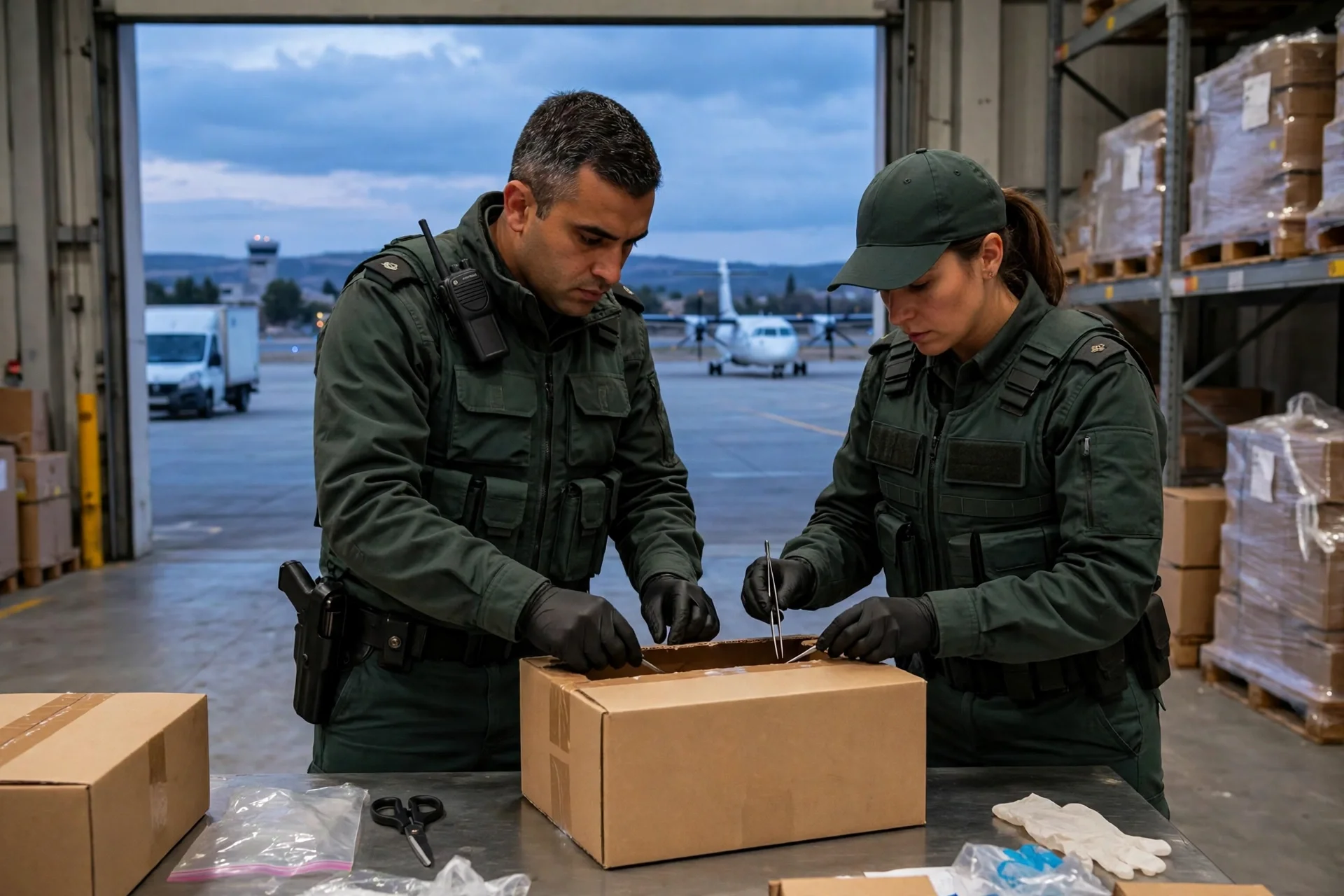
Entrega controlada junto al Aeropuerto de Asturias: 15,9 kilos de hachís en un paquete enviado desde Sevilla. · Imagen generada
Man arrested in Asturias collecting 15.9 kilos of hashish sent from Seville
A 37-year-old man was arrested near Asturias Airport while collecting a package sent from Seville containing 15.9 kilograms of hashish, after a judicially…
Alleged trafficker held in Asturias over 15.9 kilos of hashish from Seville
The Civil Guard arrested a 37-year-old man in Asturias, the alleged perpetrator of drug trafficking, as he collected 15.9 kilograms of hashish sent from…
--- The context ---
The area around Asturias Airport was the scene of an operation against drug trafficking, with a land shipment from Seville intercepted before reaching its recipient. A 37-year-old man was arrested as the alleged perpetrator of a public health offence involving drug trafficking, after workers raised the alarm.
--- The facts ---
The events took place on November 5, when workers at a company in the airport area alerted the Civil Guard to a suspicious package, opened by mistake, that could contain narcotic substances. Officers from the Judicial Police Organic Unit of Asturias and the Piedras Blancas Main Post attended the scene and identified a regular client.
Once secured, the package was taken to the Court of Instance, Civil and Instruction Section number 8 of Avilés, to seek permission to open it. Inside were 159 tablets of 100 grams each of hashish resin, a total of 15.9 kilograms, above the 2.5 kilograms threshold. With judicial authorization, officers prepared a simulated package: the suspect arrived from Seville at 19.30 hours, collected the package and was arrested.
--- The positions ---
The Civil Guard acted with judicial authorization at every decisive step, from opening the original package to the controlled delivery. The judicial authority ordered the detainee held at the Asturias Penitentiary Centre after he appeared before the Avilés duty Court of Instance on November 6. He remains the alleged perpetrator.
--- What remains unknown ---
Investigators determined that the goods were sent from Seville on November 4 using false identities for sender and recipient, but who really sent them and who was finally meant to receive them has not been established. The result is also awaited of the analysis entrusted to the Pharmacy Inspection Area of the Government Delegation in Cantabria.
--- Unanswered questions ---
Who really sent the package from Seville using false identities? Was the alleged perpetrator acting alone or in a wider network? What will the definitive analysis show about the resin? Will there be further arrests linked to this shipment?
--- EPM analysis ---
The procedure shows a careful chain of custody: a warning from workers, police intervention, judicial authorization and substitution with a simulated package. It also exposes a vulnerability in land freight, where false identities allowed 15.9 kilograms to move without suspicion until the package was opened by mistake.
📌 EPM Take:
In EPM's view, this operation is an example of effective policing with safeguards because every step had judicial authorization and the arrest took place at the precise moment of collection, without risks for travellers or workers. The deeper issue goes beyond one detainee and points to how easily opaque networks use transport companies and false identities to move drugs between regions, a route that demands finer controls and without weakening the safeguards that give it legitimacy.
--- The context ---
Security around Asturias Airport stopped a drug shipment from Seville before it could reach the street. A 37-year-old man from Seville was arrested as the alleged perpetrator of a public health offence involving drug trafficking when he tried to collect the package near the airport, after workers opened a suspicious package by mistake.
--- The facts ---
The events took place on November 5, when workers at a company in the airport area alerted the Civil Guard to the suspicious package, which could contain narcotic substances. Early inquiries pointed to a regular client who intended to collect it in person after landing in Asturias late that same afternoon.
Once secured, the package was taken to the Court of Instance, Civil and Instruction Section number 8 of Avilés, to seek authorization to open it. Inside were 159 tablets of 100 grams each of hashish resin, a total of 15.9 kilograms, above the 2.5 kilograms threshold. Officers prepared a simulated package, watched the flight from Seville due at 19.30 hours and detained the suspect as he received the package.
--- The positions ---
The police action followed the full judicial path and the authority responded firmly: the detainee appeared before the Avilés duty Court of Instance on November 6 and was ordered into the Asturias Penitentiary Centre. He had first been taken to Civil Guard facilities in Oviedo. He remains, for all purposes, the alleged perpetrator.
--- What remains unknown ---
Investigators determined that the goods were sent from Seville on November 4 using false identities for sender and recipient, a fraud that allowed the drugs to move by land transport without prior alerts. The seized drugs were sent to the Pharmacy Inspection Area of the Government Delegation in Cantabria for definitive analysis and weighing, still without a public result.
--- Unanswered questions ---
Who is behind the shipment from Seville with false identities? How many similar shipments may have passed undetected? Was the alleged perpetrator working for a larger organization? Will controls on suspicious packages around the airport be strengthened?
--- EPM analysis ---
Ordinary vigilance and attentive workers remain an effective barrier against drug trafficking. Without that initial alert, a package containing 15.9 kilograms would have entered circulation through a simple collection procedure. The controlled delivery let officers detain the recipient in the act.
📌 EPM Take:
In EPM's view, law and order worked as they should work, with a public alert, a swift police response, judicial control of every step and an immediate penal consequence for the alleged perpetrator. The lesson is practical for the whole country: opaque shipments using false identities are now a main route for drug trafficking and deserve firm, constant controls at every link of the logistics chain, and that firmness must be sustained over time, everywhere.
Detenido en Asturias al recoger 15,9 kilos de hachís enviados desde Sevilla
Un hombre de 37 años fue detenido junto al Aeropuerto de Asturias al recoger un paquete enviado desde Sevilla con 15,9 kilogramos de hachís, tras una entrega…
Cae en Asturias un presunto traficante con 15,9 kilos de hachís de Sevilla
La Guardia Civil detuvo en Asturias a un hombre de 37 años, presunto autor de tráfico de drogas, al recoger 15,9 kilogramos de hachís enviados desde Sevilla…
--- El contexto ---
El Aeropuerto de Asturias y su entorno fueron escenario de una operación contra el tráfico de drogas, con un envío terrestre desde Sevilla interceptado antes de llegar a su destinatario. Un hombre de 37 años fue detenido como presunto autor de un delito contra la salud pública por tráfico de drogas.
--- Los hechos ---
Los hechos se produjeron el pasado 5 de noviembre, cuando operarios de una empresa de la zona del aeródromo alertaron a la Guardia Civil de un bulto sospechoso, abierto por error, que podía contener sustancias estupefacientes. Acudieron efectivos de la Unidad Orgánica de Policía Judicial de Asturias y del Puesto Principal de Piedras Blancas.
Asegurado el envío, los agentes lo trasladaron al Tribunal de Instancia Sección Civil y de Instrucción número 8 de Avilés para pedir autorización de apertura. Dentro había 159 pastillas de 100 gramos cada una de resina de hachís, un total de 15,9 kilogramos, sobre el umbral de 2,5 kilogramos. Con autorización judicial se preparó un paquete simulado: el sospechoso llegó desde Sevilla a las 19.30 horas, recogió el bulto y fue detenido.
--- Las posiciones ---
La Guardia Civil actuó con autorización judicial en los pasos decisivos, de la apertura del paquete a la entrega controlada. La autoridad judicial decretó el ingreso del detenido en el Centro Penitenciario de Asturias tras pasar a disposición del Tribunal de Instancia de Guardia de Avilés el 6 de noviembre. Es presunto autor.
--- Lo que falta saber ---
La mercancía fue remitida desde Sevilla el 4 de noviembre con identidades falsas del remitente y del destinatario, pero no se ha precisado quién la envió ni quién debía recibirla. Tampoco se conoce el resultado del análisis encargado al Área de Inspección de Farmacia de la Delegación del Gobierno en Cantabria.
--- Preguntas sin respuesta ---
¿Quién remitió realmente el paquete desde Sevilla usando identidades falsas? ¿El presunto autor actuaba solo o en una red más amplia? ¿Qué mostrará el análisis definitivo de la resina? ¿Habrá nuevas detenciones vinculadas a este envío?
--- Análisis EPM ---
El procedimiento muestra una cadena cuidada: aviso de trabajadores, intervención policial, autorización judicial y sustitución por un paquete simulado. También expone una vulnerabilidad del transporte terrestre, donde identidades falsas permitieron mover 15,9 kilogramos sin sospechas hasta la apertura por error en destino.
📌 Conclusion EPM:
A juicio de EPM, la operación es un ejemplo de eficacia policial con garantías porque cada paso contó con autorización judicial y la detención se produjo en el momento preciso de la recogida, sin riesgos para viajeros ni trabajadores. El fondo va más allá de un detenido y apunta a la facilidad con que redes opacas usan empresas de transporte e identidades falsas para mover droga entre regiones, una ruta que exige controles más finos.
--- El contexto ---
La seguridad en torno al Aeropuerto de Asturias interceptó un envío de droga desde Sevilla. Un hombre de 37 años, natural de Sevilla, fue detenido como presunto autor de un delito contra la salud pública por tráfico de drogas cuando pretendía recoger el paquete junto al aeródromo.
--- Los hechos ---
Los hechos se produjeron el pasado 5 de noviembre, cuando operarios de una empresa de la zona del aeropuerto alertaron a la Guardia Civil de un bulto sospechoso, abierto por error, que podía contener sustancias estupefacientes. Las indagaciones señalaron a un cliente habitual que pensaba recogerlo en persona tras aterrizar esa tarde en Asturias.
Asegurado el envío, los agentes lo trasladaron al Tribunal de Instancia Sección Civil y de Instrucción número 8 de Avilés para pedir autorización de apertura. Dentro había 159 pastillas de 100 gramos cada una de resina de hachís, un total de 15,9 kilogramos, sobre el umbral de 2,5 kilogramos. La Guardia Civil preparó un paquete simulado, vigiló el vuelo desde Sevilla con llegada a las 19.30 horas y detuvo al sospechoso al recibir el bulto.
--- Las posiciones ---
La actuación siguió el cauce judicial completo y la autoridad judicial respondió con firmeza: el detenido pasó a disposición del Tribunal de Instancia de Guardia de Avilés el 6 de noviembre y se decretó su ingreso en el Centro Penitenciario de Asturias. Antes fue trasladado a dependencias de la Guardia Civil en Oviedo. Es presunto autor.
--- Lo que falta saber ---
La mercancía se remitió desde Sevilla el 4 de noviembre con identidades falsas del remitente y del destinatario, fraude que permitió moverla por transporte terrestre sin alertas previas. La droga fue remitida al Área de Inspección de Farmacia de la Delegación del Gobierno en Cantabria para su análisis y pesaje definitivo, aún sin resultado público.
--- Preguntas sin respuesta ---
¿Quién está detrás del envío desde Sevilla con identidades falsas? ¿Cuántos envíos similares pudieron pasar sin ser detectados? ¿El presunto autor trabajaba para una organización mayor? ¿Se reforzará el control de paquetes junto al aeropuerto?
--- Análisis EPM ---
La vigilancia ordinaria y la colaboración de trabajadores atentos siguen siendo una barrera eficaz contra el narcotráfico. La entrega controlada, autorizada judicialmente, permitió detener al receptor en el acto y preservar intacta la prueba del envío original.
📌 Conclusion EPM:
A juicio de EPM, el orden y la ley funcionaron como deben funcionar, con aviso ciudadano, respuesta policial rápida, control judicial de cada paso y consecuencia penal inmediata para el presunto autor. La lección es práctica para todo el país: los envíos opacos con identidades falsas son una vía principal del tráfico de drogas y merecen controles firmes y constantes en cada eslabón logístico, y que esa firmeza se mantenga siempre en el tiempo.