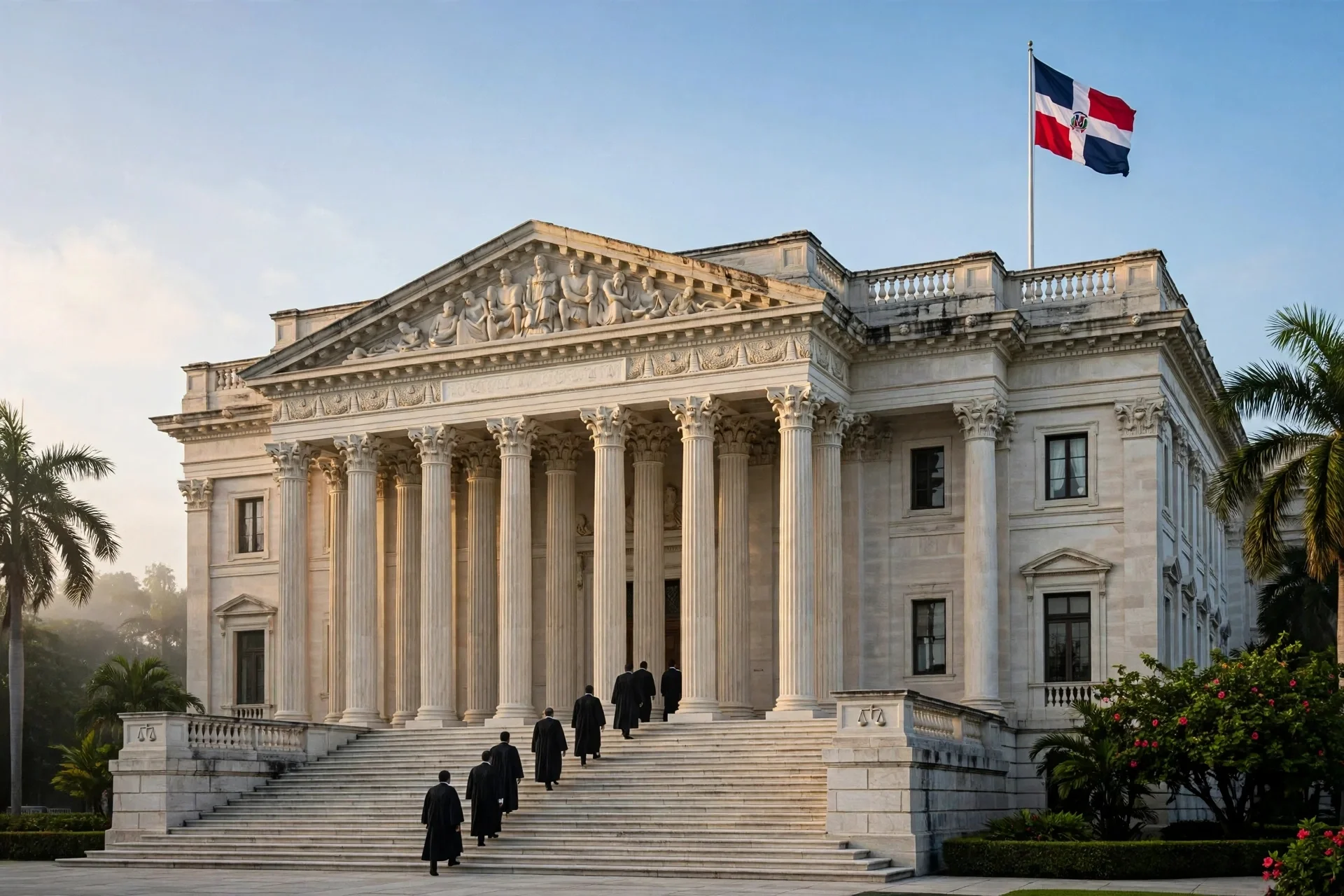
La sede de una alta corte con la bandera dominicana y magistrados subiendo su escalinata, en imagen alusiva a la juramentación de la nueva presidencia de la SCJ. · Imagen generada para Erick Prometeo Media
Montero Montero to be sworn in as Supreme Court president on Tuesday
Justiniano Montero Montero will be sworn in at 9:00 on Tuesday as president of the Supreme Court of Justice at the National Palace and will take office two…
An orderly handover safeguards the Supreme Court presidency
The National Palace will host on Tuesday at 9:00 the swearing-in of Justiniano Montero Montero as president of the Supreme Court, with the taking of office two…
--- The context ---
The Supreme Court of Justice begins a change with the swearing-in scheduled for 9:00 on Tuesday morning at the National Palace and the assumption of office planned two hours later. Justiniano Montero Montero is the first president chosen by the National Council of the Magistracy who comes from the judiciary, born in El Cercado, San Juan province.
--- The facts ---
Judge Justiniano Montero Montero will be sworn in as president of the high court. Alongside him, Julio César Emilio Canó Alfau, Antonia Josefina Grullón Blandino, Amauri Antonio Pimentel Fabián, Arelis Socorro Ricourt Gómez, Diomede Ydelfo Villalona Guerrero and Ylona María de la Rocha Camilo will take office as members. According to the information available, Rocha Camilo is the only one who does not come from the judicial career.
Montero chaired the chamber for civil and commercial matters before being confirmed in September for a second term, and last week the National Council of the Magistracy chose him as president. He replaces Luis Henry Molina, who decided not to seek a second term. Villalona Guerrero will serve as first substitute for the president and Ricourt Gómez as second substitute.
--- The positions ---
The Judiciary reported that last Wednesday the outgoing and incoming presidents met to begin the institutional transition and discuss the challenges facing that branch of the State. Mariano Germán Mejía preceded Molina after holding roles in the Executive Branch, including attorney general in the first administration of Leonel Fernández.
--- What remains unknown ---
In September, Fran Euclides Soto Sánchez was also ratified and began a third term for seven years more, alongside Samuel Arias Arzeno, Anselmo Alejandro Bello Ferreras and Rafael Vásquez Goico. Francisco Antonio Jérez Mena and Vanessa Acosta Peralta were removed from the high court. Jérez Mena had spent 14 years on the court, whose full bench is made up of 17 magistrates.
--- Unanswered questions ---
How will the work of the chamber that Montero chaired be organized after his move to the presidency? What priorities will shape the early stage of the institutional transition already begun? How will responsibilities be shared between the president and the substitutes within the full bench of 17 magistrates?
--- EPM analysis ---
The change matters because of its origin in the judicial career and the possibility of justice closer to the internal experience of the courts. The earlier transition suggests continuity without rupture, although the challenge will be turning it into verifiable improvements in access and public trust.
📌 EPM Take: In EPM's view, the arrival of a president who comes from the judiciary opens an opportunity to strengthen the independence and credibility of the high court through internal knowledge of the system. The value of this change will be measured in transparent decisions, in a transition that preserves stability and in leadership able to respond to the challenges discussed between the outgoing and incoming presidents. If that experience becomes closeness to citizens and institutional rigor, the new stage can build lasting public trust in Dominican justice.
--- The context ---
A change of leadership without interruption finds its safeguard in a procedure followed step by step. That frame surrounds the handover at the Supreme Court of Justice, where outgoing and incoming presidents spoke last Wednesday to begin the institutional transition and address, according to the Judiciary, the challenges of that branch.
--- The facts ---
The swearing-in is set for 9:00 on Tuesday morning at the National Palace. Justiniano Montero Montero will assume the presidency and take office two hours later. Diomede Ydelfo Villalona Guerrero will act as first substitute and Arelis Socorro Ricourt Gómez as second substitute. He succeeds Luis Henry Molina. Molina did not seek a second term.
Six other magistrates will be sworn in as members of the court on the same day. They are Julio César Emilio Canó Alfau, Antonia Josefina Grullón Blandino and Amauri Antonio Pimentel Fabián. Arelis Socorro Ricourt Gómez, Diomede Ydelfo Villalona Guerrero and Ylona María de la Rocha Camilo complete the group. Only Rocha Camilo arrives without a prior path in the judicial career.
--- The positions ---
Confirmation and election, at separate moments, mark the prior sequence. In September Montero was confirmed for a second term as a member of the court. Last week the National Council of the Magistracy chose him to preside over it. Before that he chaired the First Chamber, devoted to civil and commercial matters.
--- What remains unknown ---
The full bench, made up of 17 magistrates, gives dimension to the scope of the change. September also left ratified Fran Euclides Soto Sánchez, in a third term for seven more years, alongside Samuel Arias Arzeno, Anselmo Alejandro Bello Ferreras and Rafael Vásquez Goico. Francisco Antonio Jérez Mena, with 14 years on the court, and Vanessa Acosta Peralta left instead.
--- Unanswered questions ---
Which formal acts will complete the taking of office once the ceremony at the National Palace concludes? When will the new presidency make public its first working agenda for the full bench? In what way will citizens be informed about the agreements reached at the transition meeting held last Wednesday?
--- EPM analysis ---
Through continuity, an orderly succession protects decision predictability and avoids authority gaps. A transfer combining prior confirmation and later election reads as rule-bound, with a responsible body at each step.
📌 EPM Take: In EPM's view, the central value of this handover lies in institutional continuity and in an orderly transfer that preserves the authority of the court without disruption. A president who knows the judiciary from within can sustain internal discipline and the predictability required by the rule of law, provided procedures are respected and decisions are made with calm judgment. Trust will not depend on the origin of the appointment, but on stable, rule-bound and verifiable leadership before Dominican citizens.
Montero Montero asumirá la presidencia de la Suprema Corte este martes
Justiniano Montero Montero será juramentado a las 9:00 de este martes como presidente de la Suprema Corte de Justicia en el Palacio Nacional y tomará posesión…
Un relevo ordenado sostiene la presidencia de la Suprema Corte
El Palacio Nacional acogerá este martes a las 9:00 la juramentación de Justiniano Montero Montero como presidente de la Suprema Corte, con posesión dos horas…
--- El contexto ---
La Suprema Corte de Justicia inicia un relevo con la juramentación programada para las 9:00 de la mañana de este martes en el Palacio Nacional y la toma de posesión prevista dos horas después. Justiniano Montero Montero es el primer presidente escogido por el Consejo Nacional de la Magistratura que proviene de la judicatura, nacido en El Cercado, provincia San Juan.
--- Los hechos ---
El juez Justiniano Montero Montero será juramentado como presidente de la alta corte. Con él asumirán como miembros Julio César Emilio Canó Alfau, Antonia Josefina Grullón Blandino, Amauri Antonio Pimentel Fabián, Arelis Socorro Ricourt Gómez, Diomede Ydelfo Villalona Guerrero e Ylona María de la Rocha Camilo. Según la información disponible, Rocha Camilo es la única que no proviene de la carrera judicial.
Montero presidía la sala de asuntos civiles y comerciales antes de ser confirmado en septiembre para un segundo período, y la pasada semana el Consejo Nacional de la Magistratura lo escogió presidente. Sustituye a Luis Henry Molina, quien decidió no presentarse para un segundo período. Villalona Guerrero será primer sustituto del presidente y Ricourt Gómez segunda sustituta.
--- Las posiciones ---
El Poder Judicial informó que el pasado miércoles el presidente saliente y el entrante se reunieron para iniciar la transición institucional y conversar sobre los retos y desafíos de ese poder del Estado. Mariano Germán Mejía antecedió a Molina tras ocupar funciones en el Poder Ejecutivo, entre ellas procurador general en la primera gestión de Leonel Fernández.
--- Lo que falta saber ---
En septiembre se ratificó a Fran Euclides Soto Sánchez, quien empezó un tercer período por siete años más, junto a Samuel Arias Arzeno, Anselmo Alejandro Bello Ferreras y Rafael Vásquez Goico. Francisco Antonio Jérez Mena y Vanessa Acosta Peralta fueron apartados de la alta corte. Jérez Mena tenía 14 años en la corte, cuyo Pleno conforman 17 magistrados.
--- Preguntas sin respuesta ---
¿Cómo se organizará el trabajo de la sala que Montero presidía tras su llegada a la presidencia? ¿Qué prioridades marcarán la etapa inicial de la transición institucional ya iniciada? ¿Cómo se distribuirán las responsabilidades entre el presidente y sus sustitutos en el Pleno de 17 magistrados?
--- Análisis EPM ---
El relevo importa por su origen en la carrera judicial y por la cercanía a la experiencia interna de los tribunales. La transición previa sugiere continuidad sin ruptura, aunque el desafío será convertirla en mejoras verificables de acceso y confianza ciudadana.
📌 Conclusion EPM: A juicio de EPM, la llegada de un presidente proveniente de la judicatura abre una oportunidad para fortalecer la independencia y la credibilidad de la alta corte desde el conocimiento interno del sistema. El valor del relevo se medirá en decisiones transparentes, en una transición que preserve la estabilidad y en una gestión capaz de responder a los retos conversados entre el presidente saliente y el entrante. Si esa experiencia se traduce en cercanía con la ciudadanía y rigor institucional, la nueva etapa puede consolidar confianza pública.
--- El contexto ---
Un cambio de mando sin interrupciones tiene su garantía en el procedimiento cumplido paso a paso. Ese marco rodea el relevo en la Suprema Corte de Justicia, donde presidente saliente y entrante conversaron el pasado miércoles para iniciar la transición institucional y abordar, según informó el Poder Judicial, los retos de ese poder.
--- Los hechos ---
La juramentación está fijada para las 9:00 de este martes en el Palacio Nacional. Justiniano Montero Montero asumirá la presidencia y tomará posesión dos horas después. Como primer sustituto actuará Diomede Ydelfo Villalona Guerrero y como segunda sustituta Arelis Socorro Ricourt Gómez. Sucede a Luis Henry Molina. Él no buscó un segundo período.
Otros seis magistrados serán juramentados como integrantes del tribunal en la misma jornada. Son Julio César Emilio Canó Alfau, Antonia Josefina Grullón Blandino y Amauri Antonio Pimentel Fabián. Completan el grupo Arelis Socorro Ricourt Gómez, Diomede Ydelfo Villalona Guerrero e Ylona María de la Rocha Camilo. Únicamente Rocha Camilo llega sin trayectoria previa en la carrera judicial.
--- Las posiciones ---
Confirmación y elección, en momentos separados, marcan la secuencia previa. En septiembre Montero fue confirmado para un segundo período como integrante de la corte. La pasada semana el Consejo Nacional de la Magistratura lo escogió para presidirla. Antes presidía la Primera Sala, dedicada a asuntos civiles y comerciales.
--- Lo que falta saber ---
El Pleno completo, integrado por 17 magistrados, dimensiona el alcance del cambio. Septiembre dejó también ratificados a Fran Euclides Soto Sánchez, en un tercer período por siete años más, junto a Samuel Arias Arzeno, Anselmo Alejandro Bello Ferreras y Rafael Vásquez Goico. Salieron en cambio Francisco Antonio Jérez Mena, con 14 años en la corte, y Vanessa Acosta Peralta.
--- Preguntas sin respuesta ---
¿Qué actos formales completarán la posesión una vez concluida la ceremonia en el Palacio Nacional? ¿Cuándo hará pública la nueva presidencia su primera agenda de trabajo para el Pleno? ¿De qué manera se informará a la ciudadanía sobre los acuerdos alcanzados en la reunión de transición del pasado miércoles?
--- Análisis EPM ---
Desde la continuidad, una sucesión ordenada protege la previsibilidad decisoria y evita vacíos de autoridad. Un traspaso que combina confirmación previa y elección posterior se lee como reglado, con un órgano responsable en cada paso.
📌 Conclusion EPM: A juicio de EPM, el valor central de este relevo reside en la continuidad institucional y en un traspaso ordenado que preserva la autoridad del tribunal sin sobresaltos. Un presidente conocedor de la judicatura puede sostener la disciplina interna y la previsibilidad que exige el Estado de derecho, siempre que respete los procedimientos y decida con serenidad. La confianza no dependerá del origen de su nombramiento, sino de una gestión estable, reglada y verificable ante la ciudadanía dominicana.