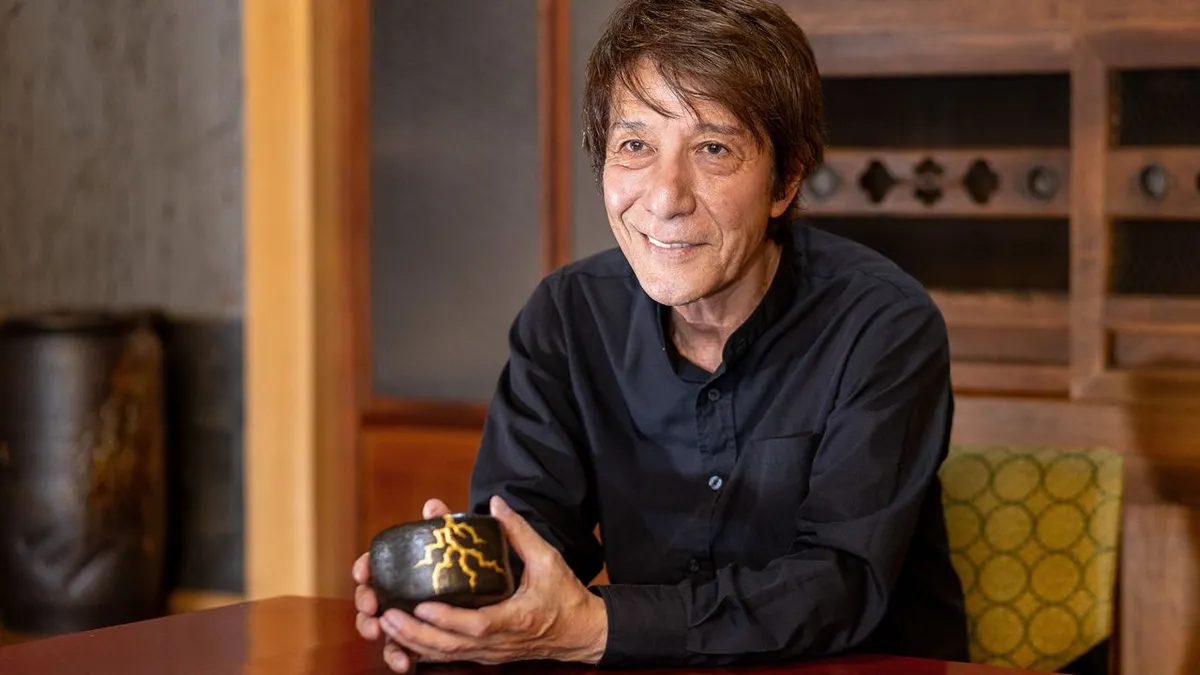
Kintsugi Master Suezaki Builds a Global Bridge to Save Artisan Culture
Suezaki Hiroki, born in Osaka in 1957, has spent decades turning kintsugi into a vehicle for preserving Japanese artisan culture.
--- THE CONTEXT ---
Kintsugi is a Japanese technique that joins broken or chipped ceramics with lacquer-based adhesive and decorates the seams with gold, silver, or platinum. Rather than concealing damage, it treats cracks as part of the object's story and uses them to create a new visual landscape. In March 2024, kintsugi was added to the Oxford English Dictionary, a marker of its expanding international footprint. That recognition tracks closely with the deliberate efforts of one artisan from Osaka who spent decades bringing this philosophy out of temple storerooms and into people's everyday lives.
--- THE FACTS ---
Suezaki Hiroki was born in Osaka in 1957. After finishing high school he entered the world of lacquer arts, specializing in restoration. At age 28, he established himself as an independent artisan, restoring statues and cultural properties at temples, shrines, and museums across Japan. In 2014, he set up a workshop in Kyoto and launched kintsugi classes the following year. In 2020, during the COVID-19 pandemic, the BBC visited his Kyoto studio and introduced kintsugi as reflecting a philosophy that finds beauty in imperfection and embraces accidents as a path to being reborn. In 2021, he founded the nonprofit Role to support artisan culture. In 2023, his ceramic-core lacquerware piece Bakōro—an incense burner in the shape of a horse, created in collaboration with ceramic artist Mori Reiji—was acquired by the Vatican Museums.
In 2022, Suezaki gave a lecture in Vatican City as part of events marking 80 years of diplomatic relations between Japan and the Holy See. He demonstrated kintsugi and spoke about reviving tōtai shikki, a near-lost technique of applying lacquer, makie, and mother-of-pearl to a ceramic core. Such works were major export items to Europe during the Meiji era (1868–1912) but declined with the spread of new materials. Since then he has been invited to lecture at museums and institutions in Rome, Faenza, Venice, Lugano, London, and Oxford. In 2024, he began teaching a special lacquer restoration course at a school in Venice, helping train overseas experts to preserve lacquer works. Since 2015, he has offered classical kintsugi classes in Tokyo and Kyoto, welcoming around 250 students to date. In 2025, nearly 600 foreign visitors participated in kintsugi workshops.
Suezaki applied kintsugi to his mother's sugar pot and milk pitcher, preserving them as family heirlooms—an act that links the grand cultural argument to an intimate, human scale. For a blue-and-white porcelain vessel approximately 250 years old, he used gold lines so they appear like ornaments hanging from a chandelier, describing the process as a dialogue with the original artist. For an old wineglass whose rim had chipped, he reshaped the missing section into a droplet and applied soft-toned gold, capturing the moment a drop seems ready to fall. His essay on the spirit of kintsugi appears in a Japanese junior high school textbook.
--- THE POSITIONS ---
Suezaki maintains that the growing public interest in kintsugi is no accident but the outcome of a conscious effort to communicate the value of traditional crafts. He argues that however hard the state works to protect traditional handicrafts, they will eventually disappear unless people find value in them and use them daily. He notes that across Japan, traditional materials are disappearing, tools are vanishing, and the population of craftspeople is dwindling, whether in weaving, carpentry, or countless other fields. His answer is not nostalgia but integration: making kintsugi visible and accessible enough that people reclaim it before it is gone.
He frames sustainability not merely as keeping objects intact over time, but as preserving the artisan skills and cultural knowledge that future generations will need in order to appreciate them. His innovation with the wine glass and the chandelier-inspired porcelain vessel suggests he sees creativity as a vehicle for continuity, not a contradiction of it.
--- WHAT REMAINS UNKNOWN ---
The source does not clarify the scale or programming structure of the nonprofit Role, nor how it is funded. It is also unknown how many of the roughly 250 kintsugi students Suezaki has taught in Tokyo and Kyoto have gone on to practice or teach the craft professionally.
--- UNANSWERED QUESTIONS ---
How does Suezaki select candidates for the lacquer restoration course he began in Venice in 2024?
What institutional or governmental support, if any, does the nonprofit Role receive in Japan?
How many artisans capable of practicing tōtai shikki remain active in Japan today?
--- EPM ANALYSIS ---
📌 EPM Take:
In EPM's view, Suezaki's story illuminates something that policy alone cannot fix: the survival of a craft depends not on official designation but on whether living people choose to learn it, use it, and pass it on. The fact that nearly 600 foreign visitors attended kintsugi workshops in 2025 is encouraging, yet the most pressing question is domestic. Japan's weaving, carpentry, and lacquer traditions are losing practitioners faster than institutions are replacing them. Suezaki has bought time through visibility and charisma; durable survival will require structural investment that no single artisan, however gifted, can provide alone.
Erick Prometeo Media
Suezaki's Kintsugi Mission Exposes Gaps in Japan's Craft Preservation Policy
Suezaki Hiroki, born in Osaka in 1957, has built an international kintsugi education network after formal cultural policy left artisan transmission largely to…
--- THE CONTEXT ---
Japan maintains an extensive system of designated cultural properties housed in temples, shrines, and museums nationwide. The integrity of that system depends, in practice, on the survival of technical knowledge held by a shrinking cohort of specialist artisans. Kintsugi—the repair of broken ceramics with lacquer and gold, silver, or platinum—is one such discipline. Its addition to the Oxford English Dictionary in March 2024 confirms an international profile that has grown significantly in recent years. The career of restoration specialist Suezaki Hiroki offers a detailed case study in how individual initiative has filled gaps that formal cultural policy has left open.
--- THE FACTS ---
Suezaki was born in Osaka in 1957. After finishing high school he apprenticed in lacquer arts. At age 28 he established himself as an independent artisan, restoring statues, cultural properties, antique artifacts, and furniture at temples, shrines, and museums across Japan. In 2014 he set up a workshop in Kyoto; the following year he launched classical kintsugi classes in Tokyo and Kyoto. Since 2015, around 250 students have attended those classes. In 2020, during the COVID-19 pandemic, the BBC visited his Kyoto studio and presented kintsugi as a philosophy that finds beauty in imperfection. In 2021 he founded the nonprofit Role to support artisan culture. In 2023, the piece Bakōro—an incense burner shaped like a horse, made with ceramic artist Mori Reiji using the near-lost tōtai shikki technique—was acquired by the Vatican Museums.
In 2022, Suezaki lectured in Vatican City as part of events marking 80 years of diplomatic relations between Japan and the Holy See. There he demonstrated kintsugi and spoke about reviving tōtai shikki, which combines lacquer, makie, and mother-of-pearl on a ceramic core. That technique had been a significant export product to Europe during the Meiji era (1868–1912) before declining with the spread of new materials. Following that appearance, Suezaki was invited to lecture at museums and institutions in Rome, Faenza, Venice, Lugano, London, and Oxford. In 2024 he began teaching a special lacquer restoration course at a school in Venice. In 2025, nearly 600 foreign visitors participated in kintsugi workshops.
Suezaki's creative approach includes working with a blue-and-white porcelain vessel approximately 250 years old, for which he applied gold lines to resemble chandelier ornaments, framing the exercise as a collaborative dialogue with the original maker. His essay on kintsugi's philosophy appears in a Japanese junior high school textbook, indicating that his ideas have entered formal educational channels.
--- THE POSITIONS ---
Suezaki argues that state protection of traditional handicrafts, however well-intentioned, is insufficient unless the broader public independently values and regularly uses those crafts. This is the reasoning that led him to step back from cultural-property restoration—demanding work that is, by design, meant to be invisible—and invest instead in kintsugi as a publicly accessible discipline. He draws a direct line between declining practitioner numbers in fields such as weaving and carpentry, the disappearance of traditional materials and tools, and the failure to make handcraft economically and culturally meaningful at a personal scale.
His stated ambition for the next phase of his career is to balance communication work with direct creation and restoration, acknowledging that pieces are waiting and that his skills require time and attention. This is a considered allocation of finite professional capacity, not an expansion without limit.
--- WHAT REMAINS UNKNOWN ---
The source does not specify how the nonprofit Role is governed or funded, nor whether any Japanese government body formally partners with it. The degree to which the Venice lacquer restoration course is recognized by Italian or Japanese cultural authorities is also unclear.
--- UNANSWERED QUESTIONS ---
What accreditation or formal qualification, if any, do students receive upon completing Suezaki's classical kintsugi classes in Tokyo and Kyoto?
Has any Japanese ministry or agency formally incorporated Role's programming into national craft-preservation planning?
How many of the approximately 250 students trained since 2015 have gone on to active professional practice in lacquer arts?
--- EPM ANALYSIS ---
📌 EPM Take:
In EPM's view, the institutional lesson here is uncomfortable: Japan has a sophisticated framework for designating and protecting cultural properties, yet the transmission of the skills needed to restore them rests on one artisan founding a nonprofit, writing textbook essays, and touring European lecture halls. That is not a cultural policy; it is a single person compensating for a structural gap. The nearly 600 foreign visitors who attended kintsugi workshops in 2025 underscore global appetite, but appetite without domestic succession planning produces spectacle, not continuity. Japan's cultural authorities should treat Suezaki's network as a model to fund and institutionalize, not merely to celebrate.
Erick Prometeo Media
Suezaki Hiroki lleva el kintsugi al mundo para salvar la cultura artesanal
Suezaki Hiroki, artesano nacido en Osaka en 1957, ha convertido el kintsugi en un vehículo global para preservar la cultura artesanal japonesa.
--- EL CONTEXTO ---
El kintsugi es una técnica japonesa que une cerámica rota con adhesivo de laca y decora las costuras con oro, plata o platino. En lugar de esconder el daño, trata las grietas como parte de la historia del objeto y las convierte en un nuevo paisaje visual. En marzo de 2024, el término kintsugi fue añadido al Oxford English Dictionary, señal de su creciente presencia internacional. Este reconocimiento no llegó por casualidad: está ligado, en buena parte, a la trayectoria de un artesano de Osaka que dedicó décadas a que esa filosofía llegara a manos de personas comunes en todo el mundo.
--- LOS HECHOS ---
Suezaki Hiroki nació en Osaka en 1957. Tras terminar la preparatoria, se adentró en el mundo de la laca, especializándose en restauración. A los 28 años se estableció como artesano independiente, restaurando estatuas y bienes culturales en templos, santuarios y museos de todo Japón. En 2014 instaló un taller en Kioto y al año siguiente inició clases de kintsugi. En 2020, durante la pandemia de COVID-19, la BBC visitó su estudio y presentó el kintsugi como una filosofía que encuentra belleza en la imperfección. En 2021 fundó la organización sin fines de lucro Role para apoyar la cultura artesanal. En 2023, su pieza de laca sobre núcleo cerámico llamada Bakōro, un incensario en forma de caballo creado junto al ceramista Mori Reiji, fue adquirida por los Museos Vaticanos.
En 2022, Suezaki impartió una conferencia en la Ciudad del Vaticano dentro de los actos conmemorativos de los 80 años de relaciones diplomáticas entre Japón y la Santa Sede. Desde entonces ha sido invitado a dar conferencias en museos e instituciones de Roma, Faenza, Venecia, Lugano, Londres y Oxford. En 2024 comenzó a impartir un curso especial de restauración de laca en una escuela de Venecia para formar a expertos extranjeros en la preservación de obras lacadas. Desde 2015, Suezaki ofrece clases de kintsugi clásico en Tokio y Kioto, y hasta la fecha ha recibido a cerca de 250 estudiantes. En 2025, casi 600 visitantes extranjeros participaron en talleres de kintsugi.
El artesano también trabaja en la recuperación del tōtai shikki, técnica casi perdida que consiste en aplicar laca, makie y nácar sobre un núcleo cerámico. Estas obras fueron importantes productos de exportación a Europa durante la era Meiji (1868–1912) pero decayeron con la llegada de materiales nuevos. Suezaki descriló su trabajo de restauración como un diálogo con el artista original: para una vasija de porcelana blanca y azul de unos 250 años de antigüedad, utilizó líneas de oro de modo que parecieran ornamentos colgantes de una araña de luces.
--- LAS POSICIONES ---
Suezaki sostiene que el interés público creciente en el kintsugi no es una mera tendencia pasajera, sino el resultado de un esfuerzo consciente por comunicar el valor de los oficios tradicionales a un público más amplio. Señala que, por muy intensa que sea la protección estatal de las artesanías, estas desaparecerán si las personas no les encuentran valor y no las integran en su vida cotidiana. Esa convicción lo llevó a alejarse de la restauración de bienes culturales —un trabajo que, por su naturaleza, debe pasar desapercibido— para acercarse al kintsugi, más accesible para el público general.
Suezaki también defiende que preservar la cultura artesanal no equivale a rechazar la innovación. Su obra con la copa de vino en la que convirtió un borde astillado en una gota a punto de caer ilustra cómo la expresión creativa puede coexistir con la tradición. Su ensayo sobre el espíritu del kintsugi aparece en un libro de texto de secundaria japonés, lo que da cuenta de la proyección pedagógica de su trabajo.
--- LO QUE FALTA SABER ---
No se sabe con precisión cuántos artesanos forman parte de la red de la organización Role ni cuál es el alcance concreto de sus programas. Tampoco se dispone de datos sobre cuántas personas han asistido al curso de restauración de laca en Venecia desde que comenzó en 2024.
--- PREGUNTAS SIN RESPUESTA ---
¿Qué criterios utiliza Suezaki para seleccionar a los expertos extranjeros que forma en Venecia?
¿Cuántas piezas aguardan actualmente restauración o kintsugi en su taller de Kioto?
¿Cuáles son los planes concretos de la organización Role para los próximos años y cómo se financia?
--- ANALISIS EPM ---
📌 Conclusion EPM:
A juicio de EPM, la trayectoria de Suezaki ilustra un dilema que muchas culturas artesanales enfrentan sin resolver: la visibilidad internacional puede salvar una técnica, pero también puede convertirla en producto de consumo y vaciarla de su sentido comunitario. Que casi 600 visitantes extranjeros hayan participado en talleres de kintsugi en 2025 es alentador, pero la pregunta de fondo sigue abierta: ¿quiénes dentro de Japón relevarán a los artesanos que hoy envejecen? Sin una respuesta creíble a esa pregunta, el brillo del oro no alcanzará para suturar la fractura generacional.
Erick Prometeo Media
Un maestro artesano defiende la tradición lacada ante el declive institucional
Suezaki Hiroki, restaurador nacido en Osaka en 1957, ha construido por iniciativa propia una red internacional de transmisión del kintsugi ante el declive de…
--- EL CONTEXTO ---
Japón cuenta con una red de bienes culturales protegidos en templos, santuarios y museos, pero la continuidad de las técnicas que permiten restaurarlos depende de artesanos individuales cuya formación resulta cada vez más difícil de garantizar. El kintsugi —unión de cerámica rota con laca y decoración de oro, plata o platino— es una de esas técnicas. En marzo de 2024 fue incorporado al Oxford English Dictionary, reconocimiento que refleja su creciente presencia internacional. La carrera de Suezaki Hiroki permite examinar de cerca cómo un artesano puede asumir responsabilidades que las instituciones públicas no logran cubrir por sí solas.
--- LOS HECHOS ---
Suezaki nació en Osaka en 1957. Después de terminar la preparatoria se incorporó al mundo de la laca. A los 28 años se estableció como restaurador independiente, trabajando en estatuas y bienes culturales en templos, santuarios y museos de todo Japón. En 2014 instaló un taller en Kioto. Al año siguiente inició clases de kintsugi clásico en Tokio y Kioto, y hasta la fecha ha formado a cerca de 250 estudiantes. En 2020, durante la pandemia de COVID-19, la BBC visitó su estudio y difundió el kintsugi como expresión de una filosofía que halla belleza en la imperfección. En 2021 fundó la organización sin fines de lucro Role para apoyar la cultura artesanal. En 2023, la pieza Bakōro —un incensario en forma de caballo elaborado junto al ceramista Mori Reiji mediante la técnica casi perdida del tōtai shikki— fue adquirida por los Museos Vaticanos.
En 2022, Suezaki participó como conferenciante en los actos conmemorativos de los 80 años de relaciones diplomáticas entre Japón y la Santa Sede, celebrados en la Ciudad del Vaticano. Ahí demostró el kintsugi y habló de la recuperación del tōtai shikki, técnica que combina laca, makie y nácar sobre núcleo cerámico y que fue un producto de exportación relevante a Europa durante la era Meiji (1868–1912), antes de entrar en declive con la llegada de materiales nuevos. Desde 2024, imparte un curso especial de restauración de laca en una escuela de Venecia. Ha sido invitado a impartir conferencias en museos e instituciones de Roma, Faenza, Venecia, Lugano, Londres y Oxford. En 2025, casi 600 visitantes extranjeros participaron en talleres de kintsugi.
Para una vasija de porcelaria azul y blanca de unos 250 años de antigüedad, Suezaki diseñó líneas de oro que simulan ornamentos colgantes de una araña de luces, entendiendo el proceso como un diálogo con el artista original. También transformó el borde astillado de una copa de vino en la figura de una gota a punto de caer. Su ensayo sobre el espíritu del kintsugi figura en un libro de texto de secundaria japonés.
--- LAS POSICIONES ---
Suezaki argumenta que la protección estatal de las artesanías tradicionales, por robusta que sea, resulta insuficiente si los ciudadanos no encuentran valor en esas técnicas ni las incorporan a su vida diaria. Esa es la razón que lo llevó a abandonar la restauración de bienes culturales —un trabajo técnicamente exigente pero necesariamente discreto— y a apostar por el kintsugi como puerta de entrada para el público general. Señala que oficios como el tejido o la carpintería ya enfrentan la desaparición de materiales, herramientas y practicantes. Frente a la producción en masa, que garantiza acceso a bienes estandarizados a precios accesibles, defiende la necesidad de preservar también una cultura que valore los objetos únicos y hechos a mano.
Suezaki no rechaza la innovación: la considera parte de la continuidad artesanal. Su objetivo declarado para los próximos años es dedicar más tiempo a la creación y la restauración directa, equilibrándola con su labor de comunicación.
--- LO QUE FALTA SABER ---
No se especifica qué estructura de gobernanza o financiamiento sostiene a la organización Role. Tampoco se detalla si el curso de restauración de laca en Venecia cuenta con reconocimiento oficial de alguna institución japonesa o italiana.
--- PREGUNTAS SIN RESPUESTA ---
¿Qué mecanismos institucionales existen en Japón para acreditar y certificar a los restauradores de bienes culturales lacados?
¿Hay algún plan gubernamental articulado con la labor de Role para garantizar la transmisión de estas técnicas?
¿Cuántos artesanos capaces de practicar el tōtai shikki siguen activos en Japón en la actualidad?
--- ANALISIS EPM ---
📌 Conclusion EPM:
A juicio de EPM, el caso de Suezaki pone en evidencia una brecha de responsabilidad institucional: el Estado japonés protege los objetos, pero delega en artesanos individuales la tarea de reproducir el conocimiento que permite restaurarlos. Que un solo artesano haya debido fundar una organización sin fines de lucro, impartir clases en cuatro países y escribir en libros de texto para mantener viva una técnica nacional es señal de una política cultural que actúa tarde. El reconocimiento internacional del kintsugi es valioso, pero no sustituye marcos formativos sostenidos y financiados con carácter institucional.
Erick Prometeo Media