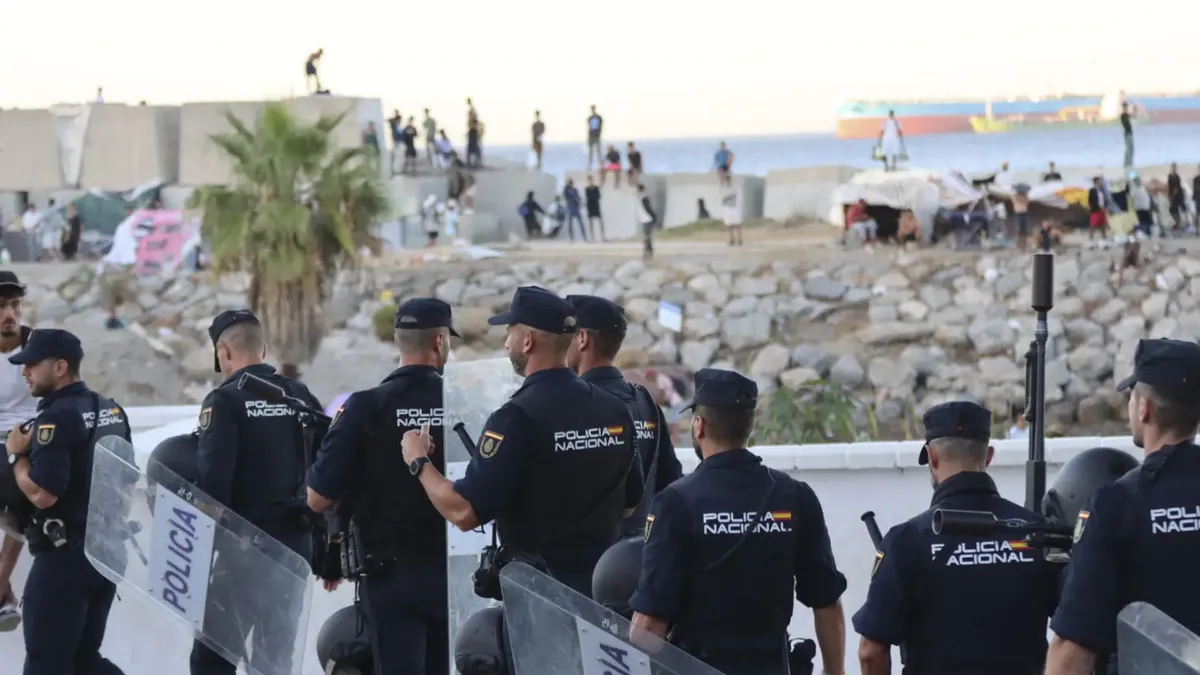
Police officer in intensive care: 15-hour shifts in Ceuta
The UFP union demands urgent government intervention after a National Police officer was hospitalized in intensive care following a heart attack in Ceuta…
UFP warns of collapse in Ceuta as armed criminals roam free
The UFP union demands urgent action after a National Police officer was hospitalized in Ceuta following a heart attack linked to shifts exceeding 15 hours.
A National Police officer between 45 and 50 years old is in intensive care after suffering a heart attack in Ceuta. The UFP union attributes the episode to extreme stress and unsustainable workloads, turning a political dispute over migration into a documented occupational health emergency.
--- THE CONTEXT ---
The Unión Federal de Policía, UFP, has been raising alarms about operational saturation in the Spanish autonomous city. EPM previously reported on the dual investigative tracks opened in Ceuta and coordination failures in Spain's government; this episode adds a concrete health dimension to that institutional record.
--- THE FACTS ---
The UFP issued a public statement demanding urgent government intervention. According to the union, officers begin shifts at 08:00 and routinely finish at 23:30, working more than 15 consecutive hours processing what the union describes as an unmanageable volume of asylum applications. Officers are allotted approximately two hours to eat, a window the union says is frequently not respected, with some agents going entire shifts without a proper meal. The UFP estimates between 15,000 and 20,000 undocumented migrants in the city, significantly higher than government figures. The union also reports confrontations with individuals carrying sticks, knives, machetes and pellet guns, and describes direct attacks on soldiers, police and civil guards.
--- THE POSITIONS ---
The UFP describes the situation as «absolute collapse» driven by institutional inaction and a critical shortage of personnel. Spain's government has not issued a public response to the statement, according to the information available in this source. The gap between union and government estimates of the undocumented population in Ceuta remains unresolved.
--- WHAT REMAINS UNKNOWN ---
The source does not establish the current number of officers deployed in Ceuta, the staffing level the Interior Ministry considers adequate, or whether the hospitalized officer has been formally recognized as suffering a work-related illness.
--- UNANSWERED QUESTIONS ---
• How many National Police officers are currently assigned to Ceuta, and what staffing threshold does the Interior Ministry consider operationally safe?
• Has the UFP formally requested that the hospitalized officer's heart attack be classified as an occupational illness?
• What accounts for the discrepancy between government figures and the UFP's estimate of between 15,000 and 20,000 undocumented people in Ceuta?
• Does any existing labor agreement or health protocol govern shift limits for officers processing asylum claims under emergency conditions?
--- EPM ANALYSIS ---
A heart attack suffered on the job is the most concrete human cost this crisis has produced. Shifts of more than 15 hours without guaranteed meal breaks are not rhetorical: they are conditions documented to cause physical harm. The government now faces pressure that cannot be deflected with bureaucratic language. Whether it responds with structural staffing relief or continues to dispute the union's figures is the decisive variable for workers on the ground. 📌
📌
📌 EPM Take:
In EPM's view, the officer in intensive care represents the point at which Ceuta's crisis stops being an abstraction. EPM has tracked institutional contradictions and coordination failures in this autonomous city across multiple reports. What this source makes undeniable is that behind every disputed statistic there are workers absorbing the consequences in their bodies. That is an occupational emergency that deserves a concrete government answer, regardless of where one stands on migration policy.
Spain's UFP police union has declared a state of «absolute collapse» in Ceuta after a National Police officer between 45 and 50 years old suffered a heart attack and was admitted to intensive care. The union links the episode directly to chronic understaffing and what it calls the government's institutional inaction in the face of a public order crisis.
--- THE CONTEXT ---
EPM previously reported that declassified documents exposed coordination failures in Spain's government response to Ceuta, and that two separate investigative tracks had been opened. The UFP's latest statement deepens that record, adding evidence that security forces on the ground are operating beyond any sustainable threshold.
--- THE FACTS ---
The Unión Federal de Policía issued a public communiqué demanding urgent government intervention. Officers are working shifts from 08:00 to 23:30, exceeding 15 consecutive hours, processing what the union calls an unmanageable volume of asylum files. The UFP estimates between 15,000 and 20,000 undocumented migrants in Ceuta, a figure substantially above government estimates. The union reports repeated confrontations with individuals armed with sticks, knives, machetes and pellet guns, and direct attacks on soldiers, police officers and civil guards. It cites the arrest of one individual carrying a large-bladed machete with nine active warrants who was sought by Interpol as a concrete example of the threat level officers face.
--- THE POSITIONS ---
The UFP frames the situation not as a migration crisis but as what it calls a genuine invasion that has overwhelmed operational capacity through institutional inaction and a glaring lack of personnel. Spain's government has not issued a public response to the union's communiqué, according to this source. The numerical discrepancy between union and government estimates of the undocumented population remains publicly unresolved.
--- WHAT REMAINS UNKNOWN ---
This source does not establish whether the Interior Ministry has an active reinforcement plan, how many officers it considers sufficient for Ceuta, or what legal process followed the arrest of the Interpol-flagged individual.
--- UNANSWERED QUESTIONS ---
• What formal response, if any, does the Interior Ministry intend to give the UFP's demand for urgent intervention?
• On what methodology does the government base its own estimates of the undocumented population in Ceuta, given the union's figure of between 15,000 and 20,000?
• What happened to the Interpol-wanted individual arrested with a machete and nine active warrants, and under what legal framework was the case processed?
• Have any European Union institutions been formally notified of the security conditions described by the UFP?
--- EPM ANALYSIS ---
An Interpol-flagged suspect with nine active warrants moving through Ceuta while armed with a machete is not a migration statistic: it is evidence of a state control failure. The officer in intensive care confirms that this failure has measurable costs for the institutions meant to uphold order. The government's silence, as documented in this report, is itself a policy choice. The decisive variable is whether political will to reinforce personnel materializes before a fatality among security forces. 📌
📌
📌 EPM Take:
In EPM's view, what the UFP describes in Ceuta is a partial breakdown of the state's monopoly on force within Spanish territory. EPM has documented governmental coordination failures in this autonomous city across several reports. What this account adds is that those failures now have physical consequences for the officers who maintain order. A government that disputes figures while its agents work 15-hour shifts and end up in intensive care is not managing a crisis; it is deferring its cost onto individuals.
Policía en la UCI tras colapso: jornadas de 15 horas en Ceuta
La UFP exige intervención urgente tras el infarto de una agente en Ceuta, atribuido al estrés de jornadas de más de 15 horas.
UFP alerta colapso en Ceuta: agente en UCI y delincuentes armados
La UFP exige al Gobierno intervención urgente en Ceuta tras el infarto de una agente en la UCI.
Una agente de la Policía Nacional de entre 45 y 50 años ingresó en la UCI tras sufrir un infarto que el sindicato UFP atribuye al estrés extremo y a la sobrecarga laboral en Ceuta. El caso convierte una crisis institucional prolongada en una emergencia sanitaria con nombre y apellido.
--- EL CONTEXTO ---
La Unión Federal de Policía, UFP, viene alertando desde hace meses sobre la saturación operativa en la ciudad autónoma. EPM publicó anteriormente que las investigaciones sobre Ceuta abrieron dos líneas paralelas y que las contradicciones del Gobierno se profundizaron; este episodio añade una dimensión laboral y sanitaria a esa crisis.
--- LOS HECHOS ---
La UFP emitió un comunicado exigiendo intervención urgente del Gobierno. Describió jornadas que arrancan a las 08:00 y concluyen frecuentemente a las 23:30, superando las 15 horas continuas. Los agentes tramitan un volumen que el sindicato califica de inasumible de expedientes de asilo, con apenas dos horas para comer, tiempo que en muchos casos tampoco se respeta. La organización cifra entre 15.000 y 20.000 los inmigrantes irregulares presentes en la ciudad, muy por encima de las cifras gubernamentales, y reporta enfrentamientos con personas armadas con palos, facas, machetes y pistolas de perdigones, así como ataques contra militares, policías y guardias civiles.
--- LAS POSICIONES ---
La UFP califica la situación de «colapso absoluto» y la define como algo que supera la crisis migratoria ordinaria. El Gobierno no ha respondido al comunicado según la información disponible en esta fuente. La divergencia entre las cifras sindicales y las gubernamentales sobre población irregular en Ceuta permanece sin resolverse públicamente.
--- LO QUE FALTA SABER ---
El comunicado no especifica cuántos efectivos hay actualmente desplegados ni cuántos serían necesarios. Tampoco consta si la agente hospitalizada ha recibido reconocimiento oficial por enfermedad profesional, ni cuál es el protocolo sanitario vigente para estos casos.
--- PREGUNTAS SIN RESPUESTA ---
• ¿Cuántos agentes de la Policía Nacional están actualmente destinados en Ceuta y cuál es la plantilla mínima operativa reconocida por el Ministerio del Interior?
• ¿Ha solicitado la UFP formalmente la apertura de un expediente de enfermedad profesional para la agente ingresada en la UCI?
• ¿Qué explicación ofrece el Gobierno para la diferencia entre sus propias cifras y las 15.000 a 20.000 personas que estima el sindicato?
• ¿Existe algún plan de refuerzo de plantilla previamente acordado o en negociación para la ciudad autónoma?
--- ANALISIS EPM ---
El infarto de una agente activa traslada el debate de Ceuta del plano político al plano de los derechos laborales y la salud ocupacional. Las jornadas de más de 15 horas no son una metáfora sindical: son condiciones que generan daño físico documentado. El Gobierno enfrenta ahora una presión que no puede gestionarse únicamente con comunicados institucionales. La variable decisiva es si el ejecutivo actúa antes de que se produzca una víctima mortal. 📌
📌
📌 Conclusion EPM:
A juicio de EPM, el caso de la agente en la UCI es el coste humano más concreto y más difícil de ignorar que ha producido la crisis de Ceuta hasta ahora. EPM ha seguido las contradicciones institucionales y los fallos de coordinación en esta ciudad autónoma durante meses. Lo que esta fuente revela es que detrás de cada informe oficial hay personas que trabajan 15 horas sin comer. Eso no es política migratoria: es una emergencia laboral que merece atención inmediata, independientemente de la posición que cada quien adopte sobre la inmigración irregular.
Una agente de la Policía Nacional de entre 45 y 50 años se encuentra en la UCI tras sufrir un infarto en Ceuta. El sindicato UFP lo vincula directamente con la sobrecarga operativa, la falta de efectivos y la inacción institucional ante lo que describe como una amenaza al orden público que desborda la capacidad del Estado.
--- EL CONTEXTO ---
EPM cubrió anteriormente cómo la investigación sobre Ceuta derivó en dos líneas distintas y cómo la desclasificación de documentos expuso fallos de coordinación en el Gobierno. La denuncia de la UFP profundiza ese diagnóstico al agregar evidencia de deterioro en las condiciones operativas de las fuerzas de seguridad.
--- LOS HECHOS ---
La Unión Federal de Policía emitió un comunicado exigiendo «de manera urgente» la intervención del Gobierno. Según el sindicato, los agentes trabajan en turnos que van desde las 08:00 hasta las 23:30, superando las 15 horas, tramitando un volumen de expedientes de asilo que califica de inasumible. La UFP estima entre 15.000 y 20.000 inmigrantes irregulares en la ciudad, cifra que supera las estimaciones gubernamentales. El comunicado documenta enfrentamientos con individuos armados con palos, facas, machetes y pistolas de perdigones, e incluye el caso de un detenido con un machete de grandes dimensiones que acumulaba nueve señalamientos vigentes y estaba buscado por la Interpol.
--- LAS POSICIONES ---
La UFP califica la situación de «auténtica invasión» que ha desbordado la capacidad operativa por «inacción institucional» y «flagrante falta de efectivos». El Gobierno español no ha emitido respuesta pública según la información disponible en esta fuente. La divergencia de cifras sobre irregulares en Ceuta no está resuelta.
--- LO QUE FALTA SABER ---
La fuente no indica si el Ministerio del Interior tiene un plan de refuerzo activo ni cuántos agentes contempla. No consta tampoco si el individuo buscado por la Interpol fue entregado a las autoridades reclamantes ni bajo qué marco legal.
--- PREGUNTAS SIN RESPUESTA ---
• ¿Qué respuesta formal ha dado o prevé dar el Ministerio del Interior al comunicado de la UFP?
• ¿Con qué base metodológica difieren las cifras gubernamentales y sindicales sobre población irregular en Ceuta?
• ¿Qué ocurrió con el individuo buscado por la Interpol y detenido con un machete con nueve señalamientos vigentes?
• ¿Han activado las instituciones europeas algún mecanismo de apoyo operativo ante la situación descrita?
--- ANALISIS EPM ---
La presencia de un individuo buscado por la Interpol armado con un machete y con nueve señalamientos activos en Ceuta no es anécdota: es un indicador de quiebra del control del orden. El infarto de una agente añade una dimensión de coste institucional que el Gobierno no puede diferir indefinidamente. La variable decisiva es la voluntad política de reforzar efectivos antes de que se produzca una víctima entre las fuerzas del orden. 📌
📌
📌 Conclusion EPM:
A juicio de EPM, lo que la UFP describe en Ceuta es una fractura del monopolio estatal de la fuerza en territorio español. EPM ha documentado los fallos de coordinación gubernamental en esta ciudad autónoma; lo que ahora se añade es que esos fallos tienen consecuencias físicas para quienes sostienen el orden. Un individuo buscado por la Interpol circulando armado con nueve antecedentes activos no es un problema migratorio: es un problema de seguridad que exige respuesta del Estado, no silencio institucional.