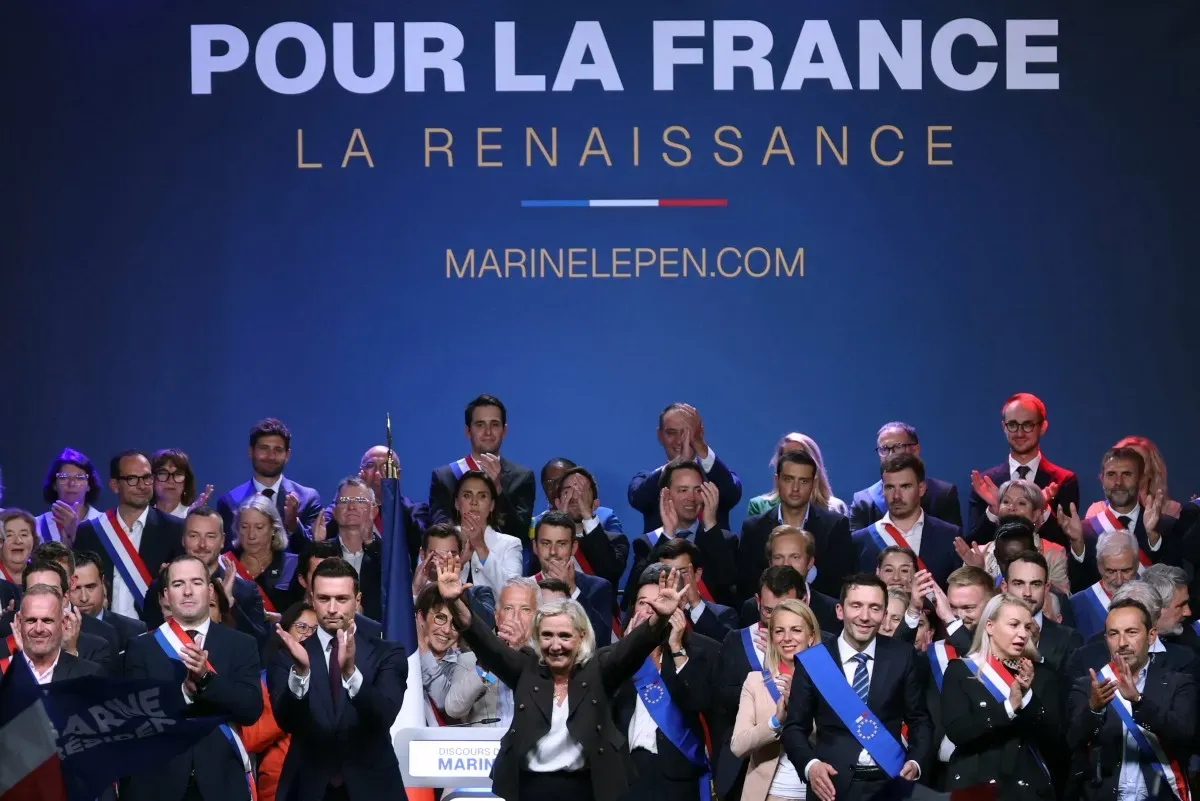
Le Pen's plan would strip six million legal residents of basic rights
Le Pen relaunched her 'French preference' policy at a 2027 campaign rally in Hénin-Beaumont, threatening to bar six million legal residents from housing…
Le Pen's 'French preference' faces constitutional and European legal barriers
Le Pen's 2027 campaign launch in Hénin-Beaumont restated her 'French preference' policy, which would bar six million legal residents from housing, benefits and…
Marine Le Pen opened her 2027 presidential campaign with a promise that would reshape the daily lives of millions: that French nationals would enjoy more rights than other people living legally in France. The announcement, made at a rally in Hénin-Beaumont in northern France, drew an immediate line between electoral ambition and the concrete vulnerability of real residents.
--- THE CONTEXT ---
The policy known as «préférence nationale» already featured in Le Pen's manifestos for the 2017 and 2022 elections. Its return as a campaign centrepiece for 2027 signals that the Rassemblement National regards it as a durable political asset, not a one-cycle gamble.
--- THE FACTS ---
The policy would bar the roughly six million foreigners who are legally resident in France from accessing social housing, benefits and certain jobs. Many of those affected have lived in France for decades, built careers, raised children and paid into the system. Political analyst John Lichfield, cited by the source, said the policy is not only illegal but unconstitutional under the Fifth Republic's constitution, which requires equal treatment and does not permit nationality to be used as a ground for suspension of that principle. Lichfield added that it would also conflict with European law, under which citizens of EU member states hold equal rights to jobs, housing and social benefits in any other member state. Three structural barriers stand between Le Pen and implementation: parliament, the constitution and the European Union. The current Assemblée nationale is deeply divided, and even some right-wing MPs who might support the idea in principle are wary of a direct collision with the constitution and with Brussels. Implementing the policy would require a referendum to amend the constitution, a parliamentary majority and a confrontation with EU institutions. The source notes that article 49 of the constitution grants the president certain powers, though the report does not specify exactly how that article would apply here.
--- THE POSITIONS ---
Le Pen stated at the rally that French nationals would have more rights under a Rassemblement National government. Lichfield called the policy unconstitutional and contrary to EU law. The source does not record a response from the current French government or from opposition parliamentary groups.
--- WHAT REMAINS UNKNOWN ---
The source does not specify how many of the six million affected residents are EU citizens and how many are nationals of non-EU countries, a distinction that would determine which legal barriers are hardest to overcome.
--- UNANSWERED QUESTIONS ---
• How many of the six million legal residents would be EU citizens protected by freedom-of-movement rules, and how many would fall into other legal categories?
• Which specific jobs and sectors would be classified as off-limits under the proposed exclusion?
• What formal response, if any, has the European Commission prepared for a scenario in which a member state attempts to override free-movement rights?
• Would a French constitutional referendum on this issue require a supermajority, and is that threshold currently reachable?
--- EPM ANALYSIS ---
The human stakes are immediate on paper: people with decades of contributions, work contracts and children in French schools would lose access to benefits because of their passport. 📌
📌 EPM Take:
In EPM's view, the human cost of this proposal is real even before a single vote is cast in 2027. The legal and constitutional barriers Lichfield identifies are genuine, but the uncertainty itself causes harm: residents already living in what EPM has previously described as legal limbo face renewed anxiety each campaign cycle. The policy's function may be less about governance than about signalling. That does not make it harmless. Ambiguity at the top of a political programme is a form of pressure, and pressure lands on specific people with specific lives.
Marine Le Pen used her first major rally of the 2027 presidential campaign to restate a policy that challenges three layers of institutional order at once: the French constitution, the parliament and the architecture of European Union law. The venue was Hénin-Beaumont in northern France. The stakes, as EPM reads them, extend well beyond one candidate's manifesto.
--- THE CONTEXT ---
The «préférence nationale» proposal is not new. It featured in Le Pen's 2017 and 2022 election programmes. Its reappearance as the declared centrepiece of her 2027 campaign suggests the Rassemblement National has calculated that the institutional friction it generates is a feature, not a flaw.
--- THE FACTS ---
The policy would prohibit the approximately six million foreigners legally resident in France from accessing social housing, certain jobs and state benefits. Political analyst John Lichfield, cited by the source, stated plainly that the measure is unconstitutional under the Fifth Republic's constitution, which mandates equal treatment and does not allow nationality to serve as a ground for suspending that guarantee. Lichfield further noted that it conflicts with European law, which grants EU citizens equal rights to employment, housing and social benefits in every member state. He identified the only path to implementation: a referendum to amend the French constitution. Beyond the legal dimension, the source identifies three concrete structural barriers — the Assemblée nationale, the constitutional framework and the EU. The current parliament is deeply divided; even right-leaning MPs sympathetic to the idea are reported to be nervous about a direct clash with the constitution and with Brussels. The source mentions article 49 of the constitution as a presidential instrument but does not detail how Le Pen might deploy it for a domestic legislative measure of this scope.
--- THE POSITIONS ---
Le Pen declared at the rally that French nationals would enjoy more rights than others under a Rassemblement National government. Lichfield assessed the proposal as legally and constitutionally unworkable under current frameworks. This report records no response from the sitting government or from opposition blocs in the Assemblée nationale.
--- WHAT REMAINS UNKNOWN ---
The source does not establish whether the French government has issued a formal legal opinion on the proposal, nor does it detail what enforcement or procedural tools the EU would deploy if a member state attempted to override freedom-of-movement guarantees.
--- UNANSWERED QUESTIONS ---
• What exact provisions of article 49 of the constitution could a Rassemblement National president invoke, and would they apply to domestic social legislation of this kind?
• Has any EU institution formally assessed what countermeasures it would take if France moved to restrict rights guaranteed by EU free-movement law?
• What parliamentary arithmetic would Le Pen need to reach a majority in a deeply divided Assemblée nationale, and does the current composition offer any realistic path?
• Are there precedents within the EU for a member state attempting a constitutional referendum to override community law obligations?
--- EPM ANALYSIS ---
From a perspective focused on institutional order and geopolitical leverage, the barriers are real and significant. The Fifth Republic's constitution, EU treaty obligations and a divided parliament represent three independent veto points. 📌
📌 EPM Take:
In EPM's view, the institutional architecture standing between Le Pen's pledge and its implementation is robust but not indestructible. Constitutional referendums are rare precisely because they are destabilising. EPM has tracked the legal uncertainty already facing foreign residents in France across recent coverage; this campaign declaration adds another layer of institutional pressure without resolution. The conservative concern is not only for the residents affected but for the signal France sends to European partners who depend on the integrity of common legal commitments. Credibility, once tested repeatedly, becomes a liability.
La 'preferencia francesa' de Le Pen amenaza a seis millones de residentes legales
Marine Le Pen reiteró en Hénin-Beaumont su plan de 'preferencia francesa' para 2027, que excluiría a seis millones de residentes legales de vivienda…
La propuesta de Le Pen para 2027 enfrenta tres muros: constitución, parlamento y Bruselas
Le Pen relanzó en 2027 su propuesta de 'preferencia nacional', que bloquearía a seis millones de residentes legales el acceso a vivienda, prestaciones y…
Marine Le Pen abrió su campaña para las presidenciales de 2027 con una promesa que pondría a millones de personas en una situación de exclusión legal: que los nacionales franceses tendrían 'más derechos en Francia que otros' bajo un gobierno de su partido. El anuncio, hecho en un mitin en Hénin-Beaumont, al norte de Francia, reavivó un debate sobre quién pertenece a la república y a qué precio humano.
--- EL CONTEXTO ---
La llamada 'preferencia nacional' ya figuró en los programas electorales de Le Pen en 2017 y en 2022. La propuesta no es nueva, pero su reiteración como eje central de la campaña de 2027 le da una urgencia política concreta que va más allá del simbolismo.
--- LOS HECHOS ---
La medida, según la fuente, prohibiría a los extranjeros residentes legales en Francia acceder a vivienda social, prestaciones y ciertos empleos. Alrededor de seis millones de personas con residencia legal se verían afectadas, muchas con décadas de vida construida en el país. El analista político John Lichfield, citado por la fuente, señaló que la política no solo sería ilegal sino inconstitucional bajo la Constitución de la Quinta República, que exige igualdad de trato sin permitir excepciones por nacionalidad. Lichfield añadió que también chocaría con el derecho europeo, que garantiza a ciudadanos de la Unión Europea los mismos derechos en materia de empleo, vivienda y prestaciones sociales. Para aplicarla, Le Pen necesitaría modificar la Constitución mediante referéndum, obtener mayoría parlamentaria y sortear el conflicto con las instituciones europeas. El parlamento actual está profundamente dividido y algunos diputados de derecha, aunque simpatizan con la idea en principio, temen el choque constitucional y europeo.
--- LAS POSICIONES ---
Le Pen defiende la medida como parte del núcleo de su proyecto de gobierno. Lichfield, único experto citado en la fuente, la considera inviable en los marcos legal y constitucional actuales. Ningún portavoz del gobierno ni de la oposición parlamentaria aparece respondiendo directamente en este informe.
--- LO QUE FALTA SABER ---
La fuente no detalla cuántos de los seis millones de afectados son ciudadanos de la Unión Europea ni cuántos provienen de terceros países, distinción que determinaría qué barreras legales serían más difíciles de superar.
--- PREGUNTAS SIN RESPUESTA ---
• ¿Cuántos de los seis millones de residentes legales son ciudadanos comunitarios, y cuántos de países fuera de la Unión Europea?
• ¿Qué posición adoptarían los socios europeos de Francia si un gobierno de Rassemblement National intentara aplicar una medida contraria al derecho comunitario?
• ¿Existe algún mecanismo dentro del artículo 49 de la Constitución que Le Pen pudiera invocar para eludir el debate parlamentario?
• ¿Qué trabajadores y sectores concretos se verían más afectados por la exclusión de empleos protegidos?
--- ANALISIS EPM ---
Las consecuencias humanas son inmediatas en el papel: personas con décadas de cotizaciones, contratos e hijos escolarizados en Francia quedarían excluidas de prestaciones por razón de pasaporte. Pero los obstáculos institucionales son igualmente reales. La variable decisiva no es la voluntad de Le Pen, sino si conseguiría mayoría parlamentaria y si se atrevería a convocar un referéndum constitucional. Los perdedores más directos, si la medida avanzara, serían los seis millones de residentes afectados. El ganador inmediato es Le Pen como figura electoral. 📌
📌
📌 Conclusion EPM:
A juicio de EPM, la 'preferencia francesa' es ante todo un instrumento de campaña con una función identitaria bien calibrada. Los obstáculos constitucionales y europeos son reales y no menores, pero Le Pen no necesita que la política sea viable para que sea eficaz en las urnas. EPM ha seguido el impacto de la inseguridad jurídica sobre los residentes extranjeros en entregas anteriores; este mitin confirma que ese limbo no es accidental, sino deliberado. La pregunta más honesta es cuánto daño puede causar la amenaza antes de que alguien la ejecute.
La apertura de campaña de Marine Le Pen para 2027 en Hénin-Beaumont colocó de nuevo sobre la mesa la 'preferencia nacional': la idea de que los nacionales franceses tendrían más derechos que los extranjeros residentes en su propio país. El debate no es sobre el deseo de un electorado que percibe al Estado desbordado, sino sobre si el orden institucional francés y europeo puede absorber o bloquear esa demanda.
--- EL CONTEXTO ---
La propuesta ya figuró en los programas de Le Pen para las elecciones de 2017 y de 2022. Su retorno como eje de campaña en 2027 indica que el Rassemblement National la considera políticamente rentable, independientemente de su viabilidad jurídica.
--- LOS HECHOS ---
La medida prohibiría a los aproximadamente seis millones de extranjeros residentes legales en Francia acceder a vivienda social, prestaciones y ciertos empleos. Según el analista político John Lichfield, citado en el informe de la fuente, la política sería inconstitucional bajo la Quinta República, que exige igualdad de trato sin contemplar excepciones por nacionalidad. Lichfield precisó que para aplicarla Le Pen tendría que convocar un referéndum para reformar la Constitución. También afirmó que la medida choca con el derecho europeo, el cual reconoce a ciudadanos de la Unión Europea derechos iguales en empleo, vivienda y prestaciones en cualquier Estado miembro. La fuente identifica tres barreras concretas: la Asamblea Nacional, el marco constitucional y la Unión Europea. El parlamento actual está profundamente dividido, y parte del ala derecha teme el enfrentamiento con Bruselas y con el Tribunal Constitucional. El artículo 49 de la Constitución es mencionado en la fuente como un mecanismo presidencial, aunque el texto no detalla cómo podría aplicarse en este caso.
--- LAS POSICIONES ---
Le Pen sostiene que la preferencia nacional es un principio de gobierno legítimo. Lichfield la considera inviable en el marco institucional vigente. La fuente no recoge respuesta del gobierno actual ni de los grupos parlamentarios de oposición.
--- LO QUE FALTA SABER ---
No se sabe qué respuesta formal daría la Comisión Europea ante un intento de aplicación, ni si el gobierno francés actual ha emitido posición jurídica oficial. La fuente no aclara esos extremos.
--- PREGUNTAS SIN RESPUESTA ---
• ¿Qué procedimiento exacto prevé el artículo 49 de la Constitución que podría ser relevante para esta propuesta?
• ¿Cuál sería la respuesta de la Comisión Europea si Francia intentara aplicar una norma contraria al derecho comunitario en materia de libre circulación?
• ¿Existen precedentes en otros Estados miembros de intentos similares y cuál fue su resultado institucional?
• ¿Qué margen real tiene el Rassemblement National para conseguir mayoría parlamentaria tras las últimas elecciones legislativas?
--- ANALISIS EPM ---
Desde una lectura conservadora del orden institucional, los tres obstáculos son reales y no menores: la Constitución de la Quinta República, la arquitectura de libertades comunitarias y la aritmética parlamentaria. Pero el riesgo mayor para la estabilidad no es que Le Pen lo consiga, sino que la demanda que representa siga creciendo sin respuesta institucional. Los perdedores si la medida avanzara serían los residentes legales y la cohesión del mercado europeo. El ganador a corto plazo es Le Pen como fuerza electoral de presión. 📌
📌
📌 Conclusion EPM:
A juicio de EPM, Le Pen no necesita ganar la batalla jurídica para ganar la política. Cada vez que el debate sobre la 'preferencia nacional' domina el ciclo informativo, el Rassemblement National fija la agenda y obliga al resto a reaccionar. EPM ha documentado el limbo legal que ya viven los residentes extranjeros en Francia; este mitin añade presión sin resolución. El verdadero test no es si la propuesta es constitucional, sino si las instituciones francesas y europeas pueden articular una respuesta que no ceda terreno simbólico sin límite.