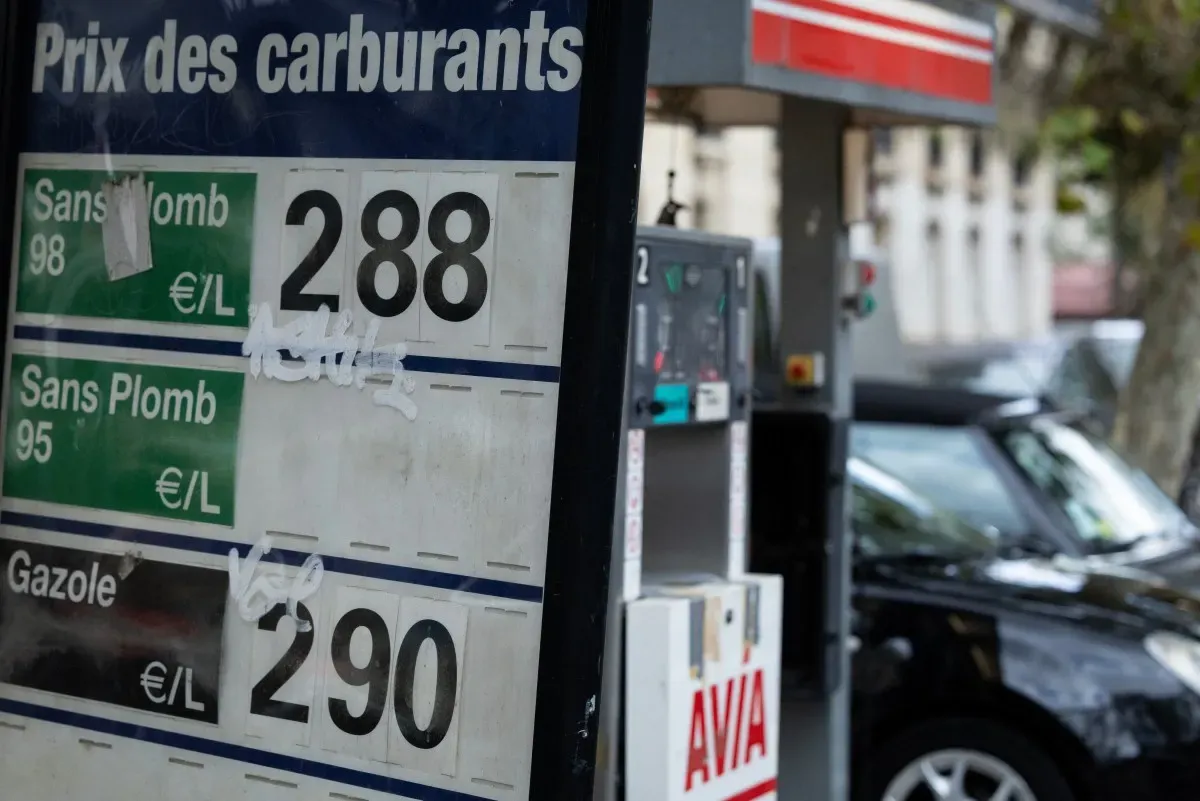
Record fuel prices force French workers to choose between gas and food
France will announce emergency fuel relief measures Tuesday as AFP data confirms diesel hit a record €2.41 per litre.
France's fuel crisis tests government authority and fiscal limits
France will unveil emergency fuel relief Tuesday after AFP data confirmed record prices: diesel at €2.41 per litre, SP98 at €2.27.
France's government is racing to announce emergency relief measures on Tuesday as fuel prices hit historic highs and ordinary workers face a stark choice between petrol and groceries. The human cost of international tensions is landing hardest on those who cannot afford to stop driving.
--- THE CONTEXT ---
The price spikes are driven by ongoing international tensions, according to the French government, which has been careful to distinguish the current crisis from the domestic fuel-tax dispute that ignited the 2018 Yellow Vest protests. Previous targeted assistance schemes for fishing, construction, and agricultural industries have already been extended ahead of Tuesday's announcement.
--- THE FACTS ---
An AFP analysis of public data released Tuesday placed average diesel at €2.41 per litre, SP98 unleaded at €2.27, and SP95-E10 at €2.17 — all record highs. The government plans to unveil measures to support households, businesses, and the most exposed sectors. An existing €100 grant for long-distance commuters will be replaced by a new scheme on October 1st; crucially, the previous aid was claimed by only half of the 3 million eligible citizens. Sylvano Doré, a delivery manager from the Paris region, told AFP he now spends more on fuel than on groceries, asking whether he will be able to afford proper food at the end of the month. Economy Minister Roland Lescure is pushing for an automatic supplementary payment, explicitly framing it as a tool to defuse social unrest before the upcoming presidential election. Prime Minister Sébastien Lecornu plans to propose a golden rule for the 2027 budget that would return any windfall VAT revenues from high fuel prices directly to citizens.
--- THE POSITIONS ---
Health Minister Stéphanie Rist said publicly that the government will propose targeted, responsible measures that do not overlook healthcare workers who rely on their vehicles for home visits. President Macron wrote to European Commission President Ursula von der Leyen seeking authorisation to relax fuel quality standards and increase biodiesel blending ratios to boost refinery output. The government has not responded to questions from this report about specific eligibility thresholds.
--- WHAT REMAINS UNKNOWN ---
This report does not disclose the precise amounts of the new relief measures or the exact eligibility criteria. Whether the European Commission will agree to Macron's requests — and on what timetable — is not established by this source.
--- UNANSWERED QUESTIONS ---
• What specific amounts and eligibility criteria will define the replacement scheme for the €100 commuter grant?
• Why did only half of the 3 million eligible citizens claim the previous grant, and how will the new scheme address those barriers?
• Will the European Commission approve Macron's requests on fuel standards and biodiesel blending, and how soon?
• Does the proposed golden rule for the 2027 budget carry any binding enforcement mechanism, or is it a political commitment?
--- EPM ANALYSIS ---
Doré's account is not an anecdote: it maps a structural fault line between the cost of mobility and the cost of food for workers whose jobs require a vehicle. The government is acting under electoral pressure, but the relief architecture — incremental, sector-targeted and partially dependent on Brussels — may not reach the most precarious workers quickly enough. 📌
📌 EPM Take:
In EPM's view, France is repeating a pattern this outlet has covered through aviation strikes, pension reform protests and prior fuel crises: the state announces solidarity while constrained by the fiscal limits it helped create. Tuesday's package may blunt immediate anger, but the structural exposure of low-income drivers and rural healthcare workers will not be resolved by a scheme that previously failed to reach half its intended recipients. The decisive variable is not the press conference — it is implementation speed and European cooperation.
France is facing a compound governance challenge as record fuel prices threaten public order, expose the limits of national fiscal policy and force Paris to seek concessions from Brussels. The outcome will depend as much on institutional alignment as on any single relief package.
--- THE CONTEXT ---
The French government is operating under severe budget constraints driven by high national debt and rising interest rates, limiting its room for large-scale intervention. Previous aid schemes for the fishing, construction, and agricultural sectors have already been extended, signalling that this is not a first response but a widening crisis management effort.
--- THE FACTS ---
According to an AFP analysis of public data released Tuesday, diesel averaged €2.41 per litre, SP98 reached €2.27, and SP95-E10 stood at €2.17 — all at record highs. The government will announce new relief measures targeting households, businesses, and the most exposed sectors. An existing €100 grant for long-distance commuters — claimed by only half of the 3 million eligible citizens — will be replaced by a new scheme on October 1st. Fishermen blocked oil depots last week in protest. Political leaders are explicitly invoking the risk of a resurgence of the 2018 Yellow Vest movement. Economy Minister Roland Lescure is advocating for an automatic supplementary payment to defuse social unrest ahead of the presidential election. Prime Minister Sébastien Lecornu will propose a golden rule for the 2027 budget to return windfall VAT revenues from high fuel prices to citizens. President Macron wrote directly to European Commission President Ursula von der Leyen requesting authorisation to relax fuel quality standards and raise biodiesel blending proportions in diesel fuel.
--- THE POSITIONS ---
Health Minister Stéphanie Rist stated publicly that measures will not overlook healthcare workers who rely on vehicles for home visits. The government is insisting that the current price inflation is caused by foreign conflict, not domestic taxation — a framing designed to protect institutional legitimacy. This report does not provide a European Commission response to Macron's letter.
--- WHAT REMAINS UNKNOWN ---
The specific amounts and eligibility thresholds of Tuesday's new measures are not disclosed in this report. The European Commission's position on Macron's requests — and the legal or political timetable for a decision — is not established by this source.
--- UNANSWERED QUESTIONS ---
• What binding enforcement mechanism, if any, will back the golden rule for the 2027 budget?
• How will the government ensure the replacement commuter scheme reaches the half of eligible citizens who did not claim the previous €100 grant?
• Does the European Commission have the political appetite to grant France the regulatory flexibility Macron is requesting without opening similar demands from other member states?
--- EPM ANALYSIS ---
The 2018 Yellow Vest reference is both a warning and a political alibi. It signals that French leaders understand the order risk but also frames any future unrest as historically exceptional rather than a product of policy failure. The leverage France holds with Brussels is real but untested in this specific context. Organised sectors — fishing, transport — are already exerting pressure; dispersed individual commuters have less institutional voice and may receive less targeted relief. 📌
📌
📌 EPM Take:
Our reading is that France's credibility test is not Tuesday's announcement but rather the speed of delivery and the European Commission's response to Macron's letter. As EPM has documented across France's recent wave of labour and pension disputes, delayed relief breeds the very disorder governments seek to avoid. A golden rule for 2027 and an automatic payment proposal are sound institutional instincts, but they require legislative backing and European alignment that this source does not confirm is in place. Without both, the announcement risks becoming another promise that escalates rather than calms.
Francia anuncia ayudas ante precios récord del combustible
El gobierno francés anunciará el martes medidas de alivio ante precios récord del combustible: €2,41 el diésel y €2,27 el SP98, según AFP.
Crisis del combustible en Francia entre riesgo social y límites fiscales
Con el diésel en €2,41 por litro según AFP, Francia anuncia ayudas de emergencia ante precios récord del combustible mientras teme una repetición de las…
El gobierno francés enfrenta una crisis social con el tanque lleno de urgencia y las arcas casi vacías. Los precios del combustible han alcanzado máximos históricos y, para millones de hogares, la pregunta ya no es si llenar el depósito, sino si quedará dinero para la compra de alimentos.
--- EL CONTEXTO ---
La subida de precios se produce en un momento de severas restricciones presupuestarias para el Estado francés, con una deuda nacional elevada y tasas de interés al alza. El gobierno ha extendido esquemas de ayuda previos a sectores como la pesca, la construcción y la agricultura, pero los efectos sobre los trabajadores individuales siguen siendo insuficientes, según los datos publicados por AFP.
--- LOS HECHOS ---
Según un análisis de AFP sobre datos públicos difundidos este martes, el diésel promedió €2,41 por litro, la gasolina SP98 alcanzó €2,27 y la SP95-E10 se situó en €2,17. El gobierno prevé anunciar ese mismo martes nuevas medidas de alivio dirigidas a hogares, empresas y sectores más expuestos. El esquema anterior de €100 para desplazados de larga distancia —que apenas fue reclamado por la mitad de los 3 millones de ciudadanos elegibles— será reemplazado el 1 de octubre. Sylvano Doré, responsable de reparto en la región parisina, declaró a AFP que actualmente gasta más en combustible que en alimentos. El primer ministro Sébastien Lecornu planea proponer una «regla de oro» para el presupuesto del año 2027 que devuelva a los ciudadanos cualquier recaudación adicional de IVA generada por los altos precios del combustible.
--- LAS POSICIONES ---
El ministro de Economía Roland Lescure defiende un pago suplementario «automático» para evitar tensiones sociales antes de las elecciones presidenciales. La ministra de Sanidad Stéphanie Rist aseguró en declaraciones públicas que las medidas no ignorarán a los profesionales sanitarios que dependen del vehículo para sus visitas domiciliarias. El presidente Macron envió una carta a la presidenta de la Comisión Europea, Ursula von der Leyen, solicitando flexibilizar los estándares de calidad del combustible para aumentar la producción de las refinerías y elevar la proporción de biodiésel mezclado en el gasóleo.
--- LO QUE FALTA SABER ---
Este informe no detalla los montos concretos de las nuevas ayudas ni los mecanismos exactos del pago automático que propone Lescure. Tampoco establece si la Comisión Europea responderá favorablemente a la solicitud de Macron ni en qué plazo.
--- PREGUNTAS SIN RESPUESTA ---
• ¿Cuál será el monto exacto y los criterios de elegibilidad de las nuevas ayudas para hogares y trabajadores?
• ¿Responderá favorablemente la Comisión Europea a la propuesta de Macron sobre estándares de combustible y biodiésel?
• ¿Por qué solo la mitad de los 3 millones de ciudadanos elegibles reclamó el subsidio anterior de €100, y qué medidas tomará el gobierno para mejorar el acceso al nuevo esquema?
• ¿Será suficiente la «regla de oro» presupuestaria del año 2027 para restaurar la confianza de ciudadanos que ya están limitando su gasto en alimentos?
--- ANÁLISIS EPM ---
La figura de Sylvano Doré no es retórica: condensa una fractura real entre el coste de moverse y el coste de comer. 📌
📌 Conclusion EPM:
A juicio de EPM, Francia revive un patrón que ya documentamos en nuestra cobertura de los chalecos amarillos y las huelgas de pensiones: el Estado reacciona tarde, con instrumentos insuficientes y bajo la presión de las urnas. El anuncio del martes puede amortiguar la protesta inmediata, pero no aborda la vulnerabilidad estructural de los trabajadores de reparto, los sanitarios rurales y las familias de ingresos medios bajos que dependen del vehículo como herramienta de trabajo. La variable decisiva será si Bruselas concede o bloquea el margen que Macron solicita.
Francia enfrenta una prueba de gobernabilidad cuando los precios del combustible rompen récords y el gobierno carece del margen presupuestario para una respuesta contundente. La tensión entre orden social, soberanía energética y disciplina fiscal define el escenario de los próximos días.
--- EL CONTEXTO ---
Las tensiones internacionales en curso han disparado los precios del combustible en toda Europa. Francia llega a este episodio con deuda nacional elevada y tasas de interés al alza, lo que limita severamente su capacidad de intervención directa. El gobierno ha extendido previamente ayudas sectoriales a la pesca, la construcción y la agricultura.
--- LOS HECHOS ---
Datos públicos analizados por AFP este martes sitúan el diésel en €2,41 por litro, el SP98 en €2,27 y el SP95-E10 en €2,17, todos en máximos históricos. El gobierno anunciará ese mismo martes medidas dirigidas a hogares, empresas y sectores más expuestos. El subsidio existente de €100 para desplazados de larga distancia —reclamado solo por la mitad de los 3 millones de elegibles— será reemplazado el 1 de octubre. Pescadores ya bloquearon depósitos de combustible la semana pasada. Los líderes políticos temen una resurrección de las protestas de los chalecos amarillos de 2018, que comenzaron por una subida del impuesto al combustible. El primer ministro Lecornu proyecta una «regla de oro» para el presupuesto del año 2027 que devuelva a ciudadanos cualquier plusrecaudación de IVA derivada de los altos precios. Macron escribió a la presidenta Von der Leyen para solicitar flexibilización de estándares de calidad de combustible y mayor proporción de biodiésel.
--- LAS POSICIONES ---
El ministro de Economía Roland Lescure impulsa un pago automático suplementario, explicitando que su objetivo es desactivar tensiones sociales antes de las elecciones presidenciales. La ministra Rist garantizó medidas responsables para los sanitarios con vehículo de trabajo. El gobierno subraya que la inflación en precios obedece a causas externas, no a impuestos domésticos.
--- LO QUE FALTA SABER ---
Este reporte no especifica las cifras exactas de las nuevas ayudas ni los umbrales de elegibilidad. Tampoco consta si la Comisión Europea ha dado señales previas sobre la petición de Macron o en qué plazo podría resolverse.
--- PREGUNTAS SIN RESPUESTA ---
• ¿Qué margen real tiene la Comisión Europea para aceptar la relajación de estándares de combustible sin comprometer compromisos medioambientales ya pactados?
• ¿El mecanismo automático que defiende Lescure requerirá aprobación legislativa y en qué plazo puede implementarse antes de las elecciones?
• ¿Qué garantías institucionales acompañan la «regla de oro» presupuestaria para el año 2027 para que no sea revertida por un gobierno futuro?
• ¿Cómo planea el gobierno mejorar el acceso al nuevo esquema de ayudas dado que la mitad de los elegibles no reclamó el subsidio anterior de €100?
--- ANÁLISIS EPM ---
La referencia al 2018 no es nostálgica: el gobierno la usa para justificar la urgencia, pero también reconoce que carece de los instrumentos fiscales que usó entonces. La palanca real está en Bruselas. Si la Comisión bloquea o demora la respuesta a Macron, el ejecutivo francés quedará expuesto ante su propio electorado sin herramientas propias suficientes. Los sectores organizados —pesca, transporte— tienen más capacidad de presión; los trabajadores dispersos, menos. 📌
📌
📌 Conclusion EPM:
A juicio de EPM, el verdadero test no es la conferencia de prensa del martes sino la respuesta de Bruselas y la velocidad de implementación. Francia tiene un historial reciente —huelgas de aviación, reforma de pensiones, el auge previo de los chalecos— que demuestra que el descontento escala cuando los anuncios no se convierten rápidamente en alivio concreto. El gobierno necesita orden institucional más que retórica de solidaridad: sin una arquitectura de ayuda funcional y respaldo europeo, el riesgo de desbordamiento social es real y creciente.