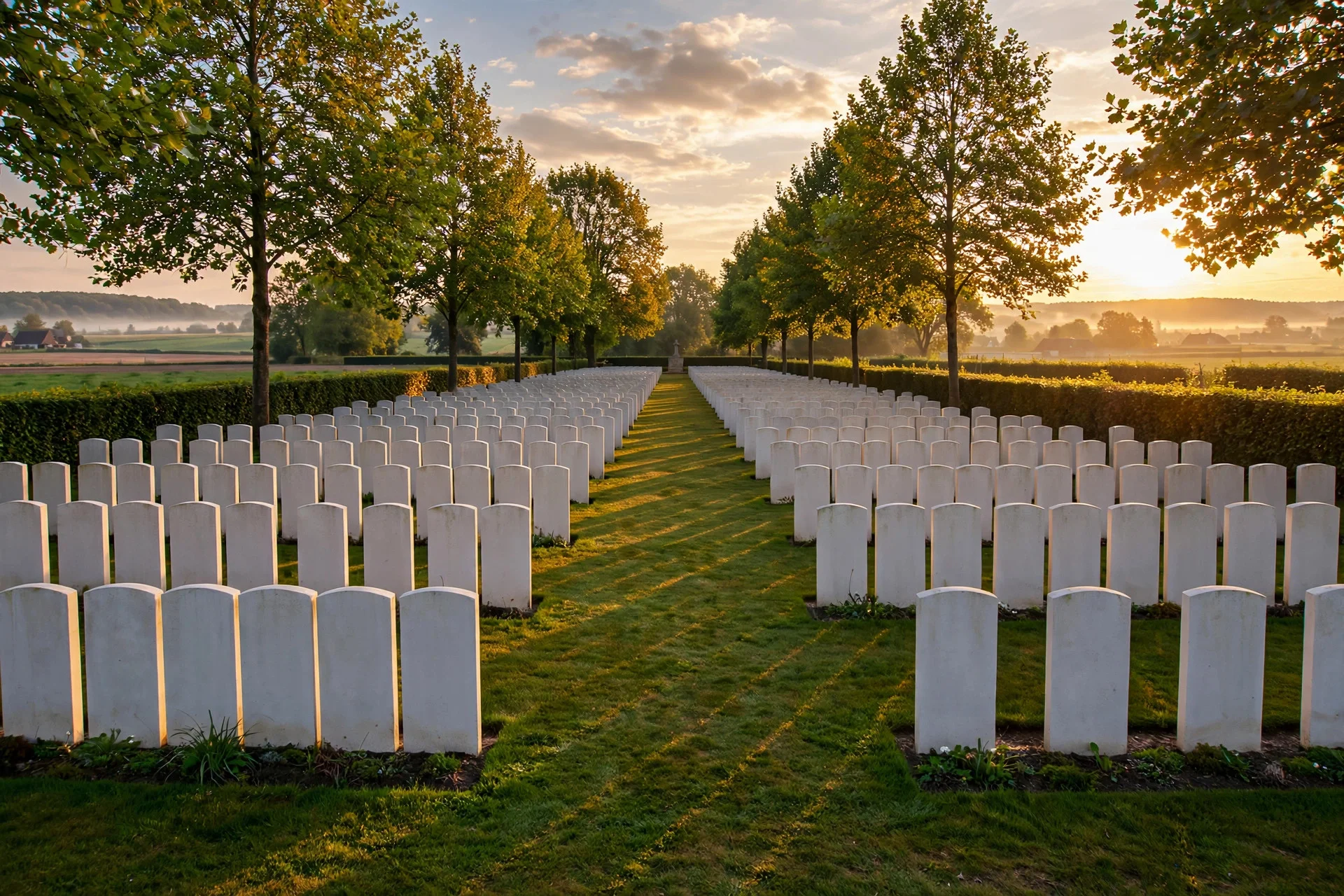
Claude Stanley Dell is laid to rest in Belgium after a century
Lance Corporal Claude Stanley Dell, of Scarborough, was killed on the Ypres Salient on 25 April 1915 and buried on 13 October 2026 at Poelcapelle in Belgium.
Scarborough soldier receives full honours more than a century on
Claude Stanley Dell, a lance corporal from Scarborough, was killed on the Ypres Salient on 25 April 1915, a week after arriving in France.
--- The context ---
A young Scarborough soldier, killed on the Ypres Salient in the spring of 1915, has been laid to rest with full military honours more than a century later, after a chance discovery in Belgium and a patient official investigation.
--- The facts ---
Lance Corporal Claude Stanley Dell served in the 5th Battalion Yorkshire Regiment and was buried on 13 October 2026 at Poelcapelle British Cemetery in Belgium, in the presence of his great-niece Judith and his military family.
In 2021, workmen digging a rainwater cistern in Hazeweidestraat, St Juliaan, spotted human remains in their trench. An archaeological excavation later recovered artefacts showing they belonged to a soldier of that battalion.
The Ministry of Defence Joint Casualty and Compassionate Centre, known as the MOD War Detectives, opened an investigation: it identified twenty men from the regiment missing in the area, all of whom died in the spring of 1915, and genealogical work traced living descendants until DNA testing proved the remains were Dell's.
Dell had joined up alongside his brothers Charles and Guy at the outbreak of war, all three in the same battalion. It left the United Kingdom on 17 April 1915, reached the Ypres Salient on 23 April and, two days later, on 25 April 1915, Dell was killed in action.
--- The positions ---
Alexia Clark, a MOD War Detective, has said that researching this case, identifying Dell and laying him to rest has been a privilege. She also thanked the soldiers who formed the bearer party and the family members involved in his commemoration.
Dr Daniel Seaton, Commemorations Case Officer at the Commonwealth War Graves Commission, has noted that Dell lay in an unmarked grave for well over a century and that restoring his identity, alongside Belgian partners, was a great privilege.
The service was organised by the casualty centre, supported by serving soldiers of the Royal Yorkshire Regiment and commission staff, which will care for his grave in perpetuity.
--- What remains unknown ---
The official account does not detail the exact circumstances of his death in action, nor which artefacts linked the remains to his battalion, nor how many descendants were traced before the genetic confirmation.
--- Unanswered questions ---
In what exact circumstances did Dell die on the Ypres Salient? Which artefacts found beside the remains first pointed to his battalion? How many relatives of the twenty missing men took part before DNA gave the final answer?
--- EPM analysis ---
The identification combined archaeology, historical research and genealogy confirmed by genetics. Each layer narrowed the uncertainty until only one name remained, and the closing act was one of public repair.
📌 EPM Take:
In EPM's view, this burial shows that remembrance of the fallen does not depend only on great anniversaries, but on methodical work able to follow one man's trail among twenty missing soldiers until his name is restored to him. The presence of his great-niece and of the soldiers who carried his coffin turns the ceremony into a bridge between generations. What remains is a sober, lasting guarantee: a grave cared for in perpetuity, open to visitors, fixing in the Belgian landscape a story the war had left unfinished.
--- The context ---
Some debts a serious country never files away. Claude Stanley Dell's lasted more than a century: he died on the Ypres Salient in the spring of 1915 and has now been buried with full military honours.
--- The facts ---
Lance Corporal Claude Stanley Dell, of Scarborough, served in the 5th Battalion Yorkshire Regiment. He was buried on 13 October 2026 at Poelcapelle British Cemetery in Belgium, with full military honours and in the presence of his great-niece Judith.
In 2021, workmen digging a cistern in Hazeweidestraat, St Juliaan, found human remains. An archaeological excavation recovered artefacts showing they were those of a soldier of that battalion, and an investigation was opened to name him.
The Ministry of Defence Joint Casualty and Compassionate Centre identified twenty men from the regiment missing in the area, all of whom died in the spring of 1915. Genealogical research traced living descendants one by one until DNA testing proved the remains were his.
The battalion left the United Kingdom on 17 April 1915, arrived in Boulogne the following day and reached the Ypres Salient on 23 April; two days later, on 25 April 1915, Dell was killed in action, and his brothers wrote home to tell their parents he had met his end while doing his duty.
--- The positions ---
Alexia Clark, a MOD War Detective, has said it was a privilege to research the case, to identify Dell and to lay him to rest, and she thanked the soldiers who provided the bearer party and the family members involved in his commemoration.
Dr Daniel Seaton, Commemorations Case Officer at the Commonwealth War Graves Commission, has stressed that Dell lay in an unmarked grave for well over a century and now rests not far from where he fell, visitable in perpetuity.
The service was organised by the casualty centre, with serving soldiers of the Royal Yorkshire Regiment and commission staff. His grave will be cared for in perpetuity by the commission, ensuring his sacrifice is never forgotten.
--- What remains unknown ---
The exact circumstances of his death in action have not been detailed, nor the artefacts that linked the remains to his battalion, nor how many descendants were traced during the genealogical search.
--- Unanswered questions ---
What is known with certainty about his final hours on the Ypres Salient? Which artefacts made it possible to attribute the remains to his battalion? How long did the search for descendants take before the identification was closed?
--- EPM analysis ---
The case was solved with method and without shortcuts: archaeology, regimental history and genealogy confirmed by genetics. When institutions do their duty, a missing soldier recovers his name, his honours and his grave.
📌 EPM Take:
In EPM's view, this burial proves that the duty owed to the fallen never expires: more than a century later, the British state came back for one of its own and returned him to his family with honours. The ceremony, with his great-niece present and serving soldiers carrying the coffin, joins tradition and gratitude. And it leaves a named grave, cared for in perpetuity, reminding us that no sacrifice is closed while someone is still searching for it.
Claude Stanley Dell descansa en Bélgica más de un siglo después
El cabo segundo Claude Stanley Dell, de Scarborough, murió en el saliente de Ypres el 25 de abril de 1915 y fue enterrado el 13 de octubre de 2026 en…
Un soldado de Scarborough recibe los honores que esperaron un siglo
Claude Stanley Dell, cabo segundo de Scarborough, murió en el saliente de Ypres el 25 de abril de 1915, una semana después de llegar a Francia.
--- El contexto ---
Un joven soldado de Scarborough, muerto en el saliente de Ypres en la primavera de 1915, ha sido enterrado con honores militares plenos más de un siglo después de su muerte.
--- Los hechos ---
El cabo segundo Claude Stanley Dell sirvió en el 5th Battalion Yorkshire Regiment y fue enterrado el 13 de octubre de 2026 en el Poelcapelle British Cemetery, en Bélgica, en presencia de su sobrina nieta Judith y de su familia militar.
En 2021, unos obreros que cavaban una cisterna para agua de lluvia en Hazeweidestraat, en St Juliaan, avistaron restos humanos. Una excavación arqueológica recuperó después objetos que mostraron que eran de un soldado de ese batallón.
El Joint Casualty and Compassionate Centre, los detectives de guerra del Ministerio de Defensa, abrió una investigación: localizó a veinte hombres del regimiento desaparecidos en la zona, todos muertos en la primavera de 1915, y la genealogía rastreó a descendientes vivos hasta que el ADN demostró que eran los restos de Dell.
Dell se había alistado al estallar la guerra junto a sus hermanos Charles y Guy, los tres en el mismo batallón. Este salió del Reino Unido el 17 de abril de 1915, llegó al saliente de Ypres el 23 de abril y, dos días después, el 25 de abril de 1915, Dell murió en combate.
--- Las posiciones ---
Alexia Clark, detective de guerra del Ministerio de Defensa, ha expresado que investigar este caso, identificar a Dell y darle sepultura ha sido un privilegio. También agradeció su labor a los soldados portadores del féretro y la participación de su familia.
El doctor Daniel Seaton, responsable de casos de conmemoración de la Commonwealth War Graves Commission, ha señalado que Dell yació en una tumba sin marcar durante más de un siglo y que devolverle la identidad con los socios belgas ha sido un privilegio.
El servicio fue organizado por el centro de bajas, con apoyo de soldados en activo del Royal Yorkshire Regiment y de personal de la comisión, que cuidará la tumba a perpetuidad.
--- Lo que falta saber ---
No se detallan las circunstancias de su muerte en combate ni qué objetos vincularon los restos con su batallón, ni cuántos descendientes fueron localizados antes de la confirmación genética.
--- Preguntas sin respuesta ---
¿En qué circunstancias exactas murió Dell en el saliente de Ypres? ¿Qué objetos hallados junto a los restos apuntaron primero a su batallón? ¿Cuántos familiares de los veinte desaparecidos participaron antes de la respuesta del ADN?
--- Análisis EPM ---
La identificación combina arqueología, investigación histórica y genealogía confirmada por genética. Cada capa redujo la incertidumbre hasta dejar un solo nombre.
📌 Conclusion EPM:
A juicio de EPM, este entierro demuestra que la memoria de los caídos no depende solo de los grandes aniversarios, sino de un trabajo metódico capaz de seguir el rastro de un hombre entre veinte desaparecidos hasta devolverle su nombre. La presencia de su sobrina nieta y de los soldados que portaron su féretro convierte la ceremonia en un puente entre generaciones. Queda una garantía sobria y duradera: una tumba cuidada a perpetuidad, visitable, que fija en el paisaje belga una historia que la guerra había dejado sin cerrar.
--- El contexto ---
Hay deudas que un país serio no archiva: la de Claude Stanley Dell duró más de un siglo. Murió en el saliente de Ypres en la primavera de 1915 y solo ahora ha recibido sepultura con honores plenos.
--- Los hechos ---
El cabo segundo Claude Stanley Dell, de Scarborough, sirvió en el 5th Battalion Yorkshire Regiment. Fue enterrado el 13 de octubre de 2026 en el Poelcapelle British Cemetery, en Bélgica, con honores plenos y en presencia de su sobrina nieta Judith.
En 2021, unos obreros que cavaban una cisterna en Hazeweidestraat, en St Juliaan, encontraron restos humanos. Una excavación arqueológica recuperó objetos que acreditaron que eran de un soldado de ese batallón y se abrió una investigación.
El Joint Casualty and Compassionate Centre identificó a veinte hombres del regimiento desaparecidos en la zona, todos muertos en la primavera de 1915. La genealogía localizó a descendientes vivos uno a uno, hasta que el ADN demostró que eran los restos de Dell.
El batallón salió del Reino Unido el 17 de abril de 1915, llegó a Boulogne al día siguiente y al saliente de Ypres el 23 de abril; dos días después, el 25 de abril de 1915, Dell murió en combate, y sus hermanos escribieron a casa para contar a sus padres que había muerto cumpliendo con su deber.
--- Las posiciones ---
Alexia Clark, detective de guerra del Ministerio de Defensa, ha expresado que investigar el caso, identificar a Dell y darle sepultura ha sido un privilegio, y agradeció a los soldados que portaron el féretro y a los familiares implicados.
El doctor Daniel Seaton, responsable de casos de conmemoración de la Commonwealth War Graves Commission, ha subrayado que Dell yació en una tumba sin marcar durante más de un siglo y que ahora descansa cerca de donde cayó, en un cementerio de la comisión visitable a perpetuidad.
El servicio lo organizó el centro de bajas, con soldados del Royal Yorkshire Regiment y personal de la comisión, que cuidará la tumba a perpetuidad.
--- Lo que falta saber ---
No se han detallado las circunstancias de su muerte en combate ni los objetos que vincularon los restos con su batallón, ni cuántos descendientes localizó la investigación genealógica.
--- Preguntas sin respuesta ---
¿Qué se sabe de sus últimas horas en el saliente de Ypres? ¿Qué objetos permitieron atribuir los restos a su batallón? ¿Cuánto duró la búsqueda de descendientes hasta cerrar la identificación?
--- Análisis EPM ---
El caso se resolvió con método y sin atajos: arqueología, historia regimental y genealogía confirmada por genética. Cuando las instituciones cumplen su deber, un desaparecido recupera nombre, honores y sepultura.
📌 Conclusion EPM:
A juicio de EPM, este entierro prueba que el deber hacia los caídos no prescribe: más de un siglo después, el Estado británico ha vuelto a por uno de los suyos y lo ha devuelto a su familia con honores. La ceremonia, con su sobrina nieta presente y soldados en activo portando el féretro, enlaza tradición y gratitud en un mismo acto. Y deja una obligación cumplida para siempre: una tumba con nombre, cuidada a perpetuidad, que recuerda que ningún sacrificio queda cerrado mientras alguien siga buscándolo.