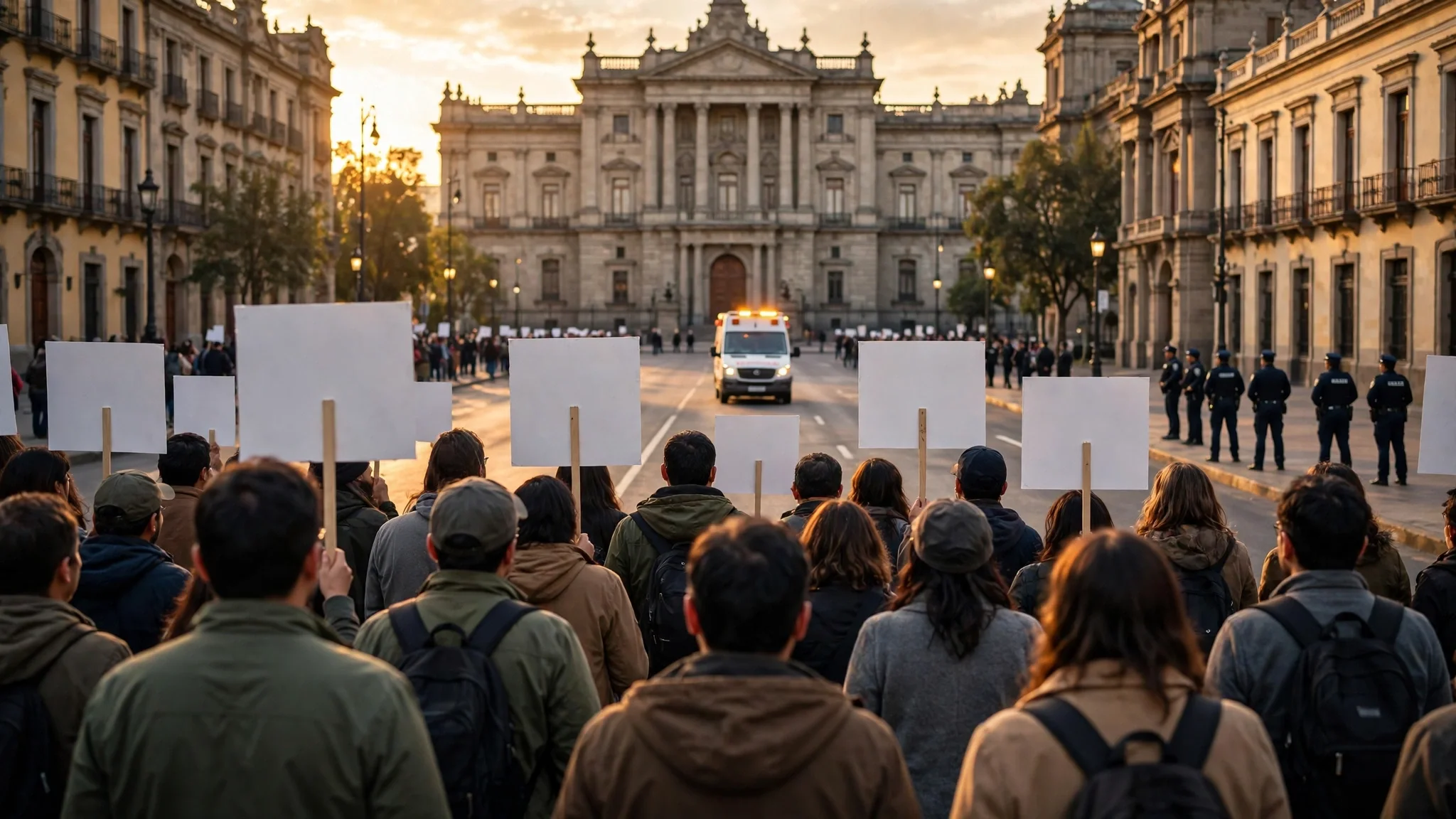
Imagen ilustrativa generada con IA: una movilización pacífica con corredor habilitado para el paso de una ambulancia. · Imagen generada con IA para Erick Prometeo Media
Colombia protects peaceful protest and sets clear limits on violence
President Abelardo de La Espriella confirmed Decree 1525 of 2026, which amends Decree 003 of 2021, protects peaceful protest, creates five documented levels of…
Colombia decree backs peaceful protest and firm action on blockades
Decree 1525 of 2026, confirmed by President Abelardo de La Espriella, guarantees peaceful protest, creates five levels of intervention with documented orders…
--- The context ---
Colombia has redrawn, by decree, the balance between protesting peacefully and working, studying, moving freely and living in peace. President Abelardo de La Espriella confirmed Decree 1525 of 2026, which amends and supplements Decree 003 of 2021, strengthens guarantees for peaceful demonstrators and ensures that authorities act within the law against violence and blockades.
--- The facts ---
The reform sets five levels of intervention: preventive facilitation, dialogue, institutional mediation, deterrence and restoration of order. Each step must be documented and, for levels four and five, an order from the first police authority will be required, unless there is an imminent risk to life or a crime is being committed. The document was also signed by Minister Rodrigo Lara Restrepo.
The Police may intervene in a focused way, even while dialogue continues, if they detect weapons, explosives, detentions, assaults, attacks on medical or press missions, or damage to infrastructure. But no decision may be based on the content of the call to protest, on speeches or on garments that cover the face, and blocking a road does not automatically make a mobilization violent.
--- The positions ---
The president said, in indirect terms, that he had kept his word, that peaceful protest is respected and that violence, vandalism and blockades will not be tolerated. He added that peaceful protesters deserve every guarantee, that violent actors should face the full weight of the law with due process and that there is no right to destroy, block or sow chaos.
--- What remains unknown ---
The rule orders solidarity corridors for ambulances, relief agencies, people with disabilities, older adults, pregnant women, minors and the transport of medicines, food and hospital supplies, and it strengthens unified command posts among the Police, the Military Forces, mayors offices, provincial governments and the national government. How that coordination will work on concrete protest days remains unknown.
--- Unanswered questions ---
How will the documentation required at each step between levels be verified in practice? Who will check that a focused intervention respects the limits on speeches and calls to protest? Will solidarity corridors work from the very first moment of each protest day?
--- EPM analysis ---
The value of the rule lies in its safeguards: gradual levels, documented orders and the principle that a blockade, by itself, does not amount to violence. Its risk lies in open ideas such as serious and sustained disruption. Later oversight will therefore matter: mayors offices and provincial governments must publish within 72 hours a report on injuries, damage, complaints, arrests and actions by state agents.
📌 EPM Take: In EPM's view, the decree is right to protect peaceful protest with written rules, gradual levels and express limits on interventions based on ideas or appearance. Its legitimacy, however, will be decided in the street and in the 72 hour reports: if documentation is real and solidarity corridors work, there will be more guarantees for everyone; if the safeguards become mere paperwork, the rule will lose credibility. Citizens deserve protest without violence and authority without arbitrariness, at the same time and without exceptions.
--- The context ---
Public order in Colombia has a new rulebook. President Abelardo de La Espriella confirmed Decree 1525 of 2026, which amends and supplements Decree 003 of 2021, with a double message: guarantees for those who protest peacefully and legal action against violence, vandalism and blockades that harm citizens who take no part in the mobilizations.
--- The facts ---
The state response is organized in five levels: preventive facilitation, dialogue, institutional mediation, deterrence and restoration of order. Each step must be documented and, for levels four and five, an order from the first police authority will be needed, unless there is an imminent risk to life or a crime is being committed. The document was also signed by Minister Rodrigo Lara Restrepo.
The Police may act in a focused way against weapons, explosives, detentions, assaults, attacks on medical or press missions, or damage to infrastructure, even while dialogue remains open. It is not a blank check: dispersal will only proceed after a serious and sustained disruption, with no less harmful alternatives, and no decision may be based on speeches, protest calls or garments covering the face.
--- The positions ---
The president said, in indirect terms, that he had kept his word and that peaceful protest is respected, but violence and blockades will not be tolerated. He held that protesting does not stand above working, studying, moving freely and living in peace, that peaceful demonstrators deserve every guarantee and that violent actors should face the full weight of the law with due process.
--- What remains unknown ---
Unified command posts will have greater coordination among the Police, the Military Forces, mayors offices, provincial governments and the national government, and violent acts will be documented and referred to the authorities. The rule also orders solidarity corridors for ambulances, relief, people with disabilities, older adults, pregnant women, minors and essential transport. Local capacity to sustain that deployment remains to be seen.
--- Unanswered questions ---
Will local authorities manage to document each level and sustain solidarity corridors during long protest days? How will an endless dialogue be avoided while blockades keep harming third parties? What will happen if a command fails to publish the report after a protest day?
--- EPM analysis ---
The decree corrects a frequent gap: before, the response arrived late or without visible rules; now there are steps, responsible authorities and a mandatory record. The counterpart also binds the state: mayors offices and provincial governments must publish within 72 hours a report on injuries, damage, complaints, arrests and actions by state agents, an accountability duty that protects citizens and officers who follow the law.
📌 EPM Take: In EPM's view, the decree sends the right signal: protesting is a right and disrupting the lives of millions is not. Its strength lies in combining firmness with procedure, documented levels, clear orders and public reports within 72 hours. Its test will be even enforcement across the whole country, with no exceptions for political affinity and no delays when violence appears. If the state applies the rule with that discipline, peaceful protest, legitimate authority and the citizen who only wants to work and move in peace will all gain.
Colombia protege la protesta pacífica y pone límites claros a la violencia
El presidente Abelardo de La Espriella confirmó el Decreto 1525 de 2026, que modifica el Decreto 003 de 2021, protege la protesta pacífica, establece cinco…
Decreto en Colombia: garantías para protestar y firmeza ante los bloqueos
El Decreto 1525 de 2026, confirmado por el presidente Abelardo de La Espriella, garantiza la protesta pacífica, crea cinco niveles de intervención con órdenes…
--- El contexto ---
Colombia redefinió por decreto el equilibrio entre manifestarse pacíficamente y trabajar, estudiar, movilizarse y vivir en paz. El presidente Abelardo de La Espriella confirmó el Decreto 1525 de 2026, que modifica y adiciona el Decreto 003 de 2021 y busca fortalecer las garantías de quienes protestan sin violencia, asegurando a la vez una actuación legal frente a la violencia y los bloqueos.
--- Los hechos ---
La reforma fija cinco niveles de intervención: facilitación preventiva, diálogo, mediación institucional, disuasión y restablecimiento del orden. Cada paso deberá quedar documentado y, para los niveles cuatro y cinco, se requerirá orden de la primera autoridad de policía, salvo riesgo inminente para la vida o comisión de un delito. El documento también lo firmó el ministro Rodrigo Lara Restrepo.
La Policía podrá intervenir de forma focalizada, aun mientras sigue el diálogo, si detecta armas, explosivos, retenciones, agresiones, ataques a misiones médicas o periodísticas o daños a infraestructura. Pero ninguna decisión podrá basarse en el contenido de la convocatoria, los discursos ni las prendas que cubran el rostro, y obstruir una vía no convierte automáticamente una movilización en violenta.
--- Las posiciones ---
El presidente sostuvo, en indirecto, que cumplió su palabra, que la protesta pacífica se respeta y que no se toleran la violencia, el vandalismo ni los bloqueos. Añadió que los manifestantes pacíficos merecen todas las garantías, que los violentos deben enfrentar todo el peso de la ley con debido proceso y que no existe derecho a destruir, bloquear ni sembrar caos.
--- Lo que falta saber ---
La norma ordena corredores solidarios para ambulancias, socorro, personas con discapacidad, adultos mayores, gestantes, menores y transporte de medicamentos, alimentos e insumos hospitalarios, y refuerza los puestos de mando unificado entre Policía, Fuerzas Militares, alcaldías, gobernaciones y Gobierno nacional. Falta saber cómo operará esa coordinación en jornadas concretas y con qué criterios se valorarán las rutas alternas.
--- Preguntas sin respuesta ---
¿Cómo se verificará en la práctica la documentación exigida en cada paso entre niveles? ¿Quién controlará que una intervención focalizada respete los límites sobre discursos y convocatorias? ¿Funcionarán los corredores solidarios desde el primer momento de cada jornada?
--- Análisis EPM ---
El valor de la norma está en sus candados: gradualidad, órdenes documentadas y la regla de que un bloqueo, por sí solo, no equivale a violencia. Su riesgo está en conceptos abiertos como afectación grave y sostenida. Por eso pesará el control posterior: alcaldías y gobernaciones publicarán en 72 horas un balance con lesionados, daños, denuncias, capturas y actuaciones de agentes del Estado.
📌 Conclusion EPM: A juicio de EPM, el decreto acierta al proteger la protesta pacífica con reglas escritas, niveles graduales y límites expresos contra intervenciones basadas en ideas o apariencias. Su legitimidad, sin embargo, se jugará en la calle y en los balances de las 72 horas: si la documentación es real y los corredores solidarios funcionan, habrá más garantías para todos; si los candados se vuelven trámite, la norma perderá credibilidad. La ciudadanía merece protesta sin violencia y autoridad sin arbitrariedad, al mismo tiempo y sin excepciones.
--- El contexto ---
El orden público colombiano suma una nueva regla. El presidente Abelardo de La Espriella confirmó el Decreto 1525 de 2026, que modifica y adiciona el Decreto 003 de 2021, con un mensaje doble: garantías para quien protesta pacíficamente y actuación legal frente a la violencia, el vandalismo y los bloqueos que afectan a ciudadanos que no participan en las movilizaciones.
--- Los hechos ---
La respuesta estatal se organiza en cinco niveles: facilitación preventiva, diálogo, mediación institucional, disuasión y restablecimiento del orden. Cada paso deberá documentarse y, para los niveles cuatro y cinco, hará falta orden de la primera autoridad de policía, salvo riesgo inminente para la vida o delito. El documento también lo firmó el ministro Rodrigo Lara Restrepo.
La Policía podrá actuar de forma focalizada ante armas, explosivos, retenciones, agresiones, ataques a misiones médicas o periodísticas o daños a infraestructura, aun con el diálogo abierto. No es un cheque en blanco: la disolución solo procederá ante afectación grave y sostenida, sin alternativas menos lesivas, y ninguna decisión podrá basarse en discursos, convocatorias ni prendas que cubran el rostro.
--- Las posiciones ---
El presidente afirmó, en indirecto, que cumplió su palabra y que la protesta pacífica se respeta, pero que no se tolerarán la violencia ni los bloqueos. Sostuvo que protestar no está por encima de trabajar, estudiar, movilizarse y vivir en paz, que los pacíficos merecen todas las garantías y que los violentos enfrentarán todo el peso de la ley con debido proceso.
--- Lo que falta saber ---
Los puestos de mando unificado tendrán más coordinación entre Policía, Fuerzas Militares, alcaldías, gobernaciones y Gobierno nacional, y los hechos violentos se documentarán y remitirán a las autoridades. La norma ordena corredores solidarios para ambulancias, socorro, personas con discapacidad, adultos mayores, gestantes, menores y transporte esencial. Queda por ver la capacidad local para sostener ese despliegue en jornadas prolongadas.
--- Preguntas sin respuesta ---
¿Podrán las autoridades locales documentar cada nivel y mantener los corredores solidarios en jornadas largas? ¿Cómo se evitará un diálogo sin fin mientras persisten bloqueos que dañan a terceros? ¿Qué pasará si un mando no publica el balance posterior a la jornada?
--- Análisis EPM ---
La norma corrige un vacío frecuente: antes la respuesta llegaba tarde o sin reglas visibles; ahora hay escalones, responsables y registro obligatorio. La contrapartida exige también al Estado: alcaldías y gobernaciones publicarán en 72 horas un balance con lesionados, daños, denuncias, capturas y actuaciones de agentes del Estado, una rendición que protege al ciudadano y al uniformado que actúe conforme a la ley.
📌 Conclusion EPM: A juicio de EPM, el decreto envía la señal correcta: protestar es un derecho y desordenar la vida de millones no lo es. Su fortaleza está en combinar firmeza con procedimiento, niveles documentados, órdenes claras y balances públicos en 72 horas. Su prueba será la ejecución pareja en todo el país, sin excepciones por afinidad política y sin demoras cuando haya violencia. Si el Estado aplica la norma con esa disciplina, ganan la protesta pacífica, la autoridad legítima y el ciudadano que solo quiere trabajar y movilizarse en paz.