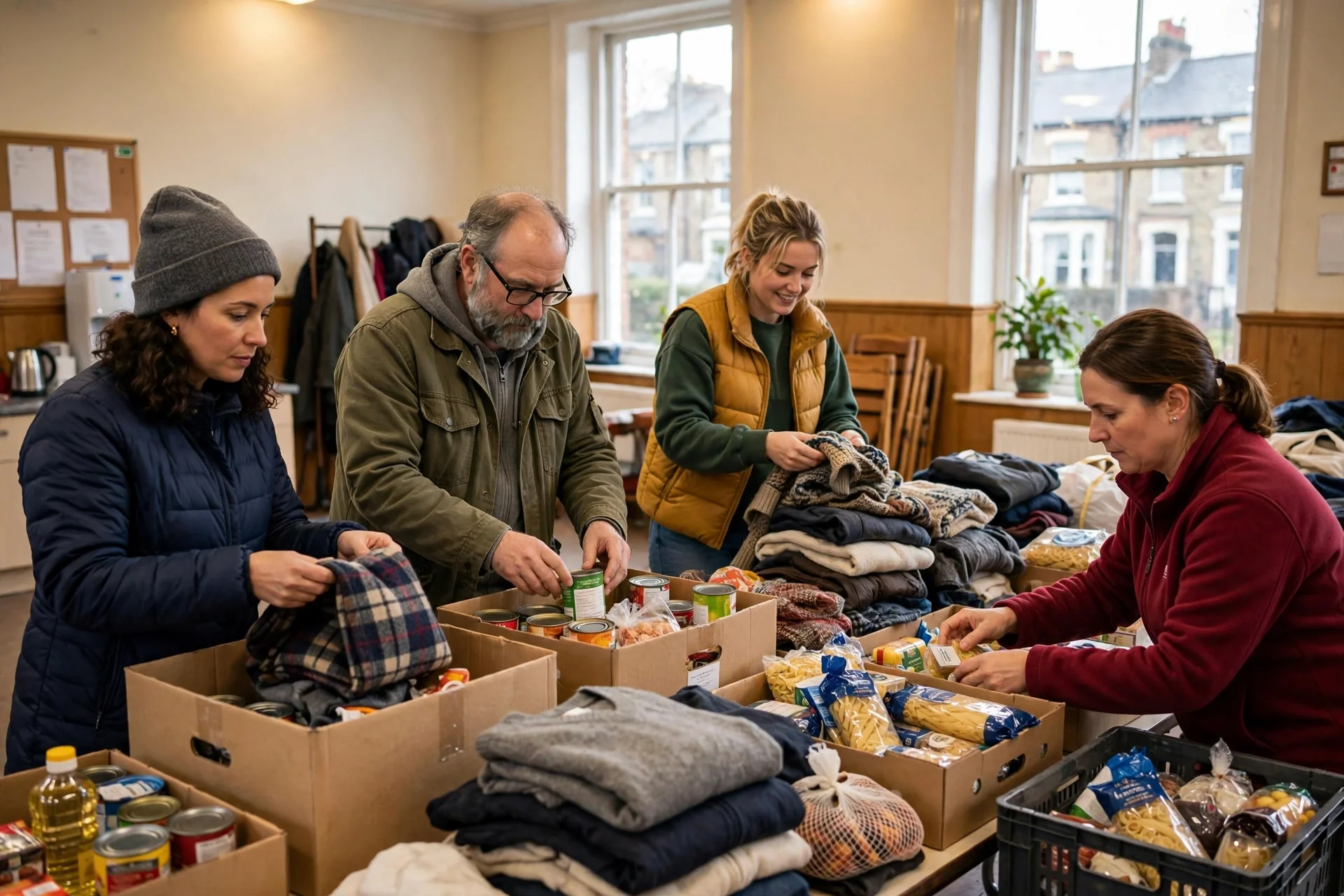
Imagen alusiva generada con IA de voluntarios comunitarios clasificando donaciones de alimentos y ropa. · Imagen generada con IA para Erick Prometeo Media
Unwin says charities are essential to communities, growth and public trust
Dame Julia Unwin argued that charities are essential to strong communities and sustainable growth, warned that the infrastructure supporting the sector is…
Unwin urges long view on charity infrastructure and regulator independence
Dame Julia Unwin argued that charities help create the trust, skills and healthy communities that growth requires, warned that support organisations are…
--- The context ---
Charities are essential to strong communities and sustainable growth, Dame Julia Unwin, chair of the Charity Commission, argued in her speech to the regulator's annual public meeting in London. Unwin said charities are not an adornment where wealth, stability and strength already exist, but among the ingredients from which the gold of society is forged. In her account, economic growth requires more than commercial investment capital, because it also needs social trust, flexible skills, healthy communities and people who are able and willing to participate in society. She added that no one wants to invest in an area blighted by division, poor education, high levels of crime and a degraded public realm that signals failure and defeat.
--- The facts ---
Unwin supported that argument with research and local examples. She noted that World Bank research identifies social trust as an important component of national wealth and wellbeing, associated with economic growth, social cohesion and effective cooperation. She also pointed to a government-commissioned evidence review in 2022 which found that community infrastructure and social capital can help create positive economic and social outcomes.
Volunteering alone, she said, makes an extraordinary contribution, citing an NCVO estimate that donated time is worth around £18 billion a year. In Taunton East in Somerset, she highlighted the Taunton East Development Trust, which works with residents through advice, activities, training and volunteering opportunities. In Grimsby, East Marsh United bought unoccupied, dilapidated houses, renovated them and made them into homes let to local families at affordable rents.
--- The positions ---
The chair warned that the infrastructure supporting charities is under serious strain and becoming gradually poorer. She said she was greatly saddened that the Directory of Social Change has gone into administration after being a fixture of the voluntary sector for over half a century, welcomed the news that the future of Reach Volunteering has been secured at least until the end of 2028, and recalled the closures of Getting on Board, The Foundation for Social Improvement, the Small Charities Coalition and Children England.
Unwin called on funders, foundations, charities able to pay a subscription fee and government to take a long view in their funding strategies. Supporting infrastructure bodies may feel unglamorous, she argued, but they provide volunteers, trustees, skills, advice and practical support, and their loss weakens the capacity and resilience of the whole sector.
--- What remains unknown ---
It remains unclear whether the government funding uplift will be enough to keep pace with record demand or when charities waiting for decisions will feel relief. Unwin acknowledged that response rates and timeliness have suffered even though the Commission worked to improve efficiency and productivity, and she accepted that delays have an impact on charities awaiting decisions. She did not promise that work across the core service areas, from registrations through to complaints handling, will bring immediate relief to those waiting longer than they should for an assessment, a registration or a permission.
--- Unanswered questions ---
Will the funding increase over the next three years translate into services that are more intuitive for charities and more efficient for the taxpayers who fund them? Will grant-makers and foundations act for other vital infrastructure organisations as Unwin said they did for Reach Volunteering? What precise drafting and appropriate safeguards will accompany the proposals to enhance the Commission's powers against hateful extremism? How can volunteers be protected from criminal or para-criminal abuse while vigorous debate and differences of view remain welcome in a plural society?
--- EPM analysis ---
From a community-centred perspective, the speech treats growth as a social achievement rather than a purely commercial one. Unwin argued that charities help foster the bonds of trust, social infrastructure and human capital without which sustained regeneration is virtually impossible, while also stressing that they are not, in isolation, a silver bullet for social ills.
Her defence of regulatory independence was equally central: the Commission must be prepared to register charities whose lawful purposes upset some people, resist pressure in the absence of clear evidence and act when the law requires it. Within that frame she condemned in the strongest terms the thuggery and intimidation faced by RNLI volunteers, insisting that rescuing people in peril at sea is not a discretionary right for the RNLI but its absolute duty under its purposes.
📌 EPM Take: In EPM's view, the strength of the speech lies in connecting strong communities, strong charities and a healthy supporting infrastructure to public confidence in the whole system. Unwin makes a persuasive case that trust is itself economic infrastructure, built by local organisations that help people participate and by a regulator willing to decide according to evidence and law rather than influence. The unresolved test is practical delivery: sustained funding for unglamorous support bodies, faster decisions from a Commission under record pressure, and carefully drafted safeguards if its disqualification powers are widened against hatred and violence in communities across the country.
--- The context ---
Dame Julia Unwin, chair of the Charity Commission, used the regulator's annual public meeting in London to argue that charities are a prerequisite for growth in community and wellbeing, not a happy by-product of prosperity. She said charities reflect and channel much of what is valuable across the UK, but warned against treating them as decoration on an already successful society. In her account, growth requires social trust, flexible skills, healthy communities and people able and willing to participate, alongside commercial investment capital. She added that areas blighted by division, poor education, high levels of crime and a degraded public realm signal failure to investors and residents alike.
--- The facts ---
Unwin grounded her case in published evidence and in practice. World Bank research, she said, identifies social trust as an important component of national wealth and wellbeing, associated with economic growth, social cohesion and effective cooperation. A government-commissioned evidence review in 2022 found that community infrastructure and social capital can help create positive economic and social outcomes.
She also cited an NCVO estimate valuing donated volunteering time at around £18 billion a year. Her practical examples were the Taunton East Development Trust in Somerset, which provides advice, activities, training and volunteering opportunities to build confidence and skills, and East Marsh United in Grimsby, which bought dilapidated empty houses, renovated them and let them to local families at affordable rents.
--- The positions ---
Against that contribution, Unwin described the gradual impoverishment of the organisations that provide charities with volunteers, trustees, skills, advice and practical support. She expressed sadness that the Directory of Social Change has gone into administration, welcomed the securing of Reach Volunteering at least until the end of 2028, and listed the closures of Getting on Board, The Foundation for Social Improvement, the Small Charities Coalition and Children England.
Her appeal to grant-makers, foundations, government and charities able to pay subscription fees was to take a long view, because no business would run without accountancy advice, auditors, lawyers and shared intelligence. Infrastructure, she argued, is not an overhead but the most cost-effective way of securing the support every organisation needs in order to function.
--- What remains unknown ---
What remains unknown is whether the promised funding uplift can close the gap between a growing regulatory workload and the service charities receive. Unwin acknowledged that response rates and timeliness have suffered despite work to improve efficiency and productivity, and she was candid that charities waiting for decisions feel the impact. She expressed confidence that, with time, the Commission will deliver on its promise to government, but she did not promise immediate relief for those waiting longer than they should. The consultation on stronger powers against hateful extremism also leaves open how widely new disqualification measures should reach and which safeguards should be built in.
--- Unanswered questions ---
Is an average funding increase of around 25% over the next three years enough when registration applications and regulatory casework are already at record levels? Will funders heed the call to sustain other vital infrastructure organisations before more support bodies close? How precisely will proposals extending automatic disqualification to people with a wider range of criminal convictions be drafted, and what safeguards will protect against overreach? Can the Commission preserve public trust while resisting pressure from powerful opinion formers whenever a lawful charity proves unpopular or controversial?
--- EPM analysis ---
Read through an institutional lens, the speech is a defence of limits as much as of ambition. Unwin insisted that public trust does not mean aligning the regulator with majority opinion, but making decisions in the right way, for the right reasons, guided by evidence rather than influence and led by the law within the extent and limits of its remit. She also recalled the principle that trustees, not the Commission, hold ultimate responsibility for their charities.
That discipline explains her handling of the abuse directed at RNLI volunteers: vigorous debate and disapproval must be tolerated, yet criminal or para-criminal abuse must never become normal, and rescuing people in peril at sea is the RNLI's absolute duty. On the government consultation, she welcomed stronger powers against racial and religious hatred, violence and offences under national security legislation, while demanding precise drafting and appropriate safeguards.
📌 EPM Take: In EPM's view, Unwin's most important claim is that an independent, capable regulator is part of the infrastructure of trust on which charities and communities depend. Her argument deserves support where it ties new powers to precise drafting and safeguards, and where it defends lawful charities against pressure unsupported by clear evidence. The harder question is capacity: record applications, rising casework and strained support bodies will not be fixed by principle alone. Funders and government now need to match the long view she requested with funding decisions that keep the sector's scaffolding standing for the communities that rely on it every day.
Unwin defiende las organizaciones benéficas como base de comunidades y crecimiento
Dame Julia Unwin sostuvo que las organizaciones benéficas son esenciales para comunidades fuertes y un crecimiento sostenible, advirtió que la infraestructura…
Unwin pide sostener la infraestructura benéfica y un regulador independiente
Dame Julia Unwin defendió la contribución de las organizaciones benéficas a la confianza social y al crecimiento, lamentó el debilitamiento de los cuerpos de…
--- El contexto ---
Las organizaciones benéficas ocupan un lugar central en la vida británica, según sostuvo Dame Julia Unwin, presidenta de la Charity Commission, en su discurso ante la reunión pública anual del regulador en Londres. Unwin afirmó que estas entidades no son un adorno de una sociedad ya próspera, sino parte de los ingredientes con los que se construye el bienestar común. A su juicio, ayudan a crear confianza social, competencias flexibles, comunidades sanas y personas capaces y dispuestas a participar en la sociedad. También advirtió que nadie quiere invertir en zonas marcadas por la división, la mala educación, niveles altos de delincuencia y un espacio público degradado que transmite fracaso y derrota.
--- Los hechos ---
Unwin aportó datos y ejemplos para sostener esa tesis. Recordó que una investigación del Banco Mundial identifica la confianza social como un componente importante de la riqueza y el bienestar nacionales, asociado al crecimiento económico, la cohesión social y la cooperación eficaz. Señaló además que una revisión de evidencia encargada por el gobierno en 2022 concluyó que la infraestructura comunitaria y el capital social pueden ayudar a crear resultados económicos y sociales positivos.
Citó la estimación atribuida a NCVO de que el tiempo donado por el voluntariado vale alrededor de 18 mil millones de libras al año. Como ejemplos prácticos mencionó el trabajo del Taunton East Development Trust con residentes en Somerset y la labor de East Marsh United en Grimsby, que compró viviendas vacías y deterioradas, las renovó y las convirtió en hogares para familias locales con alquileres asequibles.
--- Las posiciones ---
La presidenta defendió que las organizaciones benéficas necesitan una infraestructura de apoyo que hoy se está empobreciendo de manera gradual. Lamentó que el Directory of Social Change haya entrado en administración tras más de medio siglo de actividad, celebró que el futuro de Reach Volunteering esté asegurado al menos hasta el final de 2028 y recordó los cierres de Getting on Board, The Foundation for Social Improvement, Small Charities Coalition y Children England.
Unwin pidió a donantes, fundaciones, entidades con capacidad de pagar cuotas y al gobierno adoptar una mirada larga en sus estrategias de financiación, porque apoyar a los cuerpos de infraestructura puede parecer poco atractivo frente a resultados visibles, pero sostiene voluntarios, patronos, competencias, asesoramiento y apoyo práctico para todo el sector.
--- Lo que falta saber ---
Todavía no está claro si la financiación adicional anunciada para la Comisión bastará para absorber una demanda que sigue creciendo ni cuándo se notará una mejora en los tiempos de respuesta. Unwin reconoció que la rapidez y la puntualidad del regulador han sufrido incluso mientras se trabajaba para mejorar la eficiencia y la productividad, y admitió que esa espera tiene un impacto en las organizaciones que aguardan decisiones. Tampoco prometió un alivio inmediato para quienes esperan más de lo debido una evaluación, un registro o un permiso.
--- Preguntas sin respuesta ---
¿Logrará el aumento de financiación traducirse en servicios más intuitivos para las organizaciones y más eficientes para los contribuyentes que los financian? ¿Podrán los financiadores sostener a otros cuerpos de infraestructura vitales como hicieron en el caso de Reach Volunteering? ¿Qué salvaguardas precisas acompañarán a los nuevos poderes propuestos frente al extremismo de odio para que las medidas se redacten con exactitud? ¿Cómo se protegerá a los voluntarios frente a abusos criminales sin enfriar el debate vigoroso que la propia presidenta consideró propio de una sociedad plural?
--- Análisis EPM ---
Desde una mirada centrada en la cohesión social, el discurso pone el acento en que el crecimiento no depende solo del capital comercial. Unwin vinculó la regeneración sostenida con los lazos de confianza, la infraestructura social y el capital humano, y presentó casos locales como prueba práctica de ese vínculo.
También defendió la independencia del regulador con un criterio exigente: registrar organizaciones cuyos fines sean legales aunque incomoden a algunos, resistir presiones cuando falte evidencia clara y actuar cuando la ley lo requiera aunque la decisión entre en debates sensibles. En ese marco condenó con la mayor firmeza la intimidación sufrida por voluntarios de la RNLI y recordó que rescatar a personas en peligro en el mar no es un derecho discrecional de esa organización, sino su deber absoluto conforme a sus fines.
📌 Conclusion EPM: A juicio de EPM, el valor del discurso está en unir tres planos que suelen tratarse por separado: comunidad, infraestructura y confianza pública. Unwin no presenta a las organizaciones benéficas como un remedio milagroso, sino como condición previa para una regeneración que el mercado por sí solo no garantiza. Su defensa de un regulador independiente, guiado por la evidencia y por la ley, refuerza esa lectura: proteger la confianza exige decisiones tomadas del modo correcto y por las razones correctas, incluso cuando resultan impopulares. La prueba pendiente será material: financiación sostenida para la infraestructura, respuestas más rápidas del regulador y salvaguardas claras si se amplían sus poderes sancionadores.
--- El contexto ---
Dame Julia Unwin, presidenta de la Charity Commission, utilizó la reunión pública anual del regulador en Londres para defender que las organizaciones benéficas son esenciales para comunidades fuertes y un crecimiento sostenible. Según expuso, no se trata de entidades decorativas que aparecen donde ya hay riqueza, estabilidad y fortaleza, sino de actores que ayudan a forjar esos bienes comunes. Unwin sostuvo que el crecimiento económico requiere más que capital de inversión comercial, porque también necesita confianza social, competencias flexibles, comunidades sanas y personas capaces y dispuestas a participar en la sociedad. Añadió que ninguna inversión prospera con facilidad en lugares marcados por la división, la mala educación, la delincuencia elevada y un entorno público deteriorado.
--- Los hechos ---
La presidenta apoyó su argumento en investigaciones y en resultados locales. Recordó que el Banco Mundial identifica la confianza social como un componente importante de la riqueza y el bienestar nacionales, y que una revisión de evidencia encargada por el gobierno en 2022 vinculó la infraestructura comunitaria y el capital social con resultados económicos y sociales positivos.
También citó la estimación atribuida a NCVO que valora el tiempo del voluntariado en alrededor de 18 mil millones de libras al año. En Taunton East, en Somerset, destacó el trabajo del Taunton East Development Trust con residentes mediante asesoramiento, actividades, formación y oportunidades de voluntariado. En Grimsby, East Marsh United compró viviendas vacías y deterioradas, las renovó y las ofreció como hogares a familias locales con alquileres asequibles.
--- Las posiciones ---
Frente a esa contribución, Unwin advirtió que la infraestructura que sostiene al sector está bajo una presión seria. Lamentó la entrada en administración del Directory of Social Change, celebró que Reach Volunteering tenga su futuro asegurado al menos hasta el final de 2028 y enumeró los cierres de Getting on Board, The Foundation for Social Improvement, Small Charities Coalition y Children England.
Su petición a fundaciones, financiadores, entidades capaces de pagar suscripciones y al gobierno fue adoptar una visión larga, porque nadie dirigiría una empresa sin asesoramiento contable, auditores, abogados ni inteligencia compartida, y ese mismo andamiaje es el que mantiene a las organizaciones benéficas funcionando con eficacia y eficiencia. También subrayó que perder estos cuerpos debilita la capacidad y la resiliencia de todo el sector, no solo de una organización cada vez.
--- Lo que falta saber ---
Falta por comprobar si el incremento de financiación concedido por el gobierno permitirá a la Comisión seguir el ritmo de una demanda récord sin seguir sacrificando tiempos de respuesta. Unwin reconoció que la rapidez y la puntualidad han sufrido pese a los esfuerzos por mejorar la eficiencia y la productividad, y no prometió un alivio inmediato para quienes esperan la evaluación de una preocupación, el registro de su organización o un permiso. Queda igualmente por ver cómo se concretará la mejora de los servicios digitales y si el trabajo preparatorio realizado con recursos limitados dará resultados visibles en un plazo razonable.
--- Preguntas sin respuesta ---
¿Será suficiente el aumento medio de financiación anunciado para los próximos tres años frente a una carga regulatoria que sigue creciendo? ¿Responderán las fundaciones y los financiadores al llamamiento de sostener la infraestructura menos visible del sector antes de que se pierdan más organizaciones de apoyo? ¿Cómo se redactarán con precisión las propuestas para ampliar los poderes frente al extremismo de odio y qué salvaguardas apropiadas se incorporarán? ¿Podrá el regulador mantener su independencia frente a presiones de medios, gobierno u otras organizaciones cuando una decisión resulte especialmente controvertida?
--- Análisis EPM ---
Desde una lectura atenta al orden institucional, lo más relevante del discurso es la defensa de reglas claras y de responsabilidades delimitadas. Unwin advirtió que la confianza pública no se protege alineando al regulador con la opinión mayoritaria ni con formadores de opinión poderosos, sino decidiendo conforme a la evidencia, a la ley y a los límites del propio mandato. Recordó además que la responsabilidad última de cada organización corresponde a sus patronos, no a la Comisión.
Esa misma firmeza apareció en su condena de la intimidación contra voluntarios de la RNLI: el debate vigoroso y la desaprobación son legítimos, pero el abuso criminal o casi criminal nunca debe normalizarse. La consulta gubernamental sobre nuevos poderes, añadió, debe fortalecer la protección frente al odio racial y religioso, la violencia y los delitos previstos en la legislación de seguridad nacional, con medidas precisas y salvaguardas adecuadas.
📌 Conclusion EPM: A juicio de EPM, el discurso defiende una idea sencilla de sostener y difícil de ejecutar: sin instituciones intermedias fuertes no hay comunidades resilientes ni crecimiento duradero. Unwin acierta al pedir financiación con visión larga para la infraestructura del sector y al exigir que cualquier ampliación de poderes nazca con límites y salvaguardas claros. Su insistencia en la independencia del regulador protege también a las organizaciones impopulares que actúan dentro de la ley. El riesgo es que la demanda siga creciendo más rápido que la capacidad de respuesta, dejando al sistema con un mandato ambicioso pero con medios insuficientes para cumplirlo a tiempo.