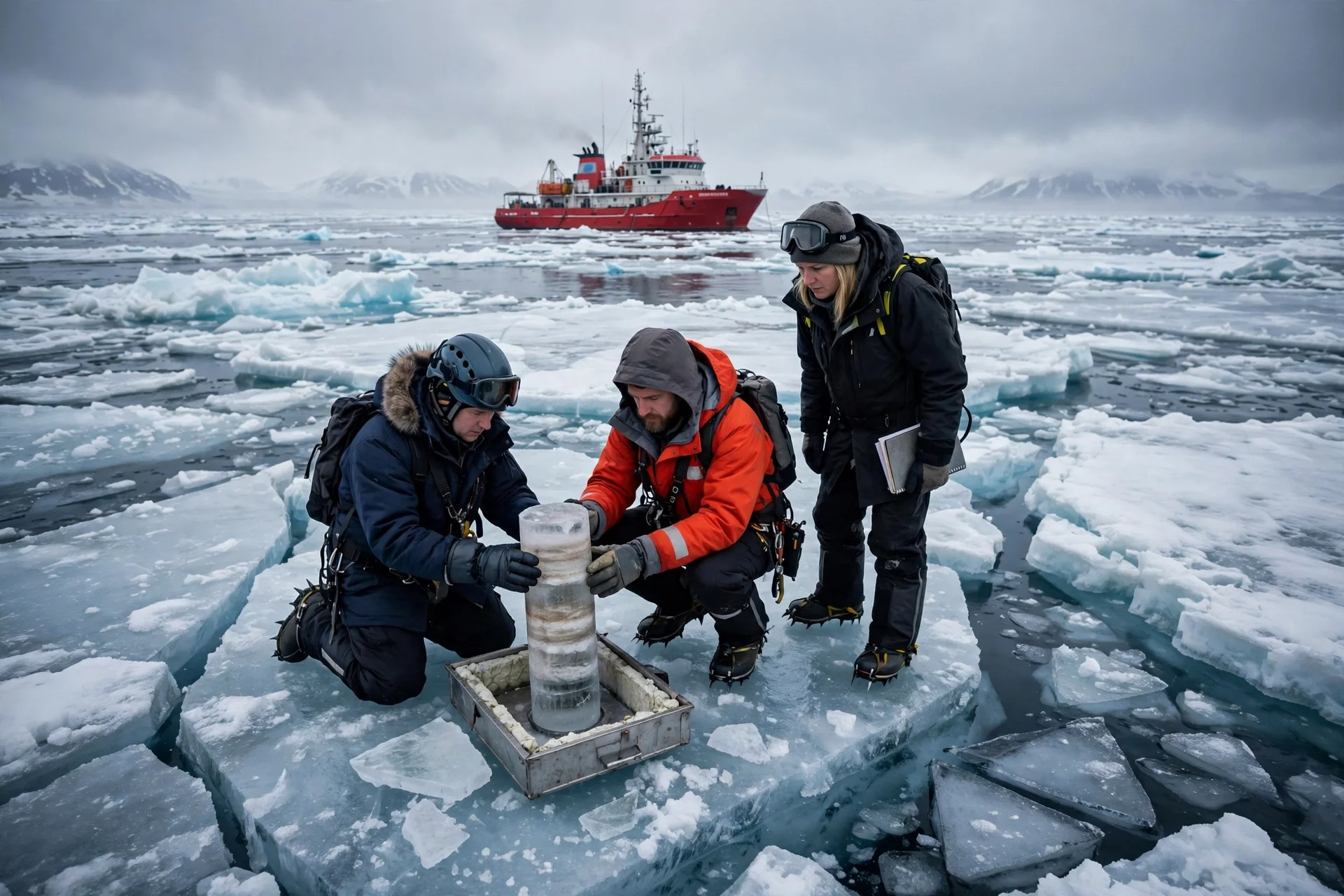
Trabajo científico sobre el hielo ártico, con un testigo de hielo en primer plano y un buque de investigación al fondo. · Imagen generada para EPM
UK renews Arctic policy as ice loss and rivalry accelerate
Minister Uma Kumaran launched the updated Arctic policy framework of the United Kingdom, with five priorities, after winter sea ice reached a record low in…
Britain strengthens Arctic strategy on security and science
The United Kingdom updated its Arctic policy framework with five priorities centred on security, governance and science, amid Russian militarisation, greater…
--- The context ---
Minister Uma Kumaran presented the updated Arctic policy framework of the United Kingdom at an event attended by Arctic state partners, Indigenous representatives and colleagues from across government. She explained in her speech that the Arctic is changing before our eyes, something that could be seen and felt last week at the Arctic Circle Assembly in Reykjavik, where over 2,000 people from 60 countries gathered, all united by a shared recognition of the importance of the region.
For those who live in the Arctic, the minister stressed, it is not just a region but home, the place where people live, work and build their lives. For others globally, the Arctic offers a renewed focus on its opportunities but also on its challenges, in one of the most significant and rapid periods of change in its history.
--- The facts ---
The updated policy responds to a region being reshaped by climate change, increasing strategic relevance and geopolitical competition, as Russia continues its campaign of militarisation and economic interest grows. In March 2025, Arctic winter sea ice reached the lowest annual maximum recorded in the 47-year record. Between 2023 and 2024, glaciers in Arctic Scandinavia and Svalbard experienced their largest net loss of ice on record.
The minister also warned that the Arctic is more competitive and more contested than ever and that the area is becoming more accessible for tourism, commercial shipping and trade, with growing effects on weather, food supply, the economy and national security in the United Kingdom.
--- The positions ---
The framework sets out five priorities: understanding and responding to a changing Arctic, enhancing security and stability, supporting effective governance, building responsible economic partnerships, and strengthening resilience. The minister argued in indirect terms that these priorities are not just about UK interests, because by bringing together expertise across science, technology and security the United Kingdom is offering practical capability to help the collective response.
On science, the minister said in indirect terms that good decisions start with evidence and noted that since 2014 the United Kingdom Natural Environment Research Council has invested more than £145 million in Arctic science. She also highlighted in indirect terms the work of the research vessel Sir David Attenborough with partners in Greenland and others on the connection between ice sheet loss and warming in Arctic waters, an initial £13 million investment alongside the Research Council of Norway, and more than £4 million over three years to support new research partnerships, including with the Arctic Council, which marked its 30th anniversary last month.
--- What remains unknown ---
The speech does not detail how responsibilities for delivering the five priorities will be divided in practice between departments or what measurable results are expected under each of them. Nor is the content of the Written Ministerial Statement laid before Parliament detailed.
--- Unanswered questions ---
How will anyone measure whether the updated framework truly improves the resilience of Arctic communities facing the thaw? What coordinated response are the United Kingdom and its allies preparing for Russian militarisation and greater competition in the region? Will the funded science arrive in time to guide decisions ahead of the International Polar Year 2032-33?
--- EPM analysis ---
The underlying reading is that the Arctic is no longer a distant matter for London: record ice loss, glacier retreat and opening routes directly affect British weather, food and security. The speech links that urgency to the idea, conveyed in indirect terms by the minister, that no country can either understand or manage these changes alone and that hope must be grounded in science and driven by action, with the 4,000-year-old ice shown in the room as a symbol of what is at stake.
📌 EPM Take:
In EPM's view, the value of the framework lies in joining climate, science and security in a single strategy and in recognising that the Arctic is above all the home of those who inhabit it. The record low ice in March 2025 and the largest glacier loss between 2023 and 2024 require that the five priorities become real protection and partnerships that include communities. If the investment sustained since 2014 and international cooperation are maintained, the United Kingdom can contribute to a collective response equal to the change under way.
--- The context ---
Minister Uma Kumaran presented the updated Arctic policy framework of the United Kingdom before Arctic state partners, Indigenous representatives and colleagues from across government. She explained in her speech that the update comes three and a half years after the previous strategy because the Arctic is changing before our eyes, something that, as she recounted, could be seen and felt last week at the Arctic Circle Assembly in Reykjavik, with over 2,000 people from 60 countries.
The minister recalled in indirect terms that British lives have been intertwined with the Arctic for over 500 years, but warned that the pace of change today and the urgency of the response are new, and stressed that for those who live there the Arctic is not just a region but home.
--- The facts ---
The region is being reshaped by climate change, its increasing strategic relevance and geopolitical competition, as Russia continues its campaign of militarisation and economic interest grows. In March 2025, Arctic winter sea ice reached the lowest annual maximum recorded in the 47-year record. Between 2023 and 2024, glaciers in Arctic Scandinavia and Svalbard experienced their largest net loss of ice on record.
At the same time, the Arctic is more competitive and more contested than ever, while it becomes more accessible for tourism, commercial shipping and trade. The minister noted that these developments are already affecting weather, the economy and national security in the United Kingdom, and that there is no UK security or indeed global security without Arctic security.
--- The positions ---
The framework sets five priorities: understanding and responding to a changing Arctic, enhancing security and stability, supporting effective governance, building responsible economic partnerships, and strengthening resilience. The minister argued in indirect terms that the United Kingdom seeks to deliver them by working with allies to keep the Arctic secure and stable, while supporting responsible and sustainable economic growth through a coordinated, all of government approach.
On science, the minister said in indirect terms that good decisions start with evidence and that since 2014 the United Kingdom Natural Environment Research Council has invested more than £145 million in Arctic science. She highlighted in indirect terms the work of the research vessel Sir David Attenborough with partners in Greenland and others on the connection between ice sheet loss and warming in Arctic waters, an initial £13 million investment alongside the Research Council of Norway, and more than £4 million over three years for new research partnerships, including with the Arctic Council, which marked its 30th anniversary last month.
--- What remains unknown ---
The speech does not detail what concrete security capabilities the United Kingdom will deploy in the region or on what timetable each priority of the framework will be delivered.
--- Unanswered questions ---
What concrete capabilities will the United Kingdom contribute so that Arctic security and stability do not remain a declaration? How will anyone verify that the £145 million invested since 2014 and the new funding produce measurable results? What clear rules will govern economic activity and commercial shipping in an increasingly accessible Arctic?
--- EPM analysis ---
The strategic reading is that London treats the Arctic as a front for security and competition, not only as a scientific laboratory. The references to Russian militarisation and to governance place the framework on the ground of order and rules, while science, with the vessel Sir David Attenborough and the 4,000-year-old ice present in the room, provides the evidence that should guide verifiable decisions ahead of the International Polar Year 2032-33.
📌 EPM Take:
In EPM's view, the framework is right to treat the Arctic as a matter of security, governance and evidence, and not only of the environment. With Russia militarising the region and ice at record lows in March 2025, the United Kingdom needs real capabilities, firm allies and rules that are actually enforced. The scientific investment since 2014 will only make sense if it becomes verifiable decisions and lasting stability. The Written Ministerial Statement laid before Parliament should account for that delivery with data, deadlines and results that everyone can check.
Reino Unido renueva su política ártica ante el cambio acelerado
La ministra Uma Kumaran presentó el marco actualizado de política ártica del Reino Unido, con cinco prioridades, tras el mínimo récord de hielo marino invernal…
Londres refuerza su estrategia ártica por seguridad y ciencia
El Reino Unido actualizó su marco de política ártica con cinco prioridades centradas en seguridad, gobernanza y ciencia, en un contexto de militarización rusa…
--- El contexto ---
La ministra Uma Kumaran presentó el marco actualizado de política ártica del Reino Unido en un acto que reunió a socios de Estados árticos, representantes indígenas y colegas de todo el Gobierno. Según explicó en su intervención, el Ártico está cambiando ante los ojos de todos y ese cambio ya se pudo ver y sentir la semana pasada en la Asamblea del Círculo Ártico celebrada en Reykjavik, donde se reunieron más de 2,000 personas de 60 países.
Para quienes viven en el Ártico, subrayó la ministra, no se trata solo de una región, sino de su hogar, el lugar donde la gente vive, trabaja y construye su vida.
--- Los hechos ---
El marco actualizado responde a una región remodelada por el cambio climático, por una relevancia estratégica creciente y por la competencia geopolítica, mientras Rusia continúa su campaña de militarización y crece el interés económico por la zona. En March 2025, el hielo marino invernal del Ártico alcanzó el máximo anual más bajo registrado en 47 años de registro. Entre 2023 y 2024, los glaciares de Escandinavia ártica y Svalbard experimentaron su mayor pérdida neta de hielo registrada.
La ministra advirtió además de que el Ártico es más competitivo y disputado que nunca y de que la zona se está volviendo más accesible para el turismo, la navegación comercial y el comercio, con efectos crecientes sobre el tiempo, el suministro de alimentos, la economía y la seguridad nacional del Reino Unido.
--- Las posiciones ---
El marco establece cinco prioridades: entender el cambio ártico y responder a él, reforzar la seguridad y la estabilidad, apoyar una gobernanza eficaz, construir alianzas económicas responsables y fortalecer la resiliencia. La ministra sostuvo en indirecto que esas prioridades no tratan solo de los intereses británicos, porque al reunir experiencia en ciencia, tecnología y seguridad el Reino Unido ofrece una capacidad práctica para ayudar a la respuesta colectiva.
En materia científica, la ministra afirmó en indirecto que las buenas decisiones parten de la evidencia y recordó que desde 2014 el consejo británico de investigación del medio natural ha invertido más de 145 millones de libras en ciencia ártica. También destacó en indirecto el trabajo del buque Sir David Attenborough con socios de Groenlandia y otros para entender mejor la conexión entre la pérdida de la capa de hielo y el calentamiento de las aguas árticas, así como una inversión inicial de 13 millones de libras junto al consejo de investigación de Noruega y más de 4 millones de libras en tres años para nuevas alianzas de investigación, incluidas las del Arctic Council, que celebró su 30.º aniversario el mes pasado.
--- Lo que falta saber ---
La intervención no detalla cómo se repartirán en la práctica las responsabilidades entre departamentos para ejecutar las cinco prioridades ni qué resultados medibles se esperan en cada una de ellas. Ni se detalla la declaración ministerial escrita ante el Parlamento.
--- Preguntas sin respuesta ---
¿Cómo se medirá si el marco actualizado mejora de verdad la resiliencia de las comunidades árticas frente al deshielo? ¿Qué respuesta coordinada preparan el Reino Unido y sus aliados ante la militarización rusa y la mayor competencia en la región? ¿Llegará la ciencia financiada a tiempo para orientar las decisiones antes del Año Polar Internacional 2032-33?
--- Análisis EPM ---
La lectura de fondo es que el Ártico ha dejado de ser un asunto lejano para Londres: el deshielo récord, la pérdida de glaciares y la apertura de rutas afectan directamente al clima, la alimentación y la seguridad británicas. El discurso conecta esa urgencia con la idea, recogida en indirecto de la ministra, de que ningún país puede entender ni gestionar estos cambios en solitario y de que la esperanza debe apoyarse en la ciencia y en la acción, con el hielo de 4,000 años mostrado en la sala como símbolo de lo que está en juego.
📌 Conclusion EPM:
A juicio de EPM, el valor del marco está en unir clima, ciencia y seguridad en una misma estrategia y en reconocer que el Ártico es el hogar de quienes lo habitan. El mínimo récord de hielo en March 2025 y la mayor pérdida de glaciares entre 2023 y 2024 exigen que las cinco prioridades se traduzcan en protección y alianzas con las comunidades. Si la inversión sostenida desde 2014 y la cooperación internacional se mantienen, el Reino Unido puede contribuir a una respuesta colectiva a la altura del cambio.
--- El contexto ---
La ministra Uma Kumaran presentó el marco actualizado de política ártica del Reino Unido ante socios de Estados árticos, representantes indígenas y colegas de todo el Gobierno. Según explicó en su intervención, la actualización llega tres años y medio después de la estrategia anterior porque el Ártico está cambiando ante los ojos de todos, algo que, según relató, se pudo ver y sentir la semana pasada en la Asamblea del Círculo Ártico de Reykjavik, con más de 2,000 personas de 60 países.
La ministra recordó en indirecto que las vidas británicas llevan más de 500 años entrelazadas con el Ártico, pero advirtió de que el ritmo del cambio actual y la urgencia de la respuesta son nuevos, y subrayó que para quienes viven allí el Ártico no es solo una región, sino su hogar.
--- Los hechos ---
La región está siendo remodelada por el cambio climático, por su creciente relevancia estratégica y por la competencia geopolítica, mientras Rusia continúa su campaña de militarización y crece el interés económico. En March 2025, el hielo marino invernal alcanzó el máximo anual más bajo registrado en 47 años de registro. Entre 2023 y 2024, los glaciares de Escandinavia ártica y Svalbard registraron su mayor pérdida neta de hielo registrada.
Al mismo tiempo, el Ártico es más competitivo y disputado que nunca, mientras se vuelve más accesible para el turismo, la navegación comercial y el comercio. La ministra señaló que estos desarrollos ya afectan al tiempo, a la economía y a la seguridad nacional británica, y que no hay seguridad británica ni seguridad global sin seguridad ártica.
--- Las posiciones ---
El marco fija cinco prioridades: entender el cambio ártico y responder a él, reforzar la seguridad y la estabilidad, apoyar una gobernanza eficaz, construir alianzas económicas responsables y fortalecer la resiliencia. La ministra sostuvo en indirecto que el Reino Unido busca cumplirlas trabajando con los aliados para mantener el Ártico seguro y estable y apoyando un crecimiento económico responsable y sostenible mediante un enfoque coordinado de todo el Gobierno.
En ciencia, la ministra afirmó en indirecto que las buenas decisiones parten de la evidencia y que desde 2014 el consejo británico de investigación del medio natural ha invertido más de 145 millones de libras en ciencia ártica. Destacó en indirecto el trabajo del buque Sir David Attenborough con socios de Groenlandia y otros sobre la conexión entre la pérdida de la capa de hielo y el calentamiento de las aguas árticas, una inversión inicial de 13 millones de libras junto al consejo de investigación de Noruega y más de 4 millones de libras en tres años para nuevas alianzas de investigación, incluidas las del Arctic Council.
--- Lo que falta saber ---
La intervención no detalla qué capacidades concretas de seguridad desplegará el Reino Unido en la región ni con qué calendario se ejecutará cada prioridad del marco. Ni se detalla la declaración ministerial escrita ante el Parlamento.
--- Preguntas sin respuesta ---
¿Qué capacidades concretas aportará el Reino Unido para que la seguridad y la estabilidad árticas no queden en una declaración? ¿Cómo se comprobará que los 145 millones de libras invertidos desde 2014 y las nuevas partidas producen resultados medibles? ¿Qué reglas claras regirán la actividad económica y la navegación comercial en un Ártico cada vez más accesible?
--- Análisis EPM ---
La lectura estratégica es que Londres asume el Ártico como un frente de seguridad y de competencia, no solo como un laboratorio científico. La referencia a la militarización rusa y a la gobernanza sitúa el marco en el terreno del orden y de las reglas, mientras la ciencia, con el buque Sir David Attenborough y el hielo de 4,000 años presente en la sala, aporta la evidencia que debe guiar decisiones verificables de cara al Año Polar Internacional 2032-33.
📌 Conclusion EPM:
A juicio de EPM, el marco acierta al tratar el Ártico como una cuestión de seguridad, gobernanza y evidencia, y no solo de medio ambiente. Con Rusia militarizando la región y el hielo en mínimos en March 2025, el Reino Unido necesita capacidades reales, aliados firmes y reglas que se hagan cumplir. La inversión científica desde 2014 solo tendrá sentido si se traduce en decisiones verificables y en estabilidad duradera. La declaración ministerial escrita ante el Parlamento deberá rendir cuentas de ese cumplimiento con datos, plazos y resultados comprobables por todos.