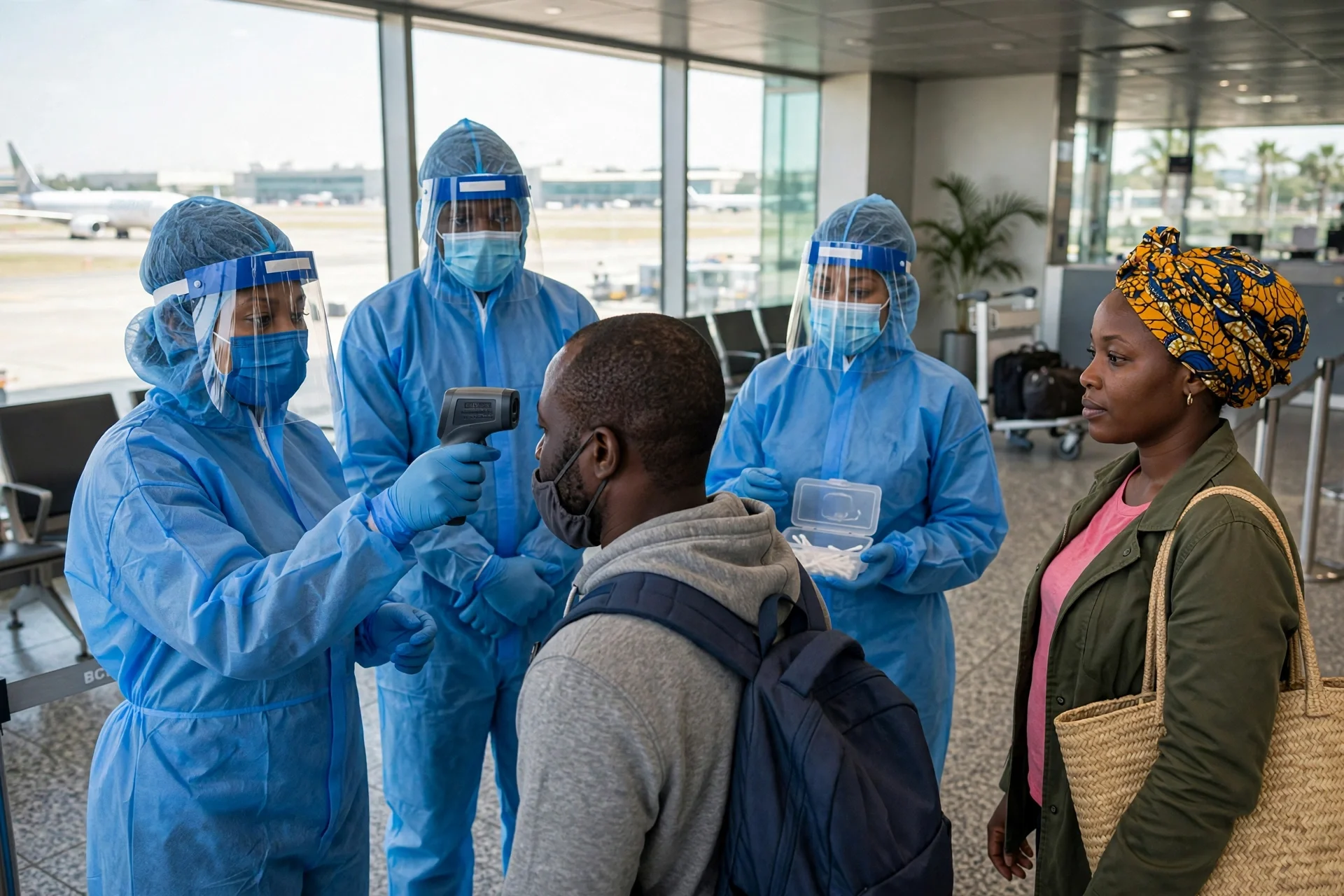
Controles sanitarios a viajeros en un aeropuerto, con personal protegido tomando la temperatura a los pasajeros. · Imagen generada para EPM
Kenya confirms second Ebola case among monitored contacts
Kenya has confirmed a second Ebola case: a 39-year-old man, a relative of the first patient, who was in quarantine and developed symptoms on 13 October.
Kenya's second Ebola case found inside quarantine
Kenya's second Ebola case, a 39-year-old relative of the first patient who died, was detected among quarantined contacts.
--- The context ---
Kenya has confirmed its second Ebola case amid the outbreak that continues in the east of the Democratic Republic of the Congo, declared in May. The new positive appeared among monitored contacts, testing the quarantine and tracing system activated after the first death, and the preparedness built since then.
--- The facts ---
The patient is a 39-year-old man, a relative of Kenya's first case, who died in hospital on 5 October. He was in quarantine as a contact and developed symptoms on 13 October. The first patient had been living in the Democratic Republic of the Congo, arrived in Nairobi via Uganda on 3 October and died in hospital two days later. The agency's representative, Dr. Neema Rusibamayila Kimambo, spoke in Nairobi a day after the Ministry of Health confirmed the new case.
The net covers more than 40 people: airline passengers and crew, airplane cleaners, airport workers, baggage handlers and immigration officials, as well as health personnel and family members. Most are in quarantine, and a few low-risk contacts have self-quarantined under monitoring. One concrete gap remains: efforts continue to reach six passengers who have been difficult to locate because they have foreign phone numbers.
--- The positions ---
Dr. Kimambo congratulated the Government for listing and quarantining contacts, and argued in indirect terms that containing the disease depends on everybody playing their part, not only the Government or its partners. The agency has brought in a senior incident manager who took part in the response in Uganda, and has donated some $70,000 worth of supplies, including infection prevention and laboratory items, since the first case. More than 4,000 health workers have been trained, including for screenings at ports of entry.
The representative said there is still no need for travel restrictions or border closures, while appropriate screening remains important for travellers who may pose a risk. She explained that Ebola is transmitted through contact with the bodily fluids of an infected person, advised handwashing, sanitizer and avoiding shaking hands, and stressed that the symptoms, fever, vomiting and diarrhoea, mimic malaria and other diseases, so care must be sought quickly.
--- What remains unknown ---
The source does not report the patient's current condition, or whether the six passengers have been located. It also does not say how many contacts have completed quarantine, or whether other symptomatic contacts have been tested.
--- Unanswered questions ---
Will the six passengers who are still missing be located in time? What is the second patient's condition, and how is he progressing? What would happen to surveillance if a case appeared with no known link to the first patient?
--- EPM analysis ---
The progressive reading stresses the public capacity built before the emergency: joint preparedness since May, thousands of trained workers and a wide net that includes often invisible staff such as airplane cleaners. The declared strategy is tracing and trust, without closing borders or feeding panic.
📌 EPM Take:
In EPM's view, the significant news is not only the second case, but that it appeared where the system expected it: inside the quarantine of monitored contacts. That speaks of tracing that worked at this link, but the account leaves the loose end that matters: six passengers still unlocated. Containment will be judged by that detail, and by how quickly anyone with fever, vomiting or diarrhoea reaches a health facility, without fear and without delay.
--- The context ---
Ebola has reappeared in Kenya in the one place the authorities could afford to find it: on the list of contacts already under quarantine. The case is linked to the outbreak still spreading in the east of the Democratic Republic of the Congo, and the underlying question is execution: close the net, find those missing and keep screening without complacency or indiscriminate closure.
--- The facts ---
The patient is a 39-year-old man, a relative of Kenya's first case, who died in hospital on 5 October. He was in quarantine as a contact and developed symptoms on 13 October. The first patient had been living in the Democratic Republic of the Congo, arrived in Nairobi via Uganda on 3 October and died in hospital two days later. The Ministry of Health confirmation came a day before the remarks by the agency's representative, Dr. Neema Rusibamayila Kimambo.
More than 40 people were identified as contacts: airline passengers and crew, airplane cleaners, airport workers, baggage handlers, immigration officials, health personnel and family members. Most are in quarantine, and a few low-risk contacts have self-quarantined under monitoring. The incomplete part is measurable: efforts continue to reach six passengers who have proved difficult to locate because they have foreign phone numbers.
--- The positions ---
Dr. Kimambo congratulated the Government for listing and quarantining contacts, and commended how widely the net was cast, in the air and on the ground. In indirect terms, she argued that case management and infection prevention and control are critical in the quarantine centres, and ruled out travel restrictions or border closures for now, underlining screening at ports of entry. The agency keeps surveillance and tracing teams working, added a senior manager with Uganda experience, and has donated some $70,000 in supplies.
The representative also asked for individual responsibility: do not over-panic, because there is no community spread, and make sure anyone who falls sick gets care at a health facility. She recalled that the disease is transmitted through contact with the bodily fluids of an infected person, advised hand hygiene and avoiding shaking hands, and noted that fever, vomiting and diarrhoea mimic malaria and other diseases. More than 4,000 health workers have been trained, including for entry screenings.
--- What remains unknown ---
The patient's clinical progress is not reported, nor whether any other contact has developed symptoms since 13 October. The source does not confirm whether the six passengers have been located, or give test results for the remaining contacts.
--- Unanswered questions ---
When will the contact net be declared closed, with the six passengers located or ruled out as a risk? What have the tests of the other quarantined contacts shown? What threshold of cases would lead to entry screening being reconsidered?
--- EPM analysis ---
From a conservative reading, the case shows the value of the basics done well: identify, isolate, monitor and communicate with calm. Keeping borders open protects the economy and mobility without abandoning control, provided screening genuinely works. The point of demand is the six passengers: a net with a known hole cannot be called finished.
📌 EPM Take:
In EPM's view, Kenya is doing what a state should do with an imported outbreak: trace widely, isolate in time and state clearly what is known and what is not. A second case found inside quarantine is a sign of control, not of its loss. But the standard should be strict: locate the six passengers, publish how the contacts progress and keep the public calm without lowering the guard. Public trust is preserved with complete information, not with managed reassurance.
Kenia confirma un segundo caso de ébola entre contactos vigilados
Kenia confirmó un segundo caso de ébola: un hombre de 39 años, familiar del primer paciente, que estaba en cuarentena y desarrolló síntomas el 13 October.
Segundo caso de ébola en Kenia, detectado dentro de la cuarentena
El segundo caso de ébola de Kenia, un hombre de 39 años familiar del primer paciente fallecido, fue detectado entre los contactos en cuarentena.
--- El contexto ---
Kenia confirmó su segundo caso de ébola en medio del brote que continúa en el este de la República Democrática del Congo, declarado en May. El nuevo positivo apareció entre los contactos vigilados, lo que pone a prueba la cuarentena y el rastreo activados tras la primera muerte.
--- Los hechos ---
El paciente es un hombre de 39 años, familiar del primer caso de Kenia, que murió en el hospital el 5 October. Estaba en cuarentena como contacto y desarrolló síntomas el 13 October. El primer paciente había vivido en la República Democrática del Congo, llegó a Nairobi vía Uganda el 3 October y murió dos días después. La representante de la agencia sanitaria, la doctora Neema Rusibamayila Kimambo, habló en Nairobi un día después de que el Ministerio de Salud confirmara el caso.
La red supera las 40 personas: pasajeros y tripulación de aerolínea, limpiadores de aviones, trabajadores del aeropuerto, encargados de equipaje, funcionarios de inmigración, personal sanitario y familiares. La mayoría está en cuarentena y unos pocos contactos de bajo riesgo se autoaislaron bajo vigilancia. Queda un hueco concreto: se sigue intentando localizar a seis pasajeros difíciles de encontrar por tener números de teléfono extranjeros.
--- Las posiciones ---
Kimambo felicitó al Gobierno por listar y poner en cuarentena a los contactos, y sostuvo en términos indirectos que contener la enfermedad depende de que cada persona haga su parte, no solo del Gobierno o de los socios. La agencia incorporó a un responsable senior que participó en la respuesta de Uganda y donó suministros por unos $70,000, incluidos artículos de control de infecciones y de laboratorio, desde el primer caso. Más de 4,000 trabajadores sanitarios han sido formados, también para los controles en los puntos de entrada.
La representante afirmó que no hay necesidad de restricciones de viaje ni de cerrar fronteras, aunque sí de controles adecuados para viajeros de riesgo. Explicó que el ébola se transmite por contacto con los fluidos corporales de una persona infectada, recomendó lavarse las manos, usar desinfectante y evitar dar la mano, y subrayó que los síntomas, fiebre, vómitos y diarrea, se parecen a los de la malaria, por lo que hay que buscar atención rápido.
--- Lo que falta saber ---
La fuente no informa del estado actual del paciente ni de si los seis pasajeros han sido localizados. Tampoco dice cuántos contactos han completado la cuarentena ni si otros contactos con síntomas han sido analizados.
--- Preguntas sin respuesta ---
¿Se localizará a tiempo a los seis pasajeros que siguen sin aparecer? ¿Cuál es el estado del segundo paciente y cómo evoluciona? ¿Qué ocurriría con la vigilancia si apareciera un caso sin vínculo conocido con el primer paciente?
--- Análisis EPM ---
La lectura progresista destaca la capacidad pública construida antes de la emergencia: preparación conjunta desde May, miles de trabajadores formados y una red que incluye a personal a menudo invisible, como limpiadores de aviones. La apuesta declarada es rastreo y confianza, sin cerrar fronteras ni alimentar el pánico.
📌 Conclusion EPM:
A juicio de EPM, la noticia no es solo el segundo caso, sino que apareció donde el sistema esperaba: dentro de la cuarentena de los contactos vigilados. Eso habla de un rastreo que funcionó en este eslabón, pero el propio relato deja el cabo suelto que importa: seis pasajeros sin localizar. La contención se juzgará por ese detalle y por la rapidez con la que cualquier persona con fiebre, vómitos o diarrea llegue a un centro sanitario, sin miedo y sin demora.
--- El contexto ---
El ébola reapareció en Kenia en el único lugar donde las autoridades podían permitirse encontrarlo: la lista de contactos bajo cuarentena. El caso está vinculado al brote que sigue en el este de la República Democrática del Congo, y la cuestión de fondo es de ejecución: cerrar la red, localizar a quienes faltan y mantener los controles sin complacencia ni cierres indiscriminados.
--- Los hechos ---
El paciente es un hombre de 39 años, familiar del primer caso keniano, fallecido en el hospital el 5 October. Estaba en cuarentena como contacto y presentó síntomas el 13 October. El primer paciente había vivido en la República Democrática del Congo, llegó a Nairobi vía Uganda el 3 October y murió dos días después. La confirmación del Ministerio de Salud llegó un día antes de las declaraciones de la representante de la agencia sanitaria, la doctora Neema Rusibamayila Kimambo.
Más de 40 personas fueron identificadas como contactos: pasajeros y tripulación, limpiadores de aviones, personal del aeropuerto, encargados de equipaje, funcionarios de inmigración, personal sanitario y familiares. La mayoría cumple cuarentena y algunos contactos de bajo riesgo se autoaislaron bajo vigilancia. Se sigue buscando a seis pasajeros difíciles de localizar porque sus números de teléfono son extranjeros.
--- Las posiciones ---
Kimambo felicitó al Gobierno por listar y poner en cuarentena a los contactos y elogió que la red se lanzara muy amplia, en el aire y en tierra. En términos indirectos, defendió que la gestión de casos y el control de infecciones son críticos en los centros de cuarentena, y descartó por ahora restricciones de viaje o cierres de fronteras, subrayando los controles en los puntos de entrada. La agencia mantiene equipos de vigilancia y rastreo, sumó a un responsable senior con experiencia en Uganda y donó suministros por unos $70,000.
La representante pidió responsabilidad individual: no entrar en pánico, porque no hay propagación comunitaria, y acudir a un centro sanitario en cuanto alguien enferme. Recordó que el contagio se produce por contacto con los fluidos corporales de una persona infectada, recomendó higiene de manos y evitar dar la mano, y advirtió que fiebre, vómitos y diarrea se confunden con malaria y otras enfermedades. Más de 4,000 trabajadores sanitarios han sido formados, incluidos los de los controles de entrada.
--- Lo que falta saber ---
No se conoce la evolución clínica del paciente ni si otro contacto ha desarrollado síntomas tras el 13 October. La fuente no confirma si los seis pasajeros han sido localizados ni detalla los resultados de las pruebas de los demás contactos.
--- Preguntas sin respuesta ---
¿Cuándo se dará por cerrada la red de contactos, con los seis pasajeros localizados o descartados como riesgo? ¿Qué han mostrado las pruebas de los demás contactos en cuarentena? ¿Qué umbral de casos llevaría a reconsiderar los controles en los puntos de entrada?
--- Análisis EPM ---
Desde una lectura conservadora, el caso muestra el valor de lo básico bien hecho: identificar, aislar, vigilar y comunicar con serenidad. No cerrar fronteras protege la economía y la movilidad sin renunciar al control, siempre que el cribado funcione. La exigencia está en los seis pasajeros: una red con un hueco conocido no puede darse por terminada.
📌 Conclusion EPM:
A juicio de EPM, Kenia está haciendo lo que un Estado debe hacer ante un brote importado: rastrear ancho, aislar a tiempo y decir con claridad lo que se sabe y lo que no. El segundo caso dentro de la cuarentena es señal de control, no de descontrol. Pero la vara debe ser estricta: localizar a los seis pasajeros, publicar la evolución de los contactos y mantener la calma sin bajar la guardia. La confianza pública se conserva con datos completos, no con tranquilidad administrada.