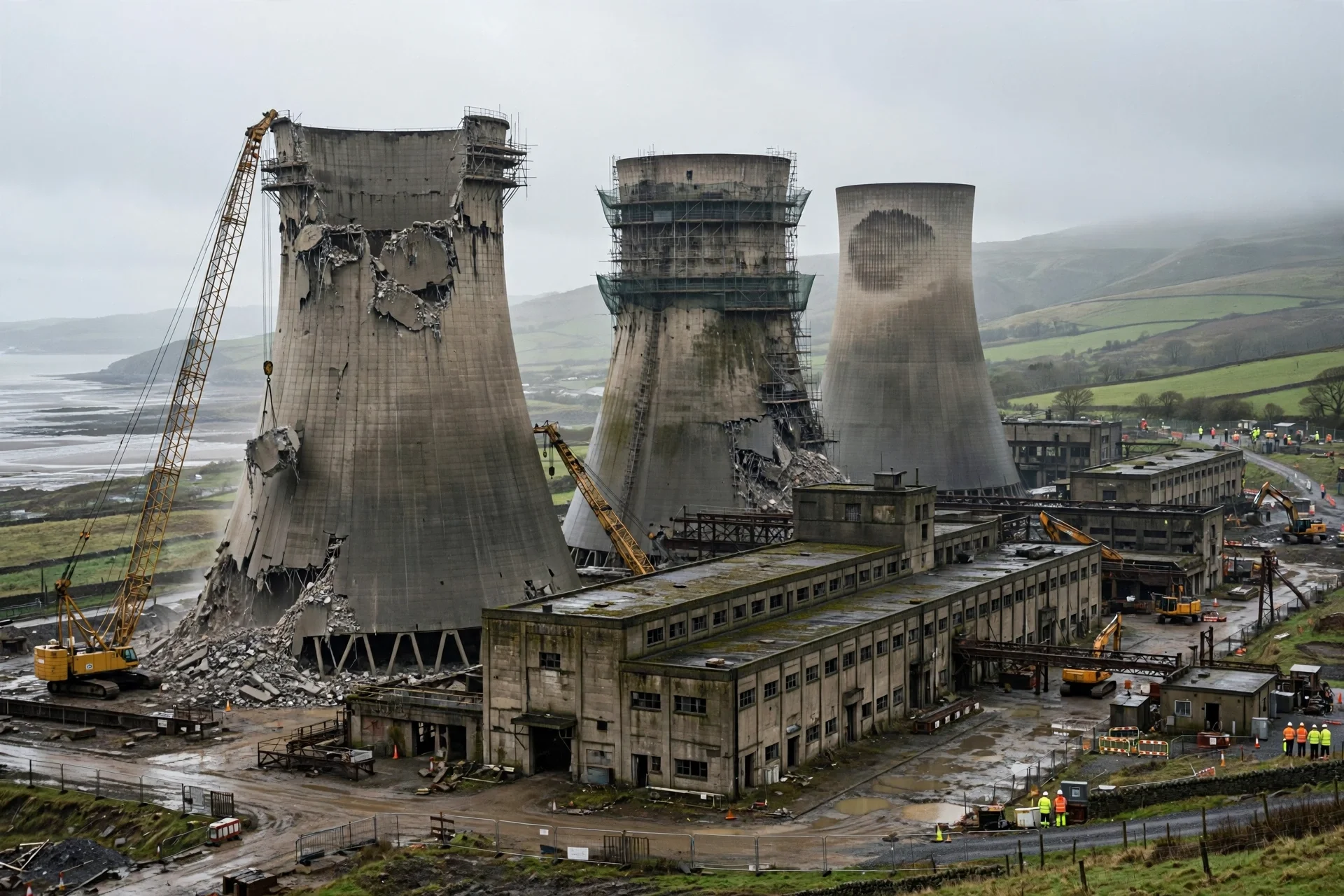
Desmantelamiento de torres de refrigeración en una antigua central nuclear, con grúas y maquinaria de demolición en el emplazamiento. · Imagen generada para EPM
Calder Hall, first commercial nuclear station, is taken apart
Seventy years after opening in 1956, Calder Hall, the world's first commercial nuclear power station, is being decommissioned at Sellafield: fuel-free since…
Taking Calder Hall apart: method and land for Sellafield's future
Calder Hall, opened in 1956 and closed in 2003, is being decommissioned in phases at Sellafield after the removal of its 40,000 fuel rods.
--- The context ---
Seventy years after it opened, the world's first commercial nuclear power station is being taken apart piece by piece at Sellafield. Calder Hall helped establish the United Kingdom's civil nuclear industry and today its role is different: to teach how to decommission a station of its generation safely, and to free land for the facilities the site will need in the future.
--- The facts ---
The station was opened on 17 October 1956 by Her Majesty the Queen, Elizabeth II. Its 4 Magnox reactors generated electricity for 47 years until the station closed in March 2003, and other Magnox stations were based on its design, in the United Kingdom and around the world. The fuel has been removed from the reactors: Calder Hall was confirmed free of fuel in 2019, after all 40,000 fuel rods were taken out of its reactors.
Taking the station apart requires a planned sequence: fuel removed, plant and services isolated, large amounts of asbestos and other hazards removed, and buildings made safe so they could be taken down. The cooling towers have been taken down, thousands of tonnes of asbestos have been removed from the station and nearby buildings, and redundant plant, pipework and structures have been dismantled. Calder Hall is now a decommissioning site, and people will soon see more buildings come down.
--- The positions ---
The position set out in the case is that decommissioning needs safety plans that match the site as it is today and the work taking place there, Demolition also has a practical purpose: land at Sellafield is limited, and future delivery requires space for new facilities and infrastructure, including supporting the SIXEP Continuity Plant.
The case also stresses the learning value of the project: what teams learn at Calder Hall about how safety plans change as hazards are removed, how demolition can be carried out safely and how land can be prepared for future use will help other decommissioning projects at Sellafield and across the NDA group. Seventy years after Calder Hall opened, its contribution has changed: the work now is to complete its final chapter safely and make room for what the country needs next.
--- What remains unknown ---
The source gives no completion timetable for the decommissioning and no cost figures. It also does not detail which buildings will come down next, or the specific use of each parcel of freed land beyond the general need for space for new facilities.
--- Unanswered questions ---
How long will the full decommissioning of Calder Hall take, and what will it cost? Which buildings will be demolished in the next phase, and what will be built on the freed land? How will the lessons be documented so that other projects in the group can apply them without repeating mistakes?
--- EPM analysis ---
The progressive reading of this case focuses on long-term responsibility: the industry that promised power must show it can close the full cycle, remove hazards such as asbestos and leave the land fit for reuse. Presenting it as a school for future decommissioning acknowledges that a nuclear legacy is managed across generations.
📌 EPM Take:
In EPM's view, Calder Hall sums up an uncomfortable and useful truth about nuclear power: opening a station is a day of ceremony, but taking one apart is decades of work demanding the same seriousness as its construction. The progress described, fuel-free since 2019, cooling towers down and thousands of tonnes of asbestos removed, shows an orderly and verifiable process. The pending test is transparency: publish timetables, costs and next phases so that this final chapter can be judged on data, not only on memory.
--- The context ---
The world's first commercial nuclear power station no longer produces electricity: it produces experience in how such a facility is taken apart. Calder Hall, at Sellafield, opened seventy years ago and helped create the United Kingdom's civil nuclear industry; since it closed, the work has been to retire it in phases, safely and without improvisation, while the site frees land for its next stage.
--- The facts ---
Her Majesty the Queen, Elizabeth II, opened the station on 17 October 1956. Its 4 Magnox reactors generated for 47 years and the station closed in March 2003; other Magnox stations were based on its design. The fuel has been fully removed: all 40,000 fuel rods were taken from the reactors, and Calder Hall was confirmed free of fuel in 2019.
Taking it apart requires a planned sequence: fuel first, then plant and services isolated, large amounts of asbestos and other hazards removed, and buildings made safe before demolition. The cooling towers have been taken down, thousands of tonnes of asbestos have been removed from the station and nearby buildings, and redundant plant, pipework and structures have been dismantled. Calder Hall is no longer a working power station but a decommissioning site, and more buildings will soon be taken down.
--- The positions ---
The approach in the case is prudent risk management: the station was built to generate, and its buildings and systems were designed to keep it running, so the way it is managed safely has had to change as the site itself has changed. Safety plans need to match the site as it is today and the work taking place, and decommissioning has given the team a much clearer picture of the hazards that remain.
Alongside that prudence sits a practical motive: land at Sellafield is limited, and new facilities and infrastructure are required, including supporting the SIXEP Continuity Plant. Removing the parts of Calder Hall that are no longer needed creates that space, so a site from one of the earliest chapters of the nuclear programme helps create room for its next phase. What is learned about safety, demolition and preparing land will also help other projects at Sellafield and across the NDA group.
--- What remains unknown ---
The case publishes no completion timetable and no decommissioning costs. It also does not list the next buildings to be demolished, or specify which facilities will occupy the freed land, beyond the support mentioned for the SIXEP Continuity Plant.
--- Unanswered questions ---
What are the timetable and the total expected cost for completing the decommissioning? Which buildings will be demolished in the next publicly visible phase? How will success be measured, so that Calder Hall's experience demonstrably reduces risk or cost in the group's other projects?
--- EPM analysis ---
From a conservative reading, the case is a lesson in responsible stewardship of complex assets: no symbolic haste and no spectacular demolitions, but sequence, safety and use of scarce land. It is also a reminder that nuclear power requires institutions able to sustain commitments across seventy years, from a royal opening to the last demolition, and that this constancy is part of the credibility of the whole programme.
📌 EPM Take:
In EPM's view, the most valuable thing about Calder Hall today is not nostalgia but method: remove the fuel first, measure the real hazard at each stage and turn the experience into knowledge for the whole group. That order is what separates serious decommissioning from demolition under another name. What is missing is full accountability: timetables, costs and results published with the same clarity as the station's history, so the public can verify the progress for itself.
Calder Hall, la primera central nuclear comercial, se desmantela
Setenta años después de su apertura en 1956, Calder Hall, la primera central nuclear comercial del mundo, avanza en su desmantelamiento en Sellafield: sin…
Desmantelar Calder Hall: método y suelo para el futuro de Sellafield
Calder Hall, inaugurada en 1956 y cerrada en 2003, se desmantela por fases en Sellafield tras retirar sus 40,000 barras de combustible.
--- El contexto ---
Setenta años después de su apertura, la primera central nuclear comercial del mundo está siendo desmontada pieza a pieza en Sellafield. Calder Hall ayudó a establecer la industria nuclear civil británica y hoy su papel es otro: aprender a desmantelar con seguridad una central de su generación y liberar suelo para las instalaciones que el emplazamiento necesitará en el futuro.
--- Los hechos ---
La central fue inaugurada el 17 October 1956 por la reina Elizabeth II. Sus 4 reactores Magnox generaron electricidad durante 47 años, hasta el cierre en March 2003, y su diseño sirvió de base para otras centrales Magnox dentro y fuera del país. El combustible ya salió de los reactores: la central quedó confirmada libre de combustible en 2019, tras retirarse las 40,000 barras de combustible de sus reactores.
El desmantelamiento sigue una secuencia planificada: retirar el combustible, aislar la planta y los servicios, eliminar grandes cantidades de amianto y otros peligros, y dejar los edificios seguros para su demolición. Las torres de refrigeración ya fueron derribadas, se han retirado miles de toneladas de amianto de la central y de edificios cercanos, y también se han desmontado planta, tuberías y estructuras redundantes. Calder Hall es ya un emplazamiento en desmantelamiento, y pronto se verán más derribos.
--- Las posiciones ---
La posición que expresa el caso es que desmantelar exige planes de seguridad que cambien con el propio emplazamiento: los equipos necesitan planes ajustados al estado actual del lugar y al trabajo que se realiza en cada fase, La demolición tiene además una finalidad práctica: el suelo en Sellafield es limitado y el futuro del emplazamiento requiere espacio para nuevas instalaciones e infraestructura, incluido el apoyo a la planta SIXEP Continuity Plant.
El caso subraya también el valor de aprendizaje del proyecto: lo que los equipos aprenden en Calder Hall sobre cómo cambian los planes de seguridad al retirarse los peligros, cómo demoler con seguridad y cómo preparar el suelo para usos futuros servirá a otros proyectos de desmantelamiento en Sellafield y en todo el grupo NDA. Setenta años después de abrir, la aportación de la central ha cambiado: ahora consiste en completar su capítulo final con seguridad y hacer sitio a lo que el país necesite después.
--- Lo que falta saber ---
La fuente no da un calendario de finalización del desmantelamiento ni cifras de coste. Tampoco detalla qué edificios se derribarán a continuación ni qué uso concreto tendrá cada parcela liberada, más allá de la necesidad general de espacio para nuevas instalaciones.
--- Preguntas sin respuesta ---
¿Cuánto durará el desmantelamiento completo de Calder Hall y cuánto costará? ¿Qué edificios caerán en la siguiente fase y qué se construirá en el suelo liberado? ¿Cómo se documentará lo aprendido para que otros proyectos del grupo puedan aplicarlo sin repetir errores?
--- Análisis EPM ---
La lectura progresista de este caso pone el foco en la responsabilidad de largo plazo: la misma industria que prometió energía debe demostrar que sabe cerrar el ciclo completo, retirar peligros como el amianto y dejar el territorio en condiciones de reutilizarse. Presentarlo como escuela para futuros desmantelamientos reconoce que el legado nuclear se gestiona durante generaciones.
📌 Conclusion EPM:
A juicio de EPM, Calder Hall resume una verdad incómoda y útil de la energía nuclear: inaugurar una central es un día de ceremonia, pero desmantelarla es un trabajo de décadas que exige la misma seriedad que su construcción. El avance descrito, sin combustible desde 2019, con las torres caídas y miles de toneladas de amianto retiradas, muestra un proceso ordenado y verificable. La prueba pendiente es de transparencia: publicar plazos, costes y siguientes fases para que el capítulo final se juzgue con datos, no solo con memoria.
--- El contexto ---
La primera central nuclear comercial del mundo ya no produce electricidad: produce experiencia en cómo se desmonta una instalación así. Calder Hall, en Sellafield, abrió hace setenta años y ayudó a crear la industria nuclear civil del Reino Unido; desde su cierre, el trabajo consiste en retirarla por fases, con seguridad y sin improvisación, mientras el emplazamiento libera suelo para su siguiente etapa.
--- Los hechos ---
La reina Elizabeth II inauguró la central el 17 October 1956. Sus 4 reactores Magnox generaron durante 47 años y la central cerró en March 2003; otras centrales Magnox se basaron en su diseño. El combustible se retiró por completo: se extrajeron las 40,000 barras de los reactores y en 2019 la central quedó confirmada libre de combustible.
Desmontarla exige una secuencia planificada: primero el combustible, después aislar planta y servicios, retirar grandes cantidades de amianto y otros peligros, y asegurar los edificios antes de demolerlos. Las torres de refrigeración ya se derribaron y se han retirado miles de toneladas de amianto de la central y de edificios próximos, además de planta, tuberías y estructuras que ya no se necesitan. Calder Hall ya no es una central operativa, sino un emplazamiento en desmantelamiento donde pronto caerán más edificios.
--- Las posiciones ---
El planteamiento del caso es de gestión prudente del riesgo: como la central se construyó para funcionar, sus edificios y sistemas se diseñaron para mantenerla en marcha, y la forma de gestionarla con seguridad ha tenido que cambiar a medida que cambiaba el emplazamiento. Los planes de seguridad deben corresponder al estado real del lugar y al trabajo de cada momento, y el desmantelamiento ha permitido formarse una imagen mucho más clara de los peligros que quedan.
A esa prudencia se suma un motivo práctico: el suelo de Sellafield es limitado y hacen falta nuevas instalaciones e infraestructura, incluido el apoyo a la planta SIXEP Continuity Plant. Retirar lo que sobra de Calder Hall crea ese espacio, de modo que un emplazamiento de los primeros capítulos del programa nuclear ayuda a preparar su fase siguiente. Lo aprendido sobre seguridad, demolición y preparación del suelo servirá además a otros proyectos de Sellafield y del grupo NDA.
--- Lo que falta saber ---
El caso no publica plazos de finalización ni costes del desmantelamiento. Tampoco enumera los próximos edificios a demoler ni precisa qué instalaciones ocuparán el suelo liberado, más allá del apoyo mencionado a la planta SIXEP Continuity Plant.
--- Preguntas sin respuesta ---
¿Cuál es el calendario y el coste total previstos para terminar el desmantelamiento? ¿Qué edificios se derribarán en la siguiente fase visible para el público? ¿Cómo se medirá que la experiencia de Calder Hall reduce riesgos o costes en los demás proyectos del grupo?
--- Análisis EPM ---
Desde una lectura conservadora, el caso es una lección de administración responsable de activos complejos: nada de prisas simbólicas ni de derribos espectaculares, sino secuencia, seguridad y aprovechamiento del suelo. También recuerda que la energía nuclear exige instituciones capaces de sostener compromisos de setenta años, y que esa constancia es parte de la credibilidad del programa entero.
📌 Conclusion EPM:
A juicio de EPM, lo más valioso de Calder Hall hoy no es la nostalgia, sino el método: retirar primero el combustible, medir el peligro real en cada fase y convertir la experiencia en conocimiento para todo el grupo. Ese orden es el que separa un desmantelamiento serio de una demolición con otro nombre. Lo que falta es la rendición de cuentas completa: plazos, costes y resultados publicados con la misma claridad con la que se cuenta la historia de la central, para que el público pueda comprobar el avance.