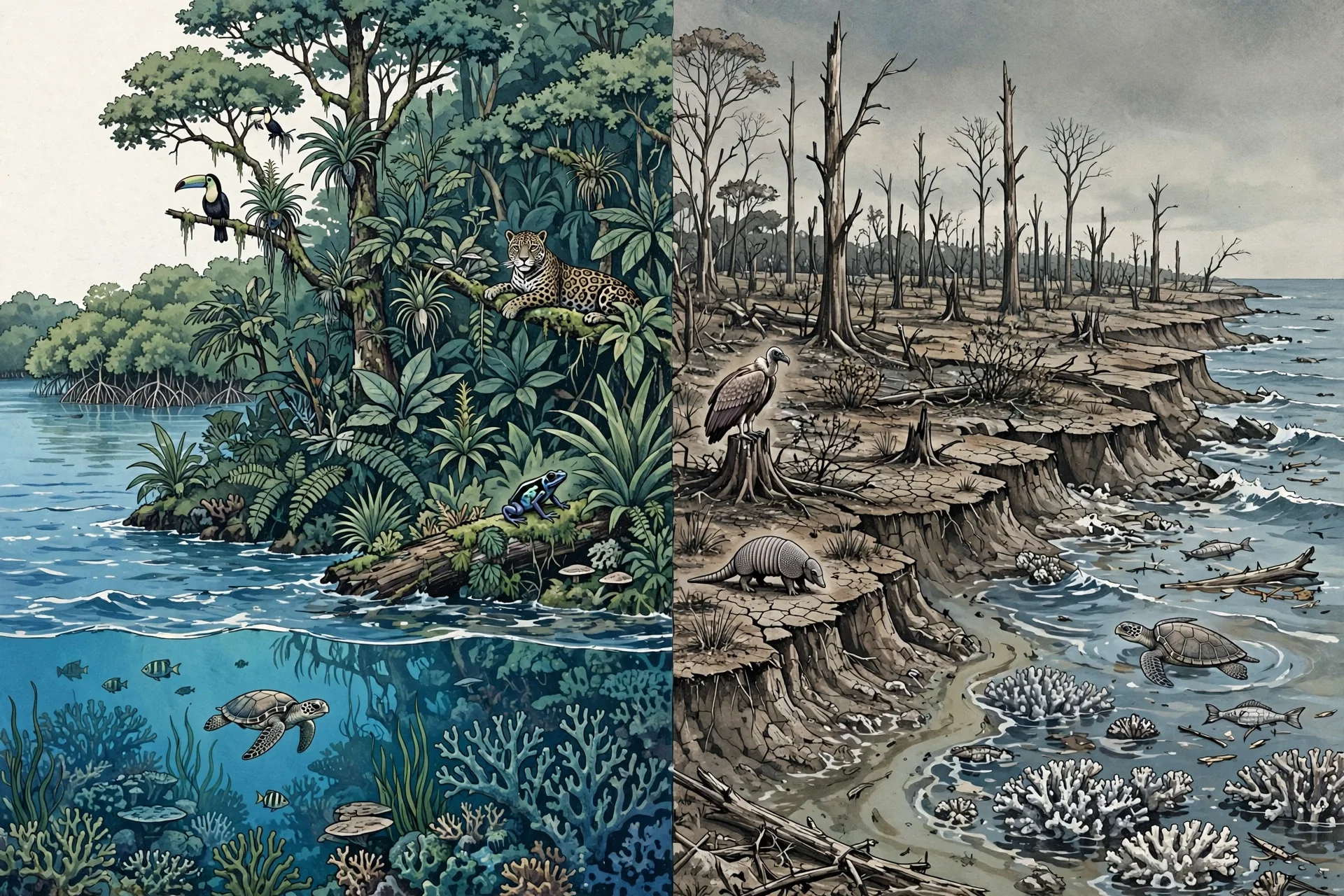
Un ecosistema vivo frente a un paisaje degradado: la brecha entre la ambición de proteger la naturaleza y la acción real. · Imagen generada para EPM
World falls behind on protecting nature, UN report warns
A UN report warns that fewer than half of national biodiversity targets are on track: even if current commitments are met, only 26 per cent of land and 12 per…
Protecting nature requires results, not only targets
Fewer than half of national targets to protect plants, animals and ecosystems are on track, a UN report finds.
--- The context ---
A new United Nations report warns that fewer than half of the national targets set to protect plants, animals and ecosystems are on track, days before countries gather in Yerevan, Armenia, for the biodiversity conference. The warning follows the deal struck in Montreal in 2022, which set out living in harmony with nature by 2050, with urgent action needed by 2030.
--- The facts ---
The flagship goal is to protect at least 30 per cent of land, inland waters, coasts and oceans by 2030. Yet the report finds that even if current commitments are met, only 26 per cent of land and 12 per cent of the ocean would be protected by that deadline. Progress is also lagging on money, skills, cooperation and data, and on incentives that reward protecting nature rather than destroying it.
There has been partial progress since 2022. Nearly 90 per cent of countries that are parties to the Convention on Biological Diversity have set national targets, and more than half have drawn up their own plans. More than 70 per cent have measured and reported on their results. Indigenous Peoples, local communities, regional and city authorities, charities and businesses have made some 5,000 commitments, though a serious gap remains between ambition and action.
--- The positions ---
Secretary-General António Guterres wrote in the report that biodiversity underpins life and that safeguarding it is essential to the health of the planet, the resilience of economies and the wellbeing of all people. At the launch in Yerevan, he said that the war on nature has not yet ended, and he warned of three interlinked crises: climate change, biodiversity loss and pollution.
The report calls for money and expertise for developing countries on a far bigger scale, for scrapping subsidies that harm nature, strengthening social protection and redirecting spending towards protecting nature. It also calls for work with businesses on strong disclosure rules, better coordination between governments, business, civil society, young people, women and Indigenous Peoples, and for biodiversity to be part of every decision across policies, regulations and budgets, as Guterres argued.
--- What remains unknown ---
What remains unclear is how the gap will be closed between the 26 per cent of land expected to be protected and the 30 per cent goal, or how ocean protection will grow from 12 per cent, or what mechanisms will make the 5,000 commitments count in practice.
--- Unanswered questions ---
Which countries will provide the money and expertise that developing countries need, and by when? Will subsidies that harm nature be scrapped, or will they keep rewarding its destruction? How will anyone verify that commitments by businesses and communities become real protection on the ground?
--- EPM analysis ---
The progressive reading stresses that nature is not defended by declarations: it requires collective financing, social protection so that change does not punish the most vulnerable, and a voice for Indigenous Peoples, women and young people in decisions. That nearly 90 per cent of countries have targets shows that consensus exists; what is missing is turning it into budgets, rules and verifiable results before 2030.
📌 EPM Take:
In EPM's view, the central fact is not only the delay but the distance between promising and protecting: even if every current commitment is met, land protection would reach 26 per cent and ocean protection 12 per cent, short of the 2030 goal. The answer cannot be another cycle of good intentions. It requires money at a far bigger scale, subsidies aligned with protecting rather than destroying, and biodiversity built into every budget and regulation, with public accountability for results.
--- The context ---
The world committed itself in Montreal in 2022 to living in harmony with nature by 2050, with urgent action needed by 2030. A new United Nations report, published days before the biodiversity conference in Yerevan, Armenia, finds that fewer than half of the national targets to protect plants, animals and ecosystems are on track.
--- The facts ---
The flagship goal is to protect at least 30 per cent of land, inland waters, coasts and oceans by 2030. Yet the report finds that even if current commitments are met, only 26 per cent of land and 12 per cent of the ocean would be protected by that deadline. Progress is also lagging on money, skills, cooperation and data, and on incentives that reward protecting nature rather than destroying it.
Progress since 2022 is real but insufficient. Nearly 90 per cent of countries that are parties to the Convention on Biological Diversity have set national targets, more than half have drawn up their own plans, and more than 70 per cent have measured and reported on their results. Indigenous Peoples, local communities, regional and city authorities, charities and businesses add some 5,000 commitments, with a serious gap between ambition and action.
--- The positions ---
Secretary-General António Guterres wrote in the report that biodiversity underpins life and that safeguarding it is essential to the health of the planet, the resilience of economies and the wellbeing of all people. At the launch in Yerevan, he said that the war on nature has not yet ended, and he warned of three interlinked crises: climate change, biodiversity loss and pollution.
Much of what the report asks for is management discipline: money and expertise for developing countries on a far bigger scale, scrapping subsidies that harm nature, strengthening social protection and redirecting spending towards protecting nature. It adds strong disclosure rules for businesses and better coordination between governments, business, civil society, young people, women and Indigenous Peoples to strengthen accountability, enforcement and cooperation.
--- What remains unknown ---
What is missing is a clear test of success beyond setting targets: which redirected spending will produce checkable results, which harmful subsidies will be removed first, and what happens when governments whose commitments do not become effective protection of land and ocean by 2030 are called to account.
--- Unanswered questions ---
What measurable results will be required in return for the money and expertise sent to developing countries? Which harmful subsidies will be scrapped first, and what controls will stop them returning under another name? Who will be held accountable if protection stays at 26 per cent of land and 12 per cent of the ocean?
--- EPM analysis ---
From a conservative reading, the problem is not a shortage of targets but of effectiveness: commitments are plentiful, while the right incentives, well-directed spending and consequences for failure are scarce. Scrapping perverse subsidies and requiring strong disclosure matter more than multiplying declarations, because they change what money rewards. Protection that is neither measured nor enforced ends up as paper.
📌 EPM Take:
In EPM's view, the lesson of the report is about management: setting national targets, as nearly 90 per cent of countries have done, does not by itself protect a single ecosystem. What matters is scrapping subsidies that pay for destruction, redirecting spending towards measurable results and requiring strong disclosure from businesses. Without coordination, enforcement and clear accountability, the 30 per cent goal for 2030 will remain a slogan while real protection stays at 26 and 12 per cent.
El mundo pierde terreno en la defensa de la biodiversidad
Un informe de la ONU advierte de que menos de la mitad de las metas nacionales de biodiversidad va en camino: aun cumpliendo los compromisos actuales, solo se…
Proteger la naturaleza exige resultados, no solo metas
Menos de la mitad de las metas nacionales para proteger plantas, animales y ecosistemas va en camino, según un informe de la ONU.
--- El contexto ---
Un nuevo informe de las Naciones Unidas advierte de que menos de la mitad de las metas nacionales para proteger plantas, animales y ecosistemas van en camino, a pocos días de que los países se reúnan en Ereván, Armenia, para la conferencia de biodiversidad. El aviso llega tras el acuerdo de Montreal de 2022, que fijó vivir en armonía con la naturaleza para 2050, con acción urgente antes de 2030.
--- Los hechos ---
La meta emblemática es proteger al menos el 30 por ciento de la tierra, las aguas continentales, las costas y los océanos para 2030. Pero el informe concluye que, aun cumpliendo los compromisos actuales, solo se protegería el 26 por ciento de la tierra y el 12 por ciento del océano. El retraso alcanza también al dinero, las capacidades, la cooperación y los datos, y a los incentivos que deberían premiar proteger en vez de destruir.
Desde 2022 hay avances parciales. Casi el 90 por ciento de los países partes del Convenio sobre la Diversidad Biológica ha fijado metas nacionales y más de la mitad tiene planes propios. Más del 70 por ciento ha medido y reportado resultados. Pueblos indígenas, comunidades locales, autoridades regionales y municipales, organizaciones benéficas y empresas suman unos 5,000 compromisos, aunque persiste una brecha seria entre ambición y acción.
--- Las posiciones ---
El secretario general António Guterres sostuvo en el informe que la biodiversidad sustenta la vida y que salvaguardarla es esencial para la salud del planeta, la resiliencia económica y el bienestar. En la presentación en Ereván afirmó que la guerra contra la naturaleza aún no ha terminado, y advirtió de tres crisis interconectadas: cambio climático, pérdida de biodiversidad y contaminación.
El informe pide dinero y experiencia para los países en desarrollo a mucha mayor escala, eliminar subsidios que dañan la naturaleza, reforzar la protección social, redirigir el gasto hacia protegerla y trabajar con empresas en reglas sólidas de divulgación. También pide mejor coordinación entre gobiernos, empresas, sociedad civil, jóvenes, mujeres y pueblos indígenas, y que la biodiversidad forme parte de cada decisión en políticas, regulaciones y presupuestos, como planteó Guterres.
--- Lo que falta saber ---
No se sabe cómo se cerrará la brecha entre el 26 por ciento de tierra previsto y la meta del 30 por ciento, ni cómo crecerá la protección oceánica desde el 12 por ciento previsto, ni qué mecanismos harán cumplir los 5,000 compromisos registrados.
--- Preguntas sin respuesta ---
¿Qué países aportarán el dinero y la experiencia que necesitan los países en desarrollo, y en qué plazo? ¿Se eliminarán los subsidios que dañan la naturaleza o seguirán premiando su destrucción? ¿Cómo se comprobará que los compromisos de empresas y comunidades se convierten en protección real?
--- Análisis EPM ---
La lectura progresiva subraya que la naturaleza no se defiende con declaraciones: exige financiación colectiva, protección social para que el cambio no castigue a los más vulnerables y voz para pueblos indígenas, mujeres y jóvenes. Que casi el 90 por ciento de los países tenga metas muestra que el consenso existe; falta convertirlo en presupuestos, reglas y resultados verificables antes de 2030.
📌 Conclusion EPM:
A juicio de EPM, el dato central no es solo el retraso, sino la distancia entre prometer y proteger: incluso cumpliendo todo lo anunciado, la tierra quedaría en el 26 por ciento y el océano en el 12 por ciento, lejos de la meta de 2030. La respuesta no puede ser otro ciclo de buenas intenciones. Hace falta dinero a mayor escala, subsidios coherentes con proteger y no con destruir, y biodiversidad presente en cada presupuesto y cada regulación, con rendición de cuentas pública.
--- El contexto ---
El mundo se comprometió en Montreal en 2022 a vivir en armonía con la naturaleza para 2050, con acción urgente antes de 2030. Un nuevo informe de las Naciones Unidas, publicado a pocos días de la conferencia de biodiversidad de Ereván, Armenia, constata que menos de la mitad de las metas nacionales para proteger plantas, animales y ecosistemas va en camino de cumplirse.
--- Los hechos ---
La meta emblemática es proteger al menos el 30 por ciento de la tierra, las aguas continentales, las costas y los océanos para 2030. Pero el informe concluye que, aun cumpliendo los compromisos actuales, solo se protegería el 26 por ciento de la tierra y el 12 por ciento del océano. El retraso alcanza también al dinero, las capacidades, la cooperación y los datos, y a los incentivos que deberían premiar proteger en vez de destruir.
El progreso desde 2022 es real pero insuficiente. Casi el 90 por ciento de los países partes del Convenio sobre la Diversidad Biológica ha fijado metas nacionales, más de la mitad ha elaborado planes propios y más del 70 por ciento ha medido y reportado resultados. A ello se suman unos 5,000 compromisos de pueblos indígenas, comunidades locales, autoridades regionales y municipales, organizaciones benéficas y empresas, con una brecha seria entre ambición y acción.
--- Las posiciones ---
El secretario general António Guterres sostuvo en el informe que la biodiversidad sustenta la vida y que salvaguardarla es esencial para la salud del planeta, la resiliencia económica y el bienestar. En la presentación en Ereván afirmó que la guerra contra la naturaleza aún no ha terminado, y advirtió de tres crisis interconectadas: cambio climático, pérdida de biodiversidad y contaminación.
Lo que pide el informe es, en buena medida, disciplina de gestión: más dinero y experiencia para los países en desarrollo a mucha mayor escala, eliminar subsidios que dañan la naturaleza, reforzar la protección social y redirigir el gasto hacia protegerla. Añade reglas sólidas de divulgación para las empresas y mejor coordinación entre gobiernos, empresas, sociedad civil, jóvenes, mujeres y pueblos indígenas para rendición de cuentas, cumplimiento y cooperación.
--- Lo que falta saber ---
Falta saber con qué criterios se medirá el éxito: qué parte del gasto redirigido dará resultados comprobables, qué subsidios se eliminarán primero y cómo responderán los gobiernos cuyos compromisos no se traduzcan en protección efectiva dentro del plazo de 2030.
--- Preguntas sin respuesta ---
¿Qué resultados medibles se exigirán a cambio del dinero y la experiencia destinados a los países en desarrollo? ¿Qué subsidios dañinos se eliminarán primero y con qué controles se evitará que reaparezcan con otro nombre? ¿Quién rendirá cuentas si la protección se queda en el 26 por ciento de la tierra y el 12 por ciento del océano?
--- Análisis EPM ---
Desde una lectura conservadora, el problema no es la falta de metas, sino de eficacia: sobran compromisos y faltan incentivos correctos, gasto bien dirigido y consecuencias por incumplir. Eliminar subsidios perversos y exigir divulgación sólida vale más que multiplicar declaraciones, porque cambia lo que el dinero premia.
📌 Conclusion EPM:
A juicio de EPM, la lección del informe es de gestión: fijar metas nacionales, como ya hizo casi el 90 por ciento de los países, no protege ni una hectárea por sí solo. Lo decisivo es eliminar subsidios que pagan por destruir, redirigir el gasto con resultados medibles y exigir divulgación sólida a las empresas. Sin coordinación, cumplimiento y cuentas claras, el 30 por ciento de 2030 seguirá siendo un eslogan mientras la protección real se queda en el 26 y el 12 por ciento.