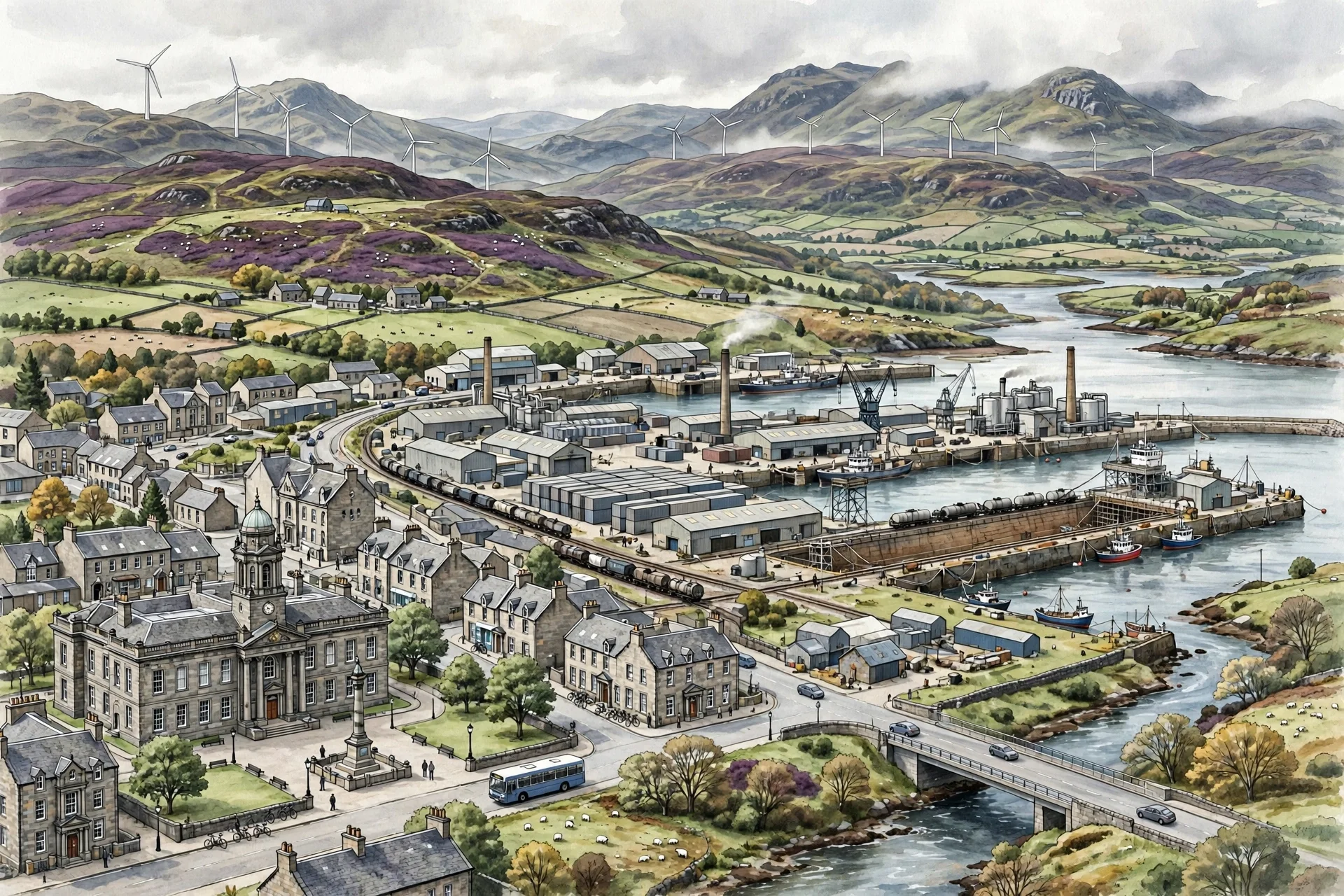
Localidad escocesa ilustrativa con su edificio municipal, su tejido residencial y su zona industrial y portuaria junto al río. · Imagen generada para EPM
Burnham to offer Holyrood joint work to empower Scottish regions
Prime Minister Andy Burnham will invite Scotland's First Minister to work together to push more power out of Westminster and Holyrood towards Scottish regions…
More regional power in Scotland, if it brings responsibility and jobs
Andy Burnham will offer to work with the Scottish Government to push more power out of Westminster and Holyrood and develop a model of regional empowerment…
--- The context ---
Devolution has moved significant power from Westminster over the last 27 years, but decision-making has not always continued downwards from Holyrood. That is the underlying tension Prime Minister Andy Burnham will put on the table in a speech today.
The Scottish Government is described as one of the most centralised devolved administrations in Europe. The progressive idea running through the offer is simple: people who know their areas best should have more of a say, because opportunity is not spread evenly across Scotland's regions and cities.
--- The facts ---
Burnham will invite Scotland's First Minister to work with him on the common good of pushing more power out of both Westminster and Holyrood. The aim is to unlock jobs and opportunity in every region, placing more decision-making in the hands of Scotland's regions and cities to drive reindustrialisation.
He will deliver his remarks after speaking with young people today in Lanarkshire. As part of the offer, he will call on the Scottish Government to work with the UK Government through No10 North and the Scotland Office to develop a new model of regional empowerment for Scotland.
--- The positions ---
Burnham has said, in attributed remarks, that during his first week in office he told the First Minister he wanted to work with him to spread opportunities to communities across Scotland's regions and cities, and that through No10 North the state is being rewired.
Scottish Secretary Douglas Alexander has said, in attributed remarks, that devolution has done a great deal but power was never supposed to stop at the doors of the Scottish Parliament, that the offer is a genuine one, and that the Scotland Office is ready to work alongside the Scottish Government.
--- What remains unknown ---
The source does not set out what the new model of regional empowerment would look like, which concrete decisions would move to regions and cities, or what timetable is proposed. Nor is there yet any response from the Scottish Government to the announced offer, or any sign of whether it will accept that joint framework.
--- Unanswered questions ---
Will the Scottish Government respond to the offer and agree to develop a joint model of regional empowerment? Which concrete decisions would pass from Holyrood to Scotland's regions and cities? How would that capacity be shared among territories with such different strengths, identities and ambitions of their own?
--- EPM analysis ---
The progressive reading stresses local participation: bringing decisions closer to communities can fit them better to each territory and open opportunities where they do not reach. Reindustrialisation appears linked to decentralisation, not as a central instruction, but as a shared capacity for regions with their own identity.
📌 EPM Take:
In EPM's view, what matters in this announced offer is not only that it asks for power to move out of Westminster, but that it also asks for power to move out of Holyrood, recognising that devolution can stop halfway if decisions never reach regions and cities. If the Scottish Government responds and the model gains detail, the test will be practical: more local capacity to unlock jobs, reindustrialisation and real opportunity in every Scottish community, rather than decentralisation remaining a shared statement of intent.
--- The context ---
After 27 years of significant devolution from Westminster, the debate Andy Burnham will open today is not whether Scotland has its own Parliament, but whether decision-making is too concentrated in Holyrood. The source describes the Scottish Government as one of the most centralised devolved administrations in Europe.
The conservative approach views that concentration with a clear test: moving decisions closer only counts if it improves jobs, reindustrialisation and results in each territory. Creating new layers without real capacity or defined responsibility would not solve the problem the proposal says it wants to correct.
--- The facts ---
In a speech today, after speaking with young people in Lanarkshire, Burnham will invite Scotland's First Minister to work with him to push more power out of Westminster and Holyrood. He will argue that the next stage of devolution should place more decision-making in the hands of Scotland's regions and cities.
He will also call, as announced, on the Scottish Government to work with the UK Government through No10 North and the Scotland Office to develop a new model of regional empowerment. The stated purpose is for communities with their strengths and ambitions to seize new economic opportunities and unlock potential.
--- The positions ---
Burnham has said, in attributed remarks, that this is an offer to the Scottish Government and that, working together, there is no limit to what can be achieved for the Scottish people. He has said he wants regions in Scotland fully part of rewiring the state.
Douglas Alexander, the Scottish Secretary, has said, in attributed remarks, that people in North Lanarkshire, in Fife or in the Highlands know what their communities need better than any minister in London or Edinburgh, and that the shared goal is good jobs and real opportunity in every corner.
--- What remains unknown ---
The Scottish Government's response is not known, nor is the detail of the proposed model: which powers would move, with what resources, and under what responsibility regions would answer. Without that detail, it cannot be judged whether this is effective subsidiarity or another structure on paper.
--- Unanswered questions ---
Will the Scottish Government accept working with the UK Government on this new regional model? Which concrete powers, resources and responsibilities would regions and cities actually receive under it? How will success be measured, so that announced decentralisation produces jobs and reindustrialisation rather than only new layers of management?
--- EPM analysis ---
The conservative reading values subsidiarity when it brings decisions closer to those who know the ground and subjects them to results. Jobs and reindustrialisation give the proposal a testable standard: if regions gain capacity to use their strengths, there will be progress; if only the chart changes, there will not.
📌 EPM Take:
In EPM's view, the announced offer is right to say that power was never supposed to stop at Holyrood, but its value will depend on the responsibility that accompanies every power transferred. Decentralising without clear resources or accountability would create new layers without results; doing it with jobs, reindustrialisation and measurable aims in each region would be something different. The Scottish Government's response is still missing and, above all, the detail of the model, which is where this proposal will earn or lose its practical credibility.
Burnham ofrecerá a Holyrood llevar más poder a las regiones escocesas
El primer ministro, Andy Burnham, anunciará que invitará al primer ministro escocés a trabajar juntos para sacar más poder de Westminster y de Holyrood hacia…
Más poder regional en Escocia, si llega con responsabilidad y empleo
Andy Burnham anunciará una oferta al Gobierno escocés para trabajar juntos, sacar más poder de Westminster y de Holyrood, y desarrollar un modelo de…
--- El contexto ---
La devolución ha trasladado competencias importantes desde Westminster durante los últimos 27 años, pero el poder de decisión no siempre ha seguido bajando desde Holyrood hacia los territorios. Esa es la tensión de fondo que el primer ministro, Andy Burnham, anuncia que pondrá sobre la mesa en un discurso previsto para hoy.
Según el planteamiento anunciado, el Gobierno escocés figura entre las administraciones devueltas más centralizadas de Europa. La idea progresista que lo recorre es sencilla: quienes mejor conocen su zona deberían tener más voz, porque las oportunidades no se reparten igual en cada región ni en cada ciudad escocesa.
--- Los hechos ---
Burnham anunciará que invitará al primer ministro escocés a trabajar con él por el bien común de sacar más poder tanto de Westminster como de Holyrood. El objetivo declarado es desbloquear empleo y oportunidad en todas las regiones, con más decisiones en manos de las regiones y las ciudades.
El discurso llegará tras conversar hoy con jóvenes en Lanarkshire. Como parte de la oferta, pedirá al Gobierno escocés que trabaje con el Gobierno británico, a través de No10 North y la Scotland Office, para desarrollar un nuevo modelo de empoderamiento regional para Escocia.
--- Las posiciones ---
Burnham ha explicado, en declaraciones atribuidas, que durante su primera semana en el cargo dijo al primer ministro escocés que quería trabajar con él para extender las oportunidades a las comunidades de las regiones y ciudades escocesas, y que mediante No10 North se está reconfigurando el Estado.
El secretario para Escocia, Douglas Alexander, ha sostenido, en declaraciones atribuidas, que la devolución ha logrado mucho, pero que el poder nunca debió detenerse a las puertas del Parlamento escocés, y que la oferta es genuina y su oficina está lista para trabajar junto al Gobierno escocés.
--- Lo que falta saber ---
La fuente no detalla cómo sería ese nuevo modelo de empoderamiento regional, qué decisiones concretas bajarían a regiones y ciudades, ni qué calendario se propone. Tampoco consta todavía una respuesta del Gobierno escocés a la oferta anunciada, ni si aceptará trabajar en ese marco conjunto.
--- Preguntas sin respuesta ---
¿Responderá el Gobierno escocés a la oferta y aceptará desarrollar un modelo conjunto de empoderamiento regional? ¿Qué decisiones concretas pasarían de Holyrood a las regiones y las ciudades escocesas? ¿Cómo se repartiría esa capacidad entre territorios con fortalezas, identidad y ambiciones tan distintas?
--- Análisis EPM ---
La lectura progresista subraya la participación local: acercar la decisión a la comunidad puede hacerla más ajustada a cada territorio y abrir oportunidades donde hoy no llegan. La reindustrialización aparece así vinculada a la descentralización, no como una orden central, sino como una capacidad compartida por regiones con identidad propia.
📌 Conclusion EPM:
A juicio de EPM, lo relevante de esta oferta anunciada no es solo que pida sacar poder de Westminster, sino que también lo pida de Holyrood, reconociendo que la devolución puede quedarse a mitad de camino si la decisión no llega a regiones y ciudades. Si el Gobierno escocés responde y el modelo gana detalle, la prueba será práctica: más capacidad local para impulsar empleo, reindustrialización y oportunidades reales en cada comunidad escocesa, sin que la descentralización se quede en una declaración de intenciones compartida.
--- El contexto ---
Tras 27 años de devolución importante desde Westminster, el debate que el primer ministro, Andy Burnham, anuncia para hoy no es si Escocia tiene Parlamento propio, sino si la decisión se concentra demasiado en Holyrood. La fuente describe al Gobierno escocés como una de las administraciones devueltas más centralizadas de Europa.
El enfoque conservador mira esa concentración con una exigencia clara: acercar la decisión solo vale si mejora el empleo, la reindustrialización y los resultados en cada territorio. Crear nuevas capas sin capacidad real ni responsabilidad definida no resolvería el problema que se dice corregir.
--- Los hechos ---
En un discurso previsto para hoy, tras hablar con jóvenes en Lanarkshire, Burnham anunciará que invitará al primer ministro escocés a trabajar con él para sacar más poder de Westminster y de Holyrood. Argumentará que la siguiente etapa de la devolución debe poner más decisiones en manos de regiones y ciudades.
También pedirá, según lo anunciado, que el Gobierno escocés trabaje con el Gobierno británico a través de No10 North y la Scotland Office para desarrollar un nuevo modelo de empoderamiento regional. La finalidad declarada es que cada comunidad aproveche nuevas oportunidades económicas y despliegue su potencial propio.
--- Las posiciones ---
Burnham ha afirmado, en declaraciones atribuidas, que esto es una oferta al Gobierno escocés y que, trabajando juntos, no hay límite para lo que pueden lograr por el pueblo escocés. También ha señalado que quiere asegurar que las regiones escocesas formen plenamente parte de la reconfiguración del Estado.
Douglas Alexander, secretario para Escocia, ha señalado, en declaraciones atribuidas, que quienes viven en North Lanarkshire, en Fife o en las Highlands conocen mejor las necesidades de sus comunidades que cualquier ministro en Londres o Edimburgo, y que el objetivo común son buenos empleos y oportunidades reales.
--- Lo que falta saber ---
No se conoce todavía la respuesta del Gobierno escocés, ni el detalle del modelo propuesto: qué competencias bajarían, con qué recursos y bajo qué responsabilidad responderían las regiones. Sin ese detalle, no puede juzgarse si habrá subsidiariedad efectiva o solo una estructura más sobre el papel.
--- Preguntas sin respuesta ---
¿Aceptará el Gobierno escocés trabajar con el Gobierno británico en este nuevo modelo regional? ¿Qué competencias, recursos y responsabilidades concretas recibirían las regiones y las ciudades? ¿Cómo se medirá si la descentralización anunciada produce empleo y reindustrialización, y no solo nuevas capas de gestión?
--- Análisis EPM ---
La lectura conservadora valora la subsidiariedad cuando acerca la decisión a quien conoce el terreno y la somete a resultados. El empleo y la reindustrialización dan a la propuesta un criterio verificable: si las regiones ganan capacidad para aprovechar sus fortalezas, habrá avance; si solo cambia el organigrama, no.
📌 Conclusion EPM:
A juicio de EPM, la oferta anunciada acierta al señalar que el poder no debía detenerse en Holyrood, pero su valor dependerá de la responsabilidad que acompañe a cada competencia transferida. Descentralizar sin recursos claros ni rendición de cuentas crearía capas nuevas sin resultados; hacerlo con empleo, reindustrialización y objetivos medibles en cada región sería otra cosa. Falta la respuesta del Gobierno escocés y, sobre todo, el detalle del modelo, que es donde esta propuesta se ganará o perderá su credibilidad práctica.