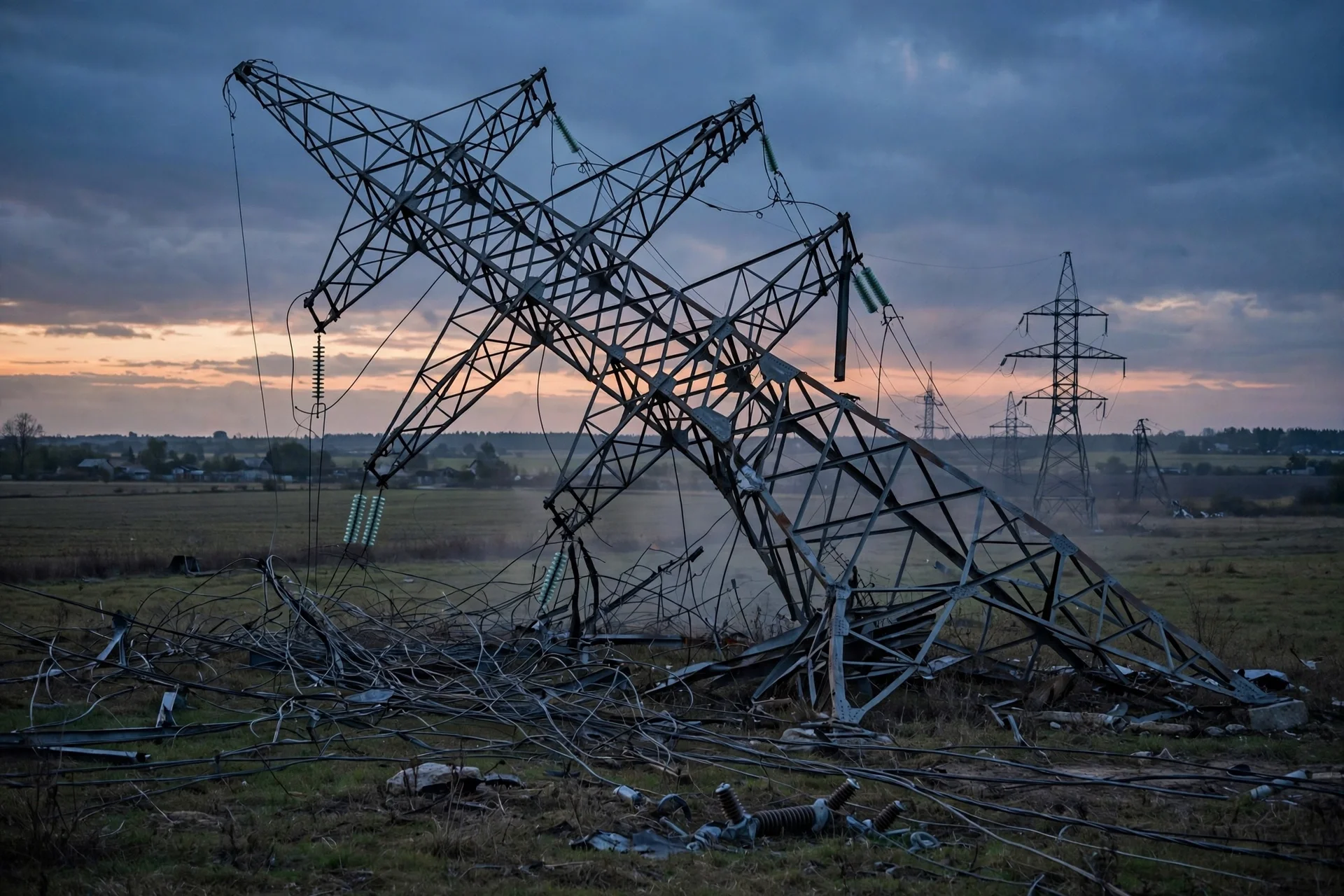
Infraestructura eléctrica dañada al anochecer, imagen alusiva a los ataques contra la red energética ucraniana. · Imagen generada para EPM
Massive strike leaves 600,000 people without power in Ukraine
A night offensive with missiles and drones left at least 600,000 people without electricity in Ukraine and damaged 30 energy and gas facilities.
Kyiv seeks stronger air defense after Russian night strike
Russia struck the power grid of Kyiv, its region and Kharkiv overnight with ballistic missiles and drones, leaving at least 600,000 people without power and…
--- The context ---
Ukraine faces another night of attacks on its power system amid a dispute over an announced pause covering that kind of infrastructure. The American president had announced an understanding to halt strikes on energy targets, but neither side jointly confirmed its terms, and the grid that sustains homes and basic services once again stood at the center of the war.
--- The facts ---
The Ukrainian president accused Russia of launching a night offensive against Kyiv, the capital region and Kharkiv despite the announced pause. According to his account, the attack left at least 600,000 people without electricity and caused damage to the power grid and to oil and gas sector infrastructure. He said 39 ballistic missiles and more than 120 attack drones and loitering munitions were used, and that the target was the infrastructure covered by the understanding announced from Washington.
Ukrainian authorities detailed damage to 30 energy and gas facilities: 26 in the electricity system and four in the oil and gas sector. Deaths and injuries were also reported, without a precise toll being given. Emergency services and repair crews were deployed to deal with the aftermath, while technical teams assess the damage and warn that the cuts could widen as repairs move forward.
--- The positions ---
The Ukrainian president described the attack as deliberate and demonstrative in its scale, and argued that it showed ostentatious contempt toward the United States as never before. He maintained that peace can only come through strength and called for a reaction from the United States, Europe and Ukraine's other allies, with tougher sanctions and new shipments of interceptors for the Patriot systems, which Kyiv considers necessary against ballistic missiles.
Russia's Defense Ministry, for its part, reported a massive strike with precision weapons and drones against facilities that, in its version, supplied electricity to companies in the Ukrainian military-industrial complex and to the country's armed forces. It named the Darnytskaya and Kievskaya thermal power plants in the capital, the Kievskaya and Tripolskaya plants and a substation linking Kyiv's grid with the western regions, and in Kharkiv the Kharkovskaya and Zmievskaya plants. Kyiv regards those facilities as part of a system essential to the civilian population.
--- What remains unknown ---
The exact number of victims is not known, nor is the expected duration of the blackouts in each affected area. It is also unclear whether the announced understanding included any verification mechanism or consequences for a breach.
--- Unanswered questions ---
How many people remain without supply, and how long will it take to restore electricity in the affected areas? Will there be a concrete allied response in the form of sanctions or more interceptors? Can a pause on energy hold when neither side ever confirmed it jointly?
--- EPM analysis ---
The dispute is no longer only about each damaged plant, but about the meaning of an agreement that each side interprets in its own way. For the population, the immediate consequence is practical and harsh: less light, less heat and more uncertainty before winter, on a grid attacked repeatedly since the start of the invasion.
📌 EPM Take:
In EPM's view, when an offensive leaves hundreds of thousands of people without electricity, the debate can no longer be confined to the military sphere, because light, heating and water are part of everyday civilian life and their loss punishes first those who have the least. Protecting the power grid should be a shared priority for allies, with swift repairs, adequate defense and sustained pressure, without losing sight of the fact that every prolonged blackout erodes the basic security of the Ukrainian population.
--- The context ---
The night offensive against Ukraine's power grid comes days after the American president announced an understanding to pause attacks on energy infrastructure. That announcement was never jointly confirmed by the two sides, and its fragility was exposed as soon as the missiles returned over a country whose grid has been battered repeatedly since the start of the invasion.
--- The facts ---
The Ukrainian president attributed to Russia a night attack on Kyiv, its region and Kharkiv with 39 ballistic missiles and more than 120 attack drones and loitering munitions. According to his account, at least 600,000 people were left without electricity and there were deaths and injuries, with no precise toll given. Damage reached 30 energy and gas facilities: 26 in the electricity system and four in the oil and gas sector, and authorities warned that the cuts could widen.
Emergency services, repair crews and energy sector workers were deployed to deal with the consequences. The Ukrainian leader argued that the target was precisely the infrastructure covered by the ceasefire announced by the American president, and that the scale of the strike made it a deliberate and demonstrative act, showing ostentatious contempt toward the United States as never before, in his words.
--- The positions ---
Kyiv called for a reaction from the United States, Europe and its other allies: tougher sanctions against Moscow and new shipments of interceptors for the Patriot systems, which it considers essential against ballistic missiles. The Ukrainian president argued that Washington has instruments to pressure Russia and bring a negotiated way out closer, and he summed up his stance by stating, in reference to his approach, that peace can only come through strength.
Russia's Defense Ministry maintained that its massive strike with precision weapons and drones was aimed at facilities supplying electricity to companies in the military-industrial complex and to the Ukrainian armed forces. It cited the Darnytskaya and Kievskaya thermal power plants in the capital, the Kievskaya and Tripolskaya plants, and a substation linking Kyiv's grid with the western regions. In Kharkiv it named the Kharkovskaya and Zmievskaya plants, linked, according to Moscow, to military supply.
--- What remains unknown ---
The exact number of victims is unknown, as is the real timeline for restoring supply across all affected areas. It is also unknown whether new interceptors will arrive, or whether the announced understanding will gain any verification.
--- Unanswered questions ---
Will the allies respond with effective sanctions and with the interceptors Kyiv demands for its air defense? What cost will Moscow pay for a strike presented as a direct challenge to Washington? Will this offensive harden the negotiation, or merely prove that the announced pause lacked force?
--- EPM analysis ---
The episode tests the credibility of any pause that does not rest on verification and consequences. A grid able to recover quickly reduces the military value of repeating the attack, and reinforced air defense raises the cost of trying. Declaratory pressure without instruments behind it tends to wear thin.
📌 EPM Take:
In EPM's view, the offensive confirms that weakness invites a repeat strike, because an adversary that calculates costs will keep attacking the power grid while the response remains slow or merely declarative. Deterrence requires air defense capable of intercepting ballistic missiles, sanctions applied without gaps and a clear signal that no understanding will be paper without verifiable compliance. Without that firmness, every announced pause risks becoming a window exploited only by the side willing to violate it.
Ataque masivo deja sin luz a 600.000 personas en Ucrania
Una ofensiva nocturna con misiles y drones dejó al menos 600.000 personas sin electricidad en Ucrania y dañó 30 instalaciones energéticas y de gas.
Kiev pide más defensa aérea tras la ofensiva rusa nocturna
Rusia golpeó de noche la red eléctrica de Kiev, su región y Járkov con misiles balísticos y drones, dejando al menos 600.000 personas sin luz y daños en 30…
--- El contexto ---
Ucrania afronta una nueva noche de ataques contra su sistema eléctrico en plena disputa sobre una pausa anunciada para ese tipo de infraestructuras. El presidente estadounidense había anunciado un entendimiento para detener los golpes contra la energía, pero ninguna parte confirmó conjuntamente sus términos, y la red que sostiene hogares y servicios básicos volvió a quedar en el centro de la guerra.
--- Los hechos ---
El presidente ucraniano acusó a Rusia de lanzar una ofensiva nocturna contra Kiev, la región capitalina y Járkov, pese a la pausa anunciada. Según su balance, el ataque dejó al menos 600.000 personas sin electricidad y dañó la red eléctrica e infraestructuras del petróleo y el gas. Sostuvo que se emplearon 39 misiles balísticos y más de 120 drones de ataque y municiones merodeadoras, y que el blanco fue la infraestructura amparada por el entendimiento anunciado desde Washington.
Las autoridades ucranianas detallaron daños en 30 instalaciones energéticas y de gas: 26 del sistema eléctrico y cuatro del sector de petróleo y gas. También se informó de muertos y heridos, sin precisar la cifra de víctimas. Los servicios de emergencia y las cuadrillas de reparación se desplegaron para atender las consecuencias, y se advirtió de que los cortes podrían ampliarse.
--- Las posiciones ---
El presidente ucraniano calificó el ataque como deliberado y demostrativo en su escala, y sostuvo que suponía un desprecio ostentoso hacia Estados Unidos como nunca antes se había mostrado. Defendió que la paz solo puede llegar mediante la fuerza y pidió una reacción de Estados Unidos, Europa y los demás aliados, con sanciones más duras y nuevos envíos de interceptores para los sistemas Patriot, que Kiev considera necesarios frente a los misiles balísticos.
El Ministerio de Defensa ruso informó, por su parte, de un ataque masivo con armas de precisión y drones contra instalaciones que, según su versión, suministraban electricidad a empresas del complejo militar-industrial y a las fuerzas armadas ucranianas. Mencionó las centrales termoeléctricas Dárnitskaya y Kíevskaya en la capital, la Kíevskaya y la Trípolskaya y una subestación que conecta la red de Kiev con las regiones occidentales, y en Járkov las centrales Járkovskaya y Zmíevskaya. Kiev considera esas infraestructuras parte de un sistema esencial para la población civil.
--- Lo que falta saber ---
No se conoce la cifra exacta de víctimas ni la duración prevista de los apagones en cada zona. Tampoco está claro si el entendimiento incluía verificación o consecuencias ante un incumplimiento.
--- Preguntas sin respuesta ---
¿Cuántas personas siguen sin suministro y cuánto tardará en restablecerse la electricidad en las zonas afectadas? ¿Habrá una respuesta concreta de los aliados en forma de sanciones o de más interceptores? ¿Puede sostenerse una pausa sobre la energía que ninguna parte confirmó de manera conjunta?
--- Análisis EPM ---
La disputa ya no es solo por cada central dañada, sino por el significado de un acuerdo que cada parte interpreta a su manera. Para la población, la consecuencia inmediata es práctica y dura: menos luz, menos calor y más incertidumbre antes del invierno, sobre una red ya castigada de forma recurrente.
📌 Conclusion EPM:
A juicio de EPM, cuando una ofensiva deja sin electricidad a cientos de miles de personas, el debate ya no puede limitarse al terreno militar, porque la luz, la calefacción y el agua forman parte de la vida civil cotidiana y su pérdida castiga primero a quienes menos tienen. Proteger la red eléctrica debería ser una prioridad compartida por los aliados, con reparaciones rápidas, defensa adecuada y presión sostenida, sin perder de vista que cada apagón prolongado erosiona la seguridad básica de la población ucraniana.
--- El contexto ---
La ofensiva nocturna contra la red eléctrica ucraniana llega días después de que el presidente estadounidense anunciara un entendimiento para pausar los ataques contra infraestructuras energéticas. Ese anuncio nunca fue confirmado de forma conjunta por las dos partes, y su fragilidad quedó expuesta en cuanto volvieron los misiles sobre una red castigada de forma recurrente desde el inicio de la invasión.
--- Los hechos ---
El presidente ucraniano atribuyó a Rusia un ataque nocturno contra Kiev, su región y Járkov con 39 misiles balísticos y más de 120 drones de ataque y municiones merodeadoras. Según su balance, al menos 600.000 personas quedaron sin electricidad y hubo muertos y heridos, sin que se precisara la cifra de víctimas. Los daños alcanzaron 30 instalaciones energéticas y de gas: 26 del sistema eléctrico y cuatro del sector de petróleo y gas, y las autoridades advirtieron de que los cortes podrían ampliarse.
Los servicios de emergencia, las cuadrillas de reparación y los trabajadores del sector energético se desplegaron para atender las consecuencias. El mandatario sostuvo que el blanco fue precisamente la infraestructura cubierta por el alto el fuego anunciado por el presidente estadounidense, y que la escala del golpe lo convertía en un acto deliberado y demostrativo, con un desprecio ostentoso hacia Estados Unidos nunca antes mostrado, según sus palabras.
--- Las posiciones ---
Kiev pidió una reacción de Estados Unidos, Europa y los demás aliados: sanciones más duras contra Moscú y nuevos envíos de interceptores para los sistemas Patriot, que considera imprescindibles frente a los misiles balísticos. El presidente ucraniano defendió que Washington dispone de instrumentos para presionar a Rusia y acercar una salida negociada, y resumió su postura al afirmar, en alusión a su planteamiento, que la paz solo puede llegar mediante la fuerza.
El Ministerio de Defensa ruso sostuvo que su ataque masivo con armas de precisión y drones se dirigió contra instalaciones que suministraban electricidad a empresas del complejo militar-industrial y a las fuerzas armadas ucranianas. Citó las centrales termoeléctricas Dárnitskaya y Kíevskaya en la capital, la Kíevskaya y la Trípolskaya, y una subestación que enlaza la red de Kiev con las regiones occidentales. En Járkov mencionó las centrales Járkovskaya y Zmíevskaya, vinculadas, según Moscú, al abastecimiento militar.
--- Lo que falta saber ---
Se desconoce la cifra exacta de víctimas y el plazo real para restablecer el suministro en todas las zonas afectadas. Tampoco se sabe si llegarán nuevos interceptores ni si el entendimiento anunciado tendrá verificación alguna.
--- Preguntas sin respuesta ---
¿Responderán los aliados con sanciones efectivas y con los interceptores que Kiev reclama para su defensa aérea? ¿Qué coste tendrá para Moscú un golpe presentado como un desafío directo a Washington? ¿Servirá esta ofensiva para endurecer la negociación o solo para demostrar que la pausa anunciada carecía de fuerza?
--- Análisis EPM ---
El episodio pone a prueba la credibilidad de cualquier pausa que no descanse en verificación y consecuencias. Una red capaz de recuperarse rápido reduce el valor militar de repetir el ataque, y una defensa aérea reforzada eleva el coste de intentarlo. La presión declarativa sin instrumentos detrás tiende a desgastarse.
📌 Conclusion EPM:
A juicio de EPM, la ofensiva confirma que la debilidad invita a repetir el golpe, porque un adversario que calcula costes seguirá atacando la red eléctrica mientras la respuesta sea lenta o meramente declarativa. La disuasión exige defensa aérea capaz de interceptar misiles balísticos, sanciones que se apliquen sin fisuras y una señal clara de que ningún entendimiento será papel sin cumplimiento verificable. Sin esa firmeza, cada pausa anunciada corre el riesgo de convertirse en una ventana que solo aprovecha quien está dispuesto a violarla.