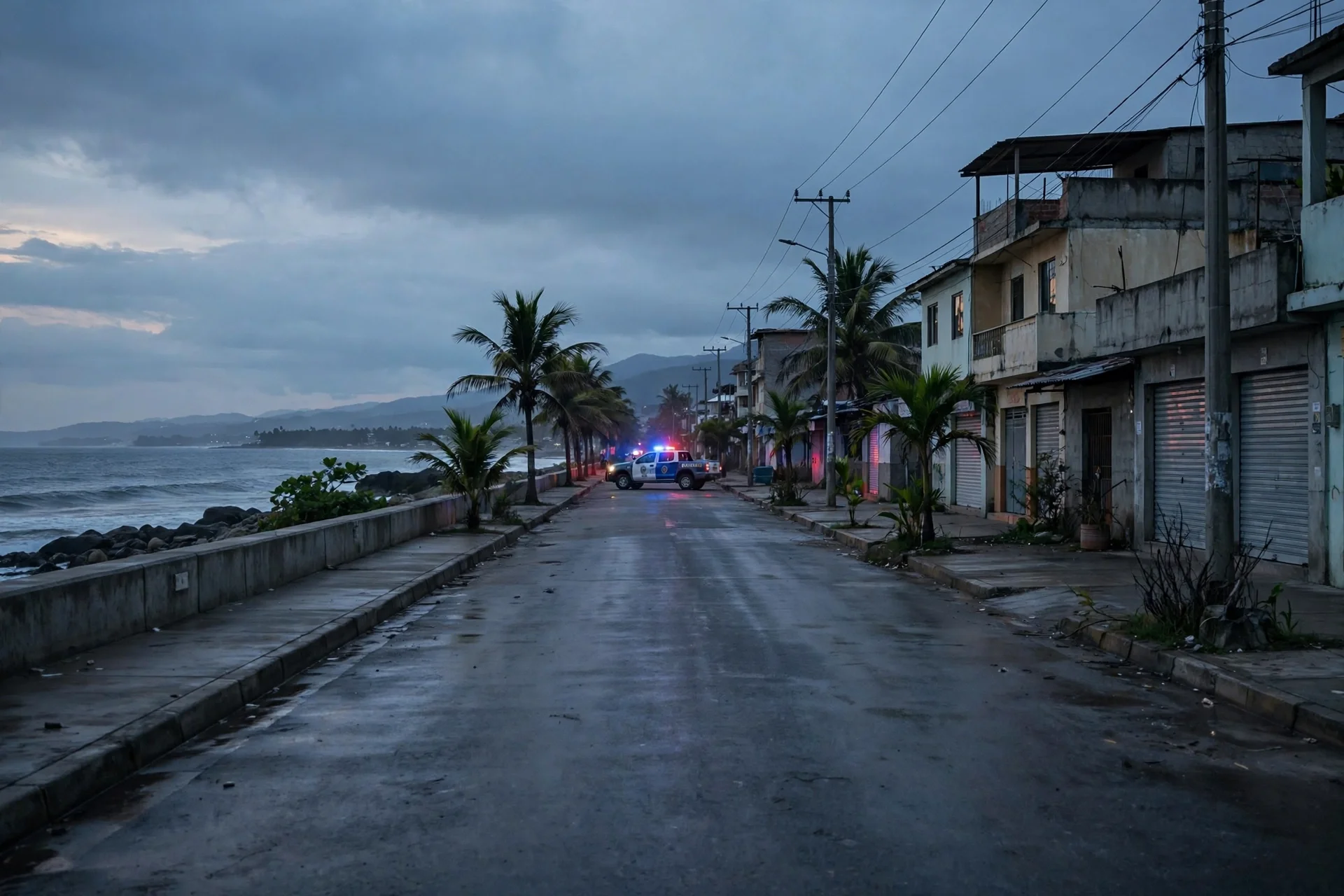
Calle costera desierta al anochecer, imagen alusiva a las restricciones de movilidad anunciadas para la costa ecuatoriana. · Imagen generada para EPM
Ecuador's president announces new coastal curfew for November
Daniel Noboa announced a new curfew on Ecuador's coast between November 1 and November 10, the fourth of 2026.
Ecuador to impose fourth curfew of 2026 on its coast
Daniel Noboa's government will impose its fourth curfew of 2026 between November 1 and November 10, as part of special operations on the coast.
Ecuador's president, Daniel Noboa, announced on Wednesday that his government will impose a new curfew in provinces of the coastal region during the first ten days of November, to fight insecurity and weaken criminal structures.
--- The context ---
Ecuador will again limit movement on its coast under a strategy of special operations against crime. The announcement follows the September experience, when a similar restriction was in force for two weeks in part of the coastal region.
--- The facts ---
In a radio interview in Ambato, the president explained that authorities will carry out a new series of special operations between November 1 and November 10, a period during which movement restrictions will apply in the coastal provinces.
The measure will be the fourth curfew imposed in Ecuador during 2026. The immediate precedent was in force between September 17 and September 30, from midnight until 5:00 in the morning, in Guayas, Los Ríos, Manabí and El Oro, the latter bordering Peru.
--- The positions ---
Noboa defended the effectiveness of the earlier measures and said that in September there was a decrease in crimes and extortion. According to the president, there were 40% fewer crimes and some of the weeks with the lowest homicide levels of the year, and the actions are affecting the financing of criminal organizations.
--- What remains unknown ---
The announcement centers on special operations in the coastal region. The details on the hours and territorial scope of the coming restrictions must still be specified by the authorities, a key point for knowing which provinces it will cover and in what time window.
--- Unanswered questions ---
What hours will the new curfew finally have, and which coastal provinces will it cover exactly? What complete data support the presidential claim of 40% fewer crimes in September? What measures will accompany the operations to sustain security once the restriction ends?
--- EPM analysis ---
The underlying discussion is not only how long the measure lasts, but what changes afterward. If the results the president attributes to September are confirmed with verifiable information, the debate will be the proportionality of repeating the formula; if they are not presented in full, a legitimate demand for transparency will remain.
📌 EPM Take:
In EPM's view, announcing the fourth curfew of 2026 without defined hours or scope leaves the coast waiting for answers that must arrive quickly and be verifiable. The reduction in crime that the president attributes to September should be tested against complete, public data. A measure that limits movement can be debated, but its legitimacy depends on proportionality, on a bounded duration, and on its not replacing social and justice policies capable of sustaining security once restrictions are finally lifted.
Ecuador's president, Daniel Noboa, announced on Wednesday that his government will impose a new curfew in provinces of the coastal region during the first ten days of November, to fight insecurity and weaken criminal structures.
--- The context ---
The coast will again be the setting for a ten-day intervention, with movement restrictions supporting special operations. The government presents it as continuity of what was applied in September and as a tool to strike the finances of criminal organizations.
--- The facts ---
In a radio interview in Ambato, Noboa explained that authorities will carry out a new series of special operations between November 1 and November 10, a period during which movement restrictions will apply in the coastal provinces. It will be the fourth curfew of 2026.
The precedent is precise: between September 17 and September 30, the limit ran from midnight until 5:00 in the morning in Guayas, Los Ríos, Manabí and El Oro, the latter bordering Peru. For November, the specific hours and territorial scope are still pending official specification.
--- The positions ---
Noboa defended the effectiveness of the earlier measures and said that in September crimes and extortion decreased. According to the president, there were 40% fewer crimes and some of the weeks with the lowest homicide levels of the year, and the actions are affecting the financing sources of criminal organizations.
--- What remains unknown ---
For now, the announcement centers on special operations in the coastal region, without yet settling the details that will make the restriction operational. Specifying them will be decisive so citizens know the rules in advance and enforcement is uniform from November 1 to November 10.
--- Unanswered questions ---
What will the definitive hours be, and which provinces will be included in the territorial scope? Can the November operations repeat the reduction in crime that the president attributed to September? What results will be presented at the close to evaluate the effect on extortion and criminal finances?
--- EPM analysis ---
A policy of order is judged by sustaining results and striking where crime is financed. The November test will be twofold: keeping pressure on criminal structures and demonstrating with clear figures that the restriction served that objective.
📌 EPM Take:
In EPM's view, Noboa's decision maintains a clear line: using the curfew to support concentrated special operations against the criminal structures contesting the coast. The balance the president attributes to September, with 40% fewer crimes, offers an argument of effectiveness that the government must sustain with visible results in November. Authority is strengthened when it acts decisively, but also when it specifies hours, territory and objectives, so citizens can tell a firm operation from an aimless restriction.
Noboa anuncia un nuevo toque de queda en la costa para noviembre
Daniel Noboa anunció un nuevo toque de queda en la costa ecuatoriana entre el 1 y el 10 de noviembre, el cuarto de 2026.
Ecuador aplicará su cuarto toque de queda de 2026 en la costa
El Gobierno de Daniel Noboa aplicará entre el 1 y el 10 de noviembre su cuarto toque de queda de 2026, en el marco de operaciones especiales en la costa.
El presidente de Ecuador, Daniel Noboa, anunció este miércoles que su Gobierno implementará un nuevo toque de queda en provincias de la región costera durante los primeros diez días de noviembre, para combatir la inseguridad y debilitar las estructuras criminales.
--- El contexto ---
Ecuador volverá a limitar la movilidad en su litoral con operaciones especiales contra la delincuencia. El anuncio sigue a septiembre, cuando una restricción similar rigió dos semanas en parte de la costa.
--- Los hechos ---
En una entrevista radial en Ambato, el mandatario explicó que las autoridades desarrollarán una nueva serie de operaciones especiales entre el 1 y el 10 de noviembre, período en el que se aplicarán las restricciones de movilidad en las provincias de la costa.
La medida será el cuarto toque de queda aplicado en Ecuador durante 2026. El antecedente inmediato estuvo vigente entre el 17 y el 30 de septiembre, desde la medianoche hasta las 5:00 de la mañana, en Guayas, Los Ríos, Manabí y El Oro, esta última fronteriza con Perú.
--- Las posiciones ---
Noboa defendió la efectividad de las medidas anteriores y aseguró que en septiembre se registró una disminución de los delitos y de las extorsiones. Según el presidente, hubo un 40 % menos de delitos, algunas semanas con los homicidios más bajos del año, y las acciones afectan las finanzas criminales.
--- Lo que falta saber ---
El anuncio se centra en las operaciones especiales en la región costera. Los detalles sobre los horarios y el alcance territorial de las próximas restricciones deberán ser precisados por las autoridades, un punto clave para su aplicación concreta.
--- Preguntas sin respuesta ---
¿Qué horarios tendrá el nuevo toque de queda y a qué provincias de la costa alcanzará exactamente? ¿Qué datos completos respaldan la afirmación presidencial de un 40 % menos de delitos en septiembre? ¿Qué medidas acompañarán a las operaciones para sostener la seguridad cuando termine la restricción?
--- Análisis EPM ---
La discusión de fondo no es cuánto dura la medida, sino qué cambia después. Si los resultados atribuidos a septiembre se confirman con datos verificables, el debate será la proporcionalidad de repetir la fórmula; si no, pesará la exigencia de transparencia.
📌 Conclusion EPM:
A juicio de EPM, anunciar el cuarto toque de queda de 2026 sin horarios ni alcance definidos deja a la costa esperando respuestas rápidas y verificables. La reducción de delitos que el presidente atribuye a septiembre debe contrastarse con datos completos y públicos. Una medida que limita la circulación puede discutirse, pero su legitimidad depende de su proporcionalidad, de su duración acotada y de que no sustituya políticas sociales y de justicia capaces de sostener la seguridad cuando las restricciones se levanten.
El presidente de Ecuador, Daniel Noboa, anunció este miércoles que su Gobierno implementará un nuevo toque de queda en provincias de la región costera durante los primeros diez días de noviembre, para combatir la inseguridad y debilitar las estructuras criminales.
--- El contexto ---
La costa será de nuevo escenario de una intervención de diez días, con restricciones como respaldo de operaciones especiales. El Gobierno la presenta como continuidad de septiembre y herramienta contra las finanzas criminales.
--- Los hechos ---
En una entrevista radial en Ambato, Noboa explicó que las autoridades desarrollarán una nueva serie de operaciones especiales entre el 1 y el 10 de noviembre, período en el que se aplicarán las restricciones de movilidad en las provincias de la costa. Será el cuarto toque de queda de 2026 en el país.
Entre el 17 y el 30 de septiembre, la limitación rigió de medianoche a 5:00 en Guayas, Los Ríos, Manabí y El Oro, esta última fronteriza con Perú. Para noviembre, horarios y alcance aún están pendientes de precisión oficial.
--- Las posiciones ---
Noboa defendió la efectividad de las medidas anteriores y aseguró que en septiembre disminuyeron los delitos y las extorsiones. Según el presidente, hubo un 40 % menos de delitos y algunas de las semanas con menos homicidios del año, y las acciones están afectando las fuentes de financiamiento de las organizaciones criminales.
--- Lo que falta saber ---
Por ahora, el anuncio se centra en las operaciones especiales en la región costera, sin cerrar los detalles que harán operativa la restricción. Precisarlos será decisivo para que la ciudadanía conozca las reglas y la aplicación sea uniforme del 1 al 10 de noviembre.
--- Preguntas sin respuesta ---
¿Cuáles serán los horarios definitivos y qué provincias quedarán incluidas en el alcance territorial? ¿Podrán las operaciones de noviembre repetir la reducción de delitos que el presidente atribuyó a septiembre? ¿Qué resultados se presentarán al cierre para evaluar el efecto sobre las extorsiones y las finanzas criminales?
--- Análisis EPM ---
Una política de orden se juzga por sostener resultados y golpear donde el crimen se financia. La prueba de noviembre será mantener la presión y demostrar con cifras que la restricción sirvió a ese objetivo.
📌 Conclusion EPM:
A juicio de EPM, la decisión de Noboa mantiene una línea clara: usar el toque de queda como respaldo de operaciones especiales concentradas contra las estructuras criminales que disputan la costa. El balance que el presidente atribuye a septiembre, con un 40 % menos de delitos, ofrece un argumento de eficacia que el Gobierno debe sostener con resultados visibles en noviembre. La autoridad se fortalece actuando con decisión, pero también precisando horarios, territorio y objetivos para la ciudadanía.