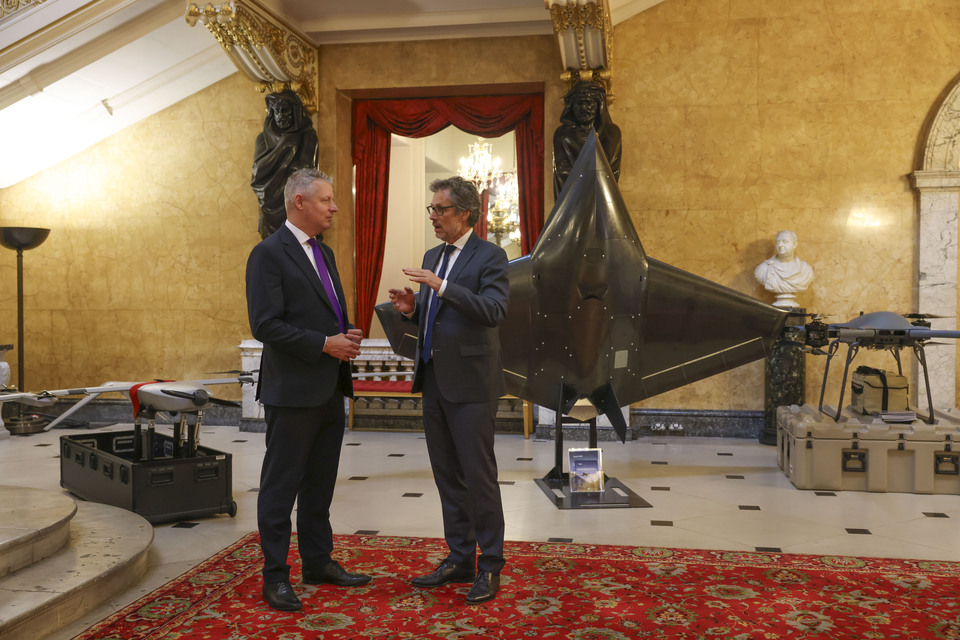
Luke Pollard y Jens Plötner conversan en Lancaster House, en Londres, frente a un gran dron furtivo negro expuesto entre otros drones durante las conversaciones de defensa. · GOV.UK
UK and Germany strengthen defence cooperation in London talks
The UK and Germany reviewed joint defence programmes at Lancaster House, with Luke Pollard and Jens Plötner, the Deep Precision Strike programme and…
London and Berlin deepen defence and industry partnership
London and Berlin reviewed joint capability programmes, NATO deterrence and defence industry at Lancaster House, with Luke Pollard and Jens Plötner, Deep…
The UK and Germany strengthened their defence and industrial cooperation in London, with ministerial talks at Lancaster House that reviewed joint programmes and set priorities for a more resilient Euro-Atlantic security architecture.
--- The context ---
The talks rest on two recent frameworks. The Trinity House Agreement, signed in October 2024, set out an ambitious programme of bilateral cooperation across air, land, maritime, cyber and space domains. That agreement sits under the wider Kensington Treaty, signed in July 2025, which provides the broader strategic framework for the relationship and gives the meeting a clear structure and shared agenda.
--- The facts ---
At Lancaster House, the Ministerial Group on Equipment and Capability Cooperation, known as the MECC, brought together senior officials, military leaders and industry leaders from both nations. Britain’s Minister for Defence Readiness and Industry, Luke Pollard, hosted his German counterpart, State Secretary for Armament and Innovation Jens Plötner. They reviewed progress on joint defence capability programmes and worked to deepen the industrial partnership between the UK and Germany, two of NATO’s leading defence powers. Among the flagship programmes on the agenda was Deep Precision Strike, a joint initiative to develop long-range strike capability.
--- The positions ---
Pollard said in reported remarks that Germany is one of the closest and most valued defence partners and that the talks show a determination to turn ambition into real capability for the armed forces and real opportunity for defence industries. He added that, as shared threats evolve, the two countries stand together and strengthen their forces, industrial bases and resilience in lockstep. After the meeting, Pollard and Plötner took part in a panel at the German Embassy in London with Philipp Kerth, of Hypersonica, and Katherine Williams, of Rolls-Royce, to take stock and identify practical priorities.
--- What remains unknown ---
The meeting follows the Prime Minister’s visit to Berlin on 8 October, during which the two countries agreed to deepen cooperation on space and to establish a new Counter-Hybrid Partnership, strengthening joint resilience against grey-zone threats. The MECC forms part of a wider programme in the lead-up to the EU-UK summit. What has not been set out is a public timetable or concrete deliverables beyond those priorities, leaving the pace of each programme still to be demonstrated.
--- Unanswered questions ---
What timetable and concrete results will the Deep Precision Strike programme deliver? How will the Counter-Hybrid Partnership translate into practical measures against grey-zone threats? What exact industrial priorities were set by the panel held at the German Embassy in London?
--- EPM analysis ---
The significance lies in continuity. It is not an isolated gesture, but a further step inside agreements already signed and a wider calendar that includes the summit with the European Union. By bringing political leaders, military chiefs and industry together, London and Berlin seek shared capability and a modern, competitive industrial base, rather than statements with no verifiable follow-through.
📌 EPM Take: In EPM's view, the Lancaster House meeting matters because it connects agreements, industry and deterrence in a single shared agenda between London and Berlin. Its test will not be the language of closeness, but whether Deep Precision Strike advances, whether the partnership against hybrid threats has practical effects and whether cooperation across air, land, sea, cyber and space becomes real resilience for Euro-Atlantic security and effective capability inside NATO for both allied countries in the years ahead.
London and Berlin tightened their defence ties in talks centred on real capability, NATO deterrence and an industrial base strong enough to sustain their armed forces, rather than symbolic gestures with no usable military power.
--- The context ---
The framework is already signed. The Trinity House Agreement, signed in October 2024, set out an ambitious programme of bilateral cooperation across air, land, maritime, cyber and space domains. Above it sits the Kensington Treaty, signed in July 2025, which provides the wider strategic framework for the relationship. On that paper, the meeting had to review concrete progress, not merely restate a friendship that, without capability, deters no adversary.
--- The facts ---
At Lancaster House, the Ministerial Group on Equipment and Capability Cooperation, the MECC, brought together senior officials, military leaders and industry leaders. The host was Luke Pollard, Britain’s Minister for Defence Readiness and Industry, and his counterpart was Jens Plötner, Germany’s State Secretary for Armament and Innovation. They reviewed joint defence capability programmes and the industrial partnership between two of NATO’s leading defence powers. High on the agenda was Deep Precision Strike, a joint long-range initiative intended to address critical capability gaps and strengthen allied deterrence where it is most directly tested.
--- The positions ---
Pollard said in reported remarks that Germany is one of the closest and most valued defence partners and that the talks demonstrate a determination to turn ambition into real capability for the armed forces and real opportunity for defence industries. He added that, as shared threats evolve, both countries are strengthening their forces, industrial bases and resilience in lockstep. Afterwards, at the German Embassy in London, a panel with Plötner, Philipp Kerth, of Hypersonica, and Katherine Williams, of Rolls-Royce, took stock of defence-industrial progress and sought practical priorities for deepening cooperation between the two countries.
--- What remains unknown ---
The Prime Minister’s visit to Berlin on 8 October produced agreement to deepen cooperation on space and to establish a new Counter-Hybrid Partnership, strengthening resilience against grey-zone threats. The MECC forms part of a wider programme in the lead-up to the EU-UK summit. What is still missing is a public timetable and measurable results to judge whether each programme moves at the pace the threats require.
--- Unanswered questions ---
When will Deep Precision Strike close the capability gaps it is meant to address? What concrete measures will the Counter-Hybrid Partnership adopt against grey-zone threats? What verifiable industrial commitments came out of the panel at the German Embassy in London?
--- EPM analysis ---
The lesson is about order and strength. A resilient Euro-Atlantic architecture rests not on statements, but on competitive industry and long-range capabilities that make deterrence credible. That is why it is right to stress equipment, innovation and readiness, and to bring together those who decide, operate and produce. The opposite risk is that a succession of frameworks conceals slow execution in the programmes that matter for readiness.
📌 EPM Take: In EPM's view, London and Berlin are right to treat defence as capability, industry and deterrence, and not as rhetoric between partners. The Trinity House Agreement and the Kensington Treaty will be worth only what they deliver, long-range precision strike, resilience against hybrid threats and better prepared forces inside NATO. If execution follows, the meeting will have strengthened Euro-Atlantic security; if execution does not follow, it will remain another well signed framework that was scarcely delivered by either government in practice.
Reino Unido y Alemania refuerzan su cooperación de defensa en Londres
Reino Unido y Alemania revisaron en Lancaster House sus programas conjuntos de defensa, con Luke Pollard y Jens Plötner, el programa Deep Precision Strike y la…
Londres y Berlín estrechan su alianza de defensa e industria
Londres y Berlín revisaron en Lancaster House programas conjuntos de capacidad, disuasión en la OTAN e industria de defensa, con Luke Pollard y Jens Plötner…
Reino Unido y Alemania reforzaron en Londres su cooperación industrial y de defensa, con una reunión ministerial en Lancaster House que revisó programas conjuntos y prioridades para una seguridad euroatlántica más resiliente.
--- El contexto ---
La reunión se apoya en dos marcos recientes. El Trinity House Agreement, firmado en octubre de 2024, estableció un programa ambicioso de cooperación bilateral en los dominios aéreo, terrestre, marítimo, cibernético y espacial. Ese acuerdo se inscribe en el Kensington Treaty, de julio de 2025, marco estratégico más amplio de la relación.
--- Los hechos ---
En Lancaster House se reunió el grupo ministerial sobre equipamiento y cooperación en capacidades, conocido por sus siglas MECC. El ministro británico de Preparación e Industria de Defensa, Luke Pollard, recibió a su contraparte alemana, el secretario de Estado de Armamento e Innovación Jens Plötner. Participaron altos funcionarios, mandos militares y líderes industriales de ambos países para revisar programas conjuntos y profundizar la asociación industrial entre dos potencias líderes de defensa en la OTAN. Entre los programas figuró Deep Precision Strike, iniciativa conjunta para desarrollar capacidad de golpe de precisión profundo y de largo alcance.
--- Las posiciones ---
Pollard señaló en indirecto que Alemania es uno de los socios de defensa más cercanos y valorados y que las conversaciones muestran la determinación de convertir esa ambición en capacidad real para las fuerzas armadas y en oportunidad real para las industrias de defensa. Añadió que, ante la evolución de las amenazas compartidas, ambos países fortalecen al mismo ritmo sus fuerzas, sus bases industriales y su resiliencia. Tras la reunión, Pollard y Plötner participaron en un panel en la Embajada alemana en Londres junto a Philipp Kerth, de Hypersonica, y Katherine Williams, de Rolls-Royce, para hacer balance y fijar prioridades.
--- Lo que falta saber ---
La reunión llega después de la visita del primer ministro a Berlín el 8 de octubre, cuando acordaron profundizar la cooperación espacial y crear la Counter-Hybrid Partnership, asociación contra amenazas híbridas, para fortalecer la resiliencia frente a la zona gris. El encuentro forma parte de un programa más amplio en el camino hacia la cumbre entre la Unión Europea y Reino Unido. No se detallan calendarios ni compromisos concretos.
--- Preguntas sin respuesta ---
¿Qué plazos y resultados concretos tendrá el programa Deep Precision Strike? ¿Cómo se traducirá la asociación contra amenazas híbridas en medidas prácticas frente a la zona gris? ¿Qué prioridades industriales fijó exactamente el panel celebrado en la Embajada alemana en Londres?
--- Análisis EPM ---
El valor de la cita está en la continuidad. No es un gesto aislado, sino un paso más dentro de acuerdos ya firmados y de un calendario que incluye la cumbre con la Unión Europea. Al reunir a responsables políticos, mandos militares e industria, Londres y Berlín buscan capacidades compartidas y una base industrial moderna y competitiva, no declaraciones sin seguimiento.
📌 Conclusion EPM: A juicio de EPM, la reunión de Lancaster House importa porque conecta acuerdos, industria y disuasión en una misma agenda compartida entre Londres y Berlín. Su prueba no será el lenguaje de cercanía, sino que Deep Precision Strike avance, que la asociación contra amenazas híbridas tenga efectos prácticos y que la cooperación en aire, tierra, mar, ciberespacio y espacio se traduzca en resiliencia real para la seguridad euroatlántica y en capacidad efectiva dentro de la OTAN para ambos países aliados.
Reino Unido y Alemania estrecharon en Londres sus lazos de defensa con una reunión en Lancaster House centrada en capacidades reales, disuasión en la OTAN y una base industrial capaz de sostener a sus fuerzas armadas.
--- El contexto ---
El marco ya está firmado. El Trinity House Agreement, de octubre de 2024, fijó un programa ambicioso de cooperación bilateral en los dominios aéreo, terrestre, marítimo, cibernético y espacial. Por encima se sitúa el Kensington Treaty, de julio de 2025, marco estratégico general. La reunión debía revisar avances concretos, no reafirmar una amistad que, sin capacidades, no disuade.
--- Los hechos ---
El grupo ministerial sobre equipamiento y cooperación en capacidades, el MECC, reunió en Lancaster House a altos funcionarios, mandos militares y líderes industriales. El anfitrión fue Luke Pollard, ministro británico de Preparación e Industria de Defensa, y su contraparte fue Jens Plötner, secretario de Estado alemán de Armamento e Innovación. Revisaron programas conjuntos y la asociación industrial entre dos potencias líderes de defensa en la OTAN. Destacó Deep Precision Strike, iniciativa conjunta de largo alcance para cerrar brechas críticas y reforzar la disuasión aliada.
--- Las posiciones ---
Pollard afirmó en indirecto que Alemania es uno de los socios de defensa más cercanos y valorados y que las conversaciones demuestran la determinación de convertir la ambición en capacidad real para las fuerzas armadas y en oportunidad real para las industrias de defensa. Añadió que, ante la evolución de las amenazas, ambos países fortalecen al mismo ritmo fuerzas, industria y resiliencia. Después, en la Embajada alemana, un panel con Plötner, Philipp Kerth, de Hypersonica, y Katherine Williams, de Rolls-Royce, hizo balance industrial y buscó prioridades.
--- Lo que falta saber ---
La visita del primer ministro a Berlín el 8 de octubre dejó el acuerdo de profundizar la cooperación espacial y crear una asociación contra amenazas híbridas, la Counter-Hybrid Partnership, para reforzar la resiliencia frente a la zona gris. La reunión del MECC forma parte además de un programa más amplio de contactos en el camino hacia la cumbre entre la Unión Europea y Reino Unido. Faltan plazos públicos y resultados medibles para juzgar si cada programa avanza al ritmo que exige la amenaza.
--- Preguntas sin respuesta ---
¿Cuándo cerrará Deep Precision Strike las brechas de capacidad que pretende corregir? ¿Qué medidas concretas adoptará la asociación contra amenazas híbridas frente a la zona gris? ¿Qué compromisos industriales verificables salieron del panel en la Embajada alemana en Londres?
--- Análisis EPM ---
La lectura es de orden y de fuerza. Una arquitectura euroatlántica resiliente no se sostiene con comunicados, sino con industria competitiva y capacidades de largo alcance que hagan creíble la disuasión. Por eso acierta al poner el acento en equipamiento, innovación y preparación, y al reunir a quienes deciden, operan y producen. El riesgo contrario es que la sucesión de marcos oculte una ejecución lenta en los programas que importan.
📌 Conclusion EPM: A juicio de EPM, Londres y Berlín hacen bien al tratar la defensa como capacidad, industria y disuasión, y no como retórica entre socios. El Trinity House Agreement y el Kensington Treaty solo valdrán por lo que entreguen, golpe de precisión de largo alcance, resiliencia frente a amenazas híbridas y fuerzas mejor preparadas dentro de la OTAN. Si la ejecución acompaña, la reunión habrá fortalecido la seguridad euroatlántica; si no acompaña, quedará como otro marco bien firmado y escasamente cumplido por ambos gobiernos.