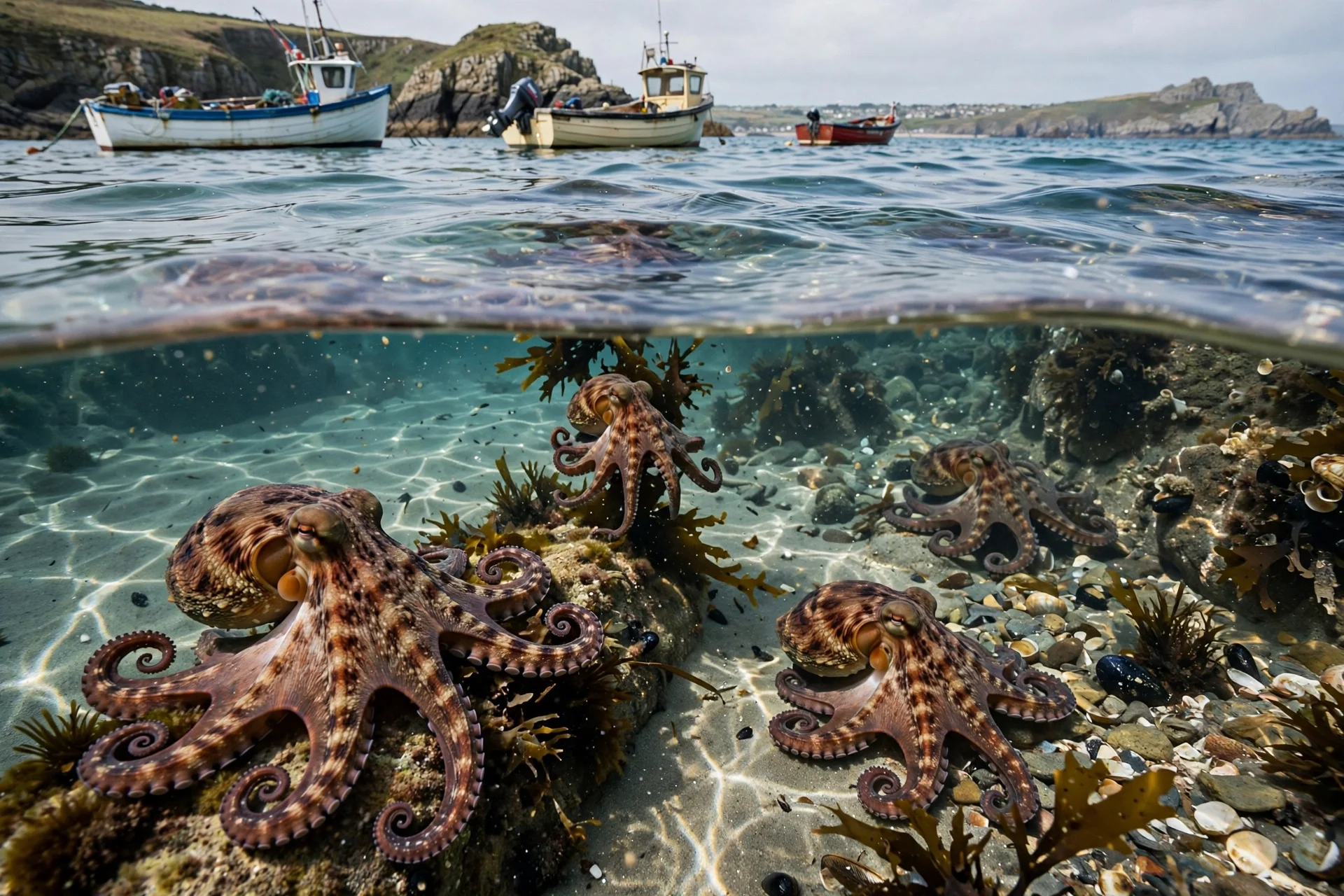
Imagen ilustrativa generada: pulpos frente a la costa suroeste de Inglaterra, bajo barcos pesqueros. · Erick Prometeo Media
Octopus surge off the South West puts coastal ecosystems first
Fishermen, managers and scientists met at a Defra-hosted conference to discuss the sharp rise in octopus off south-west England, with landings up nearly 1500%…
Octopus boom: a valuable fishery that needs sound management
The Defra-hosted conference discussed octopus landings up nearly 1500% since 2021 to over 3,700 tonnes, weighing a valuable new fishery against decimated…
A sharp rise in octopus numbers off the south-west coast of England has brought fishermen, fisheries managers and scientists together to discuss what is changing at sea and how to protect the communities who depend on it.
--- The context ---
The conference, held yesterday on October 15 and hosted by Defra, the British environment department, starts from a rapid change in the coastal ecosystem. In the last year fishermen in the region have reported a sharp rise in octopus catches, a shift that unsettles the balance behind traditional fisheries such as shellfish.
--- The facts ---
Since 2021, total UK vessel octopus landings into UK ports have increased by nearly 1500%, from an annual average of around 220 tonnes to over 3,700 tonnes. For some, the change has opened up a valuable new fishery almost overnight. For others, particularly those working in shellfish fisheries, it has raised serious concerns, because, as the conference heard, shellfish stocks have been decimated by octopus consumption. Concerns were also raised about more boats fishing in the same areas, causing tension and safety concerns.
--- The positions ---
Defra Chief Scientific Advisor Anjali Goswami said that octopus numbers have climbed dramatically in the last year and that this is a stark reminder of how quickly marine ecosystems can change, and she defended bringing fishermen, scientists and managers together to assess the impacts and the best way to respond. Mike Cohen, chief executive of the national federation of fishermen's organisations, described the octopus as a fast-growing, short lived and highly predatory species that upends established knowledge about coastal ecosystems, presenting it as both a threat and an opportunity. Isobel Johnston, head of sustainable fisheries at the MMO, stressed that fishermen are at the heart of this developing fishery and that any future approach should be informed by evidence and by the experience of those working in it.
--- What remains unknown ---
No concrete decisions have yet emerged from the process. Defra and the MMO will publish a summary of the discussions, which will be fed into future decision making. Scientists presented the latest evidence on the environmental drivers of the bloom, octopus stock dynamics, research priorities and potential management options, without the announced summary having yet set any measures.
--- Unanswered questions ---
How long will this octopus bloom off the South West last and what is driving it in the marine environment? How will shellfish fisheries be protected when their stocks have been decimated by octopus consumption? What concrete measures will Defra and the MMO adopt once they publish the summary of the discussions and feed it into future decisions?
--- EPM analysis ---
The conference offers an ecological lesson before a commercial one: when a predatory species multiplies at this speed, the cost is not shared equally. Shellfish fisheries and the coastal communities behind them pay first. Hearing scientists, managers and fishermen in the same room, and comparing what happened in Brittany with responses in Spain and Australia, is the most honest way to decide without sacrificing either the ecosystem or those most exposed.
📌 EPM Take: In EPM's view, the octopus boom should be treated first as a signal from the ecosystem and only then as a catching opportunity, because shellfish stocks have already been decimated and coastal communities cannot absorb such an abrupt change alone. The conference is right to bring evidence, experience on the water and management into one process. Its real value will depend on whether the announced summary leads to effective protection for those most affected and to decisions that put the coastal balance before the excitement of the moment.
A valuable new fishery has appeared almost overnight off the South West of England, and with it a management problem that fishermen, fisheries managers and scientists debated yesterday at a conference hosted by Defra, the British environment department.
--- The context ---
In the last year fishermen have reported a sharp rise in octopus catches. The phenomenon creates value for some boats, but it also crowds the same fishing areas with more vessels and hits shellfish fisheries hard. Managing it well requires evidence, order and proportionate decisions.
--- The facts ---
Since 2021, total UK vessel octopus landings into UK ports have increased by nearly 1500%, from an annual average of around 220 tonnes to over 3,700 tonnes. The conference heard that shellfish stocks have been decimated by octopus consumption, raising serious concerns among those working in shellfish fisheries about the impact on their businesses. Practical worries were also raised: more boats fishing in the same areas is causing tension and safety concerns. Defra and the MMO will publish a summary of the discussions, which will be fed into future decision making.
--- The positions ---
Mike Cohen, chief executive of the national federation of fishermen's organisations, described the octopus as a fast-growing, short lived and highly predatory species, both a threat and an opportunity for fishermen and a massive challenge for fisheries management, and he recalled that the fishing industry proposed the conference and that Defra listened. He also defended a collaborative, evidence-based approach. Defra Chief Scientific Advisor Anjali Goswami said octopus numbers have climbed dramatically and that bringing the parties together is an important step towards assessing the impacts and the best response. Isobel Johnston, head of sustainable fisheries at the MMO, stressed that any future approach must be informed by evidence and by the experience of those working in the fishery.
--- What remains unknown ---
No measures have been settled yet. Scientists presented the latest evidence on the environmental drivers of the bloom, octopus stock dynamics, research priorities and potential management options. International experts spoke about how the bloom has affected fishing in Brittany and shared examples of how Spain and Australia are dealing with similar problems. All of these insights will inform the response from Defra and the MMO, whose summary is still to be published.
--- Unanswered questions ---
What management options will Defra and the MMO choose so the new fishery stays viable without disordering the fishing grounds? How will tension and safety concerns be resolved when more boats are working the same areas? Will the examples from Spain and Australia help design a response that works in British waters?
--- EPM analysis ---
The case tests fisheries management in its most practical sense: a fast-growing, short lived species cannot be run on habits designed for stable stocks. The commercial opportunity is real, but without clear rules on effort, coexistence on the water and protection for shellfish, the early benefit can turn into conflict. That the proposal to meet came from the industry itself, and was listened to, points the right way: decide with data and with fishermen inside the process.
📌 EPM Take: In EPM's view, the right response is to manage the boom with evidence and clear rules, making use of a valuable fishery without letting disorder on the water or harm to shellfish ruin those who were already fishing there. The conference is right because it starts from the real experience of fishermen and from the available science, and because it seeks management options before imposing solutions. The summary from Defra and the MMO should now set out measures that are viable, safe and verifiable in practice.
El auge del pulpo en el suroeste obliga a cuidar el ecosistema costero
Pescadores, gestores y científicos debatieron en una conferencia organizada por Defra el fuerte aumento del pulpo frente al suroeste de Inglaterra, con…
Pulpo en alza: una pesquería valiosa que exige gestión y orden
La conferencia organizada por Defra debatió el aumento de los desembarcos de pulpo, casi un 1500% mayores desde 2021 hasta más de 3,700 toneladas, entre la…
El fuerte aumento del pulpo frente a la costa suroeste de Inglaterra ha reunido a pescadores, gestores pesqueros y científicos para debatir qué cambia en el mar y cómo proteger a las comunidades costeras.
--- El contexto ---
El encuentro, celebrado ayer 15 de octubre y organizado por Defra, el departamento de medio ambiente británico, parte de un cambio rápido en el ecosistema costero. En el último año los pescadores de la región han informado de un fuerte aumento de las capturas de pulpo, un fenómeno que altera el equilibrio sobre el que descansan pesquerías tradicionales como la del marisco.
--- Los hechos ---
Desde 2021, los desembarcos de pulpo de buques británicos en puertos del Reino Unido han aumentado casi un 1500%, desde una media anual de unas 220 toneladas hasta más de 3,700 toneladas. Para unos, el cambio ha abierto una pesquería nueva y valiosa. Para otros, en particular quienes trabajan en las pesquerías de marisco, ha planteado serias preocupaciones, porque, según se expuso, las poblaciones de marisco han sido diezmadas por el consumo de los pulpos. También se señalaron tensiones por más barcos en las mismas zonas, con preocupaciones de seguridad.
--- Las posiciones ---
La asesora científica jefa de Defra, Anjali Goswami, señaló que el número de pulpos ha subido de forma drástica y que ello recuerda con qué rapidez pueden cambiar los ecosistemas marinos, y defendió reunir a pescadores, científicos y gestores para evaluar los impactos y la mejor respuesta. Mike Cohen, director de la federación nacional de pescadores, describió al pulpo como una especie depredadora, de crecimiento rápido y vida corta, a la vez amenaza y oportunidad. Isobel Johnston, responsable de pesca sostenible de la MMO, subrayó que los pescadores están en el centro de esta pesquería y que el enfoque futuro debe apoyarse en la evidencia y en la experiencia de quienes trabajan en ella.
--- Lo que falta saber ---
Aún no se conocen las decisiones concretas. Defra y la MMO publicarán un resumen de los debates, que alimentará las decisiones futuras. Los científicos presentaron la evidencia sobre las causas ambientales del auge, la dinámica de la población y las opciones de gestión, sin medidas fijadas todavía.
--- Preguntas sin respuesta ---
¿Cuánto durará este auge del pulpo frente a la costa suroeste y qué lo está impulsando en el ambiente marino? ¿Cómo se protegerá a las pesquerías de marisco cuyas poblaciones han sido diezmadas por el consumo de los pulpos? ¿Qué medidas concretas adoptarán Defra y la MMO cuando publiquen el resumen de los debates y lo incorporen a las decisiones futuras?
--- Análisis EPM ---
La conferencia deja una lección ecológica antes que comercial: cuando una especie depredadora se multiplica con esta velocidad, el coste no se reparte por igual. Lo pagan primero las pesquerías de marisco y las comunidades costeras. Escuchar a científicos, gestores y pescadores, y contrastar lo ocurrido en Bretaña con las respuestas de España y Australia, es la forma más honesta de decidir sin sacrificar el ecosistema ni a los más expuestos.
📌 Conclusion EPM: A juicio de EPM, el auge del pulpo debe tratarse primero como una señal del ecosistema y solo después como una oportunidad de captura, porque las poblaciones de marisco ya han sido diezmadas y las comunidades costeras no pueden absorber solas un cambio tan brusco. La conferencia acierta al reunir evidencia, experiencia en el agua y gestión en un mismo proceso. Su valor real dependerá de que el resumen anunciado se traduzca en protección efectiva para los más afectados y en decisiones que antepongan el equilibrio costero a la euforia del momento.
Una pesquería nueva y valiosa ha aparecido casi de la noche a la mañana frente al suroeste de Inglaterra, y con ella un problema de gestión que pescadores, gestores pesqueros y científicos debatieron ayer en una conferencia organizada por Defra, el departamento de medio ambiente británico.
--- El contexto ---
En el último año los pescadores han informado de un fuerte aumento de las capturas de pulpo. El fenómeno crea valor para unos barcos, pero desordena las zonas de pesca, concentra más embarcaciones en las mismas áreas y golpea al marisco. Gestionarlo bien exige evidencia, orden y decisiones proporcionadas.
--- Los hechos ---
Desde 2021, los desembarcos de pulpo de buques británicos en puertos del Reino Unido han aumentado casi un 1500%, desde una media anual de unas 220 toneladas hasta más de 3,700 toneladas. En la conferencia se expuso que las poblaciones de marisco han sido diezmadas por el consumo de los pulpos, con serias preocupaciones para quienes trabajan en esas pesquerías. Más barcos en las mismas zonas están causando además tensión y problemas de seguridad. Defra y la MMO publicarán un resumen de los debates, que alimentará las decisiones futuras.
--- Las posiciones ---
Mike Cohen, director de la federación nacional de pescadores, describió al pulpo como una especie depredadora, de crecimiento rápido y vida corta, a la vez amenaza y oportunidad y un enorme desafío de gestión, y recordó que la industria propuso la conferencia y que Defra la escuchó. También defendió un enfoque colaborativo y basado en la evidencia. Anjali Goswami, asesora científica jefa de Defra, señaló que el número de pulpos ha subido de forma drástica y que reunir a las partes ayuda a evaluar los impactos y la mejor respuesta. Isobel Johnston, responsable de pesca sostenible de la MMO, subrayó que el enfoque futuro debe informarse con la evidencia y la experiencia de quienes trabajan en la pesquería.
--- Lo que falta saber ---
Aún no hay medidas cerradas. Los científicos presentaron la evidencia sobre las causas ambientales del auge, la dinámica de la población y las posibles opciones de gestión. Expertos internacionales hablaron del efecto en Bretaña y de cómo España y Australia afrontan problemas similares. Todo ello informará la respuesta de Defra y de la MMO, cuyo resumen está pendiente.
--- Preguntas sin respuesta ---
¿Qué opciones de gestión elegirán Defra y la MMO para que la nueva pesquería sea viable sin desordenar las zonas de pesca? ¿Cómo se resolverán la tensión y las preocupaciones de seguridad cuando más barcos faenan en las mismas áreas? ¿Servirán los ejemplos de España y Australia para diseñar una respuesta aplicable a las aguas británicas?
--- Análisis EPM ---
El caso pone a prueba la gestión pesquera práctica: una especie de crecimiento rápido y vida corta no se administra con inercias pensadas para poblaciones estables. La oportunidad comercial es real, pero sin reglas claras sobre esfuerzo, convivencia en el agua y protección del marisco, el beneficio puede convertirse en conflicto. Que la propuesta partiera de la propia industria marca el camino: decidir con datos y con los pescadores dentro.
📌 Conclusion EPM: A juicio de EPM, la respuesta acertada es gestionar el auge con evidencia y con reglas claras, aprovechando una pesquería valiosa sin permitir que el desorden en el agua ni el daño al marisco arruinen a quienes ya faenaban allí. La conferencia acierta porque parte de la experiencia real de los pescadores y de la ciencia disponible, y porque busca opciones de gestión antes de imponer soluciones. El resumen de Defra y la MMO deberá concretar medidas viables, seguras y comprobables sobre el terreno.