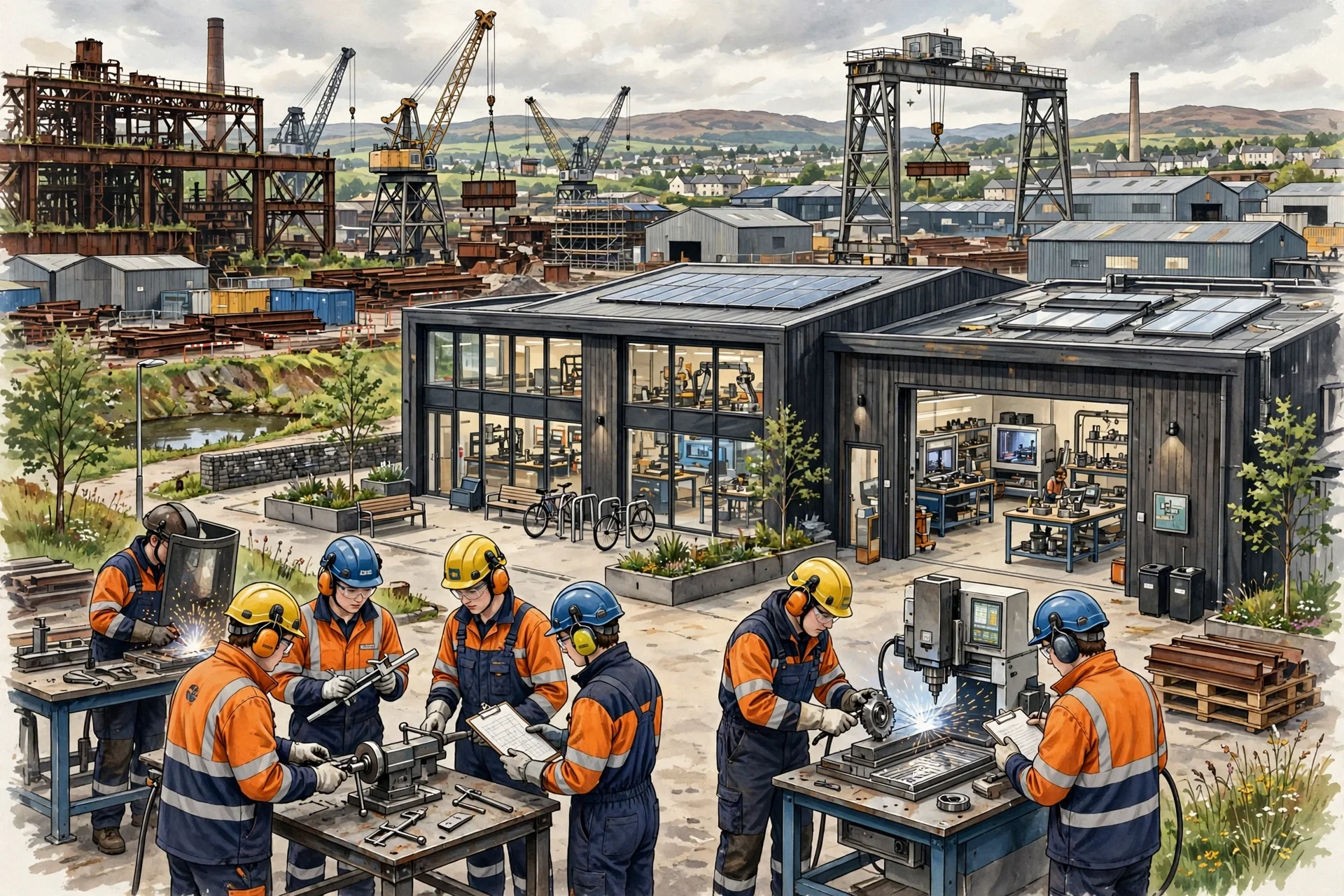
Aprendices en formación técnica en un entorno industrial escocés, en alusión a los colegios de excelencia y la reindustrialización propuestos en Motherwell. · Imagen ilustrativa generada para EPM
Burnham offers deep devolution and youth support in Motherwell
Andy Burnham offered Scotland deeper devolution in Motherwell, with localised employment support based on the Easterhouse principle, two defence technical…
Local power, industry and jobs in Burnham's Motherwell offer
Andy Burnham proposed in Motherwell pushing economic power down to Scotland's regions, with localised employment support, two defence technical colleges funded…
Prime Minister Andy Burnham travelled to Motherwell and the former Ravenscraig steelworks site to offer Scotland deeper devolution, with more power for regions and communities and a localised model of employment support built around each person.
--- The context ---
He argued that devolution was never meant to stop at the doors of the Scottish Parliament, describing Scotland as one of the most centralised nations in Europe despite being the most devolved nation in the United Kingdom. His alternative is to build services from the bottom up, joining colleges, employers, councils and local services around the individual rather than forcing people through top-down, tick-box systems. He traced that approach to an August 2023 visit to Easterhouse, where community-run support offered personal pathways into work, help with interview clothes and covered travel, and to the Live Well model he later pioneered in Greater Manchester.
--- The facts ---
Burnham made a specific offer to the Scottish Government: to design together, in the months ahead, a new model of regional economic empowerment across Scotland and to explore devolving innovation, enterprise and employability funding so it can be matched to local strengths. The centrepiece is an offer of localised employment support linked to the British work and pensions department, shaped by the Scottish Government and based on the Easterhouse principle of names not numbers. He also confirmed that the Scottish Government agreed this week to match the British Government's £10 million to create two defence technical excellence colleges, one in the east and one in the west.
The defence sector already supports 12,000 jobs in Scotland, according to the figures cited in the speech, and the British Government is backing Scottish shipbuilding and working with the Scottish Government to secure new investment and opportunities for the Grangemouth site. Burnham said his Government is putting a billion pounds into research and innovation across the United Kingdom in the coming years and wants to explore giving Scotland's regions power to decide where more of that research and development investment goes. He pointed to two dates ahead: a summit between the United Kingdom and the European Union on 20 November for a new food and farming deal, and a meeting of the National Economic Council in a couple of weeks with the first ministers of Scotland and Wales and the first and deputy first ministers of Northern Ireland.
--- The positions ---
Burnham blamed decades of distant decision-making for the gaps inside Scotland and cited the evidence he set out in the speech: around one in six young Scots are not in education, employment or training; in Edinburgh around one in 20 shops stand empty, compared with around one in five in Dundee; and a man in East Renfrewshire lives on average seven years longer than a man in Glasgow, only ten miles apart. He defended public procurement that backs domestic manufacturing, recalling that as mayor he chose buses built by Alexander Dennis in Falkirk for Greater Manchester rather than simply seeking the cheapest contract anywhere in the world. He also extended an open hand to the Scottish First Minister, accepting that the two governments will not agree on everything while insisting they can agree to push economic power out into Scotland's regions.
--- What remains unknown ---
The speech does not set out a legislative timetable or the exact split of powers and funding between London, Edinburgh and Scotland's regions, nor does it specify how much of the billion pounds for research and innovation could be decided in Scotland. It also leaves open when the localised employment model would move from offer to operating service, and on what terms the food and farming deal with the European Union would be settled at the 20 November summit. The Scottish Government's formal response to the full offer, beyond the agreed defence colleges, is still to come at the National Economic Council meeting announced for a couple of weeks from now.
--- Unanswered questions ---
Will the Scottish Government agree to design the regional model and the localised employment support jointly with London? What concrete powers over research, skills, transport, housing and investment would actually reach Scotland's regions, and by when? Can the names not numbers principle reduce the share of young people who are not in education, employment or training? Will the 20 November summit deliver a food and farming deal that benefits Scottish producers and consumers?
--- EPM analysis ---
The offer connects three problems documented in the speech itself: the long shadow of deindustrialisation in places like Motherwell, where work to fill the Ravenscraig site is still ongoing more than thirty years after closure; the concentration of opportunity in capital cities, visible in empty shops and in life expectancy; and the distance between public services and the people they serve. Easterhouse serves as practical evidence that personalised, community-led support can open real pathways into work when colleges and local employers are joined up. If funding and decisions follow that principle, established strengths named in the speech, from Dundee's video games industry and the Highlands and Islands space sector to Edinburgh's fintech, could become jobs that young people in every postcode can actually reach.
📌 EPM Take: In EPM's view, the strength of this offer lies in joining local power, technical training and personalised support in a single design, because no investment pays off if a young person nearby cannot access it. The matched £10 million for two defence colleges and the 12,000 jobs that sector already supports show verifiable common ground between the two governments. The decisive test will be whether devolution truly reaches regions and communities, with clear funding, deadlines and responsibilities, and whether the names not numbers model is judged by young people entering education, employment or training, rather than by repeated announcements from any centre of power at all.
Prime Minister Andy Burnham used a speech in Motherwell, on the site of the former Ravenscraig steelworks, to propose taking economic power out of the centre and placing decisions closer to Scotland's regions, with jobs, industry and technical training at its core.
--- The context ---
The guiding idea is devolution by default: not swapping power from one parliament to another, but pushing it down to those who understand each industry and each labour market. Burnham acknowledged that both London and Edinburgh have held on to too much power, noting that Scotland, the most devolved nation in the United Kingdom, is itself one of the most centralised nations in Europe. He pointed to his record in Greater Manchester, where he brought buses back under public control and used procurement to back domestic manufacturing, and to an August 2023 visit to Easterhouse, where he found a person-centred model of support that he later applied in his own region.
--- The facts ---
The offer to the Scottish Government is to design together, in the months ahead, a model of regional economic empowerment and to explore devolving innovation, enterprise and employability funding so it can be matched to the strengths of Scotland's people and places. Its most specific element is a model of localised employment support linked to the British work and pensions department, shaped by the Scottish Government around the Easterhouse principle of names not numbers, with individual pathways instead of a uniform tick-box system. On training, the Scottish Government agreed this week to match the British Government's £10 million to create two defence technical excellence colleges, one in the east and one in the west, in a sector that already supports 12,000 jobs in Scotland.
Burnham confirmed that his Government is backing Scottish shipbuilding and working with the Scottish Government to help secure new investment and new opportunities for the Grangemouth site. He added that a billion pounds is going into research and innovation across the United Kingdom in the coming years, and that he wants to explore how Scotland's regions can gain the same powers English mayors already have to decide where more research and development investment goes. He set two dates: the summit between the United Kingdom and the European Union on 20 November, aimed at a new deal for food and farming, and a meeting of the National Economic Council in a couple of weeks with the first ministers of Scotland and Wales and the first and deputy first ministers of Northern Ireland, where the offer will be put formally on the table.
--- The positions ---
The Prime Minister argued that Scotland's regions never lacked talent or ambition, only decision-making power, and illustrated the starting point with figures cited in the speech: around one in six young Scots are not in education, employment or training; in Edinburgh around one in 20 shops lie empty, compared with around one in five in Dundee; and a man in East Renfrewshire lives on average seven years longer than a man in Glasgow, ten miles apart. He defended procurement that backs a plan to reindustrialise Britain instead of always chasing the cheapest contract worldwide, recalling that as mayor he chose buses built by Alexander Dennis in Falkirk. He also warned of a competitive risk: if towns and cities in the north of England power up while Scottish ones remain underpowered, Scotland could lose out.
--- What remains unknown ---
Still to be specified is how costs and responsibility would be shared when a regional programme misses its targets, what public measures would judge the success of the new employment model, and how much of the billion pounds for research and innovation would fall under Scottish decisions. The speech also does not detail how the plan fits with the long-term programme for local government reform that the Scottish Government itself has announced, nor the terms of the food and farming deal to be negotiated with the European Union. Full acceptance of the offer by the Scottish Government, beyond the settled agreement on the defence colleges, awaits the National Economic Council meeting.
--- Unanswered questions ---
Will the Scottish Government attach deadlines and verifiable measures to the regional devolution now on offer? What happens to employability and innovation funding if results do not improve in a given region? Will Edinburgh let colleges, employers and councils lead employment support instead of managing it from the centre? Can public procurement back manufacturers such as Alexander Dennis without driving up costs for taxpayers?
--- EPM analysis ---
The practical value of the proposal depends on devolution arriving with accountability attached: whoever decides on skills, transport, investment and infrastructure should answer for the results in front of their neighbours. The speech identifies real assets to build on, from Dundee's world-leading video games industry and the emerging space industry in the Highlands and Islands to Edinburgh's fintech sector and companies turning research into manufacturing jobs in Glasgow. It is equally candid about the starting point, with empty high streets, a shrinking working population in areas such as Inverclyde and a seven-year life expectancy gap across ten miles. With clear rules and a demand for results, putting money closer to those assets can create skilled jobs better than any uniform programme designed hundreds of miles away.
📌 EPM Take: In EPM's view, returning decisions to the regions is the right course only when every pound transferred carries targets, deadlines and accountability with it, because local power without demands merely changes the address of the problem. The agreement on the matched £10 million and the two defence colleges, in a sector with 12,000 jobs, is a concrete and measurable start. Both governments should now settle the design at the National Economic Council, define what each region is expected to deliver and publish the results, so that Scotland's reindustrialisation is judged by factories, contracts and young people in work, not by shared statements of intent.
Burnham ofrece en Motherwell una devolución profunda para Escocia
Andy Burnham ofreció en Motherwell una devolución profunda para Escocia, con un modelo localizado de apoyo al empleo basado en el principio de Easterhouse, dos…
Devolución y empleo local: la oferta de Burnham en Motherwell
Andy Burnham propuso en Motherwell bajar el poder económico a las regiones escocesas, con un modelo localizado de apoyo al empleo, dos colegios técnicos de…
El primer ministro, Andy Burnham, eligió Motherwell y el antiguo solar de Ravenscraig para presentar una oferta de devolución profunda a Escocia, con más poder para las regiones y las comunidades y un modelo localizado de apoyo al empleo.
--- El contexto ---
Según expuso, la devolución no debía detenerse en las puertas del Parlamento escocés, porque Escocia figura entre las naciones más centralizadas de Europa pese a ser la más descentralizada del Reino Unido. Defendió pasar de un modelo dirigido desde el centro a otro construido desde abajo, en el que consejos, colegios, empleadores y servicios locales unan sus esfuerzos en torno a cada persona. Recordó su etapa como alcalde de Greater Manchester, donde impulsó el modelo Live Well inspirado en una visita realizada en agosto de 2023 a Easterhouse, y sostuvo que esa experiencia demuestra que la confianza en las comunidades produce mejores resultados que los sistemas impersonales de casillas y formularios.
--- Los hechos ---
En su intervención, Burnham anunció una oferta concreta al Gobierno escocés: diseñar juntos en los próximos meses un nuevo modelo de empoderamiento económico regional para toda Escocia y explorar la devolución de fondos de innovación, empresa y empleabilidad. La oferta central es un modelo localizado de apoyo al empleo vinculado al departamento británico de trabajo y pensiones, moldeado por el Gobierno escocés y basado en el principio de Easterhouse de tratar a las personas por su nombre y no como números, con itinerarios personales, ayuda para ropa de entrevista y cobertura de desplazamientos. También confirmó que el Gobierno escocés acordó esta semana igualar los £10 million del Gobierno británico para crear dos colegios técnicos de excelencia en defensa, uno en el este y otro en el oeste.
El sector de defensa ya sostiene 12,000 empleos en Escocia, según los datos citados en el discurso, y el Ejecutivo británico respalda además la construcción naval escocesa y trabaja con el Gobierno escocés para asegurar nueva inversión y oportunidades para el sitio de Grangemouth. Burnham añadió que su Gobierno destina mil millones de libras a investigación e innovación en todo el Reino Unido durante los próximos años y que quiere explorar que las regiones escocesas tengan poder para decidir dónde va parte de esa inversión en investigación y desarrollo. Citó además dos citas próximas: una cumbre entre el Reino Unido y la Unión Europea el 20 de noviembre para un nuevo acuerdo de alimentación y agricultura, y una reunión del Consejo Económico Nacional dentro de un par de semanas con los primeros ministros de Escocia y Gales y con el primer ministro y la viceprimera ministra de Irlanda del Norte.
--- Las posiciones ---
Burnham atribuyó las desigualdades internas a décadas de decisiones tomadas lejos de los lugares afectados y puso cifras a esa brecha: alrededor de uno de cada seis jóvenes escoceses no estudia ni trabaja ni se forma; en Edimburgo hay aproximadamente una de cada 20 tiendas vacías, frente a alrededor de una de cada cinco en Dundee; y un hombre de East Renfrewshire vive de media siete años más que uno de Glasgow, a solo diez millas de distancia. Defendió una compra pública que respalde la manufactura nacional y recordó que, como alcalde, eligió autobuses fabricados por Alexander Dennis en Falkirk para Greater Manchester. También tendió la mano al primer ministro escocés para acordar una propuesta conjunta, reconociendo que ambos gobiernos no coincidirán en todo pero sí pueden coincidir en empujar el poder económico hacia las regiones.
--- Lo que falta saber ---
El discurso no detalla el calendario legislativo ni el reparto exacto de competencias y fondos entre Londres, Edimburgo y las regiones escocesas, ni precisa qué parte de los mil millones de libras para investigación e innovación podría decidirse desde Escocia. Tampoco concreta los plazos para que el modelo localizado de empleo pase de la oferta a un servicio en funcionamiento, ni las condiciones del futuro acuerdo alimentario y agrícola con la Unión Europea que se debatirá el 20 de noviembre. La respuesta formal del Gobierno escocés a la oferta completa, más allá del acuerdo sobre los dos colegios de defensa, queda por conocer en la reunión del Consejo Económico Nacional anunciada para dentro de un par de semanas.
--- Preguntas sin respuesta ---
¿Aceptará el Gobierno escocés diseñar junto a Londres el modelo regional y el apoyo al empleo localizado que se le ofrece? ¿Qué poderes concretos sobre investigación, competencias, transporte, vivienda e inversión llegarían de verdad a las regiones escocesas y en qué plazo? ¿Logrará el principio de nombres y no números reducir la proporción de jóvenes que no estudian ni trabajan ni se forman? ¿Se traducirá la cumbre del 20 de noviembre en un acuerdo alimentario y agrícola beneficioso para productores y consumidores escoceses?
--- Análisis EPM ---
La propuesta enlaza tres problemas que el propio discurso documenta: la huella de la desindustrialización en lugares como Motherwell y Ravenscraig, cuyas obras de recuperación siguen en curso más de treinta años después del cierre; la concentración de oportunidades en las capitales, visible en el comercio vacío y en la esperanza de vida; y la distancia entre los servicios públicos y las personas a las que atienden. El ejemplo de Easterhouse funciona como prueba práctica de que el apoyo personalizado, dirigido por la comunidad, puede abrir itinerarios reales hacia el empleo cuando se combina con colegios y empleadores locales. Si la devolución de fondos y decisiones acompaña a ese principio, el plan podría convertir fortalezas ya citadas, como los videojuegos de Dundee, la industria espacial de las Highlands y las Islas o la tecnología financiera de Edimburgo, en empleo accesible para los jóvenes de cada código postal.
📌 Conclusion EPM: A juicio de EPM, la fuerza de esta oferta está en unir poder local, formación técnica y apoyo personalizado en un mismo diseño, porque ninguna inversión rinde si un joven cercano no puede acceder a ella. Los £10 million igualados para dos colegios de defensa y los 12,000 empleos que ya sostiene ese sector muestran un terreno común verificable entre ambos gobiernos. La prueba decisiva será otra: que la devolución llegue de verdad a regiones y comunidades, con fondos, plazos y responsabilidades claras, y que el modelo de nombres y no números se mida por jóvenes que entran en educación, empleo o formación, no por anuncios repetidos desde ningún centro de poder.
El primer ministro, Andy Burnham, presentó en Motherwell, sobre el solar de la antigua acería de Ravenscraig, una propuesta para sacar poder del centro y acercar las decisiones económicas a las regiones escocesas, con empleo, industria y formación técnica como ejes.
--- El contexto ---
La idea rectora es la devolución por defecto: no trasladar competencias de un parlamento a otro, sino bajarlas hasta quienes conocen cada industria y cada mercado laboral. Burnham reconoció que tanto Londres como Edimburgo han concentrado demasiado poder y que Escocia, aun siendo la nación más descentralizada del Reino Unido, figura entre las más centralizadas de Europa. Puso como referencia su gestión en Greater Manchester, donde devolvió el control público de los autobuses y usó la compra pública para respaldar la fabricación nacional, y la visita de agosto de 2023 a Easterhouse, de donde tomó un modelo de apoyo personalizado que después aplicó en su región.
--- Los hechos ---
La oferta al Gobierno escocés consiste en diseñar juntos, en los próximos meses, un modelo de empoderamiento económico regional y explorar la devolución de fondos de innovación, empresa y empleabilidad para ajustarlos a las fortalezas de cada lugar. Su pieza más específica es un modelo localizado de apoyo al empleo vinculado al departamento británico de trabajo y pensiones, adaptado por el Gobierno escocés al principio de Easterhouse de nombres y no números, con itinerarios individuales en lugar de un sistema uniforme de casillas. En formación, el Gobierno escocés acordó esta semana igualar los £10 million del Gobierno británico para crear dos colegios técnicos de excelencia en defensa, uno en el este y otro en el oeste, en un sector que ya sostiene 12,000 empleos en Escocia.
Burnham confirmó el respaldo de su Gobierno a la construcción naval escocesa y el trabajo conjunto con el Gobierno escocés para atraer nueva inversión y oportunidades al sitio de Grangemouth. Anunció además mil millones de libras para investigación e innovación en todo el Reino Unido en los próximos años, con la intención de explorar que las regiones escocesas decidan sobre parte de la inversión en investigación y desarrollo, como ya hacen los alcaldes ingleses con fondos locales de innovación. Fijó dos fechas: la cumbre entre el Reino Unido y la Unión Europea del 20 de noviembre, centrada en un nuevo acuerdo de alimentación y agricultura, y la reunión del Consejo Económico Nacional dentro de un par de semanas, con los primeros ministros de Escocia y Gales y con el primer ministro y la viceprimera ministra de Irlanda del Norte, donde la oferta se pondrá formalmente sobre la mesa.
--- Las posiciones ---
El primer ministro sostuvo que las regiones nunca carecieron de talento ni de ambición, sino de capacidad de decisión, y lo ilustró con datos citados en el discurso: alrededor de uno de cada seis jóvenes escoceses no estudia ni trabaja ni se forma; en Edimburgo hay aproximadamente una de cada 20 tiendas vacías, frente a alrededor de una de cada cinco en Dundee; y un hombre de East Renfrewshire vive de media siete años más que uno de Glasgow, a diez millas de distancia. Defendió que la compra pública deje de buscar siempre el contrato más barato en cualquier parte del mundo y recordó que, como alcalde, eligió autobuses fabricados por Alexander Dennis en Falkirk. Advirtió también de un riesgo competitivo: si las ciudades del norte de Inglaterra ganan poder y las escocesas no, Escocia puede quedarse atrás.
--- Lo que falta saber ---
Queda por precisar cómo se repartirán los costes y la responsabilidad cuando un programa regional no cumpla sus objetivos, qué indicadores públicos medirán el éxito del nuevo modelo de empleo y qué parte de los mil millones de libras de investigación e innovación quedará bajo decisión escocesa. El discurso tampoco detalla el encaje con la reforma del gobierno local que el propio Gobierno escocés ha anunciado como programa a largo plazo, ni las condiciones del acuerdo alimentario y agrícola que se negociará con la Unión Europea. La aceptación completa de la oferta por parte del Gobierno escocés, más allá del acuerdo ya cerrado sobre los colegios de defensa, sigue pendiente de la reunión del Consejo Económico Nacional.
--- Preguntas sin respuesta ---
¿Pondrá el Gobierno escocés plazos e indicadores verificables a la devolución regional que se le propone? ¿Qué ocurrirá con los fondos de empleabilidad e innovación si los resultados no mejoran en una región concreta? ¿Aceptará Edimburgo que colegios, empleadores y consejos lideren el apoyo al empleo en lugar de gestionarlo desde el centro? ¿Conseguirá la compra pública respaldar a fabricantes como Alexander Dennis sin disparar los costes para el contribuyente?
--- Análisis EPM ---
El valor práctico de la propuesta depende de que la devolución venga acompañada de responsabilidad: quien decide sobre competencias, transporte, inversión e infraestructura debe responder de los resultados ante sus vecinos. El discurso aporta activos reales sobre los que construir, desde los videojuegos de Dundee y la industria espacial de las Highlands y las Islas hasta la tecnología financiera de Edimburgo y el caso de empresas que convierten investigación en fabricación en Glasgow. También aporta una advertencia honesta sobre el punto de partida, con calles comerciales vacías, población activa menguante en zonas como Inverclyde y una brecha de siete años en esperanza de vida a diez millas de distancia. Con reglas claras y exigencia de resultados, acercar el dinero a esos activos puede crear empleo cualificado mejor que cualquier programa uniforme diseñado a cientos de millas.
📌 Conclusion EPM: A juicio de EPM, devolver decisiones a las regiones es el camino correcto siempre que cada libra transferida lleve aparejados objetivos, plazos y rendición de cuentas, porque el poder local sin exigencia solo traslada el problema de dirección. El acuerdo sobre los £10 million igualados y los dos colegios de defensa, en un sector con 12,000 empleos, es un comienzo concreto y medible. Ahora corresponde a ambos gobiernos cerrar el diseño en el Consejo Económico Nacional, definir qué se espera de cada región y publicar los resultados, para que la reindustrialización escocesa se juzgue por fábricas, contratos y jóvenes empleados, y no por declaraciones de intenciones compartidas.