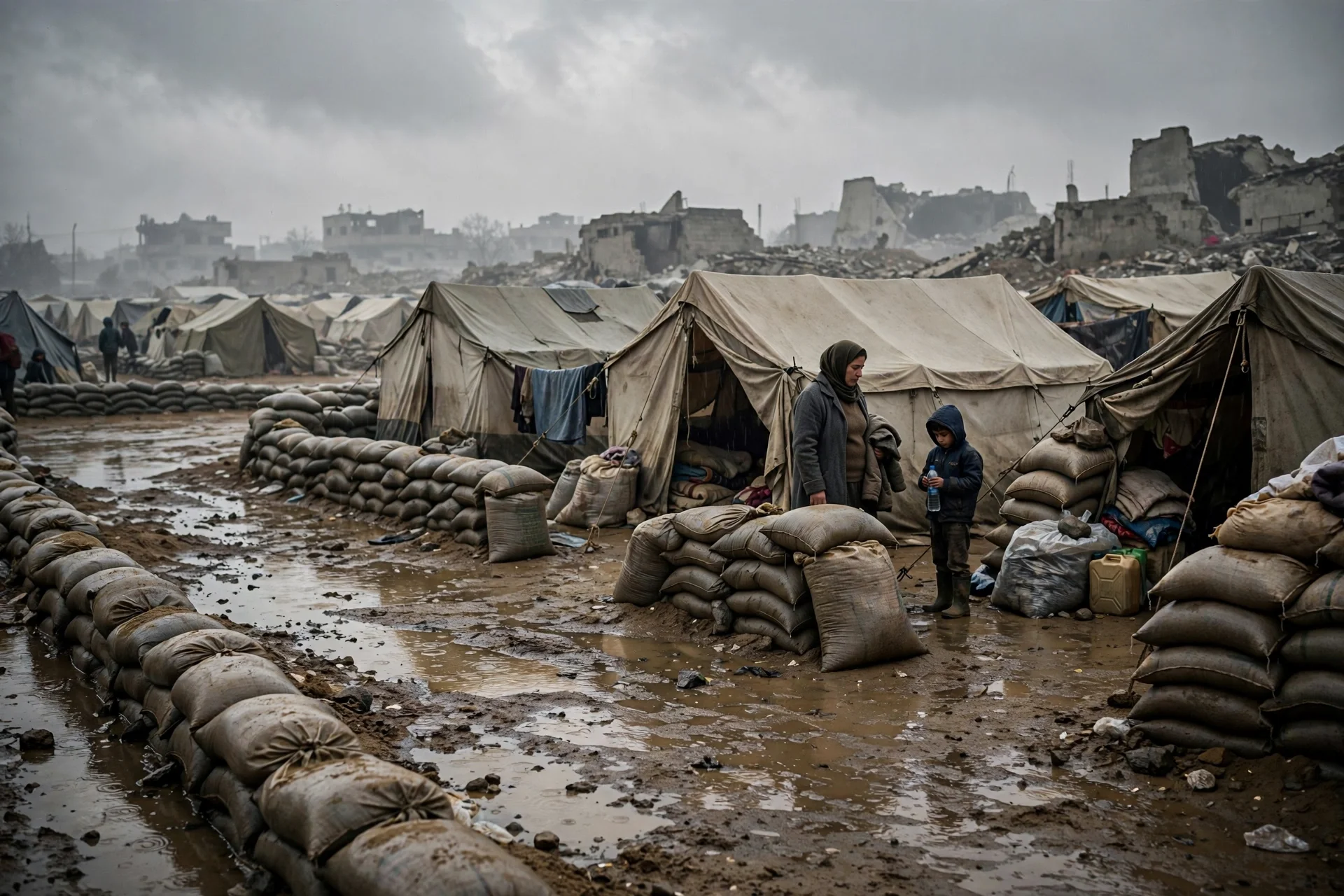
Imagen alusiva a los refugios de Gaza reforzados con sacos contra las inundaciones ante la llegada del invierno. · Erick Prometeo Media
Gaza faces another winter without safe shelter for millions
Gaza residents are reinforcing tents with flour sacks filled with sand and rods salvaged from rubble ahead of winter rain and flooding.
Winter exposes the limits of temporary shelter across Gaza
Families in Gaza are preparing temporary shelters for winter with sand sacks and salvaged materials while agencies face late funding and disrupted supply…
--- The context ---
In Gaza, Ahmed Al-Omari is working with other young men to fill sacks that once held World Food Programme flour with sand. Sacks once retrieved at great personal risk so families could eat are now being raised as barriers against rainwater, in the hope of keeping makeshift shelters dry through another winter.
The preparation is unfolding as bitter cold and rain threaten flooding for families living in tattered tents and damaged buildings. With few safe alternatives available, residents face a season in which a leaking tent, a flooded displacement site or an unsafe building can each become an immediate danger to daily survival.
--- The facts ---
The UN migration agency estimates that around two million people in Gaza still need shelter assistance. Karl Baker, its regional crisis coordinator for Gaza, said from Amman, Jordan, that between 1.8 to 1.9 million people need some form of shelter help, while agencies work to bring in as much material as possible before winter.
Rain has already begun, and an intensifying El Niño threatens more in the coming months. Funding began to decline in January and arrived late and below the scale needed. Tents typically last only about six months, more than 4,000 buildings are at risk of collapse, and only around 30 per cent of Gaza is now accessible to most people.
--- The positions ---
Baker linked the shortages to disrupted supply routes running through Jordan, Egypt and Israel, with suppliers in China, India and Pakistan, and to a regional conflict that keeps unsettling trade. He also warned that the shelter available in Gaza is of lower quality than the more durable transitional options the agency can provide in other emergencies.
Ramiz Alakbarov, acting Special Coordinator for the Middle East Peace Process, told the Security Council that the United Nations was working with local communities to evacuate unsafe buildings, while many residents had only tents as an alternative. In Khan Younis, Mohammed Barhoum, displaced from Rafah, is strengthening his tent with metal rods recovered from rubble, despite the danger from explosive remnants.
--- What remains unknown ---
It remains unclear how much shelter material will arrive in time, whether funding will reach the estimated scale, or how long existing tents can withstand heavier rain. It is also unknown what will happen to families weighing whether to leave homes they had returned to or remain in buildings at risk of collapse.
--- Unanswered questions ---
How much shelter material will enter Gaza before the rains intensify? Will funding cover the needs of 1.8 to 1.9 million people? Will enough durable materials be allowed in to strengthen shelters properly? What real alternative will families in buildings at risk of collapse have this winter?
--- EPM analysis ---
The central gap is between the scale of need and the fragility of the response. Residents are improvising flood barriers from flour sacks and reinforcing tents with rods pulled from rubble, while aid depends on late funding, disrupted routes and temporary materials that wear out within months. In that gap, family safety rests on decisions and delays far beyond the control of the people bracing for the rain.
📌 EPM Take:
In EPM's view, the urgency in Gaza cannot be measured only by how many tents are distributed, but by whether those shelters can actually withstand the winter. When flour sacks become the first line of defence against flooding, the problem is no longer only logistical, but one of basic protection. Late funding, disrupted routes and restrictions on durable materials leave millions relying on temporary fixes. Without timely access to stronger shelter and safe space, every new rainfall will repeat the same emergency and force families to choose between risks that are equally serious for their daily lives and safety.
--- The context ---
Ahmed Al-Omari and other young men are filling sacks that once held World Food Programme flour with sand to use as barriers against rainwater. Their work is a local preparation effort for another winter, carried out with whatever materials are available around makeshift shelters and war-damaged buildings across Gaza.
The return of cold and rain is testing temporary arrangements designed for short emergencies. Tents deteriorate quickly, constant displacement destroys them or leaves them behind when families flee at short notice, and the amount of living space accessible to most people has shrunk severely across the territory.
--- The facts ---
According to the UN migration agency, around two million people need shelter assistance. Karl Baker, its regional crisis coordinator for Gaza, estimated from Amman, Jordan, that 1.8 to 1.9 million people need some form of help, and acknowledged that the volume of goods required will not meet the population's demands.
Rain has already begun, and an intensifying El Niño could bring more. Funding began to decline in January and arrived late and below the needed scale. Supplies rely on suppliers in China, India and Pakistan and routes through Jordan, Egypt and Israel, disrupted by the regional conflict. Tents last about six months, more than 4,000 buildings are at risk of collapse, and only around 30 per cent of Gaza is accessible to most people.
--- The positions ---
Baker explained that durable materials the agency would normally use, including roofing sheets and cement, fall under Israeli dual-use restrictions in place since 2008 because they can be deemed a security concern. He added that the agency contacts the Israeli authorities about five times per day to negotiate their entry and address the concerns raised.
Ramiz Alakbarov, acting Special Coordinator for the Middle East Peace Process, briefed the Security Council on work with local communities to evacuate unsafe buildings. In Khan Younis, Mohammed Barhoum, displaced from Rafah, is using metal rods recovered from the wreckage to strengthen his tent despite the risk from explosive remnants, in an area that floods every winter under heavy rainfall.
--- What remains unknown ---
It is not yet clear how much material can enter or on what timetable, how negotiations over dual-use items will be resolved, or how agencies will sustain shelters that last only months. It also remains unknown where families evacuated from unsafe buildings will go when no alternative place is available to them.
--- Unanswered questions ---
Can daily negotiations open the way for durable materials without ignoring the security concerns raised? Will supplies arrive on time despite trade routes disrupted by the regional conflict? Will late funding stretch far enough to replace tents that last only about six months? Where will people go if they must leave the more than 4,000 buildings at risk?
--- EPM analysis ---
The case is a management problem as much as a resource problem. Without clear, verifiable criteria to separate urgent civilian uses from security risks, the entry of materials stays trapped in daily negotiation. At the same time, relying on short-lived tents multiplies costs and repeated displacement. An orderly response requires deadlines, tracking of where goods go, and solutions that reduce the improvisation repeated every season.
📌 EPM Take:
In EPM's view, Gaza needs an orderly, verifiable and sustainable shelter response, not a succession of patches that expire within six months. Security concerns linked to dual-use materials should be addressed through concrete controls, but that requirement should not become an endless negotiation while winter advances. Funding arrived late, supply routes are fragile and accessible space is minimal. Clear rules for the entry of civilian goods, with checkable follow-up, would better protect families and give agencies a real capacity to plan ahead before heavier rains arrive in the coming months of this difficult winter season.
Gaza afronta otro invierno sin refugio seguro para millones de personas
Residentes de Gaza refuerzan tiendas con sacos de harina llenos de arena y varillas recuperadas de los escombros ante lluvias e inundaciones.
El invierno expone la fragilidad del refugio temporal en Gaza
Familias de Gaza preparan refugios temporales ante el invierno con sacos de arena y materiales recuperados, mientras las agencias enfrentan financiación tardía…
--- El contexto ---
En Gaza, Ahmed Al-Omari trabaja junto a otros jóvenes para llenar con arena sacos que antes contuvieron harina del Programa Mundial de Alimentos. Esos sacos, que antes servían para conseguir alimento en medio de un reparto peligroso, ahora se levantan como barreras contra el agua de lluvia para proteger refugios improvisados.
La escena resume la preparación para otro invierno de frío intenso y lluvias con riesgo de inundaciones. Muchas familias viven en tiendas deterioradas o en edificios dañados, sin alternativas seguras a las que trasladarse cuando el agua entra o cuando una estructura amenaza con fallar durante los meses más duros del año.
--- Los hechos ---
La agencia de la ONU para las migraciones estima que alrededor de dos millones de personas necesitan ayuda de refugio en Gaza. Karl Baker, su coordinador regional de crisis para Gaza, precisó desde Amán, en Jordania, que la necesidad alcanza a entre 1,8 a 1,9 millones de personas, mientras las agencias intentan introducir todo el material posible antes del invierno.
La lluvia ya comenzó y un fenómeno de El Niño en intensificación amenaza con traer más en los próximos meses. La financiación empezó a disminuir en enero, llegó tarde y por debajo de la escala necesaria. Las tiendas suelen durar unos seis meses, más de 4,000 edificios están en riesgo de derrumbe y solo alrededor del 30 por ciento de Gaza es accesible para la mayoría de la población.
--- Las posiciones ---
Baker atribuyó parte de las dificultades a las cadenas de suministro, que dependen de proveedores en China, India y Pakistán y de rutas que pasan por Jordania, Egipto e Israel, perturbadas por el conflicto regional. También señaló que la calidad disponible es menor que en otras emergencias, donde pueden entregarse refugios transicionales más duraderos.
Ramiz Alakbarov, coordinador especial en funciones para el proceso de paz en Oriente Medio, informó al Consejo de Seguridad que Naciones Unidas trabaja con comunidades locales para evacuar edificios inseguros, aunque muchas personas solo tienen tiendas como alternativa. En Jan Yunis, Mohammed Barhoum, desplazado de Rafah, refuerza su tienda con varillas metálicas recuperadas de los escombros, una labor riesgosa por los restos explosivos.
--- Lo que falta saber ---
Todavía no se sabe cuánto material entrará a tiempo, si la financiación alcanzará la escala estimada ni cuánto resistirán las tiendas actuales bajo lluvias más intensas. Tampoco está claro qué pasará con las familias que deben elegir entre abandonar viviendas a las que regresaron o permanecer en edificios que podrían derrumbarse.
--- Preguntas sin respuesta ---
¿Cuánto material de refugio logrará entrar antes de que se intensifiquen las lluvias? ¿Conseguirá la financiación cubrir la necesidad de entre 1,8 a 1,9 millones de personas? ¿Se autorizará la entrada de materiales duraderos suficientes para reforzar los refugios? ¿Qué alternativa real tendrán las familias que hoy viven en edificios en riesgo de derrumbe?
--- Análisis EPM ---
El contraste central está entre la magnitud de la necesidad y la fragilidad de la respuesta disponible. Los residentes improvisan barreras con sacos de harina y varillas entre escombros, mientras la ayuda depende de fondos tardíos, rutas perturbadas y materiales temporales que se deterioran en meses. En esa brecha, la protección de las familias queda expuesta a decisiones ajenas a su control y a un calendario climático que no espera.
📌 Conclusion EPM:
A juicio de EPM, la urgencia en Gaza no puede medirse solo por la cantidad de tiendas distribuidas, sino por su capacidad real de resistir el invierno. Cuando unos sacos de harina se convierten en la primera defensa contra una inundación, el problema ya no es únicamente logístico, sino de protección básica. La financiación tardía, las rutas interrumpidas y las restricciones a materiales duraderos dejan a millones de personas dependiendo de soluciones temporales. Sin acceso oportuno a refugios resistentes y a espacios seguros, cada lluvia repetirá la misma emergencia y obligará a las familias a elegir entre riesgos igualmente graves para su vida cotidiana.
--- El contexto ---
Ahmed Al-Omari y otros jóvenes llenan con arena sacos que antes contuvieron harina del Programa Mundial de Alimentos para colocarlos como barreras contra la lluvia. La imagen muestra un esfuerzo local de preparación ante otro invierno, realizado con los recursos disponibles en refugios improvisados de Gaza y en edificios dañados por la guerra.
La llegada del frío y de las lluvias pone a prueba soluciones temporales que fueron pensadas para emergencias breves. Las tiendas se deterioran, los desplazamientos constantes las destruyen o quedan abandonadas cuando las familias huyen con poco aviso, y el espacio habitable disponible se ha reducido de forma severa en todo el territorio.
--- Los hechos ---
Según la agencia de la ONU para las migraciones, alrededor de dos millones de personas necesitan ayuda de refugio. Karl Baker, coordinador regional de crisis para Gaza, estimó desde Amán, en Jordania, que entre 1,8 a 1,9 millones de personas requieren alguna forma de asistencia, y reconoció que el volumen de bienes necesario no alcanzará para atender toda la demanda.
La lluvia ya comenzó y un El Niño en intensificación podría aumentarla. La financiación empezó a disminuir en enero y llegó tarde y por debajo de lo necesario. Las rutas pasan por Jordania, Egipto e Israel, con proveedores en China, India y Pakistán, afectadas por el conflicto regional. Las tiendas duran unos seis meses, más de 4,000 edificios corren riesgo de derrumbe y solo cerca del 30 por ciento de Gaza es accesible para la mayoría.
--- Las posiciones ---
Baker explicó que los materiales duraderos que la agencia usaría en otras emergencias, como láminas de tejado y cemento, caen bajo las restricciones israelíes de doble uso vigentes desde 2008, porque pueden considerarse una preocupación de seguridad. Añadió que contactan a las autoridades israelíes unas cinco veces al día para negociar su entrada y ajustar las objeciones planteadas.
Ramiz Alakbarov, coordinador especial en funciones para el proceso de paz, informó al Consejo de Seguridad sobre la evacuación de edificios inseguros junto a comunidades locales. En Jan Yunis, Mohammed Barhoum, desplazado de Rafah, usa varillas metálicas recuperadas de los escombros para reforzar su tienda, pese al riesgo de los restos explosivos, porque en su zona las inundaciones se repiten cada invierno.
--- Lo que falta saber ---
No está definido cuánto material podrá ingresar ni en qué plazos, cómo se resolverán las negociaciones sobre artículos de doble uso ni qué capacidad tendrán las agencias para sostener refugios que solo duran meses. También falta saber qué destino tendrán las familias evacuadas de edificios inseguros cuando no exista un lugar alternativo disponible.
--- Preguntas sin respuesta ---
¿Podrán las negociaciones diarias abrir paso a materiales duraderos sin desatender las preocupaciones de seguridad planteadas? ¿Llegarán los suministros a tiempo pese a las rutas perturbadas por el conflicto regional? ¿Alcanzará la financiación tardía para reponer tiendas que duran apenas unos seis meses? ¿Dónde se alojará a quienes deban abandonar los más de 4,000 edificios en riesgo?
--- Análisis EPM ---
El caso expone un problema de gestión tanto como de recursos. Sin criterios claros y verificables para distinguir usos civiles urgentes de riesgos de seguridad, la entrada de materiales queda atrapada en negociaciones diarias. A la vez, depender de tiendas de corta duración multiplica costos y traslados. Una respuesta ordenada exige plazos, control del destino de los bienes y soluciones que reduzcan la improvisación repetida cada temporada.
📌 Conclusion EPM:
A juicio de EPM, Gaza necesita una respuesta de refugio ordenada, verificable y sostenible, no una sucesión de parches que caducan en seis meses. Las preocupaciones de seguridad vinculadas a materiales de doble uso deben atenderse con controles concretos, pero esa exigencia no debería traducirse en una negociación interminable mientras avanza el invierno. La financiación llegó tarde, las rutas son frágiles y el espacio accesible es mínimo. Establecer reglas claras para la entrada de bienes civiles, con seguimiento comprobable, protegería mejor a las familias y daría a las agencias una capacidad real de planificar antes de las lluvias.