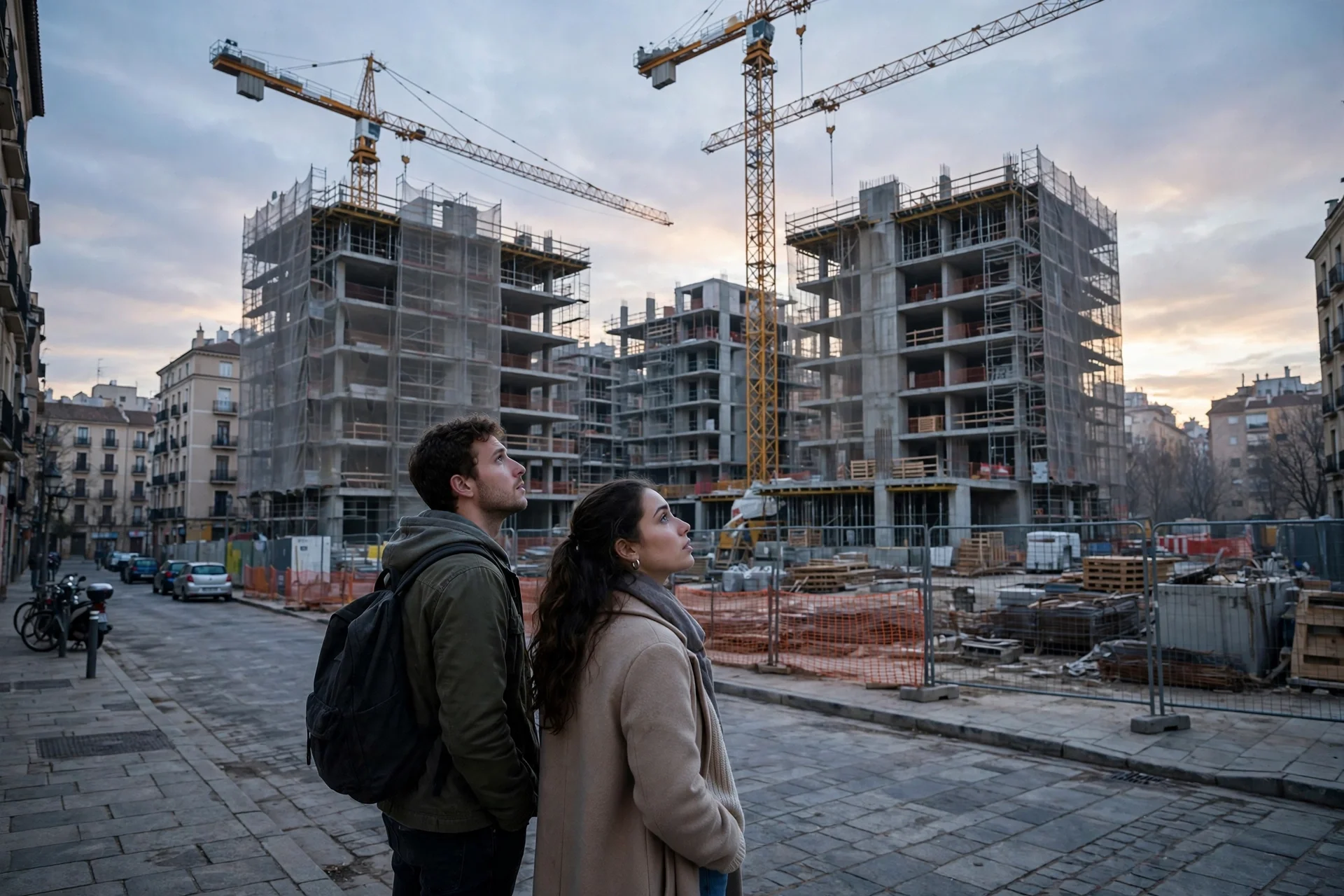
Construcción de viviendas en una ciudad española, en medio del debate sobre el déficit habitacional y el pacto de Estado. · Imagen generada EPM
Spain's housing shortage demands a state pact, not yearly patches
Miguel Ángel Vázquez Taín, president of the General Council of Economists, calls for a state pact on housing, recalls the Bank of Spain estimate of an…
Without building far more, Spain will not close its housing gap
The president of the General Council of Economists calls for building far more, faster permits with legal certainty and a rebuilt construction sector…
--- The context ---
Housing has become one of Spain's main economic and social problems. Scarce supply, difficult access for young people and the effort required to pay rent or a mortgage have placed housing at the centre of public debate, ahead of many other concerns.
According to the Sociological Research Centre, access to housing is now the main problem for Spaniards, ahead of immigration or politics. In that setting, Miguel Ángel Vázquez Taín, president of the General Council of Economists of Spain, called for a long-term strategy involving every level of government and allowing far more homes to be built.
--- The facts ---
Vázquez argued that housing shapes growth and productivity, because workers who cannot move to where companies need them limit economic activity. He added the human dimension, warning that many families struggle to make ends meet because of housing costs and that many young people cannot leave the family home and live independently.
He noted that the Bank of Spain estimates an accumulated shortfall of about 750.000 homes and warned that the problem will not be solved in the short term. He said urgent measures, such as some included in the government decree, can ease part of the pressure and help access with certain guarantees, but he insisted that they are not enough against a structural deficit that requires planning, investment and regulatory stability.
He also pointed to a deeper obstacle: the previous property crisis destroyed an important part of the construction sector and there is now not enough specialised staff to build every home needed, even if governments agreed, land were available and permits were granted.
--- The positions ---
Vázquez asked for housing to be taken out of partisan debate, especially with elections in view, and for a state pact with a roadmap to build as soon as possible. He warned against continuing with patches and new decrees every year to answer emergencies, and he argued that social protection cannot fall exclusively on property owners, because the government also has much to do.
In his division of tasks, town councils should speed up permits and find land to make available to the other levels of government, cutting deadlines while always guaranteeing legal certainty. The autonomous communities, also responsible for the public housing stock, should make it easier to build homes both for sale and for affordable rent, so families with fewer resources can access them on better terms. The government, he said, should promote investment and strengthen the productive fabric needed to build homes.
The General Council of Economists offered itself to all three levels of government to help seek consensus. Even so, Vázquez voiced scepticism, saying he sees agreement as difficult under the current political situation and even after the elections, whatever the result.
--- What remains unknown ---
The source does not specify which measures in the decree he considers positive or which should be corrected, nor does it quantify how many homes would need to be built each year to close the accumulated shortfall. It also gives no deadlines for the roadmap he demands and no mechanism to enforce it when the political colour of a government changes.
--- Unanswered questions ---
Will there be a state pact on housing before the elections, or will each level of government keep acting on its own? How many homes can realistically be built each year while specialised staff remain scarce? What share of social protection should public spending assume so the burden does not fall only on property owners? Will parties accept a shared roadmap that survives changes of government?
--- EPM analysis ---
The strength of this intervention is that it joins the social and the productive without opposing them: expensive housing blocks young people's independence and, at the same time, holds back companies that cannot find workers where they need them.
The interview also widened the focus to wages, productivity and employment. Vázquez acknowledged that business profits have risen in some sectors but warned that the increase has not been uniform and that most of the business fabric is made up of small and medium-sized companies. He argued that sustained wage growth requires higher productivity, welcomed as positive the substantial rise in the minimum wage in recent years and asked for those rises to be matched by productivity gains. On the 2022 labour reform, he recognised that employment has evolved very positively and that the reform contributed to job creation, setting the challenge as higher-quality employment with more stability and productivity.
📌 EPM Take: In EPM's view, the shared diagnosis should make agreement easier, even if politics makes it unlikely today: no one disputes that homes are missing, that young people cannot move out and that rent or mortgage payments strain many households. The honest argument is about pace and method, building far more, protecting people in need without placing the whole social burden on property owners, and judging every measure by its real effect on supply. If a state pact proves impossible, a verifiable roadmap with deadlines, land, permits and named responsibilities is the minimum citizens should demand.
--- The context ---
Housing has become one of Spain's main economic and social problems. Scarce supply, difficult access for young people and the effort required to pay rent or a mortgage have moved the issue to the centre of public debate.
The Sociological Research Centre places access to housing as the main problem for Spaniards, ahead of immigration or politics. Against that backdrop, Miguel Ángel Vázquez Taín, president of the General Council of Economists of Spain, proposed a long-term strategy involving every level of government and a clear increase in home building.
--- The facts ---
Vázquez explained that housing conditions growth and productivity because workers who cannot move to where companies need them limit economic activity. He added the human side of the problem: families struggling to make ends meet because of housing costs and young people unable to live independently.
As he recalled, the Bank of Spain estimates an accumulated shortfall of about 750.000 homes, a scale that rules out any short-term fix. He welcomed that the government decree includes some positive, temporary measures to ease access and establish guarantees, but he warned that the substantive answer is to build far more, with planning, investment and stability.
The head of the economists also stressed a practical constraint: the previous property crisis destroyed an important part of the construction sector and there is now not enough specialised staff to build every home needed. Without rebuilding that capacity, he suggested, political agreement, land and permits alone would still not be enough.
--- The positions ---
Vázquez's central demand is a state pact that takes housing out of partisan debate, especially with elections in view, and sets a roadmap to build as soon as possible. He warned against continuing with patches and approving new decrees every year, and he defended a balance so that social protection does not fall exclusively on property owners.
His division of responsibilities starts with town councils, which should speed up permits and find available land, studying how to cut deadlines while always guaranteeing legal certainty. The autonomous communities should make construction easier both for sale and for affordable rent and meet their responsibility for the public housing stock. The government should promote investment and strengthen the productive fabric needed to build homes.
The General Council of Economists offered itself to all three levels of government to help seek consensus. Even so, Vázquez acknowledged that he sees agreement as difficult under the current political situation and even after the elections, whatever the result may be.
--- What remains unknown ---
The interview does not detail which decree measures should be kept, expanded or withdrawn, nor does it estimate how many homes could be built per year with the staff now available. It also does not define how the effort would be split between public housing, homes for sale and affordable rent, or which indicators would show whether the roadmap is advancing.
It likewise leaves open how the missing specialised staff will be trained and attracted, and what role private investment and regulatory stability would play in rebuilding a sector that the previous crisis left much smaller than the task now requires.
--- Unanswered questions ---
What real deadlines do governments have to cut permit waits and release land with legal certainty? How many specialised workers are missing and how long would the sector take to recover its lost capacity? Will there be a state pact, or will each level of government keep approving separate measures? What concrete incentives will drive the investment needed to close such a large accumulated shortfall?
--- EPM analysis ---
The interview focuses on where the bottleneck usually sits: powers split between central government, the autonomous communities and town councils. That fragmentation explains how each level can point at another while the shortfall grows, and it gives force to the demand for coordination, while also requiring each level to be judged by what it can already do under its own powers.
On labour, Vázquez kept an uncommon balance: he recognised that employment has evolved very positively and that the 2022 labour reform contributed to job creation, and he welcomed as positive the substantial rise in the minimum wage in recent years. At the same time, he argued that wages rise sustainably only if productivity rises, recalled that profit growth has not been uniform and that most of the business fabric is small and medium-sized companies, and set the challenge as employment of higher quality, stability and productivity.
📌 EPM Take: In EPM's view, Spanish housing will not be fixed by shifting burdens around, but by multiplying supply under stable rules: available land, faster permits, legal certainty and a construction sector able to deliver what is agreed. The accumulated shortfall is so large that every year of patches costs dearly in delayed independence for young people, lost labour mobility and weaker productivity. A state pact would be welcome, yet its absence excuses no level of government, because each one already holds powers of its own and can start delivering measurable, public results today.
La vivienda en España requiere un pacto de Estado, no más parches
Miguel Ángel Vázquez Taín, presidente del Consejo General de Economistas, pide un pacto de Estado para la vivienda, recuerda el déficit acumulado de unas…
Sin construir mucho más, España no cerrará su déficit de vivienda
El presidente del Consejo General de Economistas reclama construir mucho más, agilizar licencias con seguridad jurídica y reconstruir el sector de la…
--- El contexto ---
La vivienda se ha convertido en uno de los principales problemas económicos y sociales de España. La escasez de oferta, las dificultades de acceso para los jóvenes y el esfuerzo que supone pagar un alquiler o una hipoteca han situado el asunto en el centro del debate público.
Según el Centro de Investigaciones Sociológicas, el acceso a la vivienda es hoy el principal problema para los españoles, por delante de la inmigración o la política. Miguel Ángel Vázquez Taín, presidente del Consejo General de Economistas de España, reclama una estrategia de largo plazo que implique a todas las administraciones.
--- Los hechos ---
Vázquez sostuvo que la vivienda condiciona el crecimiento y la productividad del país, porque si los trabajadores no pueden desplazarse allí donde las empresas los necesitan, la actividad económica se limita. A esa dimensión económica sumó la humana: advirtió que muchas familias tienen dificultades para llegar a fin de mes por el coste de la vivienda y que muchos jóvenes no pueden emanciparse.
El presidente de los economistas recordó que el Banco de España estima un déficit acumulado de unas 750.000 viviendas y advirtió que el problema no se resolverá a corto plazo. Señaló que las medidas inmediatas, como algunas de las incluidas en el real decreto aprobado por el Gobierno, pueden aliviar parte de la presión y facilitar el acceso con determinadas garantías, pero insistió en que no bastan frente a un déficit estructural.
También recordó un obstáculo de fondo: la anterior crisis inmobiliaria destruyó una parte importante del sector de la construcción y hoy falta personal especializado para levantar todas las viviendas necesarias, incluso si hubiera acuerdo, suelo disponible y licencias concedidas.
--- Las posiciones ---
Vázquez pidió sacar la vivienda del debate partidista, especialmente con elecciones a la vista, y alcanzar un pacto de Estado con una hoja de ruta que permita construir cuanto antes. Advirtió que no se puede seguir poniendo parches ni aprobando nuevos decretos cada año para responder a las urgencias, y sostuvo que la protección social no puede recaer exclusivamente sobre los propietarios, porque el Gobierno también tiene mucho que hacer.
En su reparto de tareas, los ayuntamientos deben agilizar la concesión de licencias y buscar suelo para ponerlo a disposición de las demás administraciones, reduciendo plazos y garantizando siempre la seguridad jurídica. Las comunidades autónomas, responsables también del parque público, deben facilitar la construcción de viviendas para la venta y para el alquiler asequible, de modo que las familias con menos recursos accedan en condiciones más favorables. Al Gobierno le atribuyó impulsar la inversión y reforzar el tejido productivo necesario para construir.
El Consejo General de Economistas se ofreció a las tres administraciones para ayudar a buscar consensos. Aun así, Vázquez se mostró escéptico: dijo que ve complicado el acuerdo con la situación política actual e incluso después de las elecciones, con independencia del resultado.
--- Lo que falta saber ---
La fuente no detalla qué medidas concretas del real decreto considera positivas ni cuáles deberían corregirse, ni cuantifica cuántas viviendas habría que construir cada año para cerrar el déficit acumulado. Tampoco precisa plazos para la hoja de ruta que reclama ni mecanismos para obligar a su cumplimiento.
--- Preguntas sin respuesta ---
¿Habrá un pacto de Estado sobre vivienda antes de las elecciones o seguirá cada administración actuando sola? ¿Cuántas viviendas pueden construirse realmente cada año mientras falta personal especializado en el sector? ¿Qué parte de la protección social debe asumir el gasto público para no cargarla solo sobre los propietarios? ¿Aceptarán los partidos una hoja de ruta común que sobreviva a los cambios de gobierno?
--- Análisis EPM ---
El valor de esta intervención está en que une lo social y lo productivo sin contraponerlos: la vivienda cara expulsa a los jóvenes de su autonomía y, al mismo tiempo, frena a las empresas que no encuentran trabajadores donde los necesitan.
Vázquez reconoció que los beneficios empresariales han crecido en algunos sectores, pero advirtió que el aumento no ha sido homogéneo y que la mayor parte del tejido empresarial está formada por pequeñas y medianas empresas. Sostuvo que subir los salarios de forma sostenida exige aumentar la productividad, valoró como positivo que el salario mínimo haya aumentado sustancialmente en los últimos años y pidió acompañar esas subidas de mejoras productivas. Sobre la reforma laboral de 2022, reconoció una evolución del empleo muy positiva y situó el reto en la calidad, la estabilidad y la productividad.
📌 Conclusion EPM: A juicio de EPM, el diagnóstico compartido debería facilitar el acuerdo que hoy parece lejano: nadie discute que faltan viviendas, que los jóvenes no pueden emanciparse y que el coste de alquilar o comprar ahoga a muchas familias. La discusión honesta no está en el qué, sino en el cómo y en el ritmo: construir mucho más, proteger sin cargar todo el peso sobre los propietarios y medir cada medida por su efecto real en la oferta. Si el pacto no llega, al menos debería llegar una hoja de ruta verificable, con plazos, suelo, licencias y responsables claros ante los ciudadanos.
--- El contexto ---
La vivienda se ha convertido en uno de los principales problemas económicos y sociales de España. La escasez de oferta, las dificultades de acceso para los jóvenes y el esfuerzo que supone pagar un alquiler o una hipoteca han colocado el tema en el centro del debate público.
El Centro de Investigaciones Sociológicas sitúa el acceso a la vivienda como el principal problema para los españoles, por delante de la inmigración o la política. En ese escenario, Miguel Ángel Vázquez Taín, presidente del Consejo General de Economistas de España, plantea una estrategia de largo plazo con todas las administraciones implicadas y un aumento claro de la construcción.
--- Los hechos ---
Vázquez explicó que la vivienda condiciona el crecimiento y la productividad porque los trabajadores que no pueden desplazarse allí donde las empresas los necesitan limitan la actividad económica. Añadió la dimensión humana del problema: familias con dificultades para llegar a fin de mes por el coste de la vivienda y jóvenes que no pueden emanciparse.
Según recordó, el Banco de España estima un déficit acumulado de unas 750.000 viviendas, una magnitud que impide resolver el problema a corto plazo. Valoró que el real decreto del Gobierno incluye algunas medidas positivas y transitorias para facilitar el acceso y establecer garantías, pero advirtió que la respuesta de fondo es construir mucho más, con planificación, inversión y estabilidad.
El presidente de los economistas subrayó además una restricción práctica: la anterior crisis inmobiliaria destruyó una parte importante del sector de la construcción y hoy no hay suficiente personal especializado para levantar todas las viviendas que hacen falta. Sin reconstruir esa capacidad, señaló, ni el acuerdo político ni el suelo ni las licencias bastarían por sí solos.
--- Las posiciones ---
La petición central de Vázquez es un pacto de Estado que saque la vivienda del debate partidista, especialmente con elecciones a la vista, y fije una hoja de ruta para construir lo antes posible. Advirtió que no se puede seguir poniendo parches ni aprobando nuevos decretos cada año, y defendió buscar un equilibrio para que la protección social no recaiga exclusivamente sobre los propietarios.
Su reparto de responsabilidades empieza por los ayuntamientos, que deben agilizar las licencias y buscar suelo disponible, estudiando cómo reducir los plazos y garantizando siempre la seguridad jurídica. Las comunidades autónomas deben facilitar la construcción para la venta y para el alquiler asequible y atender su responsabilidad sobre el parque público. El Gobierno debe impulsar la inversión y reforzar el tejido productivo necesario para construir viviendas.
El Consejo General de Economistas se ofreció a las tres administraciones para ayudar a buscar consensos. Con todo, Vázquez reconoció que ve complicado el acuerdo con la situación política actual e incluso tras las elecciones, sea cual sea el resultado.
--- Lo que falta saber ---
La entrevista no detalla qué medidas del real decreto deberían mantenerse, ampliarse o retirarse, ni ofrece una estimación de viviendas construibles por año con el personal disponible. Tampoco define cómo se repartiría el esfuerzo entre vivienda pública, vivienda para la venta y alquiler asequible, ni qué indicadores permitirían comprobar si la hoja de ruta avanza.
--- Preguntas sin respuesta ---
¿Qué plazos reales manejan las administraciones para reducir la espera de las licencias y liberar suelo con seguridad jurídica? ¿Cuánto personal especializado falta y cuánto tardaría el sector en recuperar la capacidad perdida? ¿Habrá pacto de Estado o cada nivel de gobierno seguirá aprobando medidas por separado? ¿Qué incentivos concretos impulsarán la inversión necesaria para cerrar un déficit tan acumulado?
--- Análisis EPM ---
La entrevista pone el acento donde suele estar el cuello de botella: competencias repartidas entre la Administración central, las comunidades autónomas y los ayuntamientos. Esa fragmentación explica que cada administración pueda señalar a otra mientras el déficit crece, y da sentido a la exigencia de coordinación, aunque también obliga a juzgar a cada nivel por lo que ya puede hacer con sus propias competencias.
En materia laboral, Vázquez mantuvo un equilibrio poco frecuente: reconoció que la evolución del empleo ha sido muy positiva y que la reforma laboral de 2022 contribuyó a la generación de puestos, y valoró como positivo el aumento sustancial del salario mínimo en los últimos años. Al mismo tiempo, sostuvo que los salarios solo suben de forma sostenida si aumenta la productividad, recordó que los beneficios no han crecido de forma homogénea y que la mayor parte del tejido son pequeñas y medianas empresas, y planteó como reto un empleo de mayor calidad, estabilidad y productividad.
📌 Conclusion EPM: A juicio de EPM, la vivienda española no se arregla repartiendo cargas, sino multiplicando la oferta con reglas estables: suelo disponible, licencias rápidas, seguridad jurídica y un sector de la construcción capaz de ejecutar lo acordado. El déficit acumulado es tan grande que cada año de parches sale caro en emancipación juvenil, movilidad laboral y productividad perdida. El pacto de Estado sería deseable, pero su ausencia no excusa la inacción de ninguna administración: cada nivel tiene competencias propias y puede empezar hoy a cumplir su parte con resultados medibles y públicos.