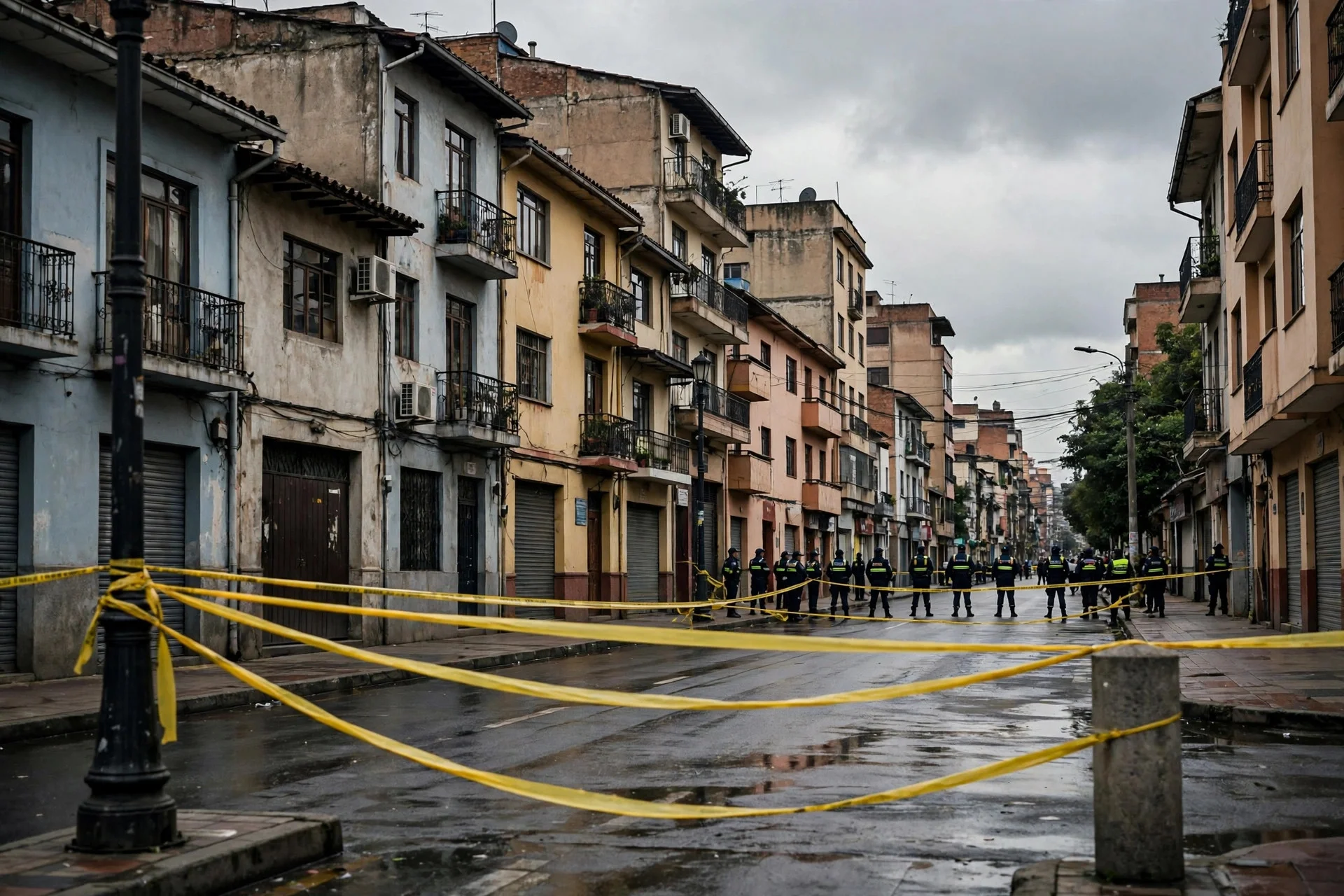
Imagen alusiva generada por EPM: una calle acordonada por la policía en una ciudad ecuatoriana. · EPM
Ecuador records 4,145 homicides amid historically extreme violence levels
Ecuador recorded 4,145 intentional homicides in the first half of 2026, about 23 a day, down roughly 10.7% from 2025.
Ecuador homicides fall 10.7% yet violence remains at extreme levels
Ecuador recorded 4,145 intentional homicides in the first half of 2026, down roughly 10.7% from 2025 in a decline the National Police links to its operations.
Ecuador recorded 4,145 intentional homicides in the first six months of 2026, an average of 23 killings a day that keeps the country among the most critical scenarios in its recent history, despite a decline of roughly 10.7% from the same period in 2025.
--- The context ---
The violence crisis dates back to the expansion of organized crime and has not returned to the security levels seen before that process. Since January 2024, when President Daniel Noboa declared an internal armed conflict, the official strategy has combined a larger military role, states of exception and other extraordinary measures. The report by the Ecuadorian Observatory of Organized Crime (OECO), an initiative of the Pan American Development Foundation (PADF), published in October 2026, measures that period using Interior Ministry records and population projections based on the 2022 Census by the National Institute of Statistics and Censuses (INEC).
--- The facts ---
The semester was the second most violent first half since the records analyzed by the OECO began. Guayas accounts for 42.39% of violent deaths and a semester rate of 36.42 homicides per 100,000 inhabitants. The sharpest deterioration is in El Oro, on the border with Peru: its rate reached 68.74 per 100,000 inhabitants, the highest in the country, with an increase of roughly 62% and 12.54% of national deaths. Huaquillas records 125.97 per 100,000 inhabitants and Machala 68.17, while Sucumbíos, on the border with Colombia, posts 34.95. Victims aged 20 to 24 are 19.04% of the total and those aged 15 to 19 another 11.80%. In addition, 3,671 victims, 88.37%, died from gunfire.
--- The positions ---
The National Police has highlighted the decline in violent deaths during 2026 as part of the results of its preventive and investigative operations. The OECO, by contrast, shows that the national reduction coexists with territorial increases, a high share of firearms and considerable harm to adolescents and young adults. Since January 2024 the Government has maintained the internal armed conflict declaration, the larger military participation and states of exception as the core of its response to criminal organizations.
--- What remains unknown ---
What explains each cantonal increase has not yet been established. The observatory raises possible links between violence, illegal mining and disputes over territorial control in Sucumbíos, but warns that those dynamics require additional investigation. Nor do homicide data alone establish the individual motivations behind each crime or confirm specific disputes over strategic corridors and illicit markets in El Oro.
--- Unanswered questions ---
Why does the national decline coexist with an increase of roughly 62% in El Oro? What supply and control mechanisms explain why 88.37% of victims die from firearms? What specific protection do adolescents and young people receive, as the group hit hardest by lethal violence? Can the country avoid closing 2026 with a rate of between 45 and 50 homicides per 100,000 inhabitants?
--- EPM analysis ---
The territorial reading is the key to the report: the national decline does not describe what happens in each province or canton. While Durán shows significant decreases, other localities record increases that reshape the distribution of risk. The setting also matters: 75% of contract killings occurred in public spaces, while 73% of femicides happened in private spaces, which demands different interventions in public security and in protection against gender violence.
📌 EPM Take:
In EPM's view, the 10.7% decline is a real change in trend but not enough to declare the crisis overcome, because it starts from an exceptionally violent year and coexists with extreme rates in El Oro, Huaquillas and Machala. The gravest fact is not only the volume but who is dying: young people aged 20 to 24 and adolescents account for a significant share of victims, at stages of education and entry into work. Without effective control of the illicit arms trade and social presence in disputed territories, the national statistic will keep hiding local emergencies that are already historic.
Ecuador ended the first half of 2026 with 4,145 intentional homicides, about 23 killings a day, and a decline of roughly 10.7% from 2025 that the National Police credits to its operations, although levels remain among the highest in the country's history.
--- The context ---
Since January 2024, the Government of President Daniel Noboa has maintained the declaration of an internal armed conflict, with a larger role for the Armed Forces in operations against criminal organizations, states of exception and other extraordinary measures. That is the framework in which the Ecuadorian Observatory of Organized Crime (OECO), an initiative of the Pan American Development Foundation (PADF), published its semester balance in October 2026, built from Interior Ministry records and population projections from the 2022 Census by the National Institute of Statistics and Censuses (INEC).
--- The facts ---
The period is the second most violent first half since the analyzed records began. If the trend holds, the country could close 2026 with a rate of between 45 and 50 homicides per 100,000 inhabitants. Guayas accounts for 42.39% of violent deaths, with a semester rate of 36.42 per 100,000 inhabitants. The gravest front is El Oro, on the border with Peru: 68.74 per 100,000 inhabitants, an increase of roughly 62% and 12.54% of the country's deaths. Huaquillas reaches 125.97 and Machala 68.17, while Sucumbíos records 34.95. Of the victims, 3,671, or 88.37%, died from gunfire, and young people aged 20 to 24 represent 19.04%.
--- The positions ---
The National Police has highlighted the decline in violent deaths during 2026 as part of the results of its preventive and investigative operations. The OECO shows, at the same time, that the national reduction coexists with territorial increases and a high share of firearms. The Government maintains the internal armed conflict declaration, the larger military participation and states of exception as instruments to confront the criminal organizations disputing corridors and territories.
--- What remains unknown ---
The precise individual motivations behind each crime and the specific connections between violence, illegal mining and disputes over territorial control that the observatory raises for Sucumbíos remain to be determined. Also missing is an explanation of the supply, circulation and control mechanisms for weapons, in a context where the predominance of firearms has held since 2022 and points, according to the OECO, to the expansion of their illicit trade.
--- Unanswered questions ---
Will the security deployment sustain the national decline during the second half of 2026? What effective control exists over the supply and circulation of weapons used by organized crime? Why do El Oro and Huaquillas worsen while Durán improves within the same country? Are current operations enough to contest the strategic corridors and illicit markets?
--- EPM analysis ---
The map outweighs the average: the concentration in Guayas and the jump in El Oro, a commercial, agricultural, port and border province, show that criminal pressure is moving toward concrete corridors. The setting also changes by crime: 75% of contract killings took place in public spaces, compared with 73% of femicides in private spaces. A serious strategy must combine territorial control, weapons intelligence and differentiated protection, without mistaking a statistical improvement for victory.
📌 EPM Take:
In EPM's view, the 10.7% decline confirms that sustained state pressure can move the trend, but it would be a mistake to call it sufficient: 23 killings a day and a projection of between 45 and 50 homicides per 100,000 inhabitants still describe an emergency. The 62% jump in El Oro and the 125.97 rate in Huaquillas require concentrating forces, intelligence and border control where crime is advancing, not where the national average looks better. Order is recovered territory by territory, with verifiable results in each canton, and that is the yardstick by which the Government should be measured.
Ecuador suma 4.145 homicidios y sigue en niveles históricos de violencia
Ecuador registró 4.145 homicidios intencionales en el primer semestre de 2026, unos 23 diarios, con una baja aproximada del 10,7% frente a 2025.
Ecuador baja homicidios 10,7%, pero la violencia sigue en niveles extremos
Ecuador registró 4.145 homicidios intencionales en el primer semestre de 2026, con una disminución aproximada del 10,7% frente a 2025 que la Policía Nacional…
Ecuador registró 4.145 homicidios intencionales en el primer semestre de 2026, un promedio de 23 asesinatos diarios que mantiene al país entre los escenarios más críticos de su historia, pese a una baja aproximada del 10,7% frente a 2025.
--- El contexto ---
La crisis se arrastra desde la expansión del crimen organizado, sin retorno a los niveles de seguridad anteriores. Desde enero de 2024, cuando el presidente Daniel Noboa declaró la existencia de un conflicto armado interno, la estrategia oficial combina mayor participación de las Fuerzas Armadas, estados de excepción y otras medidas extraordinarias. El informe del Observatorio Ecuatoriano de Crimen Organizado (OECO), iniciativa de la Fundación Panamericana para el Desarrollo (PADF), publicado en octubre de 2026, usa registros del Ministerio del Interior y proyecciones del Censo de 2022 del INEC.
--- Los hechos ---
El semestre fue el segundo primer semestre más violento desde que existen los registros analizados por el OECO. Guayas concentra el 42,39% de las muertes violentas, con tasa semestral de 36,42 por cada 100.000 habitantes. El Oro, fronteriza con Perú, tiene la tasa más alta del país: 68,74 por cada 100.000 habitantes, con un aumento aproximado del 62% y el 12,54% de las muertes nacionales. Huaquillas registra 125,97, Machala 68,17 y Sucumbíos, en la frontera con Colombia, 34,95 por cada 100.000 habitantes. Las víctimas de 20 a 24 años son el 19,04% y las de 15 a 19 años el 11,80%; 3.671 víctimas, el 88,37%, murieron por armas de fuego.
--- Las posiciones ---
La Policía Nacional ha destacado la disminución de las muertes violentas durante 2026 como resultado de sus operaciones preventivas e investigativas. El OECO, en cambio, muestra que la reducción nacional coexiste con incrementos territoriales, una elevada participación de armas de fuego y una considerable afectación de adolescentes y adultos jóvenes. El Gobierno mantiene desde enero de 2024 la declaración de conflicto armado interno, la mayor participación militar y los estados de excepción como ejes de su respuesta.
--- Lo que falta saber ---
Todavía no está establecido qué explica cada aumento cantonal. El observatorio plantea posibles relaciones entre la violencia, la minería ilegal y las disputas por el control territorial en Sucumbíos, pero advierte que requieren investigaciones adicionales. Los datos tampoco establecen las motivaciones individuales de cada crimen ni confirman disputas por corredores estratégicos y mercados ilícitos en El Oro.
--- Preguntas sin respuesta ---
¿Por qué la baja nacional convive con un aumento aproximado del 62% en El Oro? ¿Qué mecanismos de abastecimiento y control explican que el 88,37% de las víctimas muera por armas de fuego? ¿Qué protección específica reciben los adolescentes y jóvenes, el grupo más golpeado por la violencia letal? ¿Podrá el país evitar cerrar 2026 con una tasa de entre 45 y 50 homicidios por cada 100.000 habitantes?
--- Análisis EPM ---
La lectura territorial es la clave del informe: el descenso nacional no describe lo que ocurre en cada provincia o cantón. Mientras Durán muestra disminuciones importantes, otras localidades registran incrementos que modifican la distribución del riesgo. También importa el escenario: el 75% de los sicariatos ocurrió en espacios públicos, mientras el 73% de los femicidios sucedió en espacios privados, lo que exige intervenciones distintas en seguridad y en protección frente a la violencia de género.
📌 Conclusion EPM:
A juicio de EPM, la baja del 10,7% es un cambio de tendencia real pero insuficiente para hablar de una crisis superada, porque parte de un año excepcionalmente violento y convive con tasas extremas en El Oro, Huaquillas y Machala. El dato más grave no es solo el volumen, sino quién muere: jóvenes de 20 a 24 años y adolescentes concentran una parte significativa de las víctimas, en etapas de formación e ingreso al trabajo. Sin control efectivo del comercio ilícito de armas y sin presencia social en los territorios en disputa, la estadística nacional seguirá ocultando emergencias locales que ya son históricas.
Ecuador cerró el primer semestre de 2026 con 4.145 homicidios intencionales, unos 23 asesinatos diarios, y una disminución aproximada del 10,7% frente a 2025 que la Policía Nacional atribuye a sus operaciones, aunque los niveles siguen entre los más altos de la historia del país.
--- El contexto ---
Desde enero de 2024, el Gobierno del presidente Daniel Noboa sostiene la declaración de conflicto armado interno, con mayor participación militar, estados de excepción y otras medidas extraordinarias. En ese marco, el Observatorio Ecuatoriano de Crimen Organizado (OECO), iniciativa de la Fundación Panamericana para el Desarrollo (PADF), publicó en octubre de 2026 su balance semestral, con registros del Ministerio del Interior y proyecciones del Censo de 2022 del INEC.
--- Los hechos ---
El período es el segundo primer semestre más violento desde que existen los registros analizados. Si la tendencia se mantiene, el país podría cerrar 2026 con una tasa de entre 45 y 50 homicidios por cada 100.000 habitantes. Guayas concentra el 42,39% de las muertes violentas, con una tasa semestral de 36,42 por cada 100.000 habitantes. El frente más grave es El Oro, fronteriza con Perú: 68,74 por cada 100.000 habitantes, un aumento aproximado del 62% y el 12,54% de las muertes del país. Huaquillas alcanza 125,97 y Machala 68,17, mientras Sucumbíos registra 34,95. De las víctimas, 3.671, el 88,37%, murieron por disparos de armas de fuego, y los jóvenes de 20 a 24 años representan el 19,04%.
--- Las posiciones ---
La Policía Nacional ha destacado la disminución de las muertes violentas durante 2026 como parte de los resultados de sus operaciones preventivas e investigativas. El OECO muestra, a la vez, que la reducción nacional coexiste con incrementos territoriales y una elevada participación de armas de fuego. El Gobierno mantiene la declaración de conflicto armado interno, la mayor participación militar y los estados de excepción como instrumentos contra las organizaciones criminales.
--- Lo que falta saber ---
Falta determinar con precisión las motivaciones individuales de cada crimen y las conexiones específicas entre violencia, minería ilegal y disputas por el control territorial que el observatorio plantea para Sucumbíos. También falta explicar los mecanismos de abastecimiento, circulación y control del armamento, en un contexto donde el predominio de las armas de fuego se sostiene desde 2022 y apunta, según el OECO, a su comercio ilícito en expansión.
--- Preguntas sin respuesta ---
¿Sostendrá el despliegue de seguridad la baja nacional durante el segundo semestre de 2026? ¿Qué control efectivo existe sobre el abastecimiento y la circulación de armas usadas por el crimen organizado? ¿Por qué El Oro y Huaquillas empeoran mientras Durán mejora dentro del mismo país? ¿Alcanzan las operaciones actuales para disputar los corredores estratégicos y los mercados ilícitos?
--- Análisis EPM ---
El mapa manda sobre el promedio: la concentración en Guayas y el salto de El Oro, provincia comercial, agrícola, portuaria y fronteriza, muestran que la presión criminal se mueve hacia corredores concretos. También cambia el escenario según el delito: el 75% de los sicariatos se produjo en espacios públicos, frente al 73% de los femicidios en espacios privados. Una estrategia seria debe combinar control territorial, inteligencia sobre armas y protección diferenciada, sin confundir una mejora estadística con victoria.
📌 Conclusion EPM:
A juicio de EPM, la disminución del 10,7% confirma que la presión sostenida del Estado puede mover la tendencia, pero sería un error declararla suficiente: 23 asesinatos diarios y una proyección de entre 45 y 50 homicidios por cada 100.000 habitantes describen todavía una emergencia. El salto del 62% en El Oro y la tasa de 125,97 en Huaquillas obligan a concentrar fuerzas, inteligencia y control fronterizo donde el crimen avanza, no donde el promedio nacional se ve mejor. El orden se recupera territorio por territorio, con resultados verificables en cada cantón, y esa es la vara con la que debe medirse al Gobierno.