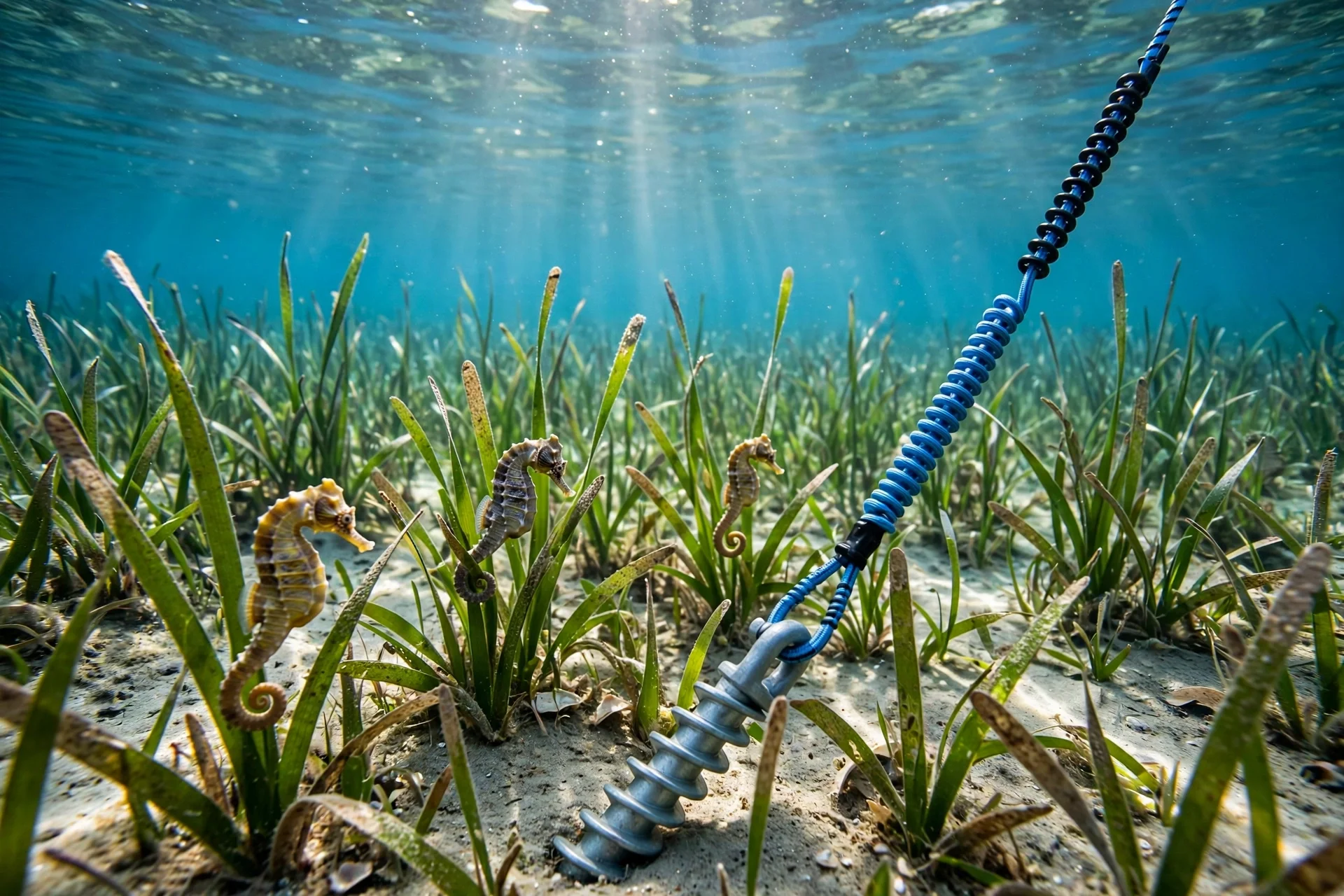
Imagen alusiva a la pradera marina de Studland Bay, en Dorset, y a los amarres ecológicos instalados para protegerla del anclaje tradicional. · Imagen generada EPM
Studland Bay seagrass recovers sharply as eco-moorings prove effective
Seagrass in Studland Bay, Dorset, is recovering dramatically after eco-moorings replaced traditional anchoring: bare patches fell 93.6% between 2021 and 2025…
Eco-moorings heal anchor scars in Studland Bay seagrass meadow
Five years of monitoring at Studland Bay show every anchor chain scar examined is healing after 87 eco-moorings were installed in Dorset, with bare patches…
--- The context ---
Studland Bay, off the Dorset coast in England, was designated a Marine Conservation Zone in 2019 and holds one of the United Kingdom's most significant seagrass beds. The beds are vital habitat for protected species including seahorses, pipefish and rays, and nursery grounds for commercially important fish species.
--- The facts ---
In 2021 the Marine Management Organisation (MMO) introduced a voluntary no anchor zone with the Studland Bay Marine Partnership, leading to the first eco-moorings so boaters could keep using the bay without harming the seagrass. Traditional moorings move across the seabed with wind and tide and can scour sensitive habitats like this one.
Eco-moorings are an environmentally friendly Advanced Mooring System: a helical screw drilled into the seabed with an elasticated riser connected to a surface buoy. In 2023 the MMO awarded a £186,000 Fisheries and Seafood Scheme (FaSS) grant toward a larger £248,000 conservation project that added 57 eco-moorings, bringing the total in the bay to 87.
Research by Kira Dunn of the University of Southampton analysed five years of monitoring data and tracked recovery across 39 damaged areas, finding every anchor chain scar examined was healing. In the trial area, bare patches shrank by 93.6% between 2021 and 2025, around 57 square metres a year; in a second area, scars fell by 65.4% after the 2023 switch, around 15.9 square metres a year.
--- The positions ---
Jessica Churchill-Bissett, head of marine conservation at the MMO, said the bay is a case study in supporting coastal communities to deliver proportionate, practical and effective conservation, and that the organisation will keep backing such schemes. David Brown, chair of the partnership steering group and a National Trust lead, said the findings exceeded expectations and that robust monitoring proves how eco-moorings benefit seagrass and its species.
--- What remains unknown ---
The announcement does not say how long full recovery of all 39 areas will take or whether the model will be extended to other bays. It also leaves open what evidence the Your Coast campaign, through which the MMO is asking coastal communities in England how activities such as anchoring affect marine protected areas, will ultimately gather.
--- Unanswered questions ---
Will eco-moorings now be extended to other marine conservation zones around the United Kingdom? How long will the deepest anchor scars take to close completely? Will boaters keep respecting the voluntary no anchor zone over the long term? What new evidence will the Your Coast campaign produce on recreational anchoring and protected habitats?
--- EPM analysis ---
The central fact is not just the percentage but the sequence: recovery began when the disturbance stopped. Where the change came in 2021, bare patches fell by 93.6%; where chains remained until 2023, the improvement was smaller and later, at 65.4%. That timing strengthens the link between the measure adopted and the recovery observed on the seabed over five years of monitoring.
📌 EPM Take:
In EPM's view, Studland Bay shows that protecting a fragile habitat does not require closing the bay to the people who use it, but changing the infrastructure that damages it and measuring the result patiently for years. A voluntary zone, 87 eco-moorings and five years of data were enough for every scar examined to be healing. If other coastal communities copy the method with the same monitoring discipline, seagrass recovery could stop being an encouraging exception and become a routine, verifiable practice along the coast.
--- The context ---
Studland Bay, off the Dorset coast, was designated a Marine Conservation Zone in 2019. Its seagrass bed, among the most significant in the United Kingdom, shelters seahorses, pipefish and rays and serves as nursery ground for commercial fish species, so damage from traditional anchoring was a practical, measurable problem rather than an abstract concern.
--- The facts ---
The Marine Management Organisation (MMO) set up a voluntary no anchor zone in 2021 with the Studland Bay Marine Partnership. Conventional moorings shift with wind and tide and scour the seabed, opening scars in the meadow. The replacement was the eco-mooring, an Advanced Mooring System using a helical screw fixed into the seabed and an elasticated riser to a surface buoy.
In 2023, a £186,000 FaSS grant funded part of a £248,000 project that added 57 eco-moorings, for a total of 87 in the bay. The installation required a marine licence, a process in which the partnership was supported by the MMO, according to the official information released about the conservation project and its funding.
Scientific monitoring by Kira Dunn of the University of Southampton reviewed five years of data across 39 damaged areas and found every anchor chain scar examined is healing. In the first area, bare patches fell by 93.6% between 2021 and 2025, about 57 square metres a year; in the second, where the switch came in 2023, they fell by 65.4%, about 15.9 square metres a year.
--- The positions ---
Jessica Churchill-Bissett of the MMO said the organisation will keep backing initiatives like this to protect habitats while supporting those who rely on and enjoy the seas. David Brown, of the local partnership and the National Trust, said the work of organisations and volunteers, combined with robust monitoring and research, provides the science to prove the benefit of eco-moorings for seagrass.
--- What remains unknown ---
It remains unclear whether further funding will expand the system and what maintenance the 87 moorings will cost over the years. The available information sets no deadline for full recovery and does not say whether the voluntary no anchor zone could one day become a compulsory measure for boaters in the bay.
--- Unanswered questions ---
Who will pay for the future maintenance of the 87 eco-moorings at Studland Bay? Will the model be replicated in other British bays with damaged seagrass? Will a voluntary no anchor zone remain enough, or will a compulsory rule be needed? What happens to boaters who still anchor outside the installed moorings in the bay?
--- EPM analysis ---
There is a lesson in method in these figures: first the damage was measured, then the technique was changed, then the seabed was measured again for five years. The gap between 93.6% in the pioneer area and 65.4% in the area that switched two years later shows that exposure time to damage matters as much as the solution applied.
📌 EPM Take:
In EPM's view, this success was built with clear rules, a prior licence, identified public money — £186,000 within a £248,000 project — and independent scientific verification over five years, not with improvised bans or campaigns without follow-up. Conservation and continued use of the bay proved compatible because someone did the technical work of replacing the dragging chain with a screw that stays put. That order — measure, license, fund, verify — is what should be demanded of any environmental policy that asks citizens to change their habits.
La pradera marina de Studland Bay se recupera con amarres ecológicos
La pradera marina de Studland Bay, en Dorset, muestra una recuperación notable: los parches desnudos cayeron un 93.6% entre 2021 y 2025 en la zona de prueba…
Amarres ecológicos curan las cicatrices de la pradera de Studland Bay
Cinco años de seguimiento en Studland Bay muestran que todas las cicatrices de cadenas de ancla examinadas se están curando tras la instalación de 87 amarres…
--- El contexto ---
Studland Bay, frente a la costa de Dorset, en Inglaterra, fue designada Zona de Conservación Marina en 2019 y alberga una de las praderas marinas más importantes del Reino Unido. Esas praderas son hábitat vital de especies protegidas como caballitos de mar, peces aguja y rayas, y zona de cría de peces de importancia comercial.
--- Los hechos ---
En 2021, la Organización de Gestión Marina (MMO) introdujo una zona voluntaria sin anclaje junto a la Alianza Marina de Studland Bay, lo que llevó a instalar los primeros amarres ecológicos para usar la bahía sin dañar la pradera. Los amarres tradicionales se mueven con el viento y la marea y pueden rozar y dañar hábitats.
Los amarres ecológicos son una forma respetuosa de Sistema Avanzado de Amarre: usan un tornillo helicoidal fijado al fondo marino y un riser elástico conectado a una boya en superficie. En 2023, la MMO concedió una subvención FaSS de £186,000 para un proyecto de £248,000 que incluyó 57 amarres ecológicos adicionales, hasta un total de 87 en la bahía.
La investigación de Kira Dunn, de la Universidad de Southampton, analizó cinco años de datos en 39 áreas dañadas del fondo: todas las cicatrices de cadenas de ancla examinadas mostraron signos de curación. En la zona de prueba, los parches desnudos se redujeron un 93.6% entre 2021 y 2025, con unos 57 square metres recuperados al año; en una segunda zona, el descenso fue del 65.4% tras el cambio de 2023, a unos 15.9 square metres al año.
--- Las posiciones ---
Jessica Churchill-Bissett, responsable de conservación marina de la MMO, señaló que Studland Bay es un caso de estudio de apoyo a comunidades costeras con iniciativas eficaces y que seguirán respaldando esquemas así. David Brown, presidente del grupo directivo de la alianza y responsable en el National Trust, sostuvo que los resultados superaron las expectativas y que la ciencia demuestra el beneficio de los amarres ecológicos.
--- Lo que falta saber ---
La fuente no precisa cuánto tardará la recuperación completa de las 39 áreas ni si el modelo se extenderá a otras bahías. Tampoco detalla las aportaciones que reunirá la campaña Your Coast, con la que la MMO pide evidencias sobre cómo el anclaje afecta a las áreas marinas protegidas.
--- Preguntas sin respuesta ---
¿Se extenderán los amarres ecológicos a otras zonas de conservación marina del Reino Unido tras estos resultados? ¿Cuánto tiempo necesitarán las cicatrices más profundas para cerrarse por completo? ¿Mantendrán los navegantes el respeto voluntario a la zona sin anclaje a largo plazo? ¿Qué nuevas evidencias aportará la campaña Your Coast sobre el anclaje recreativo?
--- Análisis EPM ---
El dato central no es solo el porcentaje: la recuperación empezó cuando cesó la perturbación. Donde el cambio llegó en 2021, los parches cayeron un 93.6%; donde las cadenas siguieron hasta 2023, la mejora fue menor y más tardía, del 65.4%. La secuencia temporal refuerza la relación entre la medida adoptada y el resultado observado.
📌 Conclusion EPM:
A juicio de EPM, el caso de Studland Bay demuestra que proteger un hábitat frágil no exige cerrar la bahía a quienes la usan, sino cambiar la infraestructura que la daña y medir el resultado con paciencia científica. Una zona voluntaria, 87 amarres ecológicos y cinco años de datos han bastado para que todas las cicatrices examinadas estén en curación. Si otras comunidades costeras copian el método con la misma disciplina de seguimiento, la recuperación de praderas marinas puede dejar de ser una excepción alentadora y convertirse en una práctica habitual y verificable.
--- El contexto ---
Studland Bay, frente a la costa de Dorset, fue designada Zona de Conservación Marina en 2019. Su pradera marina, una de las más significativas del Reino Unido, da refugio a caballitos de mar, peces aguja y rayas, y sirve de zona de cría para especies pesqueras comerciales, por lo que su deterioro por anclajes tradicionales era un problema práctico y medible.
--- Los hechos ---
La Organización de Gestión Marina (MMO) estableció en 2021 una zona voluntaria sin anclaje con la Alianza Marina de Studland Bay. Los amarres convencionales, al desplazarse con el viento y la marea, rozan el fondo y abren cicatrices en la pradera. La alternativa instalada fue el amarre ecológico, un Sistema Avanzado de Amarre con tornillo helicoidal y riser elástico unido a una boya.
En 2023, una subvención FaSS de £186,000 financió parte de un proyecto de £248,000 que añadió 57 amarres ecológicos, hasta sumar 87 en la bahía. La instalación requirió licencia marina, un trámite en el que la alianza contó con el apoyo de la MMO, según la propia información oficial difundida sobre el proyecto.
El seguimiento científico de Kira Dunn, de la Universidad de Southampton, revisó cinco años de datos en 39 áreas dañadas y constató que todas las cicatrices de cadenas de ancla se están curando. En la primera zona, los parches desnudos bajaron un 93.6% entre 2021 y 2025, unos 57 square metres al año; en la segunda, donde el cambio llegó en 2023, bajaron un 65.4%, unos 15.9 square metres al año.
--- Las posiciones ---
Jessica Churchill-Bissett, de la MMO, afirmó que el organismo seguirá respaldando iniciativas de este tipo para proteger hábitats sin renunciar a quienes usan el mar. David Brown, de la alianza local y del National Trust, destacó que la colaboración de organizaciones y voluntarios, unida a un seguimiento riguroso, permite probar con ciencia el beneficio de los amarres ecológicos para la pradera y sus especies.
--- Lo que falta saber ---
Queda por saber si habrá nueva financiación para ampliar el sistema y qué coste de mantenimiento tendrán los 87 amarres con el paso de los años. La información disponible tampoco fija plazos para la recuperación total ni aclara si la zona voluntaria sin anclaje podría convertirse algún día en una medida obligatoria.
--- Preguntas sin respuesta ---
¿Quién asumirá el mantenimiento futuro de los 87 amarres ecológicos de Studland Bay? ¿Se replicará el modelo en otras bahías británicas con praderas dañadas? ¿Seguirá siendo suficiente una zona voluntaria sin anclaje o hará falta una norma obligatoria? ¿Qué pasará con los navegantes que aún fondean fuera de los amarres instalados?
--- Análisis EPM ---
Hay una lección de método en estas cifras: primero se midió el daño, después se cambió la técnica y luego se siguió midiendo durante cinco años. La diferencia entre el 93.6% de la zona pionera y el 65.4% de la zona que cambió dos años después muestra que el tiempo de exposición al daño importa tanto como la solución aplicada.
📌 Conclusion EPM:
A juicio de EPM, este éxito se construyó con reglas claras, licencia previa, dinero público identificado —£186,000 dentro de un proyecto de £248,000— y verificación científica independiente durante cinco años, no con prohibiciones improvisadas ni con campañas sin seguimiento posterior. Conservar y seguir usando la bahía resultaron compatibles porque alguien hizo el trabajo técnico de sustituir el ancla que araña por el tornillo que no se mueve. Ese orden —medir, autorizar, financiar, comprobar— es el que debería exigirse a cualquier política ambiental que pida sacrificios a los ciudadanos.