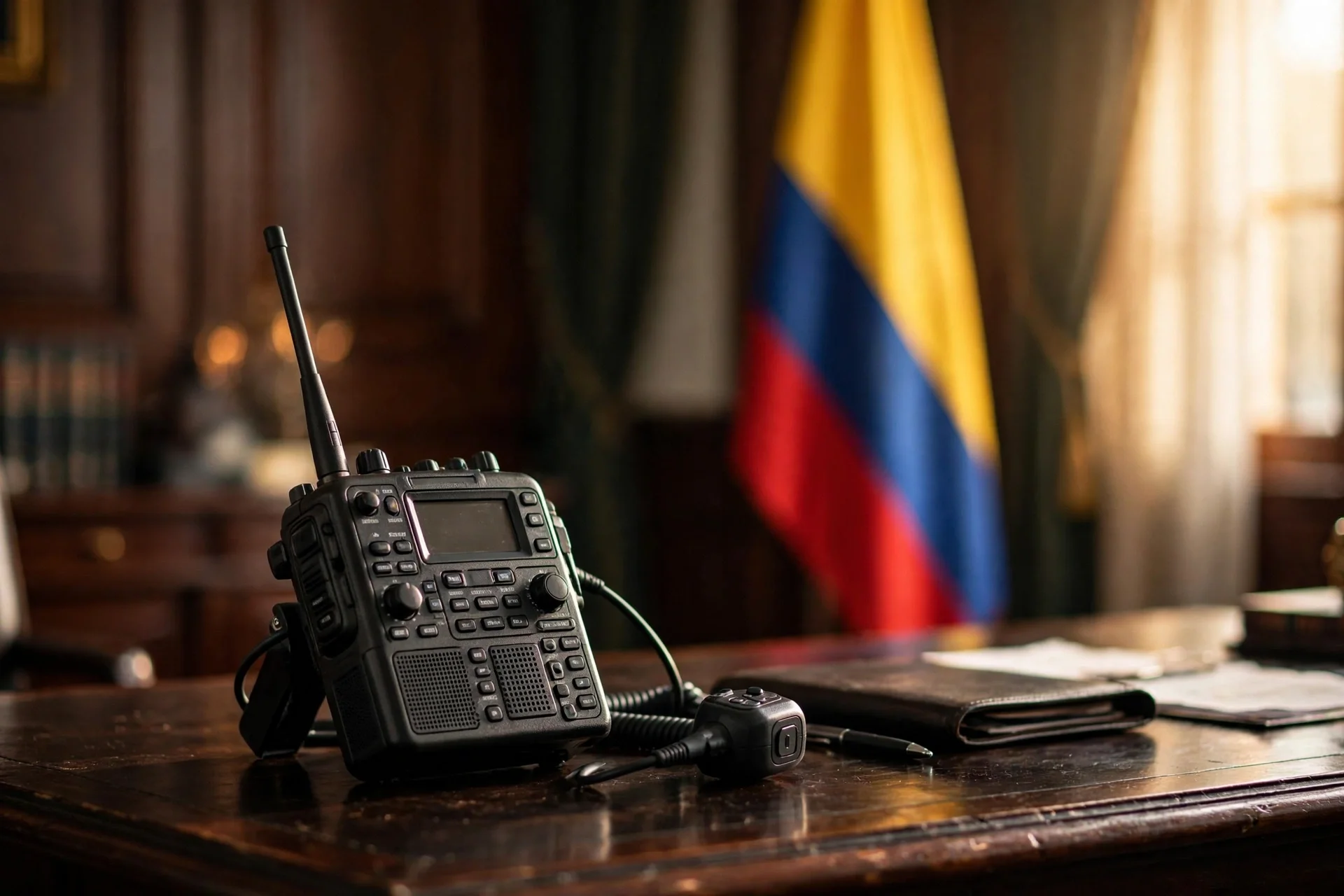
Imagen alusiva al radio con el que el presidente Abelardo De La Espriella sigue las operaciones de seguridad · Imagen generada para EPM
Abelardo's radio: direct command under scrutiny
First lady Ana Lucía Pineda said in an interview that President Abelardo De La Espriella gives instructions by radio as soon as something comes up, that he…
Abelardo stays on the radio with the security forces
Ana Lucía Pineda explained in an interview that Abelardo De La Espriella gives orders by radio as soon as something comes up, follows the country's pulse…
--- The context ---
Colombia's president, Abelardo De La Espriella, uses a communications instrument that has drawn attention: the radio. The first lady, Ana Lucía Pineda, described in an interview how the president uses the device.
--- The facts ---
According to the first lady, when something occurs to the president, he gets up and immediately calls and gives the instructions by radio. Pineda said the president is there connected with the country and with what is happening, and recalled that he has used it at important moments of his government, in his frontal fight against crime and the operations carried out.
--- The positions ---
The first lady also responded to the criticism the subject has drawn. She attributed it to opponents and held that it always comes from the left, from those who disagree with what he does. In her account, the president is on the radio connected with the public force, watching over the security of all Colombians.
--- What remains unknown ---
The available information does not specify which concrete operations have been coordinated through that channel, which protocols govern those communications, or whether a record remains of the instructions given. Reactions from the sectors she pointed to, responding to the first lady's defense, are also not known.
--- Unanswered questions ---
Which recent operations have been directed by radio from the presidency? Is there a verifiable record of the instructions the president gives through that channel? Will the criticized sectors respond to the first lady's explanation?
--- EPM analysis ---
The episode portrays a personal, immediate style of command: the instruction is born with the president and travels by radio without visible intermediaries. That immediacy can speed up decisions, but it also concentrates the official word in a single voice and leaves open the debate over the controls that should surround communications at that level.
📌 EPM Take: In EPM's view, the radio is more than a device: it is the staging of a command that wants to be permanent and connected. The country gains closeness to its president, but full trust will require knowing what is ordered through that channel and with what record, because effectiveness without traceability leaves questions no government should avoid.
--- The context ---
In Colombia, one object has become a visible part of Abelardo De La Espriella's government: a communications radio. First lady Ana Lucía Pineda explained in an interview how the president uses it.
--- The facts ---
Pineda recounted that as soon as something occurs to the president, he gets up, calls on the radio and issues the instructions. She added that this is how he stays connected with the country and with what is happening, and that the device was present at important moments of his government, particularly during the frontal fight against crime and the operations carried out.
--- The positions ---
Faced with the criticism the subject has drawn, the first lady attributed it to opponents. She held that such criticism always comes from the left, from those who disagree with what the president does, while he is on the radio connected with the public force, attentive to what happens and watching over the security of all Colombians.
--- What remains unknown ---
It has not been specified which concrete operations were coordinated through that channel or since when the radio became a habitual part of presidential command. It also remains to be seen whether the sectors the first lady pointed to will answer her words.
--- Unanswered questions ---
In which recent operations did that radio carry the president's orders? Will the direct channel extend to other commanders of the public force? Will the sectors the first lady identified as the source of the criticism respond?
--- EPM analysis ---
The scene Pineda describes is that of a commander in chief on a permanent line: without waiting for paperwork, the president orders and the public force executes. That direct, hierarchical style fits a government that placed security at the center and understands authority as presence, not procedure.
📌 EPM Take: In EPM's view, a president who gives orders by radio projects exactly the command he promised: present, immediate and close to the operation. The debate raised by the opposition, from what is known, is not about security results but about the symbol, and as long as the channel turns into operations against crime, the radio will keep speaking louder than its critics.
El radio de Abelardo: mando directo bajo la lupa
La primera dama, Ana Lucía Pineda, contó en una entrevista que el presidente Abelardo De La Espriella da indicaciones por radio en cuanto surge algo, que sigue…
Abelardo, conectado por radio con la fuerza pública
Ana Lucía Pineda explicó en una entrevista que Abelardo De La Espriella ordena por radio en cuanto surge algo, sigue así el pulso del país junto a la fuerza…
--- El contexto ---
El presidente de Colombia, Abelardo De La Espriella, utiliza un instrumento que ha llamado la atención: el radio. La primera dama, Ana Lucía Pineda, contó en una entrevista cómo usa el aparato el mandatario.
--- Los hechos ---
Según relató la primera dama, cuando al presidente se le ocurre algo, se levanta y enseguida llama y da las indicaciones por el radio. Pineda aseguró que el mandatario está ahí conectado con el país y con lo que está sucediendo, y recordó que lo ha usado en momentos importantes de su gobierno, en su lucha frontal contra el crimen y las operaciones realizadas.
--- Las posiciones ---
La primera dama también respondió a las críticas que ha suscitado ese tema. Las atribuyó a los opositores y sostuvo que siempre vienen de la izquierda, de quienes no están de acuerdo con lo que él hace. En su versión, el presidente está en el radio conectado con la fuerza pública y velando por la seguridad de todos los colombianos.
--- Lo que falta saber ---
La información disponible no precisa qué operaciones concretas se han coordinado por esa vía, ni qué protocolos rigen esas comunicaciones, ni si queda registro de las indicaciones impartidas. Tampoco se conocen reacciones de los sectores señalados a la defensa que hizo la primera dama.
--- Preguntas sin respuesta ---
¿Qué operaciones recientes se han dirigido por radio desde la presidencia? ¿Queda un registro verificable de las indicaciones que el mandatario imparte por esa vía? ¿Responderán los sectores criticados a la explicación de la primera dama?
--- Análisis EPM ---
El episodio retrata un mando personal e inmediato: la instrucción nace del presidente y viaja por radio sin intermediarios visibles. Esa inmediatez puede agilizar decisiones, pero concentra la palabra oficial en una sola voz y deja abierto el debate sobre los controles de comunicaciones de ese nivel.
📌 Conclusion EPM: A juicio de EPM, el radio es más que un aparato: es la escenografía de un mando que se quiere permanente y conectado. El país gana cercanía con su presidente, pero la confianza plena exigirá saber qué se ordena por esa vía y con qué registro, porque la eficacia sin trazabilidad deja preguntas que ningún gobierno debería eludir.
--- El contexto ---
En Colombia hay un objeto que se ha vuelto parte visible del gobierno de Abelardo De La Espriella: un radio de comunicaciones. La primera dama, Ana Lucía Pineda, explicó en una entrevista cómo lo emplea el presidente.
--- Los hechos ---
Pineda relató que el mandatario, en cuanto se le ocurre algo, se levanta, llama por el radio y da las indicaciones. Contó además que así permanece conectado con el país y con lo que está sucediendo, y que el aparato se ha usado en momentos importantes de su gobierno, en particular en la lucha frontal contra el crimen y las operaciones realizadas.
--- Las posiciones ---
Frente a las críticas que el tema ha suscitado, la primera dama las atribuyó a los opositores. Sostuvo que esas críticas vienen siempre de la izquierda, de quienes no están de acuerdo con lo que el presidente hace, mientras él está en el radio conectado con la fuerza pública, atento a lo que sucede y velando por la seguridad de todos los colombianos.
--- Lo que falta saber ---
No se ha precisado qué operaciones se coordinaron por esa vía ni desde cuándo el radio forma parte habitual del mando presidencial. Queda por conocer si los sectores aludidos responderán a sus palabras.
--- Preguntas sin respuesta ---
¿En qué operaciones recientes sonó ese radio con órdenes del presidente? ¿Se extenderá el canal directo a otros mandos de la fuerza pública? ¿Habrá respuesta de los sectores que la primera dama señaló como origen de las críticas?
--- Análisis EPM ---
La escena que describe Pineda es la de un comandante en jefe en línea permanente: el presidente ordena y la fuerza pública ejecuta. Ese estilo directo y jerárquico coincide con un gobierno que puso la seguridad en el centro y entiende la autoridad como presencia, no como trámite.
📌 Conclusion EPM: A juicio de EPM, un presidente que ordena por radio proyecta el mando que prometió: presente, inmediato y pegado a la operación. La discusión que plantea la oposición, según lo conocido, no versa sobre resultados de seguridad sino sobre el símbolo, y mientras el canal se traduzca en operaciones contra el crimen, el radio seguirá hablando más fuerte que sus críticos.