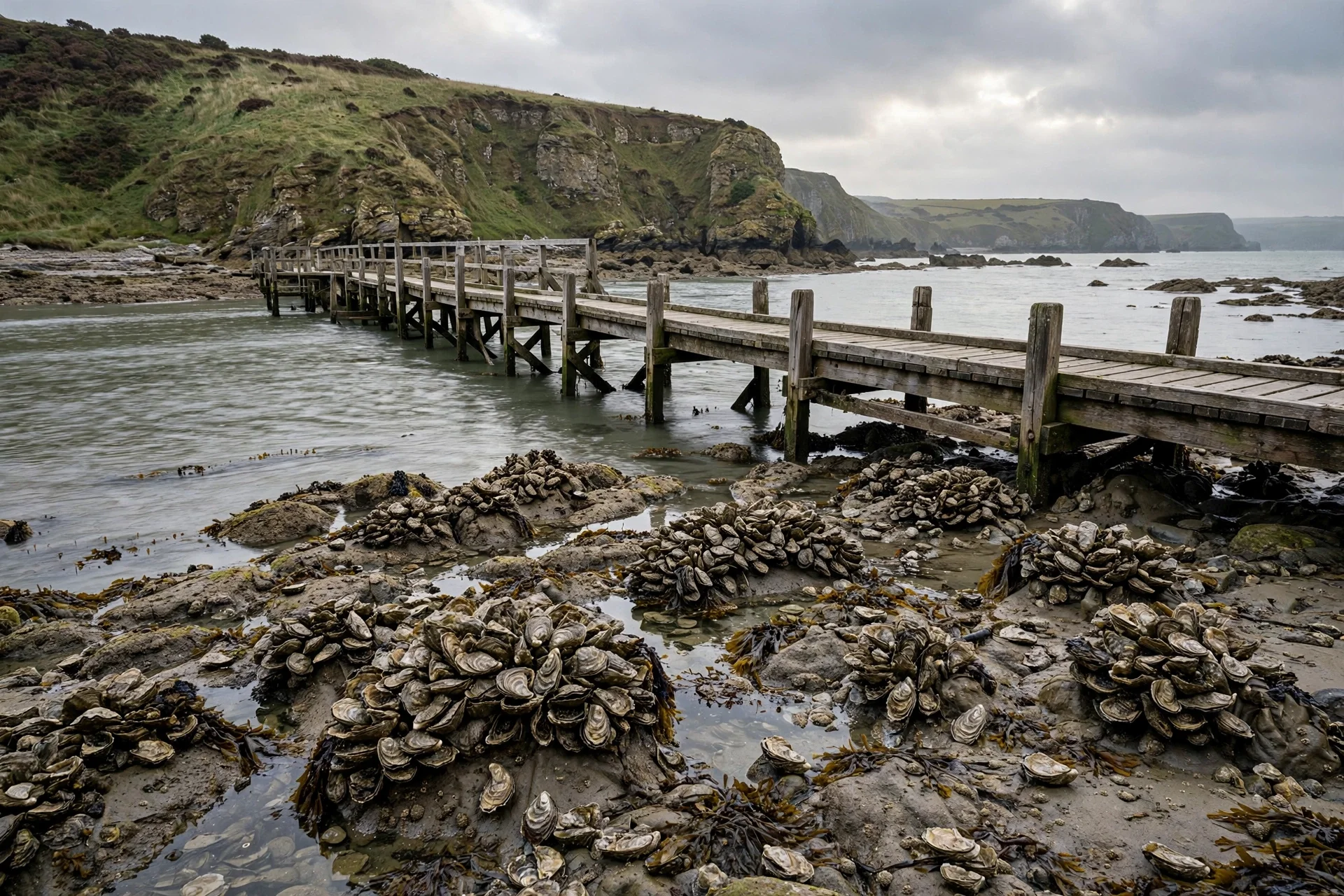
Embarcadero costero y arrecife de ostras en una bahía británica. · Imagen generada para EPM
Marine licences back farm, harbours and native oyster reef
Five approved marine licences in the United Kingdom cover the Babbacombe Bay mussel farm in Devon, the temporary Porthleven bridge, the Sandbanks rebuild in…
UK approves five coastal projects after prior assessment
Marine licensing decisions authorise the Devon mussel farm relocation, the Porthleven bridge approved on 28 April, the Sandbanks rebuild through to October…
Five marine licensing decisions in the United Kingdom combine sustainable aquaculture, harbour safety, reconstruction of storm damaged infrastructure, maintenance dredging and a pilot native oyster reef, each preceded by environmental assessment and consultation.
--- The context ---
Marine licences were required because the works affect the seabed or sit below Mean High Water Springs. The Marine Licensing team worked with regulators, the fishing industry and promoters to address concerns about site location, protected habitats and environmental safeguards before approving each project.
--- The facts ---
In Babbacombe Bay, Devon, Offshore Shellfish Ltd. will relocate its mussel farm into deeper waters and install 140 screw anchors on the seabed to support 68 mussel growing longlines across four sections in Torbay Harbour, after assessment to ensure protected habitats in Lyme Bay and Torbay were not harmed.
In Porthleven, a temporary scaffold pedestrian bridge over the harbour was applied for on 27 March 2025, with construction scheduled for 30 April, and the licensing team fast-tracked the decision and issued approval on 28 April to improve crowd flow and safety during the local food festival.
At Sandbanks in Poole, the National Trust will rebuild the storm damaged jetty next to the chain ferry slipway, with new vessel berths, a replacement quay wall, a vehicle ramp and improved loading facilities, with work running from May 2025 through to October 2029 and a detailed habitat assessment.
At Burnham Yacht Harbour, annual maintenance dredging of up to 17,500 cubic metres of sediment each year was authorised between December and May, with material dispersed into the River Crouch, and in Tyne and Wear a pilot native oyster reef led by the Zoological Society of London with Groundwork Northeast & Cumbria was approved.
--- The positions ---
Promoters and the licensing team argue, in attributed indirect terms, that the relocated farm will strengthen production, safeguard local jobs and improve biodiversity and water quality, that the bridge helped organisers manage visitors and reduce congestion, and that the restored reef can support local fisheries and naturally filter water.
--- What remains unknown ---
The announcement does not publish the full licence texts, the environmental monitoring timetable for each work or the measurable outcomes expected for the farm, the dredging and the reef. It also gives no costs, funding details or account of what will happen if monitoring detects harm to the protected habitats mentioned.
--- Unanswered questions ---
How will it be measured whether the mussel farm truly improves biodiversity and water quality in Torbay? What monitoring will follow the annual dredging in the River Crouch to protect the environment through winter? Will the Tyne and Wear pilot reef lead to wider native oyster restoration across the country?
--- EPM analysis ---
The package shows a single administrative tool applied to different ends: producing food, protecting crowds, rebuilding a tourist gateway, keeping a marina navigable and restoring a declining species. The common thread is making each work conditional on environmental assessment and consultation, rather than approving it without prior examination of the seabed and nearby habitats.
📌 EPM Take: In EPM's view, these five licences matter for their balance between economic use of the coast and verifiable protection of the sea. Relocating the farm, rebuilding Sandbanks and restoring native oysters will only be real progress if environmental monitoring is published and failures are corrected. Safety in Porthleven and navigability in Burnham show that the coast is also everyday infrastructure. Protecting habitat while sustaining local activity is the concrete test, not the announcement itself.
The marine licensing authority approved five coastal projects in the United Kingdom that strengthen infrastructure, keep harbours operating and protect local jobs, from a mussel farm in Devon to the Sandbanks jetty rebuild and an oyster reef in Tyne and Wear.
--- The context ---
Each project needed a licence because it intervenes on the seabed or lies below Mean High Water Springs. There was environmental assessment, habitat assessment at sensitive sites and consultation with regulators and stakeholders, including Natural England supporting the final approach at Sandbanks and the safeguards for dredging at Burnham.
--- The facts ---
The Offshore Shellfish Ltd. farm in Babbacombe Bay, Devon, will move into deeper waters with 140 screw anchors and 68 longlines across four sections in Torbay Harbour, after checks that protected habitats in Lyme Bay and Torbay would not be harmed and after fishing industry concerns about location were addressed.
The temporary pedestrian bridge over Porthleven Harbour was applied for on 27 March 2025 for construction on 30 April and, because it was considered vital for public safety, the licensing team fast-tracked the decision and issued it on 28 April, just days before the town food festival.
At Sandbanks in Poole, the National Trust will replace the ageing storm damaged jetty, left unstable after part of the seabed beneath it washed away, with a new pier including berths, a quay wall, a vehicle ramp and loading facilities, in a project set to run from May 2025 through to October 2029.
Burnham Yacht Harbour may remove up to 17,500 cubic metres of sediment each year between December and May, dispersing the material into the River Crouch to maintain navigational depth, while Tyne and Wear will host the Wild Oysters Project pilot reef from the Zoological Society of London and Groundwork Northeast & Cumbria.
--- The positions ---
The licensing team set out, in attributed indirect terms, that it worked with the National Trust to address consultation concerns at Sandbanks, agreed safeguards for Burnham with the applicant and Natural England, including a condition relating to freezing weather, and refined the reef plans with the project team so regulatory requirements were met before approval.
--- What remains unknown ---
The announcement gives no budget for any work, no exact penalties or conditions for breaching a licence and no inspection timetable during the Sandbanks rebuild through to October 2029. It also reports no outstanding objections and no timetable for judging whether the annual dredging should keep its authorisation in future years.
--- Unanswered questions ---
Will the Sandbanks rebuild meet its October 2029 timetable without cutting access to Brownsea Island? What precise conditions must Burnham Yacht Harbour meet in freezing weather to keep its dredging licence? What results must the pilot oyster reef show to justify expanding it nationally?
--- EPM analysis ---
Taken together, the five cases reward orderly processing: application, assessment, consultation and a licence with conditions. Speed in Porthleven did not remove the licence requirement, and urgency at Sandbanks did not avoid habitat assessment. That respect for procedure is what gives legal certainty to promoters, residents and harbour users alike.
📌 EPM Take: In EPM's view, the value of these decisions lies in order: no coastal work advanced without a licence, assessment and consultation, not even the urgent or the temporary one. Rebuilding Sandbanks, keeping Burnham navigable and giving certainty to Devon aquaculture protect jobs, tourism and safety under clear rules. Oyster restoration adds value if delivered with the same discipline. Governing the coast means authorising what is useful, conditioning what is sensitive and demanding verifiable compliance for years.
Licencias marinas impulsan granja, puertos y arrecife de ostras
Cinco licencias marinas aprobadas en el Reino Unido abarcan la granja de mejillones de Babbacombe Bay en Devon, el puente temporal de Porthleven, la…
Reino Unido autoriza cinco obras costeras con evaluación previa
Las decisiones de licencias marinas autorizan la reubicación de la granja de mejillones en Devon, el puente de Porthleven aprobado el 28 de abril, la…
Cinco decisiones de licencias marinas en el Reino Unido combinan acuicultura sostenible, seguridad en puertos, reconstrucción tras tormentas, dragado de mantenimiento y un arrecife piloto de ostras nativas, con evaluación ambiental y consulta previas.
--- El contexto ---
Las licencias se exigieron porque las obras afectan el fondo marino o se sitúan por debajo del nivel de pleamar. El equipo de licencias trabajó con reguladores, la industria pesquera y los promotores para atender preocupaciones sobre ubicación, hábitats protegidos y salvaguardas ambientales.
--- Los hechos ---
En Babbacombe Bay, en Devon, Offshore Shellfish Ltd. trasladará su granja de mejillones a aguas más profundas e instalará 140 anclas de tornillo en el fondo marino para sostener 68 longlines de cultivo en cuatro secciones de Torbay Harbour, tras una evaluación que buscó no dañar los hábitats protegidos de Lyme Bay y Torbay.
En Porthleven, un puente peatonal temporal de andamio sobre el puerto fue solicitado el 27 de marzo de 2025, con construcción prevista para el 30 de abril, y el equipo de licencias aceleró la decisión y lo aprobó el 28 de abril para mejorar el flujo de multitudes y la seguridad durante el festival gastronómico local.
En Sandbanks, en Poole, el National Trust reconstruirá el embarcadero dañado por tormentas junto a la rampa del transbordador de cadena, con nuevos atraques, un muro de muelle de reemplazo, una rampa para vehículos e instalaciones de carga mejoradas, con obras de mayo de 2025 a octubre de 2029 y una evaluación detallada de hábitats.
En Burnham Yacht Harbour se autorizó un dragado anual de mantenimiento de hasta 17,500 metros cúbicos de sedimento al año, entre diciembre y mayo, con el material dispersado en el River Crouch, y en Tyne and Wear se aprobó un arrecife piloto de ostras nativas impulsado por la Zoological Society of London junto a Groundwork Northeast & Cumbria.
--- Las posiciones ---
Los promotores y el equipo de licencias sostienen, en indirecto, que la granja fortalecerá la producción, protegerá empleos y mejorará la biodiversidad y la calidad del agua, que el puente permitió gestionar mejor a los visitantes, y que el arrecife puede apoyar la pesca local y filtrar el agua.
--- Lo que falta saber ---
La nota no publica los textos completos de las licencias, los plazos de seguimiento ambiental ni los resultados medibles esperados para la granja, el dragado y el arrecife. Tampoco detalla costos ni qué ocurrirá si los controles detectan daños en los hábitats protegidos.
--- Preguntas sin respuesta ---
¿Cómo se medirá que la granja de mejillones mejora realmente la biodiversidad y la calidad del agua en Torbay? ¿Qué seguimiento tendrá el dragado anual en el River Crouch para proteger el entorno durante el invierno? ¿Servirá el arrecife piloto de Tyne and Wear para ampliar la restauración de ostras nativas a otras zonas del país?
--- Análisis EPM ---
El paquete aplica una misma herramienta a fines distintos: producir alimentos, proteger a multitudes, reconstruir un acceso turístico, mantener navegable un puerto y restaurar una especie en declive. El hilo común es condicionar cada obra a evaluación ambiental y consulta previa.
📌 Conclusion EPM: A juicio de EPM, estas cinco licencias valen por su equilibrio entre uso económico de la costa y protección verificable del mar. Trasladar la granja, reconstruir Sandbanks y restaurar ostras nativas solo serán avances reales si el seguimiento ambiental se publica y se corrige lo que no funcione. La seguridad en Porthleven y la navegabilidad en Burnham recuerdan que la costa también es infraestructura cotidiana. Cuidar el hábitat mientras se mantiene la actividad local es la prueba concreta, no el anuncio de la aprobación.
El organismo de licencias marinas aprobó cinco proyectos costeros en el Reino Unido que refuerzan infraestructura, mantienen puertos operativos y protegen empleos locales, desde una granja de mejillones en Devon hasta la reconstrucción del embarcadero de Sandbanks y un arrecife de ostras en Tyne and Wear.
--- El contexto ---
Cada proyecto necesitó licencia porque interviene el fondo marino o queda por debajo del nivel de pleamar. Hubo evaluación ambiental, evaluación de hábitats en sitios sensibles y consulta, incluido el respaldo de Natural England al enfoque final en Sandbanks y en Burnham.
--- Los hechos ---
La granja de Offshore Shellfish Ltd. en Babbacombe Bay, en Devon, se moverá a aguas más profundas con 140 anclas de tornillo y 68 longlines en cuatro secciones de Torbay Harbour, tras revisar que los hábitats protegidos de Lyme Bay y Torbay no resultaran dañados y atender inquietudes de la industria pesquera sobre la ubicación.
El puente peatonal temporal sobre el puerto de Porthleven se solicitó el 27 de marzo de 2025 para construirse el 30 de abril y, al considerarse vital para la seguridad pública, el equipo de licencias tramitó la decisión con rapidez y la emitió el 28 de abril, días antes del festival gastronómico de la localidad.
En Sandbanks, en Poole, el National Trust reemplazará el embarcadero envejecido y dañado por tormentas, cuyo fondo se había erosionado hasta dejarlo inestable, por un muelle nuevo con atraques, muro de muelle, rampa para vehículos e instalaciones de carga, en un proyecto previsto de mayo de 2025 a octubre de 2029.
Burnham Yacht Harbour podrá retirar hasta 17,500 metros cúbicos de sedimento al año, entre diciembre y mayo, dispersando el material en el River Crouch para mantener la profundidad de navegación, mientras Tyne and Wear acogerá el arrecife piloto del Wild Oysters Project, de la Zoological Society of London y Groundwork Northeast & Cumbria.
--- Las posiciones ---
El equipo de licencias expuso, en indirecto, que trabajó con el National Trust para atender la consulta en Sandbanks, que acordó salvaguardas para Burnham, incluida una condición sobre heladas, y que refinó los planes del arrecife para cumplir los requisitos regulatorios.
--- Lo que falta saber ---
No constan los presupuestos, las sanciones si se incumplen las licencias ni el calendario de inspecciones durante la reconstrucción de Sandbanks hasta octubre de 2029. Tampoco se informa de objeciones pendientes ni de plazos para evaluar el dragado anual en próximos años.
--- Preguntas sin respuesta ---
¿Cumplirá la reconstrucción de Sandbanks el plazo hasta octubre de 2029 sin interrumpir el acceso a Brownsea Island? ¿Qué condiciones precisas deberá cumplir Burnham Yacht Harbour cuando haya heladas para conservar su licencia de dragado? ¿Qué resultados deberá mostrar el arrecife piloto de ostras para justificar su ampliación a escala nacional?
--- Análisis EPM ---
Los cinco casos premian la tramitación ordenada: solicitud, evaluación, consulta y licencia con condiciones. La rapidez en Porthleven no eliminó el requisito, y la urgencia en Sandbanks tampoco evitó la evaluación de hábitats. Ese procedimiento da seguridad jurídica a promotores, residentes y usuarios.
📌 Conclusion EPM: A juicio de EPM, el valor de estas decisiones está en el orden: ninguna obra costera avanzó sin licencia, evaluación ni consulta, ni siquiera la urgente o la temporal. Reconstruir Sandbanks, mantener Burnham navegable y dar certidumbre a la acuicultura de Devon protegen empleo, turismo y seguridad con reglas claras. La restauración de ostras suma si se ejecuta con la misma disciplina. Gobernar la costa es eso, autorizar lo útil, condicionar lo sensible y exigir cumplimiento verificable durante años.