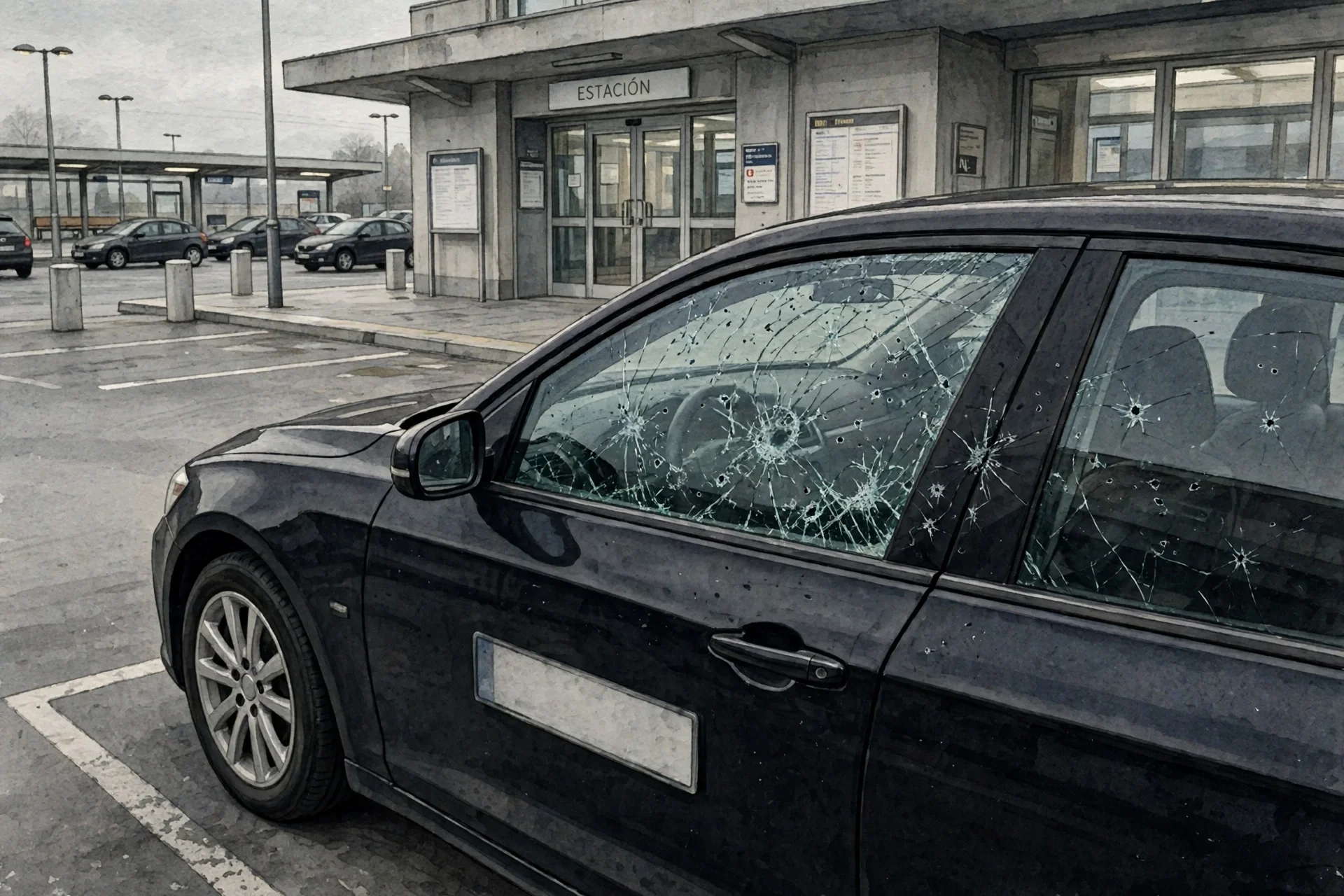
Ilustración editorial de un vehículo con el cristal lateral dañado en un aparcamiento de estación. · Imagen generada para EPM
UCO report undermines alleged shooting at Aldama car in Atocha
According to the UCO report, damage to Víctor de Aldama's Audi at Atocha in September 2024 may have come from a sharp object in an attempted theft, without a…
No shots: Aldama Audi case was attempted theft, UCO report says
According to the UCO report submitted to the National Court, Aldama, his brother and an advising journalist may have invented a shooting at his Audi to suggest…
--- The context ---
Víctor de Aldama has been cooperating with the Anticorruption Prosecutor and the National Court in cases involving former minister José Luis Ábalos and his adviser Koldo García. In October 2024, reports claimed that his car had been shot three times as a warning.
--- The facts ---
According to the UCO report submitted to the National Court and dated September 8 this year, the damage was found on September 28, 2024, on an Audi parked at Atocha station. According to the UCO report, Aldama told the journalist advising him that they might already have the story they needed and that he did not know whether it was attempted theft or shots.
According to the UCO report, a Civil Guard friend from the Rapid Action Group initially saw two blows from a blunt object. According to the UCO report, Aldama told the insurer that someone tried to steal the car by breaking the glass with a punch, without success, and that he did not report it because it happened at dawn.
According to the UCO report, the report was prepared within the Villafuel case, where Aldama and Claudio Rivas are accused of defrauding 182 million euros between 2022 and 2024. Aldama was sentenced this year in the Koldo case to four and a half years, although the Supreme Court spared him prison for cooperating.
--- The positions ---
According to the UCO report, those involved considered that the damage could have been caused by a sharp object and Aldama repaired the vehicle without a complaint. In contrast, his circle leaked to the press that he had been shot at, and that thesis circulated for weeks.
--- What remains unknown ---
The source contains no complaint for the damage and no proof of shots. Almost two years later, a report from the GEES security company still included the alleged shooting with three shots in November 2024, with the wrong month, according to the UCO report.
--- Unanswered questions ---
Who decided to turn an attempted theft into a shooting for the press? Why was no complaint filed if there was a real threat? What effect did that account have on how the risk around Aldama was perceived?
--- EPM analysis ---
The case shows how a threat narrative can be built without verified shots. Aldama's judicial cooperation remains relevant, but his credibility requires separating proven facts from interested versions.
📌 EPM Take: In EPM's view, the report attributed to the UCO seriously weakens the shooting thesis and requires caution toward any threat account based only on leaks from an interested circle. An attempted theft with a punch is not a gun attack, and mixing both levels distorts judicial and public assessment of the case. The minimum standard is a complaint, technical evidence and chronological consistency before material damage is presented as a credible and verifiable intimidation message.
--- The context ---
Víctor de Aldama began cooperating with the Anticorruption Prosecutor to reveal irregular business attributed to former minister José Luis Ábalos and his adviser Koldo García. On October 1, 2024, it was published that his car had been shot three times as a warning.
--- The facts ---
According to the UCO report submitted to the National Court, dated September 8 this year, Aldama, his police brother and an advising journalist may have invented the story to suggest a threat. The damage appeared on September 28, 2024, on an Audi at Atocha.
According to the UCO report, Aldama photographed the glass and sent the images to his brother, the journalist and a Civil Guard officer from the Rapid Action Group, who saw two blows from a blunt object. According to the UCO report, he told the insurer about an attempted theft with a punch and about not reporting it to avoid losing three hours.
According to the UCO report, the Villafuel case investigates money laundering, bribery, influence peddling and tax crime, with an accusation of defrauding 182 million euros between 2022 and 2024. In the Koldo case, Aldama received four and a half years, without entering prison for cooperating, as the Supreme Court decided.
--- The positions ---
According to the UCO report, the conclusion is that the damage could have come from a sharp object and that the vehicle was repaired without a complaint. The version spread by his circle was different: it held that there were shots and kept that reading in November 2024.
--- What remains unknown ---
The source provides no complaint and no confirmation of shots. According to the UCO report, even a later GEES security report repeated the alleged shooting, placing it in November 2024, when the damage occurred in September.
--- Unanswered questions ---
Was there any ballistic evidence supporting the three shots that were spread? Why was the car repaired without reporting an alleged serious threat? Who will take responsibility for spreading a version that the investigation now contradicts?
--- EPM analysis ---
When a judicial cooperator presents himself as threatened, verification must be at its highest. If the threat is exaggerated, public debate is contaminated and institutions are pressured with an account the facts do not support.
📌 EPM Take: In EPM's view, the most serious point is not only that there were no shots, but that a version without a complaint or ballistic proof circulated as a real threat for weeks and even reached later security reports. That path requires clear responsibility and a public correction proportional to the informational damage caused. Cooperation with justice does not grant narrative immunity: every claim by a person under investigation must be checked against documents, dates and expert evidence before media amplification.
La UCO desmonta el supuesto tiroteo al coche de Aldama en Atocha
Según el informe de la UCO, los daños en el Audi de Víctor de Aldama en Atocha en septiembre de 2024 pudieron deberse a un objeto punzante en un intento de…
Sin disparos: el Audi de Aldama fue un intento de robo, según la UCO
Según el informe de la UCO aportado a la Audiencia Nacional, Aldama, su hermano y un periodista asesor pudieron inventar el tiroteo a su Audi para insinuar una…
--- El contexto ---
Víctor de Aldama colabora con la Fiscalía Anticorrupción y con la Audiencia Nacional en causas que afectan al exministro José Luis Ábalos y a su asesor Koldo García. En ese marco, en octubre de 2024 se difundió que su coche había recibido tres tiros como aviso.
--- Los hechos ---
Según el informe de la UCO aportado a la Audiencia Nacional y fechado el 8 de septiembre de este año, los daños se descubrieron el 28 de septiembre de 2024 en un Audi aparcado en la estación de Atocha. Según el informe de la UCO, Aldama dijo al periodista que le asesoraba que podían tener ya la historia que necesitaban y que no sabía si era intento de robo o disparos.
Según el informe de la UCO, un guardia civil amigo del Grupo de Acción Rápida indicó a priori que los impactos eran dos golpes con objeto contundente. Según el informe de la UCO, Aldama explicó a la aseguradora que intentaron robarle rompiendo el cristal con un punzón sin conseguirlo y que no denunció porque ocurrió de madrugada.
Según el informe de la UCO, el informe se elaboró dentro del caso Villafuel, donde Aldama y Claudio Rivas están acusados de defraudar 182 millones de euros entre 2022 y 2024. Aldama fue condenado este año en el caso Koldo a cuatro años y medio, aunque el Tribunal Supremo le eximió de entrar en prisión por colaborar.
--- Las posiciones ---
Según el informe de la UCO, los intervinientes consideraron que los daños pudieron deberse a un objeto punzante y Aldama decidió reparar el vehículo sin denuncia. Frente a ello, su entorno filtró a la prensa que le habían disparado, y esa tesis se mantuvo durante semanas.
--- Lo que falta saber ---
No consta en la fuente una denuncia por los daños ni una prueba de disparos. Casi dos años después, un informe de la empresa GEES aún incluía el supuesto tiroteo con tres disparos en noviembre de 2024, con el mes equivocado, según el informe de la UCO.
--- Preguntas sin respuesta ---
¿Quién decidió convertir un intento de robo en un tiroteo ante la prensa? ¿Por qué no se presentó denuncia si existía una amenaza real? ¿Qué efecto tuvo ese relato en la percepción del riesgo que rodea a Aldama?
--- Análisis EPM ---
El caso muestra cómo un relato de amenaza puede construirse sin disparos verificados. La colaboración judicial de Aldama sigue siendo relevante, pero su credibilidad exige separar hechos probados de versiones interesadas.
📌 Conclusion EPM: A juicio de EPM, el informe atribuido a la UCO debilita seriamente la tesis del tiroteo y obliga a revisar con cautela cualquier relato de amenazas basado solo en filtraciones del entorno interesado. Un intento de robo con punzón no equivale a un ataque a tiros, y confundir ambos planos distorsiona la valoración judicial y pública del caso. La exigencia mínima es denuncia, prueba técnica y coherencia temporal antes de presentar un daño material como mensaje intimidatorio creíble y verificable.
--- El contexto ---
Víctor de Aldama empezó a colaborar con la Fiscalía Anticorrupción para desvelar negocios irregulares atribuidos al exministro José Luis Ábalos y a su asesor Koldo García. El 1 de octubre de 2024 se publicó que habían pegado tres tiros a su coche como aviso.
--- Los hechos ---
Según el informe de la UCO aportado a la Audiencia Nacional, fechado el 8 de septiembre de este año, Aldama, su hermano policía y un periodista asesor pudieron inventarse la historia para insinuar una amenaza. Los daños aparecieron el 28 de septiembre de 2024 en un Audi en Atocha.
Según el informe de la UCO, Aldama fotografió los cristales y envió las imágenes a su hermano, al periodista y a un guardia civil del Grupo de Acción Rápida, que vio dos golpes con objeto contundente. Según el informe de la UCO, ante la aseguradora habló de intento de robo con un punzón y de no denunciar por perder tres horas.
Según el informe de la UCO, el caso Villafuel investiga blanqueo, cohecho, tráfico de influencias y delito fiscal, con una acusación de defraudar 182 millones de euros entre 2022 y 2024. En el caso Koldo, Aldama recibió cuatro años y medio, sin entrar en cárcel por colaborar, según decidió el Tribunal Supremo.
--- Las posiciones ---
Según el informe de la UCO, la conclusión es que los daños pudieron venir de un objeto punzante y que el vehículo se reparó sin denuncia. La versión difundida por el entorno fue distinta: sostuvo que hubo disparos y mantuvo esa lectura en noviembre de 2024.
--- Lo que falta saber ---
La fuente no aporta denuncia ni confirmación de disparos. Según el informe de la UCO, incluso un informe posterior de seguridad de GEES repitió el supuesto tiroteo ubicándolo en noviembre de 2024, cuando los daños fueron en septiembre.
--- Preguntas sin respuesta ---
¿Hubo alguna prueba balística que sostuviera los tres tiros difundidos? ¿Por qué se reparó el coche sin denunciar una supuesta amenaza grave? ¿Quién asumirá la responsabilidad de haber difundido una versión que la investigación ahora desmiente?
--- Análisis EPM ---
Cuando un colaborador judicial se presenta como amenazado, la verificación debe ser máxima. Si la amenaza se exagera, se contamina el debate público y se presiona a instituciones con un relato que los hechos no sostienen.
📌 Conclusion EPM: A juicio de EPM, lo más grave no es solo que no hubiera disparos, sino que una versión sin denuncia ni prueba balística circulara como amenaza real durante semanas y llegara incluso a informes de seguridad posteriores. Ese recorrido exige responsabilidades claras y una corrección pública proporcional al daño informativo causado. La colaboración con la Justicia no otorga inmunidad narrativa: cada afirmación de un investigado debe contrastarse con documentos, fechas y peritajes antes de amplificarse mediáticamente.