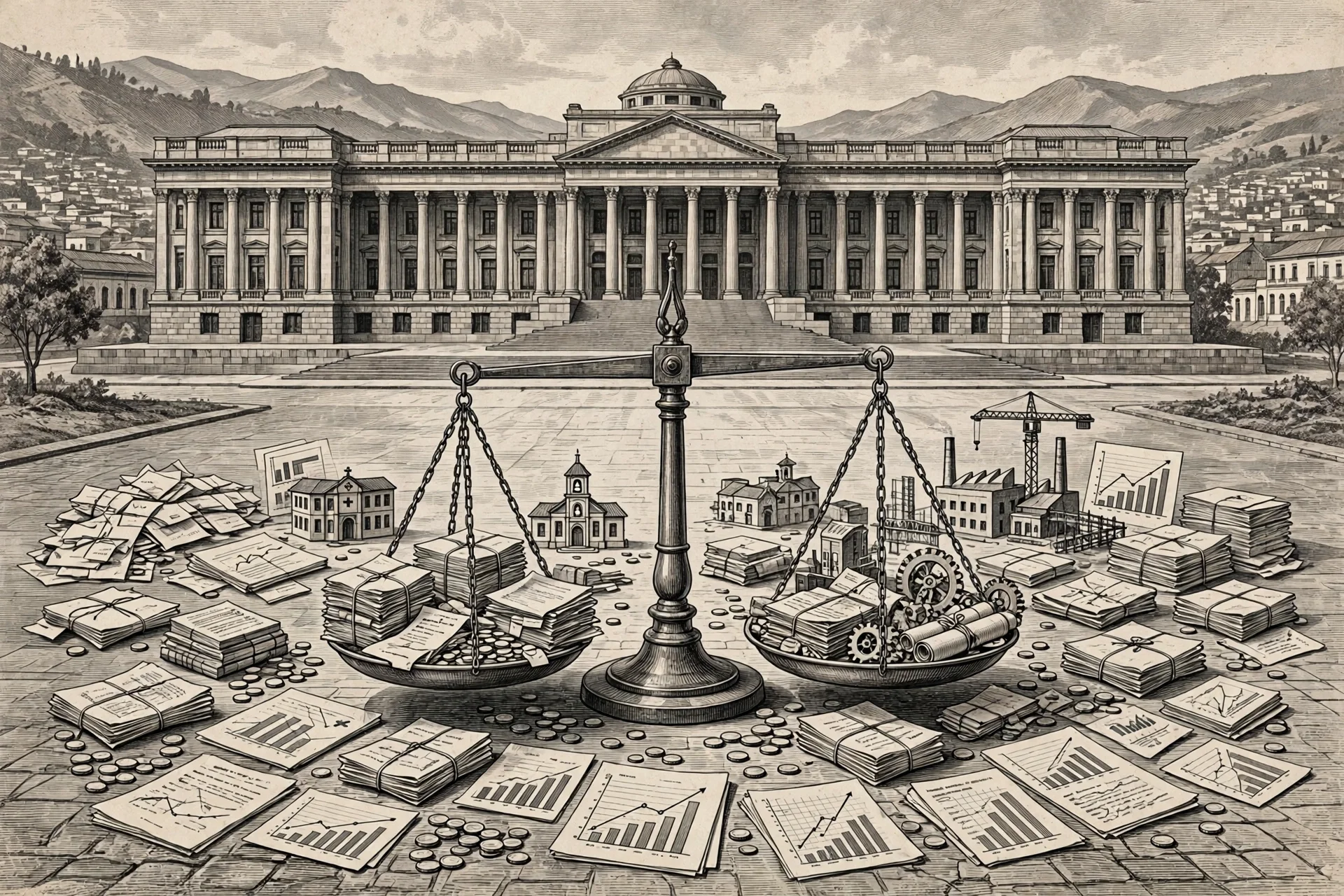
Ilustración alusiva al debate sobre el gasto público y la deuda en Colombia. · Imagen generada para EPM
Garcés calls for a $40 trillion spending cut and a debt rethink
Senator Christian Garcés, coordinating rapporteur of the General Budget of the Nation for 2027, proposed cutting $40 trillion from operating expenses, equal to…
Garcés proposes a $40 trillion cut and a reprofiled debt
Senator Christian Garcés proposed reducing the operating expenses of the State by $40 trillion, equal to two points of GDP, and rethinking the public debt of…
--- The context ---
Colombia is debating how its General Budget of the Nation for 2027 is divided, and the current distribution leaves little room to invest. According to Senator Christian Garcés, the coordinating rapporteur of that budget, the operating costs of the State absorb most resources, investment receives a reduced share and debt service takes another large portion of the total.
That structure has direct consequences for people's lives. When operating spending and financial commitments dominate the budget, fewer resources remain for infrastructure, social care and the recovery of territories hit by disasters, precisely where the presence of the State matters most for vulnerable populations across the country.
--- The facts ---
Garcés asked to cut $40 trillion from the operating expenses of the State and to rethink the public debt of the country. According to the figures he presented, operating costs represent 62% of the budget, investment corresponds to between 14% and 15%, and debt service equals 24% of the total allocation.
The proposed cut equals two points of GDP, and the amount planned for debt service amounted to $155 trillion. According to his account of the budget discussion, a reduction of $8 trillion was achieved in that item, resources that will go to energy and gas subsidies and to disaster relief related to the earthquake and the El Niño phenomenon.
--- The positions ---
The senator argued, in reported speech, that the country needs a structural change in the budget and that keeping the current level of operating spending limits the capacity of the Government to meet the needs of citizens. He also backed a fiscal adjustment or economic rescue law, while rejecting new taxes that affect companies and ventures, and defended strengthening the productive apparatus, increasing exports and generating employment.
In his proposal, reducing operating costs and reviewing the debt should expand investment without abandoning vulnerable populations. He also noted that talks with the International Monetary Fund remain open and that an eventual agreement could help recover international confidence, although he did not state that the negotiations have concluded.
--- What remains unknown ---
The details of the measures that the Executive will present under the fiscal adjustment are still unknown. According to what Garcés indicated, the Government was carrying out calculations and projections to define them, and his party expects to see that proposal to correct the fiscal imbalances, after first moving forward with the approval of the budget.
--- Unanswered questions ---
Which entities and programs would absorb the $40 trillion cut without losing essential services for citizens across the country? How would Colombia guarantee that the savings actually reach social investment and infrastructure instead of being lost along the way? What concrete mechanisms would allow the debt to be reprofiled while meeting the obligations of the State without committing such a high share of the budget?
--- EPM analysis ---
The underlying debate is not only how much the State spends, but what it spends on and whom each peso protects. An adjustment that frees resources can be positive if it shields social investment, health and reconstruction, because during the legislative process resources for medicines and health care were increased by $5 trillion and the budget of SENA had an increase of 25%, items that sustain basic rights.
Reconstruction after the earthquake requires, according to what was stated, close to $50 trillion over the next four years for areas such as Eje Cafetero, Chocó, Valle del Cauca and northern Cauca, and $3.8 trillion was secured in the budget to assist those affected. The distance between both figures shows that any cut must be measured by its impact on the territories, not only by its accounting size.
📌 EPM Take:
In EPM's view, the proposal by Garcés is right to point out that a budget where operating costs and debt dominate leaves investment in a permanent minority. The adjustment will be fair only if it protects vulnerable populations, sustains health, training and the reconstruction of affected territories, and turns every trillion saved into verifiable works and services. Cutting without that social shield would replace one imbalance with another, and the country already knows the cost of saving at the expense of those who have the least.
--- The context ---
The General Budget of the Nation for 2027 once again exposed a discipline problem: a State whose operating expenses consume most resources and leave investment in a secondary role. Senator Christian Garcés, the coordinating rapporteur of the budget, placed that distribution at the center of the debate and defended a structural reform of Colombian public spending.
When operating costs and debt service take the dominant share, the margin for infrastructure and growth narrows. Putting the accounts in order, in this reading, is not a minor accounting exercise: it is the condition for the State to meet its obligations without suffocating those who produce, build businesses and generate employment in the country.
--- The facts ---
The proposal consists of reducing operating expenses by $40 trillion, a figure equivalent to two points of GDP. The proportions described by the senator are clear: operating costs represent 62% of the budget, investment corresponds to between 14% and 15%, and debt service equals 24% of the total allocation.
The amount planned to service the debt amounted to $155 trillion, and during the budget discussion a reduction of $8 trillion was achieved in that item. Those resources will go to energy and gas subsidies, as well as to disaster relief related to the earthquake and the El Niño phenomenon, according to the account presented by the congressman himself.
--- The positions ---
Garcés proposed, in reported speech, that the costs of the State must be reviewed and that the debt must be transformed, rethought and reprofiled in order to meet the obligations acquired without committing such a high share of the budget. He also backed a fiscal adjustment or economic rescue law and stated that his party expects to see the proposal of the Government to correct the fiscal imbalances.
His rejection of new taxes was explicit in his approach: Centro Democrático does not back taxes that slow business growth and the creation of ventures. Instead, he defended strengthening the productive apparatus, increasing exports and generating employment, so that economic growth raises tax revenues without depending on new fiscal burdens on taxpayers.
--- What remains unknown ---
The Executive still has to present the concrete measures of the fiscal adjustment. According to what the senator explained, the Government was carrying out calculations and projections to define them, and regarding the talks with the International Monetary Fund he did not state that the negotiations have concluded, although he considered that an eventual agreement could recover international confidence.
--- Unanswered questions ---
What specific operating cuts will the Government present to approach the $40 trillion goal raised in the debate? What concrete alternatives will be evaluated to reorganize the financial commitments without failing to meet the obligations of the State? Will the Executive present the fiscal adjustment law with spending reductions, instead of resorting to new taxes on companies and ventures?
--- EPM analysis ---
The budget discussion also left signs of order in the priorities: resources for medicines and health care were increased by $5 trillion and the budget of SENA had an increase of 25%. Those decisions show that cutting operating costs does not mean neglecting sensitive fronts, as long as the savings come from the costs of the State and not from the services that citizens receive.
The territorial front reinforces the need to free resources with judgment. Reconstruction of the areas affected by the earthquake would require close to $50 trillion over the next four years, and $3.8 trillion was secured to assist those affected in regions such as Eje Cafetero, Chocó, Valle del Cauca and northern Cauca, allocations whose execution the senator said he will monitor closely.
📌 EPM Take:
In EPM's view, a State that allocates 62% of its budget to its own operation and barely between 14% and 15% to investment has a problem of order, not of revenue. The way out cannot be more taxes on companies and ventures, but less operating spending, a debt reprofiled with responsibility and growth that expands revenues in a sustained manner. The proposal by Garcés places discipline where it belongs: on the size of the state apparatus, not on the pockets of those who produce, build businesses and sustain employment across the country.
Garcés pide recortar $40 billones y replantear la deuda de Colombia
El senador Christian Garcés, coordinador ponente del Presupuesto General de la Nación para 2027, propuso reducir $40 billones del gasto de funcionamiento…
Garcés propone recortar $40 billones del gasto y reperfilar la deuda
El senador Christian Garcés propuso reducir $40 billones de los gastos de funcionamiento del Estado, equivalentes a dos puntos del PIB, y replantear la deuda…
--- El contexto ---
Colombia discute cómo se reparte su Presupuesto General de la Nación para 2027, y la distribución vigente deja poco margen para invertir. Según lo expuesto por el senador Christian Garcés, coordinador ponente de ese presupuesto, el funcionamiento del Estado absorbe la mayor parte de los recursos, la inversión recibe una fracción reducida y el servicio de la deuda ocupa otra porción elevada del total.
Esa estructura tiene consecuencias directas sobre la vida de las personas. Cuando el gasto de funcionamiento y los compromisos financieros concentran el presupuesto, quedan menos recursos para infraestructura, atención social y recuperación de los territorios golpeados por desastres, justo donde la presencia del Estado resulta más necesaria para las poblaciones vulnerables.
--- Los hechos ---
Garcés pidió reducir $40 billones de los gastos de funcionamiento del Estado y replantear la deuda pública del país. De acuerdo con las cifras que presentó, el funcionamiento representa el 62% del presupuesto, la inversión corresponde a entre el 14% y el 15%, y el servicio de la deuda equivale al 24% del total asignado.
El recorte que propone equivale a dos puntos del PIB, y el monto previsto para el servicio de la deuda ascendía a $155 billones. Según su balance de la discusión presupuestal, se logró una reducción de $8 billones en ese rubro, recursos que se destinarán a subsidios de energía y gas y a la atención de desastres relacionados con el terremoto y el fenómeno de El Niño.
--- Las posiciones ---
El senador sostuvo, en indirecto, que el país necesita un cambio estructural en el presupuesto y que mantener el nivel actual de funcionamiento limita la capacidad del Gobierno para atender las necesidades de los ciudadanos. También respaldó una ley de ajuste fiscal o rescate económico, aunque rechazó nuevos impuestos que afecten a las empresas y los emprendimientos, y defendió fortalecer el aparato productivo, aumentar las exportaciones y generar empleo.
En su planteamiento, la reducción del funcionamiento y la revisión de la deuda deben ampliar la inversión sin abandonar a las poblaciones vulnerables. Señaló además que las conversaciones con el Fondo Monetario Internacional siguen abiertas y que un eventual acuerdo podría contribuir a recuperar la confianza internacional, aunque no afirmó que las negociaciones hayan concluido.
--- Lo que falta saber ---
Todavía no se conoce el detalle de las medidas que el Ejecutivo presentará en el marco del ajuste fiscal. Según lo indicado por Garcés, el Gobierno estaba realizando cálculos y proyecciones para definirlas, y su partido espera conocer esa propuesta para corregir los desequilibrios fiscales, después de avanzar primero en la aprobación del presupuesto.
--- Preguntas sin respuesta ---
¿Qué entidades y programas absorberían el recorte de $40 billones sin perder servicios esenciales para la ciudadanía? ¿Cómo se garantizaría que el ahorro llegue efectivamente a inversión social e infraestructura y no se pierda en el camino? ¿Qué mecanismos concretos permitirían reperfilar la deuda cumpliendo las obligaciones del Estado sin comprometer una proporción tan elevada del presupuesto?
--- Análisis EPM ---
El debate de fondo no es solo cuánto gasta el Estado, sino en qué lo gasta y a quién protege cada peso. Un ajuste que libere recursos puede ser positivo si blinda la inversión social, la salud y la reconstrucción, porque durante el trámite legislativo se aumentaron en $5 billones los recursos para medicamentos y atención en salud y el presupuesto del SENA tuvo un incremento del 25%, partidas que sostienen derechos básicos.
La reconstrucción tras el terremoto exige, según lo señalado, cerca de $50 billones durante los próximos cuatro años para zonas como el Eje Cafetero, Chocó, Valle del Cauca y el norte del Cauca, y en el presupuesto se consiguieron $3,8 billones para atender a los damnificados. La distancia entre ambas cifras muestra que cualquier recorte debe medirse por su impacto en los territorios, no solo por su tamaño contable.
📌 Conclusion EPM:
A juicio de EPM, la propuesta de Garcés acierta al señalar que un presupuesto donde el funcionamiento y la deuda se imponen deja a la inversión en minoría permanente. El ajuste será justo solo si protege a las poblaciones vulnerables, sostiene la salud, la formación y la reconstrucción de los territorios afectados, y convierte cada billón ahorrado en obras y servicios verificables. Recortar sin ese blindaje social sería cambiar un desequilibrio por otro, y el país ya conoce el costo de ahorrar a costa de quienes menos tienen.
--- El contexto ---
El Presupuesto General de la Nación para 2027 volvió a exhibir un problema de disciplina: un Estado cuyos gastos de funcionamiento consumen la mayor parte de los recursos y dejan a la inversión en un papel secundario. El senador Christian Garcés, coordinador ponente del presupuesto, puso esa distribución en el centro del debate y defendió una reforma estructural del gasto público colombiano.
Cuando el funcionamiento y el servicio de la deuda se llevan la porción dominante, el margen para infraestructura y crecimiento se estrecha. Ordenar las cuentas, en esta lectura, no es un ejercicio contable menor: es la condición para que el Estado cumpla sus obligaciones sin asfixiar a quienes producen, emprenden y generan empleo en el país.
--- Los hechos ---
La propuesta consiste en reducir $40 billones de los gastos de funcionamiento, una cifra equivalente a dos puntos del PIB. Las proporciones descritas por el senador son claras: el funcionamiento representa el 62% del presupuesto, la inversión corresponde a entre el 14% y el 15%, y el servicio de la deuda equivale al 24% del total.
El monto previsto para atender la deuda ascendía a $155 billones, y durante la discusión presupuestal se logró una reducción de $8 billones en ese rubro. Esos recursos se destinarán a subsidios de energía y gas, así como a la atención de desastres relacionados con el terremoto y el fenómeno de El Niño, según el balance presentado por el propio congresista.
--- Las posiciones ---
Garcés planteó, en indirecto, que hay que revisar los costos del Estado y transformar, replantear y reperfilar la deuda para cumplir las obligaciones adquiridas sin comprometer una proporción tan elevada del presupuesto. Respaldó además una ley de ajuste fiscal o rescate económico y sostuvo que su partido espera conocer la propuesta del Gobierno para corregir los desequilibrios fiscales.
Su rechazo a nuevos impuestos fue explícito en su planteamiento: el Centro Democrático no respalda tributos que frenen el crecimiento empresarial y la creación de emprendimientos. En su lugar, defendió fortalecer el aparato productivo, aumentar las exportaciones y generar empleo, de modo que el crecimiento económico incremente los ingresos tributarios sin depender de nuevas cargas fiscales sobre los contribuyentes.
--- Lo que falta saber ---
Aún falta que el Ejecutivo presente las medidas concretas del ajuste fiscal. De acuerdo con lo expuesto por el senador, el Gobierno estaba realizando cálculos y proyecciones para definirlas, y sobre las conversaciones con el Fondo Monetario Internacional no afirmó que las negociaciones hayan concluido, aunque consideró que un eventual acuerdo podría recuperar la confianza internacional.
--- Preguntas sin respuesta ---
¿Qué recortes específicos de funcionamiento presentará el Gobierno para acercarse a la meta de $40 billones planteada en el debate? ¿Qué alternativas concretas se evaluarán para reorganizar los compromisos financieros sin incumplir las obligaciones del Estado? ¿Presentará el Ejecutivo la ley de ajuste fiscal con reducción del gasto, en lugar de acudir a nuevos impuestos sobre empresas y emprendimientos?
--- Análisis EPM ---
La discusión presupuestal dejó también señales de orden en las prioridades: se aumentaron en $5 billones los recursos destinados a medicamentos y atención en salud y el presupuesto del SENA tuvo un incremento del 25%. Esas decisiones muestran que recortar el funcionamiento no implica desatender frentes sensibles, siempre que el ahorro salga de los costos del Estado y no de los servicios que reciben los ciudadanos.
El frente territorial refuerza la necesidad de liberar recursos con criterio. La reconstrucción de las zonas afectadas por el terremoto requeriría cerca de $50 billones durante los próximos cuatro años, y se consiguieron $3,8 billones para atender a los damnificados en regiones como el Eje Cafetero, Chocó, Valle del Cauca y el norte del Cauca, partidas cuya ejecución el senador anunció que vigilará.
📌 Conclusion EPM:
A juicio de EPM, un Estado que destina el 62% de su presupuesto a funcionar y apenas entre el 14% y el 15% a invertir tiene un problema de orden, no de recaudo. La salida no puede ser más impuestos sobre empresas y emprendimientos, sino menos gasto de funcionamiento, una deuda reperfilada con responsabilidad y crecimiento que amplíe los ingresos de manera sostenida. La propuesta de Garcés pone la disciplina donde corresponde: en el tamaño del aparato estatal, no en el bolsillo de quienes producen, emprenden y sostienen el empleo del país.