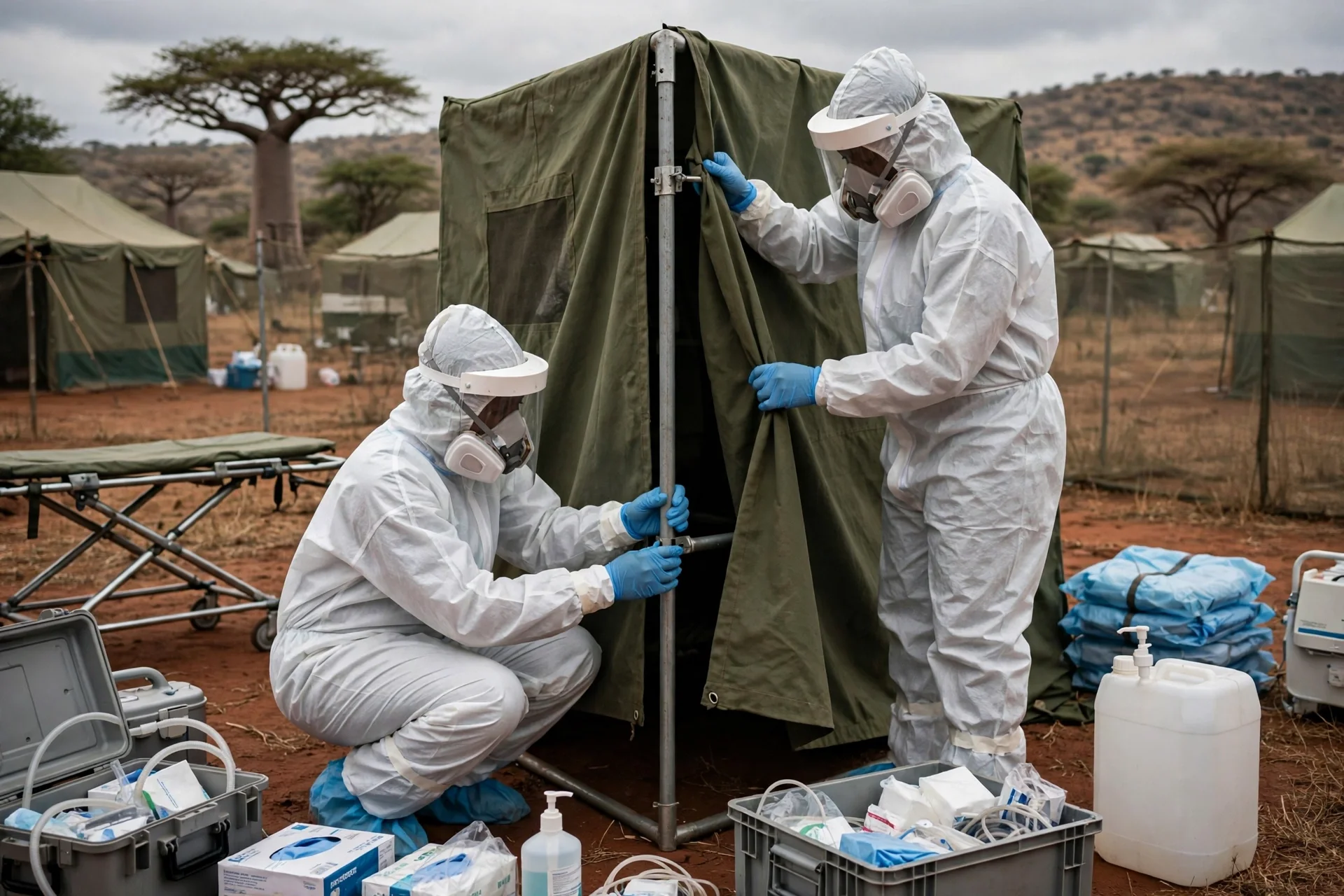
Imagen alusiva a la preparación de una unidad de respuesta sanitaria en África. · Imagen generada para EPM
Nigeria confirms first Bundibugyo Ebola case as regional response widens
Nigeria confirmed its first case of Bundibugyo Ebola virus disease in a woman who travelled from Uganda, with symptoms from 7 October and laboratory…
Nigeria's first Bundibugyo Ebola case tests readiness and early control
Nigeria confirmed its first case of Bundibugyo Ebola virus disease in a woman who arrived from Uganda and remains in isolation after laboratory confirmation on…
--- The context ---
Nigeria has confirmed its first case of Bundibugyo Ebola virus disease as a severe regional outbreak continues. The outbreak declared in the Democratic Republic of the Congo in mid-May is the deadliest in that country's history, with more than 9,500 cases and more than 4,200 deaths recorded as of 18 October, according to Congolese health authorities. There is no vaccine for the virus, so early detection and protection for communities and health workers are decisive.
--- The facts ---
The patient is a woman who recently travelled from Uganda and began showing symptoms on 7 October, four days after her arrival. She sought care at a private health facility in Abuja on 11 October, and laboratory testing confirmed the diagnosis on 20 October. She remains in isolation and is receiving medical care as investigations continue to determine the likely source of her infection and reconstruct her full travel and exposure history.
So far, 44 contacts have been identified and are being monitored amid intensified efforts to find other people who may have been exposed. Infection prevention and control measures are being ramped up in the private facility where the woman sought care. Nigeria is the fifth country to detect the disease since the outbreak was declared in the Democratic Republic of the Congo.
--- The positions ---
The Nigeria Centre for Disease Control and Prevention has activated its incident management system to coordinate response efforts. The World Health Organization said it is working closely with Nigerian health authorities and partners to strengthen case investigation, contact tracing and infection prevention and control, and that it is also assisting with essential supplies, including personal protective equipment for health workers. The agency stressed that rapid identification, timely follow-up of contacts and effective infection control are critical to contain the spread of the virus.
--- What remains unknown ---
The likely source of the patient's infection has not yet been determined, and her full travel and exposure history is still being reconstructed. It also remains unclear whether more exposed people will be found among those who may have encountered her before isolation, or how the regional outbreak centred on the Democratic Republic of the Congo will evolve in the coming weeks.
--- Unanswered questions ---
What was the exact source of the infection and what route did the patient follow from Uganda? Will new cases appear among the 44 contacts already being monitored or among people not yet located? Can tracing teams and laboratories sustain strong surveillance if the regional outbreak continues to spread?
--- EPM analysis ---
The response described combines international cooperation with local action. Uganda also faced a deadly outbreak that was officially declared over in late August, while nine cases have been reported in Kenya and one in the Netherlands linked to the Democratic Republic of the Congo. That regional path shows why shared capacity for investigation, tracing and supplies matters for protecting each community involved.
📌 EPM Take: In EPM's view, the confirmation in Nigeria makes sustained regional cooperation essential, because a single case identified quickly can prevent a larger chain if tracing and infection control work from the first day. The priority should be protecting health workers, supporting the contacts under monitoring and keeping laboratories able to test suspected cases, without turning to travel or trade restrictions that WHO has not recommended for affected countries, and sharing clear information with the communities most exposed to risk.
--- The context ---
Confirmation of the first case of Bundibugyo Ebola virus disease in Nigeria tests the country's health readiness against a grave regional outbreak. The outbreak declared in the Democratic Republic of the Congo in mid-May is the deadliest in that country's history, with more than 9,500 cases and more than 4,200 deaths recorded as of 18 October, according to Congolese health authorities. With no vaccine for the virus, constant surveillance and early control are the central tools available.
--- The facts ---
The patient is a woman who recently travelled from Uganda and began showing symptoms on 7 October, four days after her arrival. She sought care at a private health facility in Abuja on 11 October, and laboratory testing confirmed the diagnosis on 20 October. She remains in isolation and is receiving medical care as investigations continue to determine the likely source of her infection and reconstruct her full travel and exposure history.
So far, 44 contacts have been identified and are being monitored amid intensified efforts to find other people who may have been exposed. Infection prevention and control measures are being ramped up in the private facility where the woman sought care. Nigeria is the fifth country to detect the disease since the outbreak was declared in the Democratic Republic of the Congo.
--- The positions ---
The Nigeria Centre for Disease Control and Prevention has activated its incident management system to coordinate response efforts. The World Health Organization said it is supporting Nigerian authorities and working with partners on case investigation, contact tracing and infection prevention and control, along with essential supplies including personal protective equipment for health workers. The agency stressed that rapid identification, timely follow-up and effective control are critical, and advised countries in the region to sustain a high level of readiness, maintain strong disease surveillance and ensure laboratories can safely test suspected cases.
--- What remains unknown ---
The likely source of the infection has not yet been established, and the reconstruction of the patient's full travel and exposure history is not complete. It is also unknown whether further exposures will emerge among people not yet located, or how long monitoring of the identified contacts must be sustained while the outbreak in the Democratic Republic of the Congo continues to evolve.
--- Unanswered questions ---
Where and how did the exposure behind this confirmed Nigerian case occur? Will every person who may have been exposed before the patient was isolated be located? Is surveillance ready to detect a second case immediately if one appears in the coming days?
--- EPM analysis ---
The case underlines the value of acting on the first signal and isolating without delay. Uganda faced a deadly outbreak officially declared over in late August, while nine cases have been reported in Kenya and one in the Netherlands linked to the Democratic Republic of the Congo. Against that regional background, disciplined infection control in the facility that treated the patient and orderly follow-up of every contact will decide whether this episode stays contained.
📌 EPM Take: In EPM's view, Nigeria should treat this first confirmation as a demanding test of national readiness: firm isolation, complete tracing of the 44 contacts and sustained surveillance while the regional outbreak remains active. Early control, laboratories able to test suspected cases and protective equipment for health workers make the difference, within a framework in which WHO has not recommended travel or trade restrictions with affected countries, and with clear, verifiable information for the public at every step of the response.
Nigeria confirma su primer caso de Ébola Bundibugyo y activa la respuesta
Nigeria confirmó su primer caso de enfermedad por virus Ébola Bundibugyo en una mujer que viajó desde Uganda, con síntomas desde el 7 de octubre y confirmación…
Primer caso de Ébola Bundibugyo en Nigeria: aislamiento y control temprano
Nigeria confirmó su primer caso de enfermedad por virus Ébola Bundibugyo en una mujer llegada desde Uganda, aislada en Abuja tras la confirmación del 20 de…
--- El contexto ---
Nigeria confirmó su primer caso de enfermedad por virus Ébola Bundibugyo ante un brote regional que sigue activo. El brote declarado en la República Democrática del Congo a mediados de mayo es el más letal de su historia, con más de 9,500 casos y más de 4,200 muertes registradas al 18 de octubre, según las autoridades congoleñas. No existe vacuna contra el virus, por lo que detectar a tiempo y proteger a las comunidades resulta decisivo para evitar nuevos contagios.
--- Los hechos ---
La paciente es una mujer que viajó recientemente desde Uganda y comenzó a mostrar síntomas el 7 de octubre, cuatro días después de su llegada. Buscó atención en un centro privado de Abuja el 11 de octubre y las pruebas de laboratorio confirmaron el diagnóstico el 20 de octubre. Permanece aislada y bajo atención médica mientras continúa la investigación para determinar la fuente probable de su infección y reconstruir su historial completo de viaje y exposición.
Hasta ahora se han identificado 44 contactos que están siendo monitoreados, en medio de esfuerzos intensificados para localizar a otras personas que pudieron haber estado expuestas. En el centro privado donde la mujer buscó atención se están reforzando las medidas de prevención y control de infecciones. Nigeria es el quinto país que detecta la enfermedad desde que se declaró el brote en la República Democrática del Congo.
--- Las posiciones ---
El Nigeria Centre for Disease Control and Prevention activó su sistema de gestión de incidentes para coordinar la respuesta. La Organización Mundial de la Salud señaló que trabaja junto a las autoridades nigerianas y sus socios para fortalecer la investigación de casos, el rastreo de contactos y el control de infecciones, además de apoyar el suministro de materiales esenciales, incluido equipo de protección para el personal sanitario. La agencia subrayó que la identificación rápida, el seguimiento oportuno de contactos y un control eficaz de infecciones son críticos para contener la propagación del virus.
--- Lo que falta saber ---
Todavía no se ha determinado la fuente probable de la infección de la paciente ni se ha reconstruido por completo su historial de viaje y exposición. Tampoco está claro si aparecerán más personas expuestas entre quienes pudieron coincidir con ella antes del aislamiento, ni cómo evolucionará el brote regional que sigue activo en la República Democrática del Congo y que condiciona la preparación de los países vecinos.
--- Preguntas sin respuesta ---
¿Cuál fue la fuente exacta de la infección y qué ruta siguió la paciente desde Uganda? ¿Aparecerán nuevos casos entre los 44 contactos ya monitoreados o entre personas aún no localizadas? ¿Podrán los equipos de rastreo y los laboratorios sostener la vigilancia si el brote regional continúa extendiéndose?
--- Análisis EPM ---
La respuesta descrita combina cooperación internacional y acción local. Uganda ya enfrentó un brote letal declarado terminado a finales de agosto, y se han reportado nueve casos en Kenia y uno en Países Bajos vinculados al de la República Democrática del Congo. Ese recorrido muestra que la protección de cada comunidad depende también de la capacidad compartida para investigar casos, rastrear contactos y sostener suministros en el terreno.
📌 Conclusion EPM: A juicio de EPM, la confirmación en Nigeria obliga a sostener la cooperación regional sin pausas, porque un solo caso detectado a tiempo puede evitar una cadena mayor si el rastreo y el control de infecciones funcionan desde el primer día. La prioridad debe ser proteger al personal sanitario, acompañar a los contactos monitoreados y mantener laboratorios capaces de analizar casos sospechosos, sin recurrir a restricciones de viaje o comercio que la OMS no ha recomendado para los países afectados.
--- El contexto ---
La confirmación del primer caso de enfermedad por virus Ébola Bundibugyo en Nigeria pone a prueba la preparación sanitaria del país frente a un brote regional grave. El brote declarado en la República Democrática del Congo a mediados de mayo es el más letal de su historia, con más de 9,500 casos y más de 4,200 muertes al 18 de octubre, según las autoridades congoleñas. Sin vacuna, la vigilancia y el control temprano son las herramientas centrales.
--- Los hechos ---
La paciente es una mujer que viajó recientemente desde Uganda y comenzó a mostrar síntomas el 7 de octubre, cuatro días después de su llegada. Buscó atención en un centro privado de Abuja el 11 de octubre y las pruebas de laboratorio confirmaron el diagnóstico el 20 de octubre. Permanece aislada y bajo atención médica mientras se investiga la fuente probable de su infección y se reconstruye su historial de viaje y exposición.
Hasta ahora se han identificado 44 contactos que están siendo monitoreados, en medio de esfuerzos intensificados para localizar a otras personas que pudieron haber estado expuestas. En el centro privado donde la mujer buscó atención se están reforzando las medidas de prevención y control de infecciones. Nigeria es el quinto país que detecta la enfermedad desde que se declaró el brote en la República Democrática del Congo.
--- Las posiciones ---
El Nigeria Centre for Disease Control and Prevention activó su sistema de gestión de incidentes para coordinar la respuesta. La Organización Mundial de la Salud indicó que apoya a las autoridades nigerianas y trabaja con socios para fortalecer la investigación de casos, el rastreo de contactos y el control de infecciones, además de asistir con materiales esenciales y equipo de protección sanitaria. La agencia subrayó que la identificación rápida, el seguimiento oportuno de contactos y un control eficaz son críticos, y aconsejó a los países de la región mantener una preparación alta, una vigilancia fuerte y laboratorios capaces de analizar casos sospechosos.
--- Lo que falta saber ---
Aún no se ha establecido la fuente probable de la infección ni se ha completado la reconstrucción del historial de viaje y exposición de la paciente. Tampoco se sabe si surgirán más exposiciones entre personas aún no localizadas, ni cuánto deberá sostenerse el monitoreo mientras el brote congoleño sigue evolucionando.
--- Preguntas sin respuesta ---
¿Dónde y cómo se produjo la exposición que originó este caso confirmado en Nigeria? ¿Se localizará a todas las personas que pudieron estar expuestas antes de que la paciente quedara aislada? ¿Está la vigilancia preparada para detectar de inmediato un segundo caso si aparece en los próximos días?
--- Análisis EPM ---
El caso muestra la importancia de detectar en la primera señal y de aislar sin demora. Uganda enfrentó un brote letal declarado terminado a finales de agosto, y se han reportado nueve casos en Kenia y uno en Países Bajos vinculados al de la República Democrática del Congo. Con ese antecedente, la disciplina en el control de infecciones en el centro que la atendió y el seguimiento de cada contacto definen si el episodio queda contenido.
📌 Conclusion EPM: A juicio de EPM, Nigeria debe convertir esta primera confirmación en una prueba exigente de su preparación nacional: aislamiento firme, rastreo completo de los 44 contactos y vigilancia sostenida sin bajar la guardia mientras el brote regional siga activo. El control temprano, los laboratorios capaces de analizar casos sospechosos y el equipo de protección para el personal sanitario marcan la diferencia, dentro de un marco donde la OMS no ha recomendado restricciones de viaje ni de comercio con los países afectados.