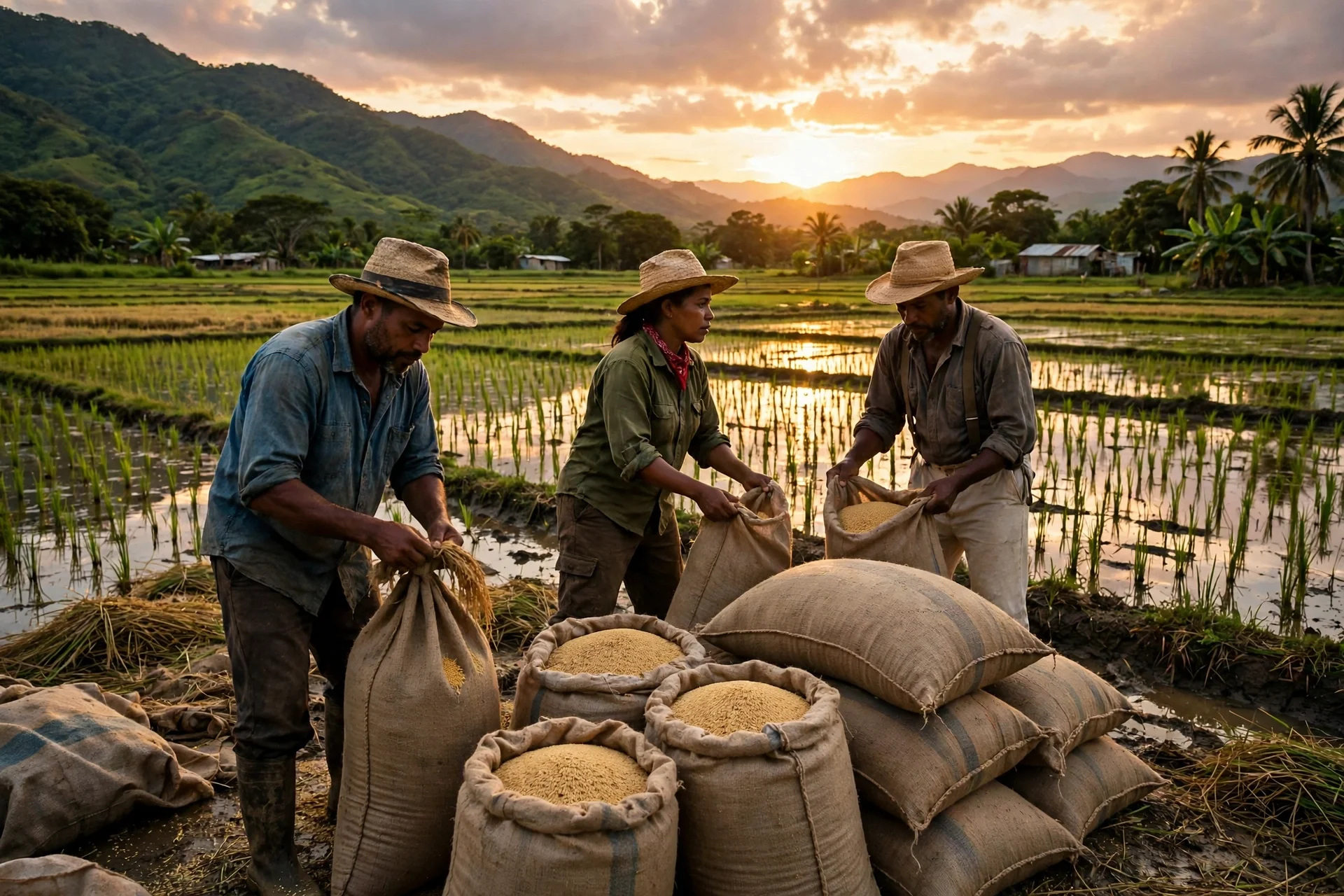
Arrozales y sacos de arroz en el campo dominicano al atardecer. · Imagen generada por EPM
Abinader defends domestic rice as a food security priority
Luis Abinader said the rice sector, including Fenarroz, was informed before Decree 693-24 was repealed and vowed to defend domestic rice production as a…
Abinader vows to defend national rice production
Luis Abinader said Fenarroz and the rice commission knew about the repeal of Decree 693-24 through Decree 635-26 and vowed to defend national rice production…
--- The context ---
Rice sits at the center of the Dominican diet and of income across wide rural areas. The tariff debate is therefore not only about trade: it concerns food security, rural jobs and the country's ability to sustain its own production against imports from the United States under DR-Cafta, after Washington stressed access for its rice to the Dominican market.
--- The facts ---
President Luis Abinader said on Wednesday, during a press conference at the Palacio Nacional, that the government would defend domestic rice production in trade negotiations with the United States, describing the grain as strategic for food security. He also said representatives of the rice sector had been informed in advance about the measures the government would adopt.
The controversy stems from the repeal of Decree 693-24 through Decree 635-26, issued on September 9, 2026. The previous framework set a tariff of 20 % within certain import quotas and 99 % beyond them, along with a quota of 23,300 metric tons of rice from the United States at zero tariff, while imports above that amount were subject to the Most Favored Nation tariff.
--- The positions ---
Abinader said that rice production is a matter of national security and would be defended as such in the negotiations, and he stated that all participants had been informed, including Fenarroz, which took part in a prior meeting. Confenagro warned that the change could affect national producers and asked the government to clarify its protective measures. The Ministerio de Agricultura said the repeal does not mean abandoning the sector and that it would keep working to improve productivity and competitiveness.
The government also reported on October 18 that representatives of the rice sector expressed support for the authorities and confidence in the negotiations. According to government figures, white rice production rose from 9.2 million quintals in 2005 to nearly 14.8 million in 2025, growth attributed to productivity improvements, new varieties and support for the sector. The same press conference also included a review of works linked to funds from an airport agreement.
--- What remains unknown ---
The concrete measures that would replace the repealed tariff protection remain undisclosed, as does the outcome the Dominican Republic seeks to secure in its negotiations with the United States. It is also unclear what support producers would receive if imported rice competition increases.
--- Unanswered questions ---
What concrete measures will the government apply to protect producers after repealing Decree 693-24? How will rural jobs be safeguarded if imports of rice grow? What minimum outcome will the Dominican Republic accept in its negotiations with the United States?
--- EPM analysis ---
The debate separates into two different issues. One is whether the sector was informed beforehand, which the president presents as settled through Fenarroz and the rice commission. The other is the practical effect of removing a protection that combined tariffs with a zero-tariff quota. Being informed about a decision is not the same as being shielded from its impact on prices, planting and rural income.
📌 EPM Take: In EPM's view, defending domestic rice requires more than a national security slogan, because trade opening has already changed the rules that protected the sector and producers need verifiable certainty on support, productivity and rural employment. The advance briefing given to Fenarroz orders the debate, but it does not settle it. The government would gain credibility by publishing the concrete measures that will accompany the negotiation with the United States before imported competition begins to pressure prices, incomes and planting across the country's rice-growing regions.
--- The context ---
Domestic rice production underpins the Dominican table and forms part of the country's food sovereignty. When a government withdraws tariff protection in dealings with a larger trading partner, the minimum requirement is full clarity: what was decided, who was informed, and how production grown on Dominican soil will be defended throughout the negotiation.
--- The facts ---
President Luis Abinader said on Wednesday, at a press conference at the Palacio Nacional, that the government would defend domestic rice production in trade negotiations with the United States, describing the grain as a strategic product. He also maintained that representatives of the rice sector had been informed in advance about the measures, including the repeal of the protective decree.
Decree 693-24 was repealed through Decree 635-26, issued on September 9, 2026. The repealed framework set a tariff of 20 % within certain import quotas and 99 % beyond them, together with a quota of 23,300 metric tons of rice from the United States at zero tariff, while imports above that amount were subject to the Most Favored Nation tariff, within the DR-Cafta context.
--- The positions ---
Abinader said that rice production is a matter of national security and is being defended as such in the negotiations, and he stated that all participants had been informed, including Fenarroz, which attended a prior meeting. Confenagro warned about the possible effect on producers and asked the government to clarify its protective measures. The Ministerio de Agricultura replied that the repeal does not mean abandoning the sector and that it would continue promoting its productivity and competitiveness.
The government reported on October 18 that representatives of the rice sector expressed support for the authorities and confidence in the negotiations. According to official figures, white rice production rose from 9.2 million quintals in 2005 to nearly 14.8 million in 2025, an advance attributed to productivity improvements, new varieties and support for the sector. The same press conference also included a review of works linked to funds from an airport agreement.
--- What remains unknown ---
The precise content of the negotiating strategy remains unknown, as do the domestic measures that would protect national production without the previous tariff shield. Without that detail, the announced defense remains a political commitment still awaiting verifiable instruments.
--- Unanswered questions ---
What concrete instruments will replace the protection of Decree 693-24 for domestic rice? Will the government publish the strategy it will take into the negotiation with the United States? How will national production be protected if access for imported rice expands under DR-Cafta?
--- EPM analysis ---
The strength of the presidential announcement lies in its principle: treating rice as a national security matter places domestic production above immediate trade convenience. Its weakness lies in the sequence, because protection was repealed before any replacement mechanism was presented. On food sovereignty, the order of steps does shape the outcome and the sector's confidence in the process.
📌 EPM Take: In EPM's view, defending national production is the right criterion and the advance briefing given to Fenarroz and the rice commission clears up part of the controversy, but food sovereignty is not protected by statements at the Palacio Nacional alone. The government should publish without delay the measures that will accompany the negotiation with the United States. If the negotiation preserves the capacity to produce the rice the country consumes, the decision will have been worthwhile; if it weakens that capacity, no press conference will make up for it.
Abinader defiende el arroz nacional como seguridad alimentaria
Luis Abinader aseguró que el sector arrocero, incluida Fenarroz, fue informado antes de derogar el decreto 693-24 y que defenderá la producción nacional de…
Abinader promete defender la producción nacional de arroz
Luis Abinader sostuvo que Fenarroz y la comisión arrocera conocían la derogación del decreto 693-24 por el decreto 635-26 y prometió defender la producción…
--- El contexto ---
El arroz ocupa un lugar central en la alimentación dominicana y en el ingreso de amplias zonas rurales. Por eso la discusión sobre aranceles no es solo comercial: toca la seguridad alimentaria, el empleo en el campo y la capacidad del país para sostener su producción frente a importaciones procedentes de Estados Unidos en el marco del DR-Cafta.
--- Los hechos ---
El presidente Luis Abinader aseguró este miércoles, durante una rueda de prensa en el Palacio Nacional, que el Gobierno defenderá la producción nacional de arroz en las negociaciones comerciales con Estados Unidos, al considerar este cereal un producto estratégico para la seguridad alimentaria. También sostuvo que los representantes del sector fueron informados previamente sobre las medidas que adoptaría el Gobierno.
La controversia gira en torno a la derogación del decreto 693-24 mediante el decreto 635-26, emitido el 9 de septiembre de 2026. El régimen anterior establecía un arancel de 20 % dentro de determinados contingentes y de 99 % fuera de estos, además de una cuota de 23,300 toneladas métricas de arroz procedente de Estados Unidos con arancel cero, mientras el exceso quedaba sujeto al arancel de Nación Más Favorecida.
--- Las posiciones ---
Abinader aseguró que la producción del arroz es de seguridad nacional y que así se defenderá en las negociaciones, y afirmó que a todos los participantes se les informó, incluida Fenarroz, que tomó parte en una reunión previa. Confenagro advirtió que el cambio podría afectar a los productores y pidió aclarar las medidas de protección. El Ministerio de Agricultura aseguró que la derogación no significa abandonar al sector y que seguirá impulsando su productividad y competitividad.
El Gobierno informó además el 18 de octubre que representantes del sector arrocero expresaron su respaldo a las autoridades y confianza en las negociaciones. Según datos divulgados por el Gobierno, la producción de arroz blanco pasó de 9,2 millones de quintales en 2005 a cerca de 14,8 millones en 2025, crecimiento atribuido a mejoras de productividad, desarrollo de variedades y apoyos al sector. La misma rueda de prensa incluyó un balance de obras vinculadas a fondos de un acuerdo aeroportuario.
--- Lo que falta saber ---
Todavía no se conocen las medidas que sustituirán la protección derogada ni el resultado que República Dominicana busca en la negociación con Estados Unidos. Tampoco está claro qué apoyos recibirán los productores si aumenta la competencia importada.
--- Preguntas sin respuesta ---
¿Qué medidas concretas aplicará el Gobierno para proteger a los productores tras derogar el decreto 693-24? ¿Cómo se garantizarán los empleos rurales si crece la entrada de arroz importado? ¿Qué resultado mínimo aceptará República Dominicana en la negociación con Estados Unidos?
--- Análisis EPM ---
El debate ordena dos planos distintos. Uno es la información previa al sector, que el presidente presenta como cumplida con Fenarroz y la comisión arrocera. El otro es el efecto práctico de retirar una protección que combinaba aranceles y una cuota con arancel cero. Informar una decisión no equivale a neutralizar su impacto sobre precios, siembras e ingresos rurales.
📌 Conclusion EPM: A juicio de EPM, defender el arroz nacional exige más que una consigna de seguridad nacional, porque la apertura comercial ya cambió las reglas que protegían al sector y los productores necesitan certezas verificables sobre apoyo, productividad y empleo rural. La información previa a Fenarroz ordena el debate, pero no lo cierra. El Gobierno gana credibilidad si publica las medidas concretas que acompañarán la negociación con Estados Unidos y si esas medidas llegan antes de que la competencia importada presione precios, ingresos y siembras en las zonas arroceras del país.
--- El contexto ---
La producción nacional de arroz sostiene la mesa dominicana y forma parte de la soberanía alimentaria del país. Cuando un gobierno retira una protección arancelaria frente a un socio comercial mayor, la exigencia mínima es claridad total: qué se decidió, a quién se informó y cómo se defenderá lo producido en suelo dominicano durante la negociación.
--- Los hechos ---
El presidente Luis Abinader aseguró este miércoles, en una rueda de prensa en el Palacio Nacional, que el Gobierno defenderá la producción nacional de arroz en las negociaciones comerciales con Estados Unidos, al considerar este cereal un producto estratégico. Sostuvo además que los representantes del sector arrocero fueron informados previamente sobre las medidas, incluida la derogación del decreto de protección.
El decreto 693-24 fue derogado mediante el decreto 635-26, emitido el 9 de septiembre de 2026. El régimen derogado fijaba un arancel de 20 % dentro de determinados contingentes y de 99 % fuera de estos, junto a una cuota de 23,300 toneladas métricas de arroz procedente de Estados Unidos con arancel cero, mientras el exceso quedaba sujeto al arancel de Nación Más Favorecida, en el contexto del DR-Cafta.
--- Las posiciones ---
Abinader aseguró que la producción del arroz es de seguridad nacional y que así se está defendiendo en las negociaciones, y afirmó que a todos los participantes se les informó, incluida Fenarroz, presente en una reunión previa. Confenagro advirtió sobre el posible efecto en los productores y pidió al Gobierno aclarar las medidas de protección. El Ministerio de Agricultura respondió que la derogación no significa abandonar al sector y que continuará impulsando su productividad y competitividad.
El Gobierno informó el 18 de octubre que representantes del sector arrocero expresaron respaldo a las autoridades y confianza en las negociaciones. De acuerdo con datos oficiales, la producción de arroz blanco pasó de 9,2 millones de quintales en 2005 a cerca de 14,8 millones en 2025, avance atribuido a mejoras de productividad, nuevas variedades y apoyos al sector. La misma rueda de prensa incluyó un balance de obras vinculadas a fondos de un acuerdo aeroportuario.
--- Lo que falta saber ---
Falta conocer el contenido preciso de la estrategia negociadora y las medidas internas que protegerán la producción nacional sin el paraguas arancelario anterior. Sin ese detalle, la defensa anunciada queda como compromiso político pendiente de instrumentos verificables.
--- Preguntas sin respuesta ---
¿Qué instrumentos concretos reemplazarán la protección del decreto 693-24 para el arroz nacional? ¿Publicará el Gobierno la estrategia que llevará a la negociación con Estados Unidos? ¿Cómo se protegerá la producción nacional si el acceso del arroz importado se amplía en el marco del DR-Cafta?
--- Análisis EPM ---
La fortaleza del anuncio presidencial está en el principio: tratar el arroz como asunto de seguridad nacional coloca la producción propia por encima de la conveniencia comercial inmediata. Su debilidad está en la secuencia, porque la protección se derogó antes de presentar el mecanismo sustituto. En materia de soberanía alimentaria, el orden de los factores sí altera el resultado y la confianza del sector.
📌 Conclusion EPM: A juicio de EPM, la defensa de la producción nacional es el criterio correcto y la información previa a Fenarroz y a la comisión arrocera despeja una parte de la controversia, pero la soberanía alimentaria no se protege solo con declaraciones en el Palacio Nacional. El Gobierno debe publicar sin demora las medidas que acompañarán la negociación con Estados Unidos. Si la negociación preserva la capacidad de producir el arroz que consume el país, la decisión habrá valido; si la debilita, ninguna rueda de prensa podrá compensarlo.