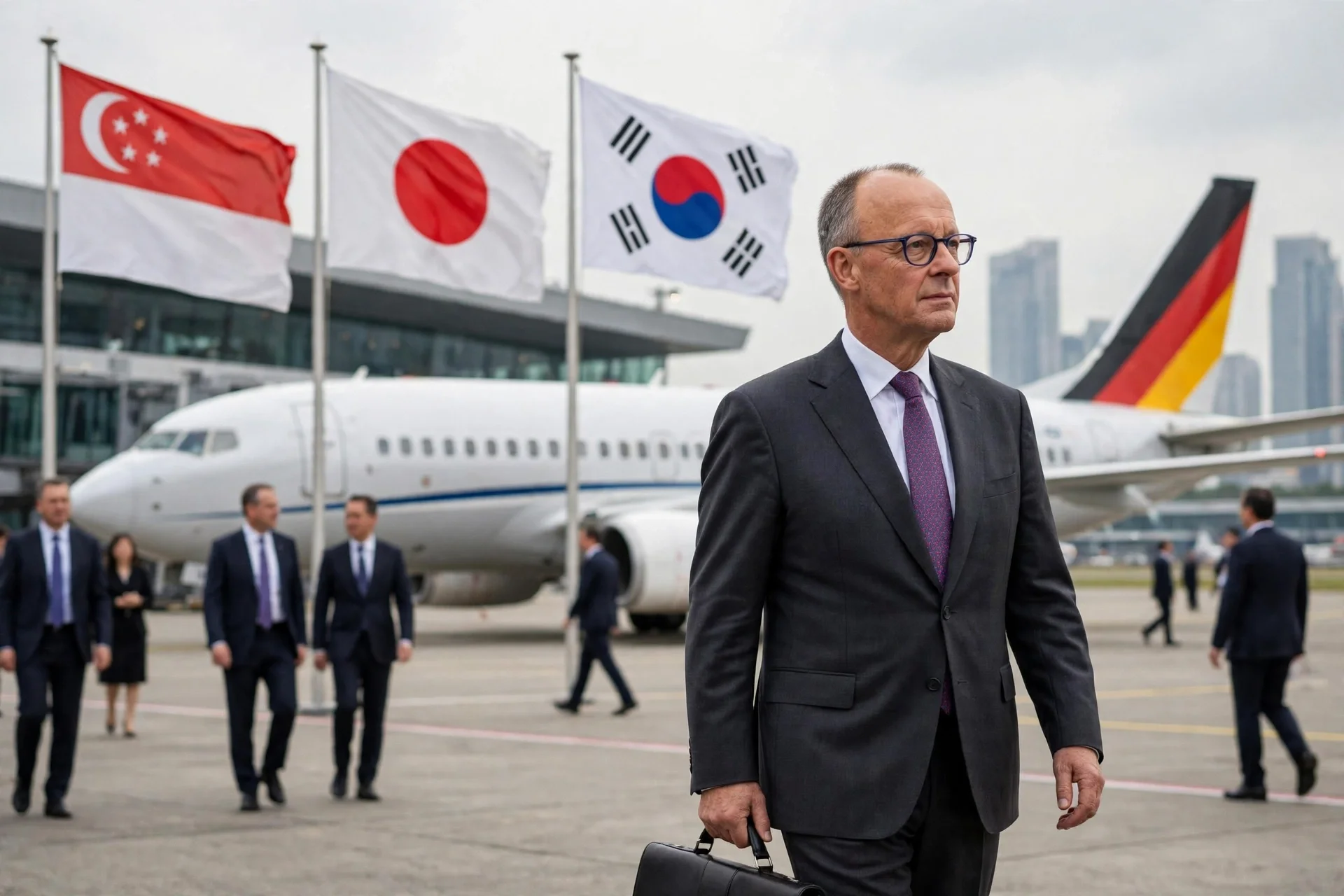
Gira asiática del canciller Merz del 26 al 30 de octubre de 2026 · Imagen generada por EPM
Merz to visit Singapore, Japan and South Korea from October 26 to 30
Chancellor Friedrich Merz will visit Singapore, Japan and the Republic of Korea from October 26 to 30, 2026, meeting Lawrence Wong, Sanae Takaichi and Lee Jae…
Merz to tour Singapore, Japan and Korea on a five-day Asia trip
Friedrich Merz will tour Singapore, Japan and South Korea from October 26 to 30, 2026, accompanied by a business delegation, with meetings with all three heads…
--- The context ---
German Chancellor Friedrich Merz will tour Asia from October 26 to 30, 2026. It brings together three close partners in the region: Singapore, Japan and the Republic of Korea.
--- The facts ---
On Tuesday, October 27, Merz will hold talks in Singapore with Prime Minister Lawrence Wong and is also scheduled to meet President Tharman Shanmugaratnam. He will also deliver a speech at the Singapore Lecture.
On October 28 he will travel to Japan, where Prime Minister Sanae Takaichi will receive him in Tokyo; he will join the German-Japanese Business Summit and visit a Japanese company with German cooperation. From Thursday, October 29, he will be in South Korea: in Seoul he will meet President Lee Jae Myung, on Friday, October 30, he will open the nineteenth Asia-Pacific Conference of German Business, and he will visit the Demilitarized Zone on the border with North Korea.
--- The positions ---
The stated position is clear: the visit seeks to deepen cooperation on security and economic matters with these close partners. Merz will be accompanied by a business delegation.
--- What remains unknown ---
The announcement details no agreements to be signed or expected outcomes. Nor does it specify which Japanese company will be visited or the topics of each bilateral talk.
--- Unanswered questions ---
What concrete commitments will emerge from the meetings in Singapore, Tokyo and Seoul? Will security agreements be announced, or only statements of intent? What role will the business delegation play at each stop of the tour?
--- EPM analysis ---
The sequence matters: opening in Singapore, passing through the Tokyo business summit and closing in Seoul combines a political and a commercial message across five days, three capitals and two economic forums.
📌 EPM Take:
In EPM's view, the tour is right to join diplomacy and economics in a single agenda, because cooperation with close partners in Asia can no longer separate security from trade. Its real value will not lie in the photographs from Tokyo, Singapore and Seoul, but in whether the business delegation returns with concrete commitments and public follow-up. Without verifiable results, the trip will remain a correct gesture that falls short of its stated ambition.
--- The context ---
Friedrich Merz will make an official visit to Singapore, Japan and the Republic of Korea from October 26 to 30, 2026. They are three close partners in Asia, gathered in a single five-day trip.
--- The facts ---
The first stop will be Singapore on Tuesday, October 27, with talks with Prime Minister Lawrence Wong and a meeting with President Tharman Shanmugaratnam. Merz will also speak at the Singapore Lecture.
On Wednesday, October 28, he will continue to Japan, where Prime Minister Sanae Takaichi will receive him in Tokyo; the agenda includes the German-Japanese Business Summit and a Japanese company with German cooperation. The final leg, from Thursday, October 29, will be South Korea: a meeting in Seoul with President Lee Jae Myung, the opening on Friday, October 30, of the nineteenth Asia-Pacific Conference of German Business, and a visit to the Demilitarized Zone on the border with North Korea.
--- The positions ---
The declared purpose is to deepen cooperation on security and economics with these close partners. The business delegation accompanying the chancellor confirms the weight of trade alongside diplomacy.
--- What remains unknown ---
No agreements or figures have been announced in advance. It remains to be seen what each meeting will contain and whether the Tokyo and Seoul forums produce verifiable announcements.
--- Unanswered questions ---
Will there be signed agreements or only working meetings in the three capitals? What will be announced after the visit to the Demilitarized Zone? Will the business delegation close concrete commitments during the tour?
--- EPM analysis ---
The order sends a message of continuity: each stop combines a meeting with the host government and an economic component. Closing in Seoul, with the conference and the border gesture, underlines the link between security and prosperity.
📌 EPM Take:
In EPM's view, the trip defends a sensible idea: Germany should tend to its Asian partners with presence at the highest level, without promising more than it can deliver. The visit to the Demilitarized Zone adds seriousness on security and the business delegation adds pragmatism. The demand now is disciplined follow-through: clear agreements, orderly monitoring and results that justify five days of travel at the highest level of government.
Merz viajará a Singapur, Japón y Corea del Sur del 26 al 30 de octubre
El canciller Friedrich Merz visitará Singapur, Japón y la República de Corea del 26 al 30 de octubre de 2026, con reuniones con Lawrence Wong, Sanae Takaichi y…
Merz visitará Singapur, Japón y Corea en una gira de cinco días
Friedrich Merz realizará del 26 al 30 de octubre de 2026 una gira por Singapur, Japón y Corea del Sur, acompañado por una delegación económica, con encuentros…
--- El contexto ---
El canciller alemán, Friedrich Merz, emprenderá una gira por Asia del 26 al 30 de octubre de 2026. Reunirá a tres socios cercanos en la región: Singapur, Japón y la República de Corea.
--- Los hechos ---
El martes 27 de octubre, Merz mantendrá conversaciones en Singapur con el primer ministro, Lawrence Wong, y tiene previsto reunirse también con el presidente, Tharman Shanmugaratnam. Además, pronunciará un discurso en la Singapore Lecture.
El 28 de octubre viajará a Japón, donde lo recibirá en Tokio la primera ministra, Sanae Takaichi; participará en el German-Japanese Business Summit y visitará una empresa japonesa con cooperación alemana. Desde el jueves 29 estará en Corea del Sur: en Seúl se reunirá con el presidente, Lee Jae Myung, el viernes 30 abrirá la decimonovena Conferencia Asia-Pacífico de la Economía Alemana y visitará la Zona Desmilitarizada fronteriza con Corea del Norte.
--- Las posiciones ---
La posición del anuncio es clara: la visita busca profundizar la cooperación en seguridad y en economía con estos socios cercanos. Merz viajará acompañado por una delegación económica.
--- Lo que falta saber ---
El anuncio no detalla acuerdos a firmar ni resultados esperados de cada encuentro. Tampoco precisa qué empresa japonesa será visitada ni los temas de cada conversación bilateral.
--- Preguntas sin respuesta ---
¿Qué compromisos concretos saldrán de las reuniones en Singapur, Tokio y Seúl? ¿Se anunciarán acuerdos de seguridad o solo declaraciones de intención? ¿Qué papel jugará la delegación económica en cada parada de la gira?
--- Análisis EPM ---
La secuencia importa: abrir en Singapur, pasar por la cumbre empresarial de Tokio y cerrar en Seúl combina mensaje político y comercial en cinco días, tres capitales y dos foros económicos.
📌 Conclusion EPM:
A juicio de EPM, la gira acierta al unir diplomacia y economía en una misma agenda, porque la cooperación con socios cercanos en Asia ya no puede separarse entre seguridad y comercio. El valor real no estará en las fotos de Tokio, Singapur y Seúl, sino en que la delegación económica regrese con compromisos concretos y seguimiento público. Sin resultados verificables, el viaje quedará como un gesto correcto pero insuficiente para la ambición que anuncia.
--- El contexto ---
Friedrich Merz realizará, del 26 al 30 de octubre de 2026, una visita oficial a Singapur, Japón y la República de Corea. Son tres socios cercanos en Asia, reunidos en un desplazamiento de cinco días.
--- Los hechos ---
La primera parada será Singapur el martes 27, con conversaciones con el primer ministro, Lawrence Wong, y un encuentro con el presidente, Tharman Shanmugaratnam. Merz pronunciará además un discurso en la Singapore Lecture.
El miércoles 28 continuará hacia Japón, donde lo recibirá en Tokio la primera ministra, Sanae Takaichi; la agenda incluye el German-Japanese Business Summit y una empresa japonesa con cooperación alemana. El tramo final, desde el jueves 29, será Corea del Sur: reunión en Seúl con el presidente, Lee Jae Myung, apertura el viernes 30 de la decimonovena Conferencia Asia-Pacífico de la Economía Alemana y visita a la Zona Desmilitarizada fronteriza con Corea del Norte.
--- Las posiciones ---
El propósito declarado es profundizar la cooperación en seguridad y economía con estos socios cercanos. La delegación económica que acompaña al canciller confirma el peso del comercio junto a la diplomacia.
--- Lo que falta saber ---
No se han anticipado acuerdos ni cifras de la gira. Queda por conocer el contenido de cada reunión y si los foros de Tokio y Seúl producirán anuncios verificables.
--- Preguntas sin respuesta ---
¿Habrá acuerdos firmados o solo encuentros de trabajo en las tres capitales? ¿Qué se anunciará tras la visita a la Zona Desmilitarizada? ¿La delegación económica cerrará compromisos concretos durante la gira?
--- Análisis EPM ---
El orden envía un mensaje de continuidad: cada parada combina encuentro con el Gobierno anfitrión y componente económico. Cerrar en Seúl, con la conferencia y el gesto en la frontera, subraya el vínculo entre seguridad y prosperidad.
📌 Conclusion EPM:
A juicio de EPM, el viaje defiende una idea sensata: Alemania debe cuidar a sus socios asiáticos con presencia al más alto nivel, sin prometer más de lo que puede cumplir. La visita a la Zona Desmilitarizada aporta seriedad en seguridad y la delegación económica aporta pragmatismo. La exigencia ahora es disciplina posterior: acuerdos claros, seguimiento ordenado y resultados que justifiquen cinco días de gira al más alto nivel.